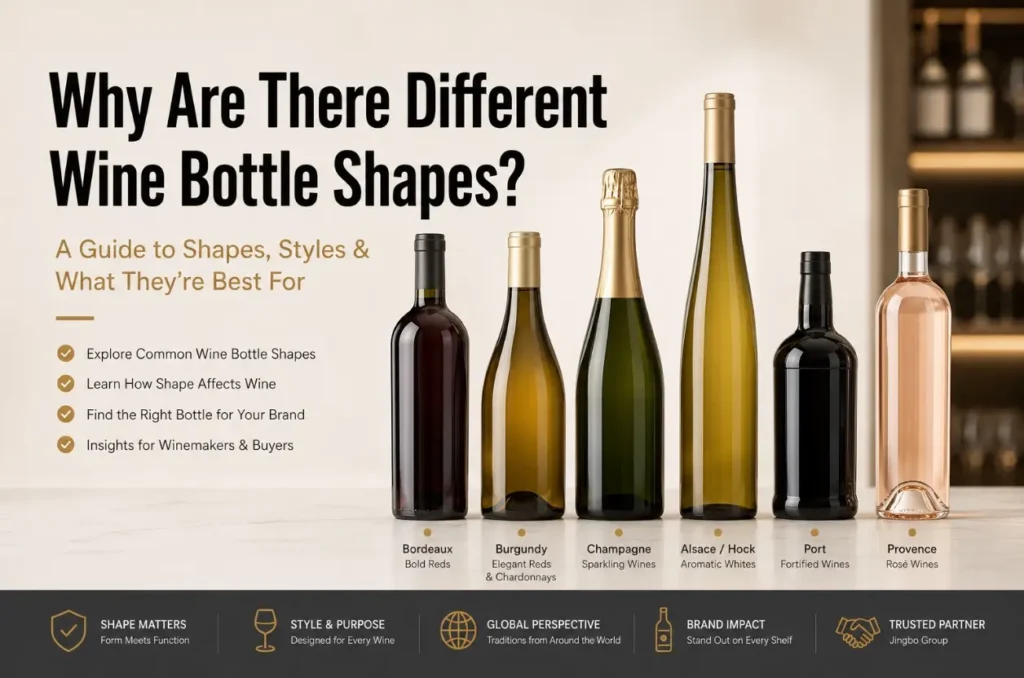
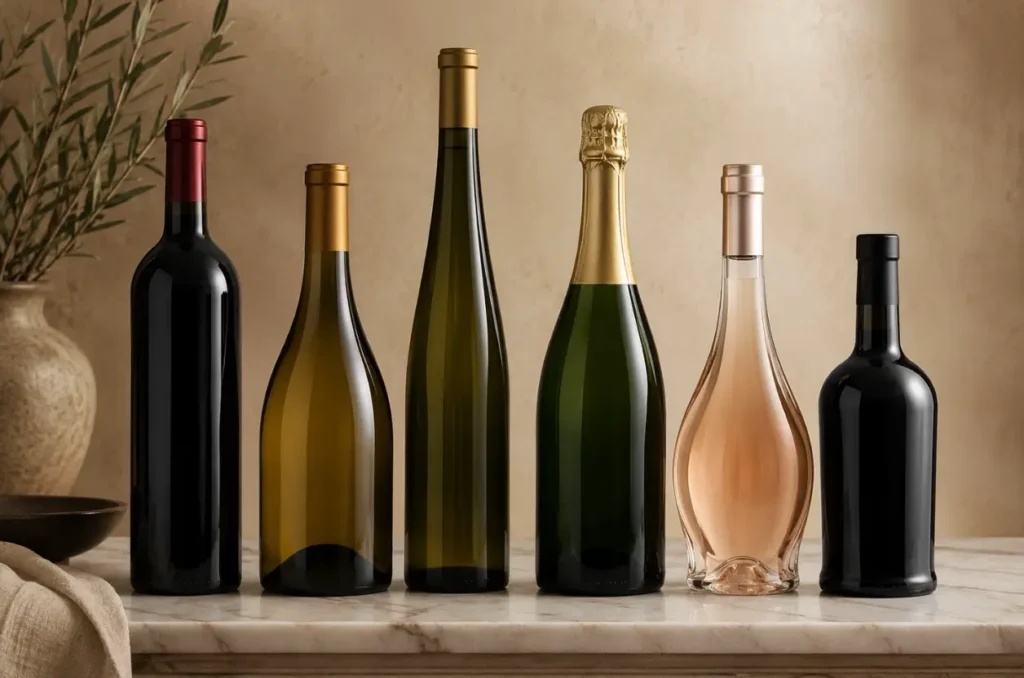
Wine bottles have different shapes because wine-producing regions developed their own packaging traditions. Over time, Bordeaux, Burgundy, Champagne, Alsace, Rhône, Port, and Provence bottles became connected with certain wine styles. Today, wineries still use these shapes to help customers recognize the type and character of the wine.
Bottle shape can provide a visual clue, but it does not prove where the wine was made. It also does not tell you whether the wine is good. A winery outside Bordeaux can use a Bordeaux-style bottle, while a Chardonnay producer can choose either a Burgundy bottle or another suitable design.
Some shapes also have practical reasons behind them. Champagne bottles need stronger glass because sparkling wine creates pressure. Other shapes mainly developed through local glassmaking, transport, storage, and winemaking traditions.
Does the Shape of a Wine Bottle Mean Anything?
The shape can suggest a wine region, grape variety, or general style. However, these meanings are based on tradition rather than a universal rule.
A high-shouldered bottle often suggests Bordeaux-style wine. It is frequently used for Cabernet Sauvignon, Merlot, Sauvignon Blanc, and blends made from similar grapes. A bottle with sloping shoulders is commonly associated with Burgundy, Pinot Noir, and Chardonnay.
A tall and narrow bottle may suggest Riesling or another aromatic white wine. A wide and heavy bottle with sloping shoulders may suggest Champagne or another sparkling wine.
These visual signals help customers understand a product before they read every word on the label. The main formas de las botellas de vino used today reflect long-standing traditions in France, Germany, Portugal, Italy, and other wine-producing countries.
Still, the shape is only a clue. It should not be treated as proof of origin, quality, age, or price.
What Are the Main Wine Bottle Shapes?
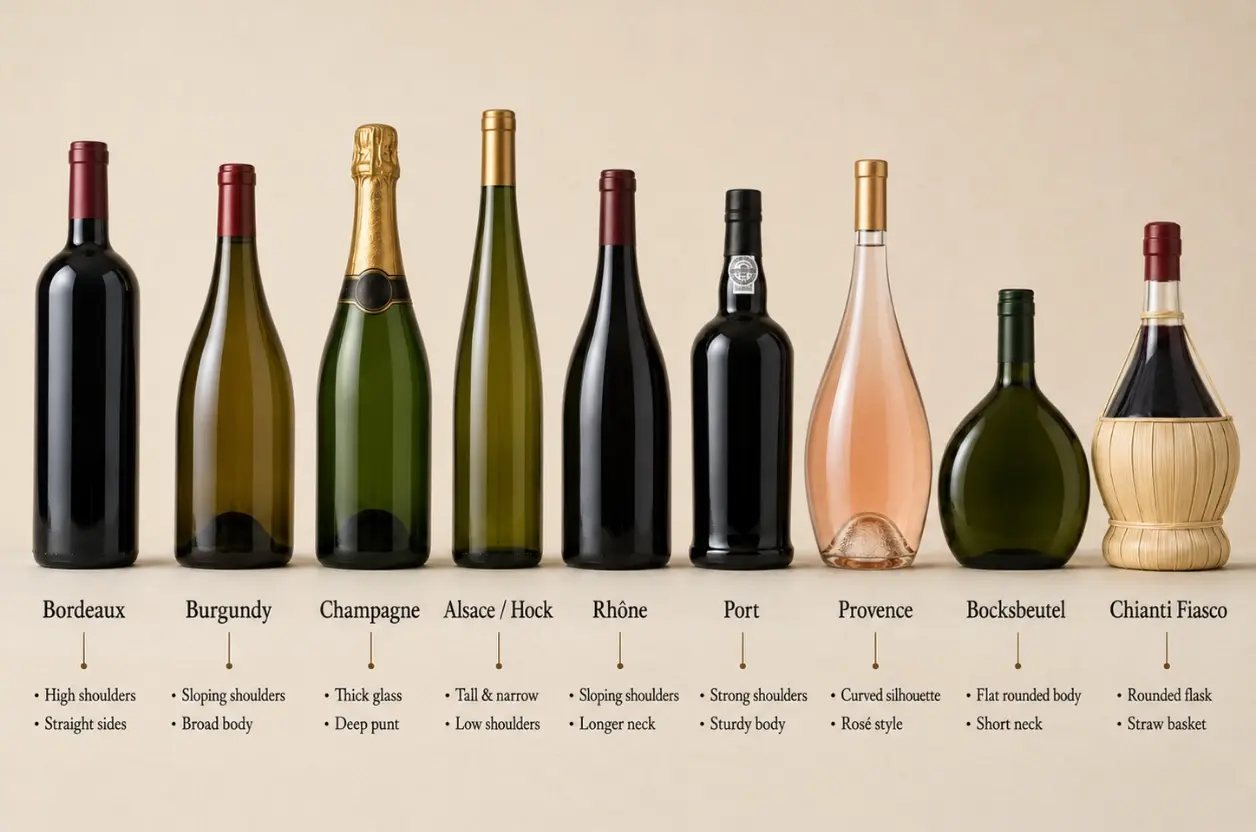
The most familiar wine bottle shapes are Bordeaux, Burgundy, Champagne, Alsace or Hock, Rhône, Port, and Provence. Some regions also use more unusual shapes, such as the Franconian Bocksbeutel and the traditional Chianti fiasco.
| Wine Bottle Shape | Main Features | Common Wine Association |
|---|---|---|
| Bordeaux | Straight sides and high shoulders | Cabernet Sauvignon, Merlot and Bordeaux blends |
| Burgundy | Wide body and sloping shoulders | Pinot Noir and Chardonnay |
| Champagne | Thick glass, sloping shoulders and deep punt | Champagne and sparkling wine |
| Alsace or Hock | Tall, narrow body and low shoulders | Riesling and aromatic white wine |
| Rhône | Similar to Burgundy, often slightly taller | Syrah, Grenache and Rhône blends |
| Port | Straight body and strong shoulders | Port and fortified wine |
| Provence | Curved body or narrow waist | Rosé and regional wines |
| Bocksbeutel | Short, flat and rounded | Franconian wine |
| Fiasco | Rounded flask traditionally covered with straw | Traditional Chianti |
These bottle families contain many variations. A modern Bordeaux bottle may be taller, lighter, heavier, wider, or more decorative than a traditional version. The same is true for Burgundy and Champagne bottles.
What Is a Bordeaux Bottle?
The Bordeaux bottle is one of the most common wine bottle shapes. It has straight sides, a cylindrical body, and clearly defined shoulders.
This profile is traditionally connected with wines from Bordeaux. It is also widely used for Cabernet Sauvignon, Merlot, Cabernet Franc, Sauvignon Blanc, and many red or white blends made outside the region.
The strong shoulders give the bottle a formal and structured appearance. They are also traditionally associated with helping control sediment while wine is poured. In modern use, however, the familiar appearance is often more important than this function.
The straight body provides a clear area for the main label. It also creates a simple silhouette that works well for both traditional and modern wine brands.
Bordeaux bottles are commonly made in dark green, antique green, amber, and clear glass. Darker glass is often used for red wine, while clear or light-colored glass may be selected when the producer wants customers to see the wine.
What Is a Burgundy Bottle?
A Burgundy bottle has a wider body and sloping shoulders. The body curves gradually toward the neck instead of forming a sharp shoulder.
This bottle is strongly associated with Burgundy wines, especially Pinot Noir and Chardonnay. Many wineries outside Burgundy also use it for these grapes because customers already recognize the connection.
The rounded shape creates a softer appearance than a Bordeaux bottle. It can look traditional, elegant, and less formal.
Burgundy bottles are often wider than Bordeaux bottles of the same capacity. This wider body makes the bottle appear substantial, even when the glass is not especially heavy.
The Burgundy profile has also influenced many other wine bottles. Rhône bottles and Champagne bottles share the same general idea of sloping shoulders, although their proportions and technical requirements are different.
What Is a Champagne Bottle?
A Champagne bottle usually has sloping shoulders, thick walls, a strong neck, and a deep punt. It is designed for sparkling wine rather than ordinary still wine.
The most important difference is pressure. Carbon dioxide inside the bottle creates much more force than still wine does. The official Champagne organization states that the pressure inside a Champagne bottle is generally between 5 and 6 bar.
The bottle therefore needs stronger construction. Its thickness, glass distribution, base, heel, neck, and finish all help it handle pressure safely.
El history of the Champagne bottle also explains that thicker and more resistant glass became an important development during the eighteenth century. This made it possible to store sparkling wine more safely inside the bottle.
A normal Burgundy bottle may look similar to a Champagne bottle, but the two are not interchangeable. A still-wine bottle should never be assumed to be suitable for sparkling wine based only on its shape.
What Is an Alsace or Hock Bottle?
An Alsace or Hock bottle is tall, narrow, and gently sloped. It has low shoulders and a long, elegant body.
This style is often associated with Riesling and other aromatic white wines. It is commonly linked with Alsace, Germany, and wine regions around the Rhine and Mosel rivers.
The bottle may also be called a Rhine bottle, Mosel bottle, flute bottle, or Schlegel bottle. The exact proportions can vary between regions and producers.
Its slim body gives the wine a light and refined appearance. This visual style suits fresh white wines, floral wines, and products that want to look elegant rather than heavy.
Alsace bottles are often made in green, brown, blue, or clear glass. Glass color can help one brand stand apart from another, even when both use the same traditional shape.
What Is a Rhône Bottle?
The Rhône bottle is similar to the Burgundy bottle. It normally has sloping shoulders, a rounded body, and a relatively long neck.
It is commonly used for Syrah, Grenache, Mourvèdre, and wines inspired by the Rhône Valley. White Rhône wines may also use this bottle.
The differences between a Rhône and Burgundy bottle can be subtle. A Rhône bottle may appear slightly taller or narrower. Some traditional versions also include embossed details near the shoulder.
For most customers, the overall message is similar. The rounded profile suggests a wine style that is different from the formal, straight-sided Bordeaux family.
Modern wineries do not always follow a strict distinction between Burgundy and Rhône shapes. Many choose the version that best supports their label and brand identity.
What Is a Port Bottle?
A Port bottle normally has straight sides, strong shoulders, and a substantial appearance. It often looks shorter or heavier than a standard Bordeaux bottle.
The shape is traditionally associated with Port and other fortified wines. Similar bottles may also be used for sherry, dessert wine, and aged specialty products.
Port bottles are often made from dark green, black, or brown glass. The dark color supports the traditional image of a wine that may be stored for a long time.
Some Port bottles have a noticeable bulge near the neck. This is a traditional feature found on certain designs, but it is not present on every modern Port bottle.
The strong profile creates a sense of age, richness, and tradition. For this reason, some producers use Port-style bottles for other premium wines even when the product is not Port.
What Is a Provence Bottle?
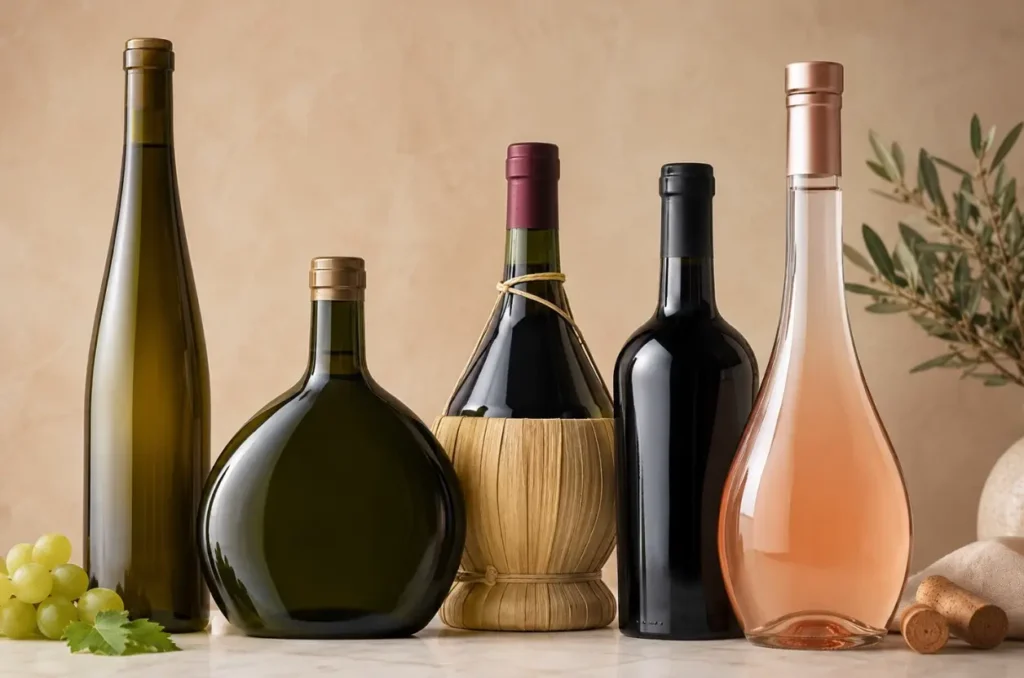
Provence bottles are best known for their decorative curves. Many versions have a narrow waist, a rounded body, or a profile that resembles an hourglass.
They are closely associated with rosé from Provence. Clear glass is common because it allows customers to see the pale pink color of the wine.
The Provence shape is more expressive than a basic Bordeaux or Burgundy bottle. It is designed to help the product look elegant, fresh, and suitable for lifestyle-focused branding.
Not every Provence rosé uses a curved bottle. Many producers use straight or gently sloped designs. However, the distinctive curved profile has become an important part of the visual identity of the category.
What Other Wine Bottle Shapes Are There?
Bordeaux, Burgundy, and Champagne bottles dominate many markets, but several other traditional shapes are still used.
The Bocksbeutel is a short, flat, rounded bottle associated with Franconian wine in Germany. Its shape is very different from the tall profile of most standard wine bottles.
The traditional Chianti fiasco has a round body covered by a straw basket. It was once a common image of everyday Italian wine. Many modern Chianti producers now use Bordeaux-style bottles, but the fiasco remains easy to recognize.
Some Jura wines use short regional bottles. Certain rosé brands use custom shapes with curves, embossing, or flat sides. Modern producers may also develop completely original bottles to create stronger brand recognition.
These unusual shapes show that wine packaging has never followed one universal design. Regional identity and brand expression have always played an important role.
Why Did Wine Regions Develop Different Bottle Shapes?
The differences began before modern packaging became standardized. Wine regions often depended on local glassmakers, local materials, and local methods of transport.
Glass bottles were made by hand for much of their early history. A glassmaker in one region could produce a different profile from a glassmaker in another region. As production improved, those local styles became more consistent.
Wine merchants and customers then began connecting certain bottle shapes with certain regions. A Bordeaux shape suggested one type of wine, while a Burgundy or Rhine shape suggested another.
Once these associations became familiar, wineries had a reason to keep using them. The bottle helped communicate the product before the customer opened it.
Modern manufacturing can produce a much wider range of designs. However, the old regional shapes remain valuable because customers already understand them.
Does Wine Bottle Shape Affect the Taste?
For still wine, bottle shape does not normally change the taste.
The same wine would not taste better simply because it was placed in a Bordeaux bottle instead of a Burgundy bottle. The outer silhouette mainly affects appearance and recognition.
Other parts of the package matter more for wine protection. These include the closure, glass color, fill level, light exposure, oxygen exposure, temperature, and storage conditions.
Sparkling wine is the important exception. The shape and structure of the bottle must safely handle internal pressure. This is a technical requirement rather than a question of flavor.
A heavier still-wine bottle also does not prove that the wine inside is better. Heavy glass may create a premium impression, but wine quality comes from the product itself.
Does Wine Bottle Shape Show the Quality of the Wine?
No. Bottle shape is not a reliable quality grade.
An expensive wine may use a familiar lightweight bottle. A lower-priced wine may use a heavy and decorative bottle. Packaging decisions depend on the producer, market, price, and brand strategy.
Customers sometimes connect heavy glass, a deep punt, or an unusual shape with premium wine. These features can affect perceived value, but they do not improve the wine itself.
The label, producer, region, vintage, grape variety, and winemaking information are more useful when judging the product.
The bottle can support a premium image. It cannot create wine quality that is not already present.
Do Wineries Have to Follow Traditional Bottle Shapes?
Most wineries can choose a shape that fits their product and market. They do not have to use a Burgundy bottle for every Pinot Noir or a Bordeaux bottle for every Cabernet Sauvignon.
Many producers still follow these traditions because they help customers understand the wine quickly. A familiar shape can make the product easier to position on a crowded shelf.
Other brands deliberately break the tradition. They may choose a custom shape, unusual glass color, flat bottle, embossed design, or decorative curve.
Both approaches can work. A traditional shape supports recognition, while a custom shape supports differentiation.
The choice should match the wine and its brand story. An unusual bottle should have a clear purpose rather than being different only for the sake of being different.
What Should Wine Brands Consider When Choosing a Bottle Shape?
Wine brands should first consider what they want the bottle to communicate.
A Bordeaux bottle can look formal and established. A Burgundy bottle can look soft and traditional. A tall Hock bottle can suggest freshness and elegance. A curved Provence bottle can support rosé and lifestyle branding.
The wine itself should remain the main focus. A very heavy or decorative bottle may feel wrong for a simple everyday wine. A basic lightweight bottle may not support the presentation of a limited-edition gift product.
A new brand can often begin with an existing bottle shape and create its identity through glass color, labels, embossing, printing, foil, or other decoration. A custom shape is more useful when the brand needs a recognizable bottle that it plans to use for a long time.
Grupo Jingbo offers several Botellas de vino y cerveza for wholesale and private-label projects. Brands can compare traditional wine bottle shapes before deciding whether they need a custom design.
Frequently Asked Questions About Wine Bottle Shapes
¿Por qué hay botellas de vino de diferentes formas?
Different wine bottle shapes developed from regional winemaking and glassmaking traditions. Over time, customers began associating each shape with a particular region or wine style.
What Are the Most Common Wine Bottle Shapes?
The most common shapes are Bordeaux, Burgundy, Champagne, Alsace or Hock, Rhône, Port, and Provence. Other distinctive shapes include the Bocksbeutel and traditional Chianti fiasco.
Does Wine Bottle Shape Mean Anything?
It can suggest a wine region, grape variety, or style. However, it does not prove the wine’s origin or quality.
Why Do Bordeaux Bottles Have High Shoulders?
High shoulders are part of the traditional Bordeaux profile. They create a formal appearance and are traditionally associated with helping control sediment during pouring.
Why Do Burgundy Bottles Have Sloping Shoulders?
Sloping shoulders developed as part of the traditional Burgundy bottle style. Today, the shape is strongly connected with Pinot Noir, Chardonnay, and Burgundy-inspired wines.
Why Are Riesling Bottles Tall and Narrow?
Riesling is often packaged in tall Hock, Rhine, Mosel, or Alsace-style bottles. The narrow profile developed through regional traditions and is now associated with aromatic white wines.
Why Are Champagne Bottles So Thick?
Champagne bottles need thicker and stronger construction because sparkling wine creates internal pressure. The official Champagne organization states that this pressure is normally between 5 and 6 bar.
Does a Deep Punt Mean Better Wine?
No. A deep punt can be part of the bottle design, but it does not prove that the wine is better. In sparkling-wine bottles, the base is one part of the complete pressure-resistant structure.
Does Bottle Shape Affect Wine Taste?
The shape of a still-wine bottle does not normally affect taste. The closure, glass color, oxygen exposure, light, temperature, and storage conditions are more important.
Can a Winery Use Any Bottle Shape?
A winery can usually choose a traditional or custom shape that fits its product and market, subject to any applicable local rules. Many wineries use traditional shapes because customers already recognize them.
Conclusión
Wine bottle shapes developed from regional traditions. Bordeaux, Burgundy, Champagne, Alsace, Port, and Provence bottles each create a different visual impression, but shape does not determine the wine’s quality.
Wine brands can choose a traditional bottle for easy recognition or use decoration and custom design to create a more distinctive package.
Grupo Jingbo offers existing wine bottle shapes and custom development support to help brands choose a bottle that fits the wine style and brand position.