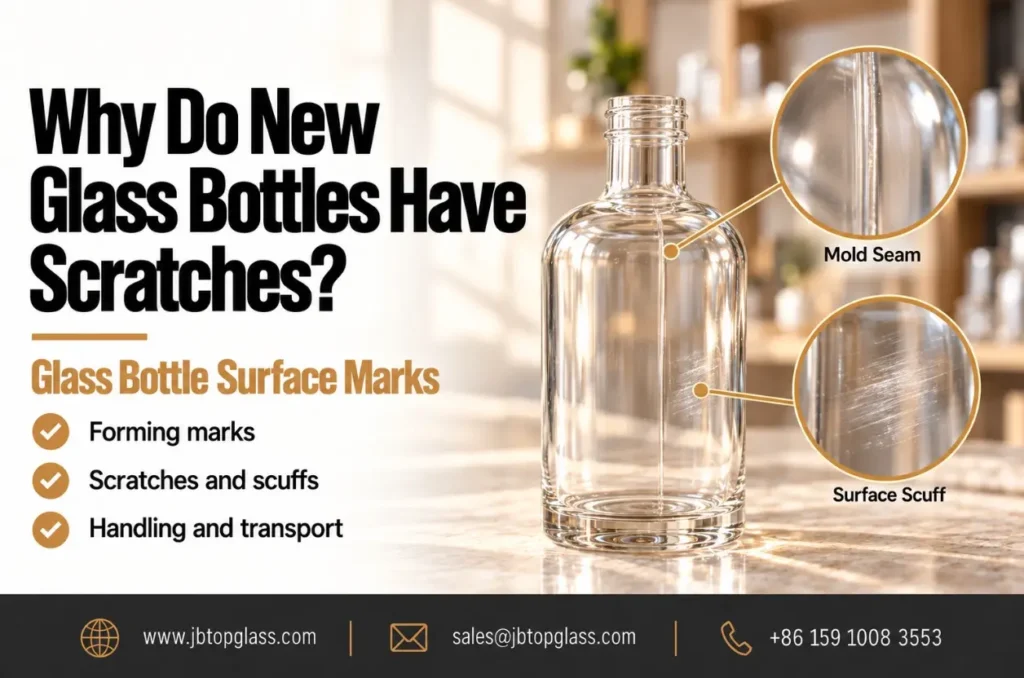
New glass bottles sometimes have fine lines or rubbed patches on the surface. Some are marks left during glassmaking. Others are scratches caused by contact with equipment, packaging or nearby bottles.
These marks can look similar, especially in a close-up photo. But they don’t necessarily have the same cause.
A line formed in the mold was already there during production. A scratch from rubbing could have appeared on a factory conveyor, during shipping or on the customer’s filling line. Finding it when you open the carton doesn’t tell you which of those happened.
Which Marks Come from Glass Manufacturing?
Mold Seams and Normal Forming Features
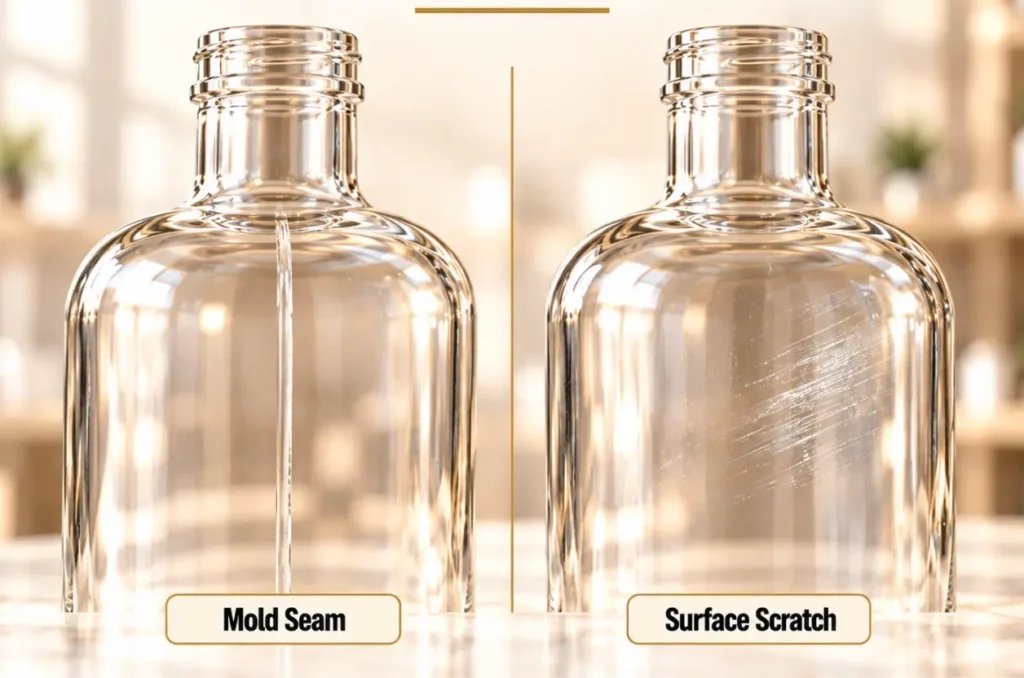
A mold seam forms where sections of the bottle mold meet. It often appears as a narrow line running along the bottle.
That line is part of the molding process. It wasn’t scraped onto the bottle during shipping, and seeing it doesn’t automatically mean the bottle is defective.
A faint mold line is different from an unusually large seam or a sharp projection. The latter needs a closer look. A visible line alone, however, isn’t enough to call the bottle damaged.
Manufacturing Defects That Resemble Scratches
Some fine lines look as though something has scraped across the glass, even though they formed during production.
Brush marks appear as fine vertical lines on the sidewall or neck. Drag marks look more like small vertical folds near the shoulder or neck. Both come from forming conditions, rather than bottles rubbing together in transit.
Cat scratch cord has a misleading name. Its fine, roughly parallel lines come from differences within the glass melt. They aren’t scratches caused by transport.
These marks don’t all affect the bottle in the same way. Some mainly affect appearance. Cracks, sharp edges and problems affecting safe use need separate attention. A fine line and a crack shouldn’t be treated as the same problem just because both are visible.
How Do Handling and Transport Create Glass Bottle Scratches?
After the glass has hardened, rubbing against other bottles, equipment or abrasive particles can scratch its surface. Repeated rubbing sometimes leaves a whitish, worn patch known as scuffing.
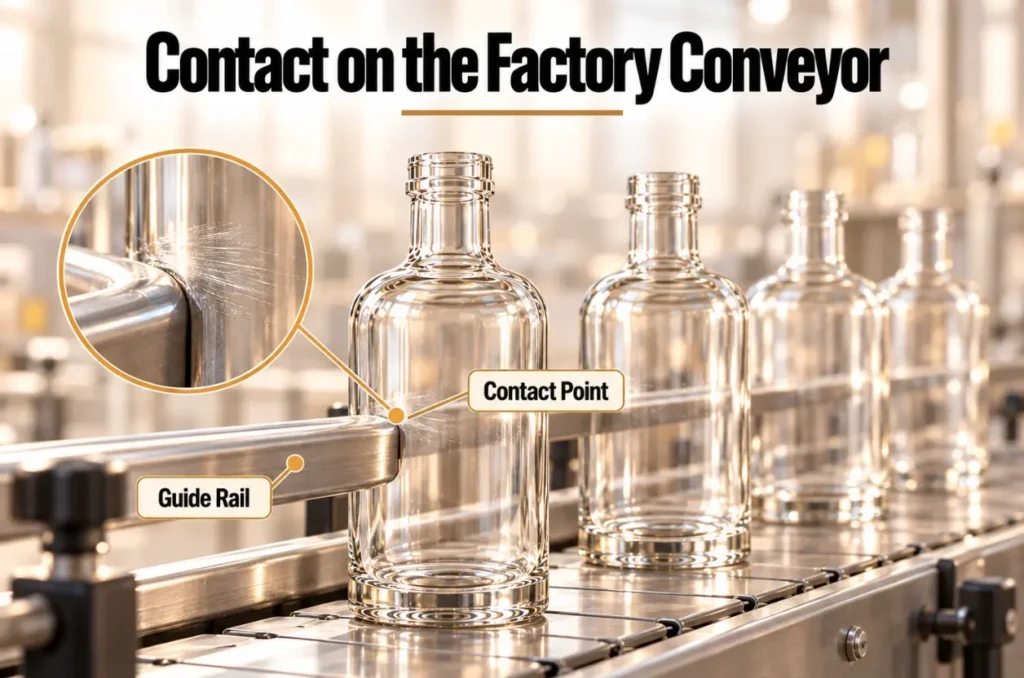
This contact starts inside the factory. Bottles pass through conveyors, transfer points and packing operations before they are dispatched. They go through more handling during transport, unloading, storage and filling.
So a mechanical scratch isn’t automatically a shipping problem. It might have happened before the bottles left the factory.
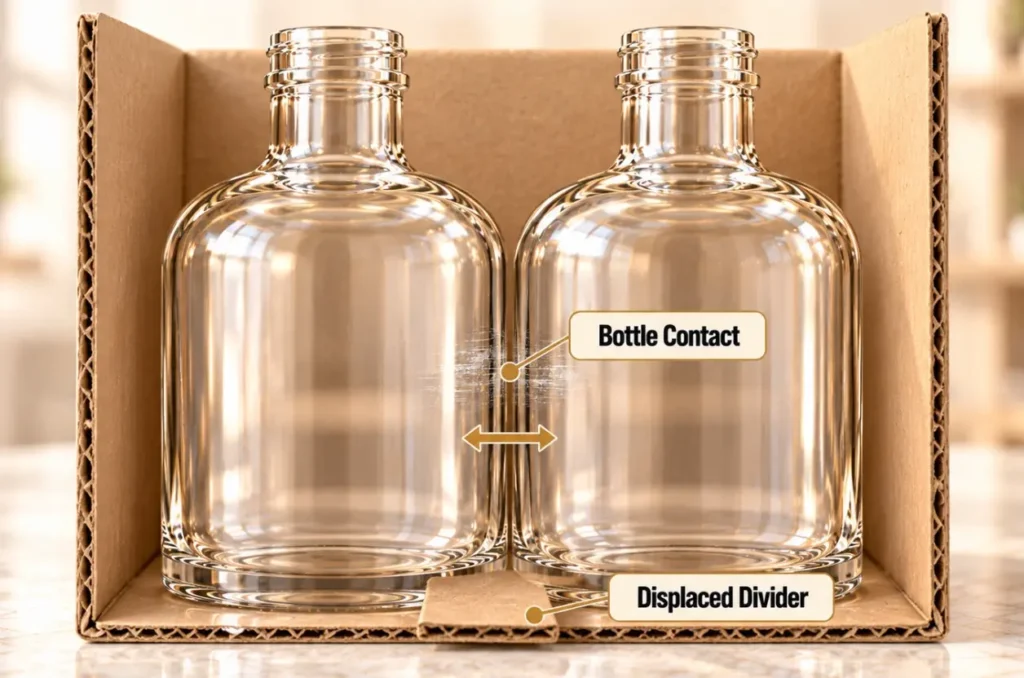
During transport, loose bottles or displaced dividers allow surfaces to rub together. A shifting load adds more movement. The carton doesn’t have to look crushed for this to happen; bottles may move inside a box that still looks fine from the outside.
On decorated bottles, the scratch may be in the printing or spray coating. Damage to that finish doesn’t necessarily show how deeply the glass underneath is affected.
Surface protection and suitable envases de botella de vidrio help reduce rubbing damage, but bottles still need careful handling.
How Can You Distinguish Forming Marks from Later Damage?
The shape and location of a mark help narrow down the cause. Photos show its appearance, while production and handling records help explain when it appeared.
| Appearance | Possible explanation | What to look at |
|---|---|---|
| A narrow line following the mold joint | Mold seam | The seam’s condition and the bottle’s appearance requirements |
| Fine vertical lines or small folds near the neck | Brush marks or drag marks | The surface feature and production records |
| Roughly parallel lines resembling cat scratches | Cat scratch cord | Whether the lines come from the glass itself |
| A rubbed patch or band at a contact point | Mechanical scuffing | What touched the bottle and at which stage |
| A scratch through a colored finish | Decoration damage | Whether the finish, glass or both are affected |
If the same mark appears in the same place on bottles from one mold cavity, production is worth checking. But a guide rail touching many bottles at the same height also leaves a repeated pattern.
That is why the pattern needs to be compared with the equipment, packing and records. Similar-looking marks don’t always come from the same source.
Who Is Responsible for Glass Bottle Scratches?
A scratch visible before dispatch and one found after a load has shifted need different follow-up. The order requirements and shipping terms also affect how the issue is handled.
When the Evidence Points to Production
If a confirmed manufacturing defect goes beyond what the buyer and supplier agreed to accept, it is a quality issue to raise with the supplier.
Scratches already visible before dispatch also need to be checked at the factory. The review should cover the conveyors, handling and packing involved. Those scratches don’t become transport damage simply because they came from rubbing rather than forming.
A normal forming feature that meets the order requirements, however, isn’t automatically a reason to reject the bottles.
When the Evidence Points to Later Handling
If the load has shifted or dividers have been damaged, the transport and unloading stages need checking. A recorded handling incident provides another useful lead.
The same applies to unpacking, repacking and filling. If marks appear after those operations, the equipment and handling involved need checking too. The fact that the customer discovered the marks doesn’t establish that the supplier caused them.
For transport claims, the purchase contract also matters. The agreed Incoterms® rule helps define delivery responsibilities and when transport risk passes between seller and buyer. It doesn’t settle every quality claim on its own.
Sometimes more than one thing has gone wrong. A transport incident and unsuitable packing may both contribute to the damage. Both need to be considered.
What Evidence Helps Establish When the Damage Occurred?
A close-up of a scratched bottle is useful, but it leaves out the packaging and handling around it. Records from the following stages give both sides more to work with:
- Before shipment: The quality report, recorded defects, packing details and batch or pallet references.
- At arrival: Photos of the load before unloading, followed by the cartons, dividers and bottle positions as the packaging is opened.
- After unpacking: Records of further movement, repacking or passage through filling equipment.
The affected bottles and original packaging are worth keeping for examination. Their carton or pallet location matters too, along with how many checked bottles show the same condition.
A pre-shipment glass bottle quality check shows what was found in the checked sample. A passing report doesn’t prove that every bottle was free of marks. Equally, a photo taken after delivery doesn’t prove that a scratch was there before shipping.
Comparing these records helps show where the problem began.
PREGUNTAS FRECUENTES
Do Scratches Mean That New Bottles Are Actually Used Bottles?
No. New bottles also come into contact with equipment and other surfaces during production, packing and distribution. Scratches alone don’t prove previous use.
Are Light Scuff Marks Always Harmless?
No. Light scuffing may mainly affect appearance, but a white patch doesn’t tell you the depth of the damage or the bottle’s strength. Suspected cracks, chips and deeper scratches need further assessment before use.
Can Transport Damage Occur Without Broken Bottles?
Yes. Bottles may rub against other surfaces without breaking. The glass and any decorative finish both need checking.
Does a Passing Shipment Check Remove Supplier Responsibility?
No. The report records the checked sample. Any claim still needs the actual damage, packing condition, quality requirements and contract terms to be considered.
Conclusión
Some apparent glass bottle scratches are marks left during glassmaking. Others come from rubbing during factory handling, transport or filling.
A mark found after delivery isn’t automatically a manufacturing defect. It isn’t automatically transport damage either. Photos, packing details and records from each stage help buyers and suppliers find the cause and work out who is responsible.
Contacta con Jingbo Group to discuss glass bottle appearance requirements and packaging for your order.