
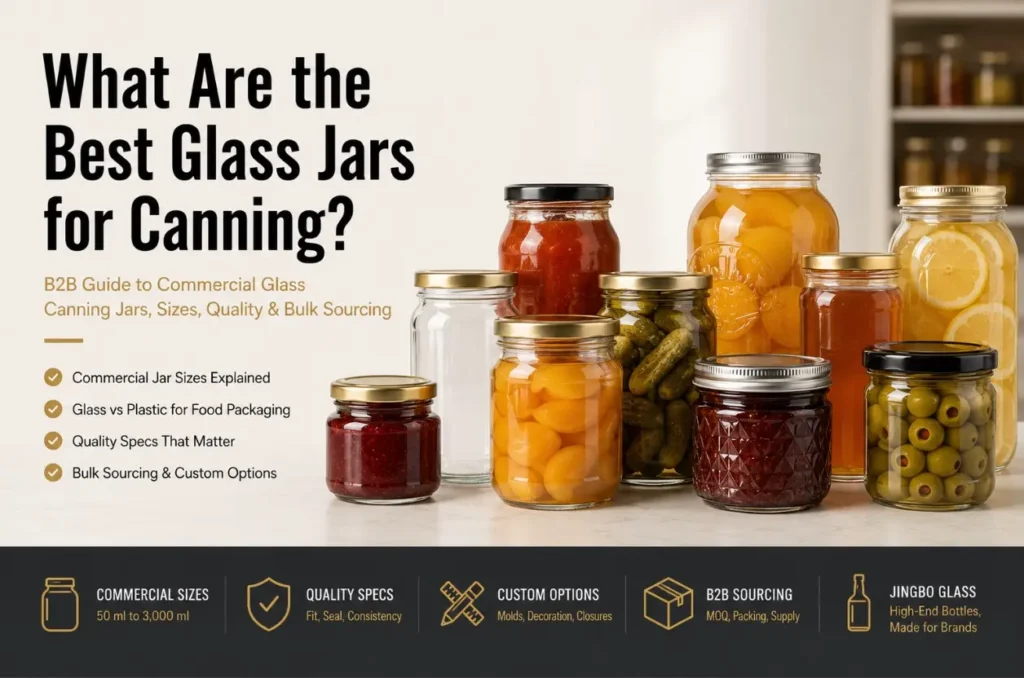
Choosing the wrong jar can lead to leaks, breakage, production delays, and damaged products. Commercial buyers need more than a container that looks good.
The best glass jars for canning are made from food-safe glass, have consistent dimensions, use a compatible closure, and suit the intended filling process. B2B buyers should also consider capacity, neck finish, packing, order quantity, customization, and long-term supply.
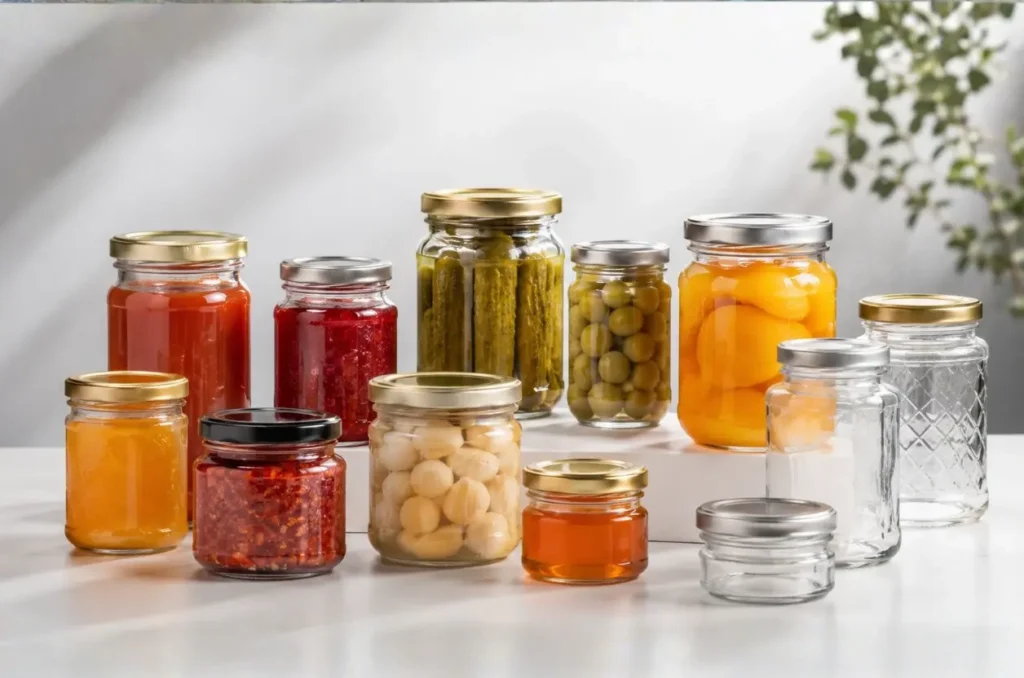
Every part of a glass jar affects how the package performs. The neck determines whether the cap fits and seals correctly. The body shape influences filling, labeling, packing, and shelf presentation. The glass structure affects handling, heating, and transport.
Supplier reliability matters as well. A suitable jar must remain consistent from one order to the next. The manufacturer should also provide clear drawings, stable production, practical export packing, and dependable communication.
This guide explains how commercial food buyers can choose glass canning jars for bulk orders. It covers jar sizes, quality specifications, closures, packaging materials, customization, and supplier selection.
How Do You Choose the Best Glass Jars for Canning?
A jar that performs well in a home kitchen may not be suitable for a commercial filling line. Food companies work with larger quantities, fixed schedules, and much higher costs when packaging fails.
A commercial canning jar must work as part of the complete packaging system. It needs to match the food product, closure, filling method, labeling equipment, shipping conditions, and sales channel.
A suitable jar should provide:
- Consistent body and neck dimensions
- A flat and reliable sealing surface
- A closure that matches the neck finish
- Enough headspace for the filling process
- A stable area for labels or printing
- Suitable strength for production and transport
- Reliable repeat production
The filling process also needs to be confirmed before the jar is approved. Cold filling, hot filling, pasteurization, and retort processing place different demands on both the jar and the closure.
No standard food jar should be treated as suitable for every thermal process without testing. The buyer, filler, glass jar manufacturer, and closure supplier need to review the actual product temperature, pressure, cooling method, and processing cycle.
Packaging failure can affect far more than one container. A leaking jar may damage its label, carton, pallet, and nearby products. A delayed shipment can stop a filling line or push back a planned product launch.
For a B2B buyer, the “best” jar is the one that fits the technical and commercial requirements of the project. It is not automatically the heaviest jar or the cheapest option.
Which Glass Jar Size Should You Choose?
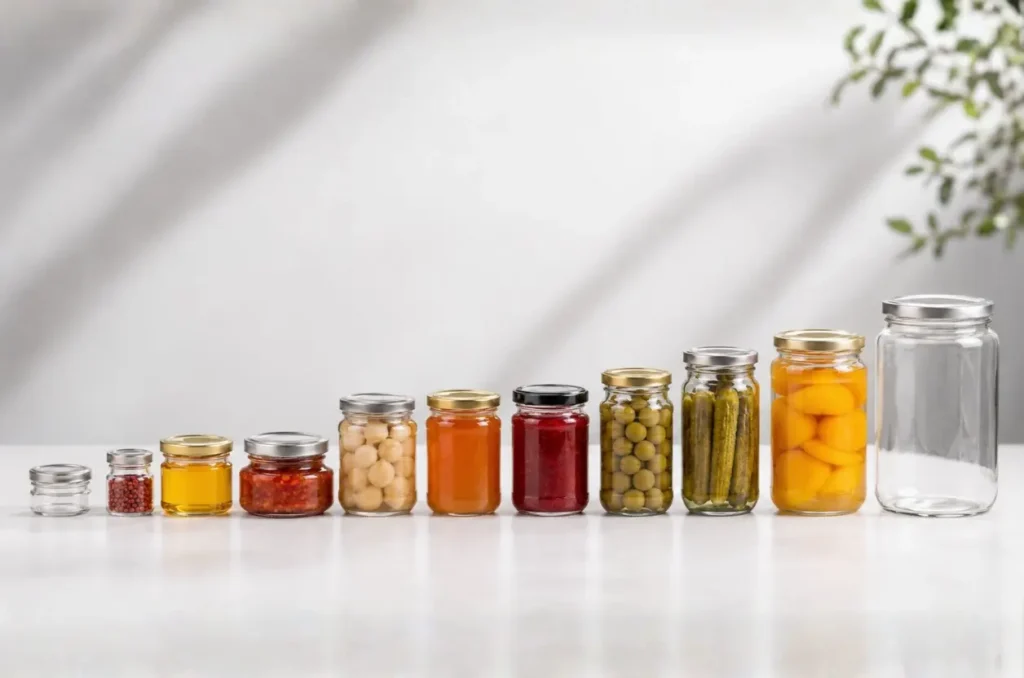
Commercial glass canning jars range from small sample jars to large food-service containers. The best glass jars for canning are not defined by capacity alone. The right size must also suit the product, portion, filling line, closure, and sales channel.
The right size depends on several factors:
- Product type
- Serving size
- Product density
- Retail or food-service use
- Filling equipment
- Closure size
- Label requirements
- Shipping cost
| Jar Capacity | Common Applications | Typical Buyers |
|---|---|---|
| 50–100 ml | Spices, samples, premium condiments | Hotels, gift brands, food brands |
| 100–200 ml | Mustard, honey, jam, chutney | Retail food companies |
| 200–500 ml | Hot sauce, salsa, preserves, nut butter | Condiment manufacturers |
| 500–1,000 ml | Pickles, olives, sauces, preserved fruit | Retail and food-service buyers |
| 1,000–3,000 ml | Bulk food and preserved products | Restaurants, caterers, distributors |
Jars between 50 ml and 200 ml are often used for samples, spices, mustard, honey, and premium condiments. Their compact size can support controlled portions and attractive product presentation. However, caps, decoration, and packing may account for a relatively large share of the total packaging cost.
The 200 ml to 500 ml range is common in retail food packaging. A 250 ml glass jar may suit hot sauce, chutney, jam, or specialty condiments. Larger 350 ml and 500 ml formats often work better for family-size sauces and preserves.
Jars from 500 ml to 3,000 ml are widely used for pickles, olives, fermented vegetables, preserved fruit, and food-service products. Because the filled package is heavier, these jars need stable bodies, suitable export cartons, and careful pallet planning.
Capacity also needs to be checked carefully. A product described as a “250 ml jar” may have a higher brimful capacity.
Nominal capacity refers to the intended product fill. Brimful capacity is the total volume when the container is filled to the top. The difference allows space for headroom, processing, and product movement.
Which Glass Jar Specifications Matter Most?
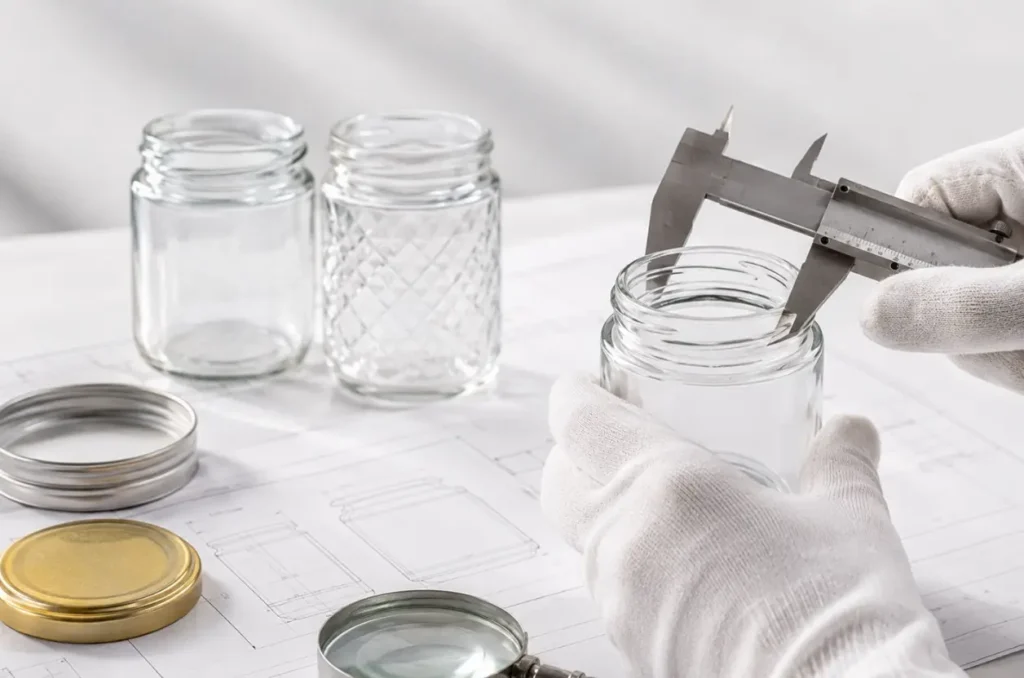
A glass jar can look suitable in a product photo and still cause problems on the filling line. Technical drawings and physical samples should be approved before mass production begins. When comparing the best glass jars for canning, buyers should look beyond appearance and check the specifications that affect filling, sealing, labeling, and transport.
| Spécifications | Pourquoi est-ce important ? |
| Capacité nominale | Controls the planned product quantity |
| Capacité maximale | Helps calculate fill level and headspace |
| Finition du col | Controls cap fit and sealing |
| Sealing surface | Affects leakage and vacuum performance |
| Jar height and diameter | Affects filling, labeling, and packing |
| Zone d'étiquetage | Controls artwork size and position |
| Jar weight | Affects handling, strength, and shipping cost |
| Filling temperature | Determines process suitability |
| Packing method | Affects transport damage |
The neck finish is one of the most important technical details. It must match the closure diameter, thread or lug design, and sealing surface.
Common food jar closures include metal lug caps, twist-off caps, continuous-thread caps, and plastic screw caps. The liner inside the cap also needs to suit the product.
An acidic sauce, an oil-based product, a dry spice, and a hot-filled preserve may each require a different closure solution. A cap should not be approved simply because it appears to fit.
The jar and cap need to be evaluated as one packaging system. Purchasing them separately without checking compatibility can increase the risk of leakage and sealing problems.
Glass distribution is another important factor. Areas that are too thin may become weak points. At the same time, adding extra glass in the wrong place can increase weight without improving performance.
Annealing helps reduce internal stress after the jar is formed. When this process is poorly controlled, the risk of cracking can increase during filling, handling, or temperature changes.
Before production, the supplier should receive accurate information about the filling conditions. This includes the product temperature, processing method, cooling process, and final filled weight.
Requirements vary by market. Buyers selling food products in the United States should review the FDA’s information on packaging and food-contact substances and confirm which requirements apply to the jar, closure, liner, coating, and decoration.
Glass Jars or Plastic Containers: Which Is Better?
Both glass and plastic can be suitable for food packaging. The better choice depends on the product, filling process, distribution channel, cost target, and brand position.
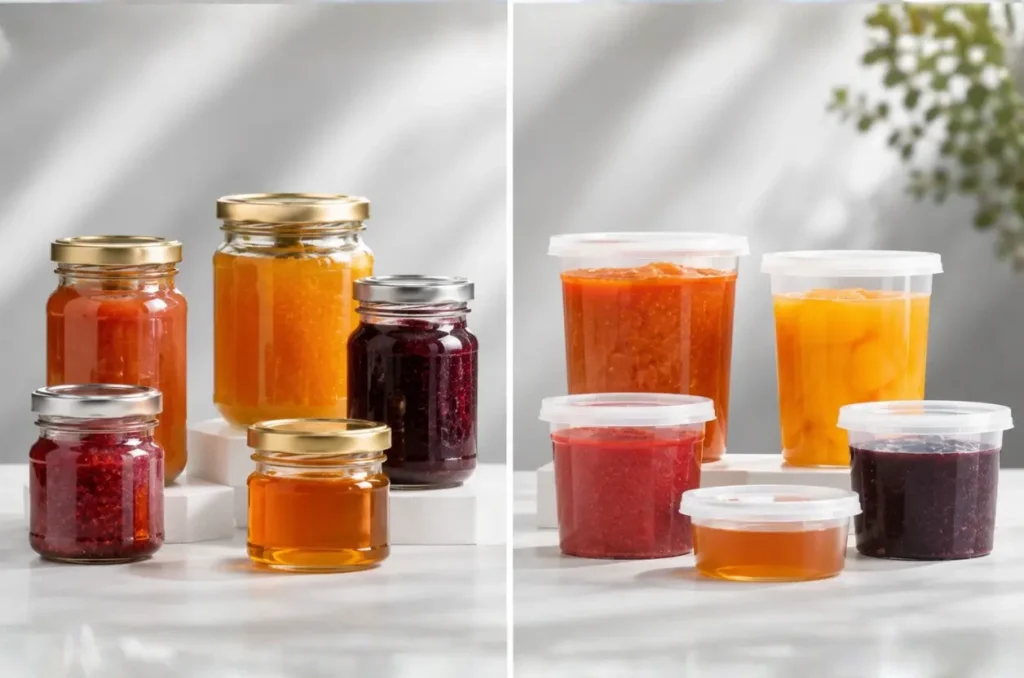
| Facteur | Glass Jar | Plastic Container |
| Présentation en rayon | Clear, solid, and often premium | Practical and lightweight |
| Weight | Plus élevé | Inférieur |
| Risque de casse | Requires careful packing | Lower in normal handling |
| Product visibility | Usually very clear | Depends on the plastic |
| Squeeze function | Not available | Available with some designs |
| Custom decoration | Printing, coating, labels, embossing | Printing, labels, and molded shapes |
| Positionnement de la marque | Often premium or traditional | Often practical or value-focused |
| Shipping cost | Higher due to weight | Généralement plus bas |
Glass is often selected for jam, honey, hot sauce, pickles, olives, preserves, and premium condiments. Its clarity allows customers to see the product, while its weight and finish can support a more premium position.
It also offers several decoration options. Brands can use paper labels, screen printing, spray coating, frosting, embossing, and premium metal closures to create a more distinctive package.
Plastic is lighter and less likely to break during normal handling. It can be a practical choice for squeeze products, large food-service packs, and projects where transport weight is a major concern.
The decision should be based on how the package will be filled, handled, sold, and used. A premium 250 ml chili sauce may benefit from a glass jar because visibility and shelf appeal matter. A large food-service sauce may be better suited to plastic because lower weight and easier handling are more important. For products that need clear visibility and a premium shelf presence, the best glass jars for canning often provide more branding value than basic plastic containers.
When Do You Need a Custom Glass Jar?
For many projects, an existing mold is the fastest and most economical option. A custom mold becomes relevant when standard jars cannot meet the technical or branding requirements.
An existing mold is usually suitable when the buyer needs:
- A faster launch
- Lower development cost
- A standard closure
- A proven jar structure
- Easier repeat production
- A familiar retail format
The buyer can send a reference image together with the required capacity, product type, order quantity, and preferred closure. The supplier can then check whether a similar mold is already available.
For example, a European condiment company may need 30,000 units of a 250 ml jar for hot sauce. Using an existing mold could shorten the development stage and make it easier to meet a fixed delivery date.
A standard jar does not have to look generic. The brand can still create a distinct appearance through the cap, label, printing, coating, or other decoration.
A custom mold may be needed when the project requires:
- A unique body shape
- A special capacity
- A wider or narrower opening
- A custom neck design
- A specific label panel
- An embossed logo
- A shape that fits existing filling equipment
- Packaging that is difficult for competitors to copy
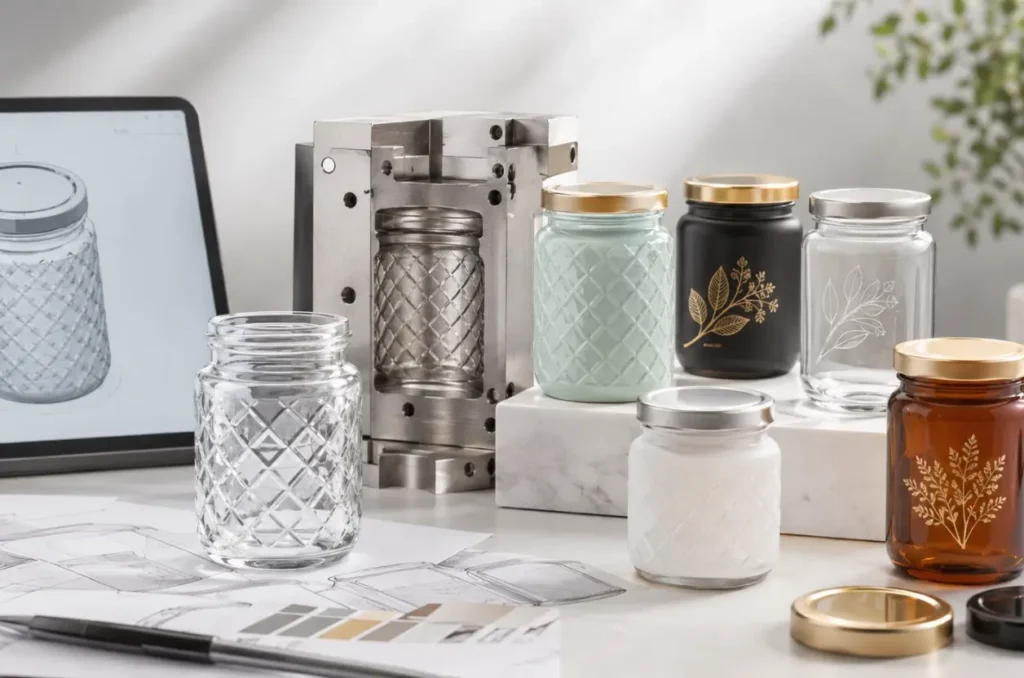
A custom glass jar project usually moves through concept review, 3D modeling, technical drawing approval, mold production, sample review, and mass production.
Jingbo Glass can also support decoration processes such as screen printing, hot stamping, spray coating, frosting, UV printing, embossing, labeling, and custom closures.
Decoration should be assessed under realistic conditions. Scratching, washing, oil contact, label adhesion, and friction inside the carton can all affect the final result.
How Should You Choose a Glass Jar Manufacturer for Bulk Orders?
A low quotation can become expensive when the supplier cannot control dimensions, closure compatibility, production schedules, or export packing.
Commercial buyers should evaluate a glass jar manufacturer in five main areas.
1. Technical support
A capable supplier will ask about the product, filling temperature, processing method, quantity, closure, destination, and delivery date.
These questions help the supplier recommend a suitable package instead of sending an unrelated price list.
2. Mold and closure options
A broad mold collection gives buyers more standard jar options and may reduce development time. The supplier should also confirm whether it can provide matching caps or work with the buyer’s existing closure.
3. Quality consistency
The buyer should receive a clear technical drawing and approve the key dimensions before production. Future orders should follow the same agreed specifications.
4. Export packing
Packing needs to match the jar shape, weight, order quantity, and shipping route. Common solutions include export cartons, pallets with cardboard partitions, and cartons placed on pallets.
5. Clear quotation and lead time
A complete quotation should state:
- Jar price
- Cap price
- Decoration cost
- Mold cost when required
- Packing method
- Quantité commandée
- Délai de production
- Terme commercial
- Validité du devis
Prices should only be compared when the specifications are equivalent. A lighter jar, different cap, simpler packing method, or different trade term can make one quotation appear lower even when it does not cover the same requirements.
Why Work with Jingbo Glass?
Founded in 2009 in Shandong, China, Shandong Jingbo Group Co., Ltd. supplies factory-direct glass packaging for food, beverage, personal care, and other branded products.
Jingbo Glass offers more than 300 bottle and jar series. Its commercial food jar range covers capacities from 50 ml to 3,000 ml. Buyers can explore our glass bottle and jar manufacturing capabilities to review available packaging categories, existing molds, and custom services.
Our services include:
- Existing glass jar molds
- Custom 3D design
- Mold development
- Matching closures
- Printing and surface decoration
- Bulk production
- Export-ready packing
- International shipping support
Our team works with buyers to match the jar shape, neck finish, closure, label area, decoration, production plan, and packing method.
Standard food jar orders commonly start at approximately 20,000 pieces. The exact MOQ depends on the jar model, manufacturing process, decoration, and project requirements.
For a faster and more accurate quotation, buyers should provide:
| Informations obligatoires | Exemple |
| Capacité | 250 ml |
| Produit | Chili sauce |
| Quantity | 30 000 pièces |
| Fermeture | Metal lug cap |
| Décoration | Paper label |
| Référence | Jar image or drawing |
| Destination | Espagne |
| Delivery requirement | septembre |
Jingbo Glass uses the slogan “High-End Bottles, Made for Brands.”
We combine packaging design, glass production, decoration, and export support to help food companies build reliable packaging with a clear brand identity.
Foire aux questions
Are all glass jars suitable for hot filling?
No. Hot-fill suitability depends on the jar design, expected temperature, temperature change, closure, and cooling process. The complete package should be tested under actual production conditions before mass use.
What is the best lid for commercial canning jars?
The correct lid depends on the neck finish, product, processing method, and sealing requirements. Metal lug caps are common for sauces, jam, pickles, and preserved food. The liner must also be compatible with the product.
What is the MOQ for bulk glass food jars?
Standard food jar projects commonly start at about 20,000 pieces. The exact MOQ depends on the model, manufacturing process, and decoration. For bulk buyers, the best glass jars for canning must also match the required quantity and repeat-order plan.
Can Jingbo Glass make a jar from a reference image?
Yes. Buyers can send a reference image together with the required capacity, product type, closure, quantity, and destination. Our team can check existing molds or discuss a custom design when no suitable model is available.
How are glass jars packed for international shipping?
Available packing options include export cartons, pallets with cardboard partitions, and cartons placed on pallets. The most suitable method depends on the jar size, shape, weight, order quantity, and shipping route.
Conclusion
The best glass jars for canning should match the product, closure, filling process, brand position, and supply plan. Jingbo Glass supports bulk buyers with standard jars, custom molds, decoration, closures, and export-ready packing.