
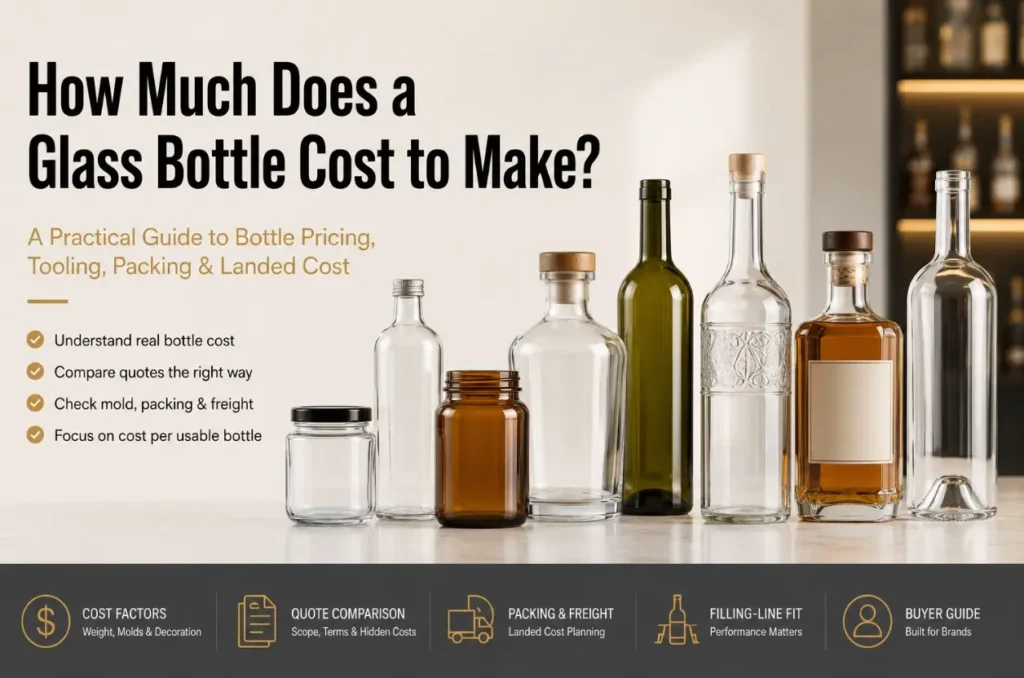
The cheapest bottle quote can become expensive after closures, decoration, poor packing, freight, and filling-line problems are added.
There is no single glass bottle cost. Simple, high-volume bottles cost less, while heavy, decorated, or fully custom bottles cost more. The useful number is the landed cost per usable bottle, not the empty-bottle price alone.
All figures and cost examples in this guide are for planning purposes only. Actual glass bottle cost depends on the confirmed design, quantity, decoration, packing, and delivery terms.
Two bottles can hold the same amount of liquid and still have very different prices.
One design may use a standard round mold and a common screw cap. Another may use more glass, a thick base, a private mold, deep embossing, spray coating, and a custom stopper.
The scope of the quotation matters just as much.
Some suppliers quote only the empty bottle. Others include closures, decoration, export cartons, pallets, or delivery to port. These unit prices cannot be compared until both offers cover the same product and service.
Before choosing a supplier, confirm what bottle is being supplied, what the quoted price includes, and what each usable bottle will cost after delivery.
What Does Glass Bottle Cost Actually Mean?
The phrase 유리병 비용 can refer to several different numbers.
The base bottle price covers the empty glass container. It normally includes forming, annealing, inspection, and preparation for packing.
The finished packaging price may include the bottle, cap, cork, label, printing, coating, or other decorative work.
The export price may add cartons, pallets, inland handling, customs documents, and delivery under an agreed trade term.
The landed cost includes freight, import charges, local handling, and delivery to the buyer.
One more figure matters during real production: the cost per bottle that can actually enter the filling line.
Cost per usable bottle = total landed project cost ÷ usable bottles received
| Cost Level | What It Usually Includes |
|---|---|
| Base bottle cost | Empty formed, annealed, and inspected bottle |
| Finished packaging cost | Bottle, closure, label, and decoration |
| Export cost | Product, cartons, pallets, and agreed export handling |
| Landed cost | Export cost, freight, import charges, and local delivery |
| Cost per usable bottle | Total landed cost divided by accepted bottles |
Rejected units still consume money.
Broken bottles have no filling value. Printed bottles with scratched surfaces may also be unusable. The same problem appears when the neck does not fit the approved closure or the bottle cannot move steadily through the filling line.
The quoted unit price does not show these losses.
Why Capacity Alone Cannot Predict Glass Bottle Cost?
Capacity only tells you how much liquid the bottle holds.
It does not show the bottle weight, base thickness, body shape, glass clarity, neck finish, decoration, or packing density.
Jingbo Glass product data shows how much these details can vary within the common 700–750 ml spirits bottle category.
| Jingbo Bottle Example | 용량 | Listed Weight | Main Design Feature | Main Cost Pressure |
|---|---|---|---|---|
| Premium hexagonal spirit bottle | 750 ml | 680 g | Multi-faceted body | Forming control and packing |
| Rectangular liquor bottle | 750 ml | 750 g | Rectangular body and thick base | Material and freight weight |
| Rounded-square long-neck bottle | 700 ml | 850 g | Wide flat body and long neck | Glass use and carton space |
| Double-teardrop spirit bottle | 700 ml | 1,000 g | Sculpted double-teardrop form | Material, forming, and freight |
These bottles belong to a similar capacity class, but their listed weights range from 680 g to 1,000 g. A request for “a 700 ml bottle price” does not give a supplier enough information to prepare a meaningful comparison.
The table is not a price list. It shows how different specifications create different cost structures.
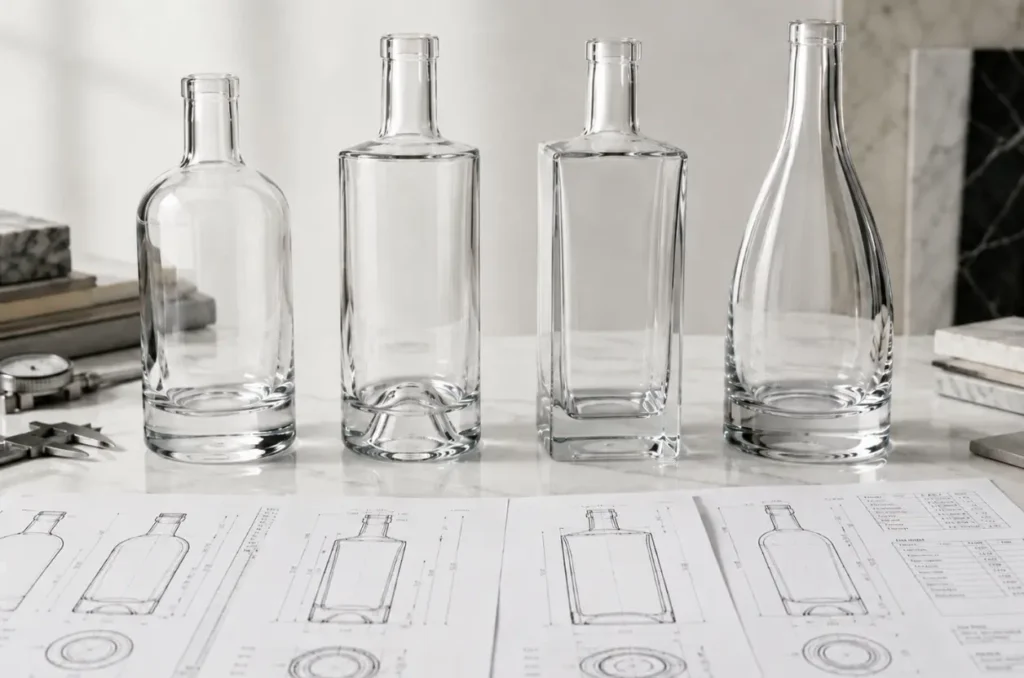
Bottle Weight
More glass usually means a higher production cost.
Extra weight also moves through every later stage. It enters the carton, pallet, shipping container, warehouse, and filling plant.
Heavy glass can still support a sound commercial decision. Premium spirits brands often use a thick base to create stronger shelf presence and a more substantial hand feel.
The extra material should serve a clear purpose.
Useful weight may improve stability, balance, strength, or brand position. Weight that adds no clear benefit only increases material and freight costs.
Bottle Shape
Round bottles often form, label, and pack efficiently.
Wide shoulders, narrow waists, sharp corners, deep embossing, and sculpted bases can need more control during production.
Shape also changes carton use.
A wide square bottle may leave empty space between units. An irregular body may need larger dividers. A narrow or curved label panel can make label application harder.
The design can raise the factory price and the freight cost per bottle at the same time.
Glass Appearance
Standard clear, amber, and green glass may be easier to plan than a special color.
Extra-clear glass and strict cosmetic limits can also require closer inspection.
Container glass is commonly made from sand, soda ash, limestone, and cullet. Cullet is processed recycled glass used as part of the manufacturing batch. The Glass Packaging Institute’s overview of glass materials explains these main ingredients and the role of cullet in container production.
Quality requirements should match the final product.
Luxury perfume or spirits bottle may need strict limits for bubbles, stones, mold seams, surface marks, color variation, verticality, and glass distribution.
Standard food bottle may not need the same cosmetic level. Paying for a standard that the final customer cannot see may not add useful value.
Are You Buying Stock, an Existing-Mold Bottle, or a Custom Bottle?
Many buyers use the word “standard” for three different supply routes.
The route changes the development cost, production schedule, and supply risk.
Stock bottles have already been produced and placed in a warehouse. They may support faster delivery when the correct color, neck, quantity, and packing are available. Stock does not always offer stable repeat supply. The same model or batch may not remain available for the next order.
An existing-mold bottle is different. The factory already has the production tooling, but it may still need to schedule a new manufacturing run. The buyer avoids the cost of new bottle tooling and can still add a custom label, closure, print, coating, or carton.
Fully custom bottle needs new design work and new tooling. The process may include a concept review, 3D model, technical drawing, sample mold, trial bottle, revision, production mold, and line test.
| Supply Route | Main Benefit | Main Cost Issue | Main Risk |
|---|---|---|---|
| Stock bottle | Faster access when inventory exists | Limited choice and batch availability | Repeat supply may change |
| Existing-mold bottle | No new bottle mold | Production may still need scheduling | Finish and closure still need approval |
| Fully custom bottle | Unique shape and stronger design control | Design, tooling, samples, and trials | Higher initial investment |
A warehouse stock offer should not be compared directly with a made-to-order custom project.
Buyers should confirm the supply route before comparing prices.
How Can Buyers Compare Two Glass Bottle Quotes Fairly?
Two unit prices only become useful when the technical and commercial scopes match.
Complete comparison should include the bottle weight, neck, closure, decoration, packing, loading quantity, and delivery term.
| Quote Detail | Supplier A | Supplier B | What Must Be Normalized |
|---|---|---|---|
| 용량 | 750 ml | 750 ml | Confirm nominal and overflow capacity |
| Bottle weight | 520 g | 680 g | Check material and freight difference |
| 목 마감 | Cork | Screw | Compare the correct closure system |
| Closure | Excluded | Included | Add the same closure to both offers |
| 장식 | None | One-color printing | Compare the same visual finish |
| Packing | Basic carton | Partitioned carton | Check protection and carton quantity |
| Trade term | EXW | FOB | Add inland and export costs to EXW |
| Container loading | Not stated | Stated | Calculate freight per bottle |
| Quote validity | 15 days | 30 days | Check when pricing may change |
Supplier A may appear cheaper at first.
The result can change after the buyer adds the closure, printing setup, inland transport, export handling, and stronger packing.
A useful quote-normalization formula is:
Comparable unit cost = quoted bottle price + missing components + missing decoration + packing difference + inland and export charges
The formula does not need to produce a perfect final cost during the first review. It only needs to expose missing items before a purchasing decision is made.
Delivery terms also need careful review. EXW, FOB, CIF, and other Incoterms® rules divide delivery, cost, and risk between the buyer and seller in different ways. The International Chamber of Commerce is the official publisher of the Incoterms® rules.
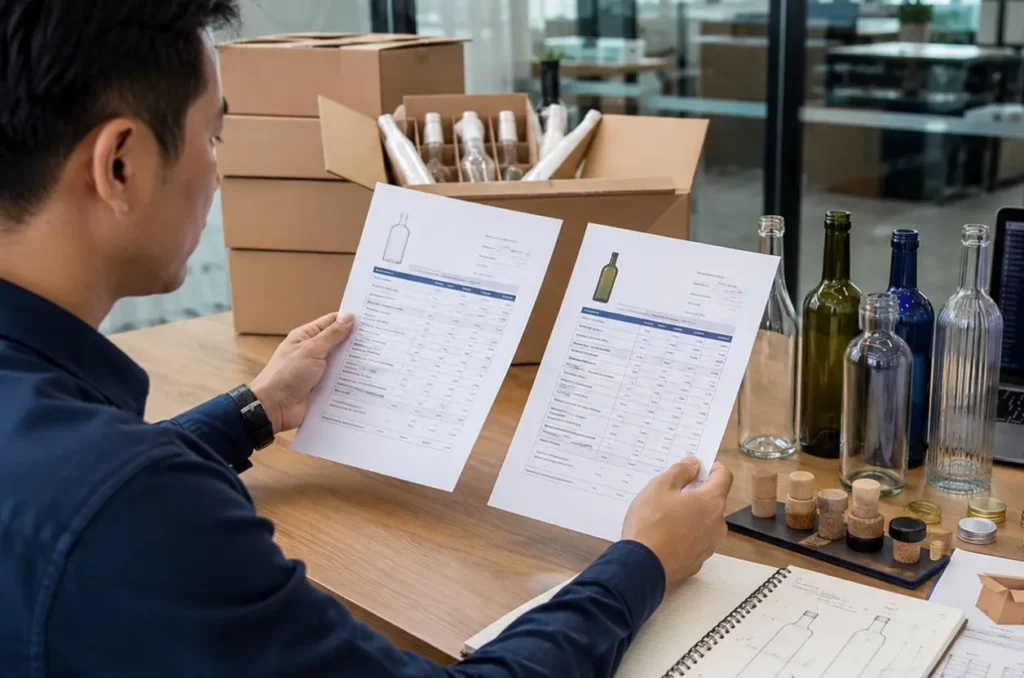
Which Design Decisions Create the Largest Cost Changes?
Buyers cannot control furnace energy, labor rates, or every factory expense.
They can control many choices within the packaging specification.
목 부분 마감 및 잠금 장치
The bottle and closure should be treated as one complete system.
The neck finish controls which cap, cork, or stopper can be used. The closure must also suit the product and the filling method.
Common neck finish may give the brand access to several closure suppliers.
Rare neck may limit future options. It can create longer lead times, fewer component sources, and less flexibility on repeat orders.
The sealing liner also matters. Alcohol, oil, water, juice, and sauce may need different materials.
Diameter measurement alone does not prove compatibility. The approved bottle and closure should be tested together.
장식
Decoration can make a standard bottle look distinctive without changing its basic structure.
Paper labels provide flexibility because artwork can change without altering the glass mold.
Screen printing places the design directly on the bottle. Each added color may need more setup and production control.
Spray coating changes most or all of the bottle surface. It also needs color matching, curing, inspection, and scratch protection.
Frosting, hot stamping, decals, UV printing, embossing, and combined finishes add more production stages.
More decoration does not always create a stronger package. One focused process often looks cleaner than several finishes competing for attention.
Tolerances and Quality Standards
Tighter tolerances may increase inspection and rejection pressure.
The buyer should define which measurements affect the closure and filling line. Important points often include total height, body width, neck dimensions, finish height, label panel size, base flatness, and verticality.
Cosmetic limits also need a clear standard.
A general request for “perfect quality” cannot be measured. An approved sample, technical drawing, defect standard, and inspection plan give both sides a more useful target.
Filling-Line Compatibility
Automatic filling lines depend on stable bottle dimensions and repeatable movement.
Bottle height affects filling-head position. Neck dimensions affect capping or corking. Base shape affects conveyor stability. Body shape affects label placement.
A bottle that needs frequent line adjustment can slow production.
A small saving on the empty container may disappear when the filling plant loses time.
Filling-line limits should be shared before the bottle is approved. The supplier should know the maximum bottle height, body width, neck type, label area, closure method, and expected line speed when those details are available.
When Does Custom Mold Cost Pay Off?
Custom tooling should be measured across the expected life of the product.
Tooling allocation per bottle = total tooling cost ÷ expected lifetime production
The following example uses a hypothetical tooling cost of $5,000.
| Expected Lifetime Volume | Tooling Allocation per Bottle |
|---|---|
| 10,000 bottles | $0.50 |
| 50,000 bottles | $0.10 |
| 100,000 bottles | $0.05 |
| 500,000 bottles | $0.01 |
These figures explain the calculation. They do not represent a fixed Jingbo Glass mold quotation.
The first tooling fee is not the only issue. Mold ownership and future use can affect the long-term project cost.
| Tooling Issue | 그것이 중요한 이유 |
|---|---|
| Mold ownership | Confirms whether the buyer or factory controls the tooling |
| Design exclusivity | Defines whether the same shape can be supplied to another buyer |
| Repair responsibility | States who pays for future maintenance or replacement |
| Storage period | Confirms how long the mold will be kept without repeat orders |
| Production-line access | Shows whether the tooling can run on one or several lines |
| Repeat-order standard | Confirms that future bottles will follow the same drawing and weight |
| End of service life | Defines what happens when stable production is no longer possible |
These terms may not change the first bottle price. They can change the total 유리병 비용 over several years.
Private tooling is easier to justify when the design supports repeat orders and creates clear brand value.
An existing mold usually offers a better starting point for a trial launch or a product that may still change.
What Hidden Costs Appear After Production?
The factory invoice does not show every cost.
Problems may appear during decoration, filling, storage, or final packing.
Decorated bottles can have a different usable yield from plain bottles. Printing may show poor alignment. Coating may show uneven color. Hot stamping may lose detail. Painted surfaces can scratch when the internal carton protection is not suitable.
The approved sample should define the required appearance. Mass-production inspection should follow the same standard.
Closure performance can create another cost. Both glass and closures have normal production tolerances. The complete system should allow this variation without causing leakage, loose fit, high insertion force, or opening problems.
Rejected bottles also create labor costs. Workers must inspect, sort, record, and store them. The filling line may slow down while the problem is reviewed.
These expenses sit outside the quoted bottle price, but they still belong in the packaging budget.
Why Cost per Usable Bottle Matters More Than Invoice Price?
Consider a hypothetical order of 30,000 bottles.
The bottle price is $0.40 each, so the empty-bottle value is $12,000.
Packing, freight, import charges, and local delivery raise the total project cost to $16,500.
After delivery, 300 bottles are broken or unsuitable for filling. The usable quantity is 29,700.
$16,500 ÷ 29,700 = $0.556 per usable bottle
Now consider a second project.
The delivered cost is $17,000, and 29,950 bottles remain usable.
$17,000 ÷ 29,950 = $0.568 per usable bottle
The second project still costs more in this example. The difference is much smaller than the invoice totals suggest.
The same calculation can include decoration rejects, closure mismatch, and filling-line failures.
Recording usable yield after each shipment gives the buyer a more accurate way to compare supplier performance over time.
How Do Packing and Container Loading Change Landed Cost?
Glass is heavy and fragile.
Packing must protect the product without wasting too much space.
A plain clear bottle may use a different packing system from a coated premium bottle. Decorated surfaces may need stronger dividers or better separation to prevent rubbing.
| Packing Detail | 그것이 중요한 이유 |
|---|---|
| 상자당 병 수 | Affects carton cost and manual handling |
| 상자 크기 | Affect storage, pallet use, and container loading |
| 상자 총 중량 | Affects lifting and transport limits |
| 팔레트당 상자 수 | Affect warehouse and loading efficiency |
| 컨테이너당 병 수 | Determine freight cost per bottle |
| Internal protection | Affects breakage and decorated surface quality |
| Pallet structure | Affects handling and load stability |
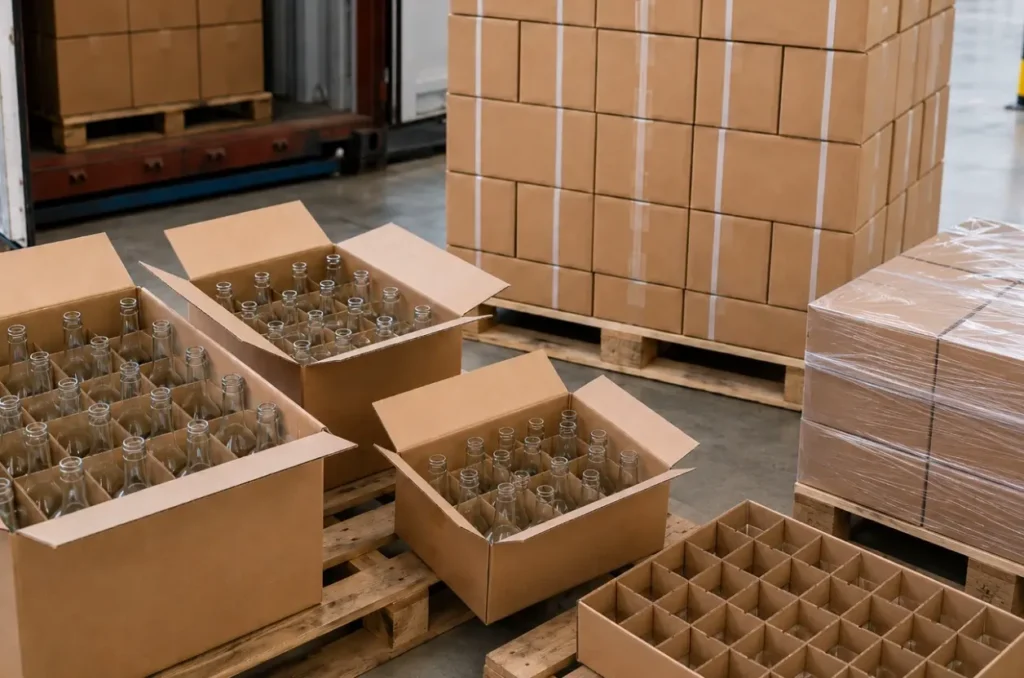
Bottle dimensions can change loading efficiency even when capacity stays the same.
A wide bottle may reduce the number of units per carton. A tall carton may reduce pallet stacking. A heavy bottle may reach the container weight limit before the available space is full.
The expected loading quantity should be confirmed before freight is compared.
Landed cost per bottle = product cost + packing + freight + import and local charges
Landed cost per usable bottle = total landed cost ÷ accepted quantity
How Do Order Quantity, Quote Validity, and Inventory Affect Cost?
Longer production runs often reduce the unit cost.
A factory still needs mold preparation, machine adjustment, first-bottle inspection, and packing confirmation for a smaller run. Decoration lines also need setup, testing, and cleaning.
Larger quantities spread this work across more units.
The lowest unit price does not always produce the best business result.
Unused bottles take warehouse space and tie up cash. Packaging can also become outdated after a label change, legal update, product redesign, or closure change.
A simple annual model gives a better view:
Annual packaging cost = purchase cost + storage cost + capital cost + obsolete inventory loss
Quote validity matters as well.
Bottle prices, closures, cartons, freight, and exchange rates may change while the project is being reviewed.
| Commercial Detail | What the Buyer Should Confirm |
|---|---|
| Product-price validity | How long the bottle and component prices remain valid |
| Freight validity | How long the shipping estimate remains valid |
| Production lead time | When production can begin and finish |
| First-order charges | Which tooling, setup, or sampling fees apply once |
| Repeat-order charges | Which decoration, packing, or component costs continue |
| Closure pricing | Whether the closure comes from a separate supplier |
| Specification stability | Whether repeat production will follow the approved drawing and weight |
This information prevents a buyer from approving a quotation that no longer reflects the current project.
How Can a Brand Lower Glass Bottle Cost Without Looking Cheap?
Good cost control removes waste. It should not remove details that protect the product or support the brand.
| Decision | Possible Cost Benefit |
|---|---|
| Use an existing mold | Avoids new bottle tooling |
| Use a common neck finish | Creates more closure options |
| Remove unnecessary glass weight | Reduces bottle and freight cost |
| Use one focused decoration method | Reduces setup and inspection work |
| Use one bottle across several products | Combines purchasing volume |
| Confirm filling-line limits early | Reduces compatibility problems |
| Improve carton and pallet use | Reduces freight per bottle |
| Plan repeat orders | Supports better production and component planning |
Weight reduction should be reviewed with the manufacturer. Less glass can reduce material and transport demand, but the bottle still needs enough strength for filling, packing, and distribution.
그 European Container Glass Federation’s lightweighting case study shows how targeted design and forming changes reduced a commercial bottle’s weight while keeping its required shape and performance.
Semi-custom packaging often gives growing brands a useful balance.
A proven bottle provides a stable production base. A suitable closure, label, or single decoration process can then create a clear brand identity.
A complex custom shape is not automatically more premium. Good proportions, clear glass, a stable base, and focused branding can produce a stronger result.
What Information Produces an Accurate Glass Bottle Quote?
A request for “a 750 ml bottle” leaves too many details open.
The supplier must guess the shape, weight, neck, closure, finish, packing, and delivery scope.
A useful RFQ gives the supplier enough information to price the correct product.
| Required Information | Example |
|---|---|
| Product | Whiskey |
| 용량 | 750 ml |
| Expected quantity | 30,000 bottles |
| Supply route | Existing mold or custom design |
| Reference | Photo, drawing, or physical sample |
| Glass appearance | Clear flint glass |
| Target bottle weight | State a range when known |
| Neck and closure | Bar-top finish with wooden T-stopper |
| 장식 | One-color screen printing |
| Label area | Required width and height |
| Packing | Partitioned export cartons |
| 목적지 | Spain |
| Trade term | FOB or CIF |
| Required delivery | September |
| Filling-line limits | Height, width, neck, and label position |
The quotation should also confirm the technical drawing, unit weight, neck and closure specification, carton quantity, pallet loading, container quantity, production lead time, price validity, and inspection standard.
These details show whether two suppliers are quoting the same product. They also reduce design changes after the price has been approved.
How Jingbo Glass Builds a Project-Based Quote?
Shandong Jingbo Group Co., Ltd. was founded in 2009. Jingbo Glass currently presents more than 300 bottle series and supports OEM and ODM projects, mold engineering, decoration, production, and export-ready packing. Its current company information also lists eight production lines and daily output of more than 500,000 bottles.
Jingbo Glass does not prepare a project quotation from capacity alone.
The team reviews the bottle shape, unit weight, glass appearance, neck finish, closure, decoration, quantity, packing, destination, and delivery plan.
Buyers can compare existing designs in the glass liquor bottle range or review Jingbo’s broader work as a 맞춤형 유리병 제조업체.
그 glass bottle packaging FAQ also explains customization, closures, packing, delivery, and project planning.
Jingbo’s role is not to add every available feature. The goal is to identify which details support the product, filling process, delivery route, and brand position.
For a project-based quotation, send the required capacity, quantity, reference design, closure, decoration, destination, and delivery date to sales@jbtopglass.com.
FAQs About Glass Bottle Cost
Is a Smaller Glass Bottle Always Cheaper?
No. A smaller bottle may use less glass, but its weight, shape, neck finish, order quantity, and production efficiency also affect the price.
A small custom bottle can cost more than a larger standard bottle.
Does an Existing Mold Mean the Bottle Is in Stock?
아니요.
An existing mold means the factory already has the production tooling. The bottle may still need a new production run.
Stock means finished bottles are already available in a warehouse.
Are Closures Included in the Bottle Price?
항상 그런 것은 아닙니다.
Some suppliers quote the empty bottle only. Buyers should confirm whether caps, corks, liners, shrink bands, and other closure parts are included.
Does Recycled Glass Reduce Manufacturing Cost?
Cullet can replace part of the virgin raw-material mix and can improve furnace efficiency. The actual cost effect depends on glass color, cullet quality, local supply, and production requirements.
What Is the Lowest-Cost Way to Create a Custom-Looking Bottle?
An existing-mold bottle with a suitable closure, clear label, or one focused decoration process is often more economical than a fully custom structure.
The right choice depends on expected order volume and the role of the bottle in the brand.
결론
Glass bottle cost cannot be judged by capacity or the first quoted unit price.
The final result depends on bottle weight, shape, supply route, mold terms, neck finish, closure, decoration, filling-line fit, usable yield, packing, and freight.
Buyers should compare the same specification, the same components, and the same delivery term.
The most useful figure is the landed cost per usable bottle.
The cheapest empty bottle is not always the most economical package. The better choice is the bottle that gives the right balance of appearance, filling performance, supply stability, protection, and total delivered cost.