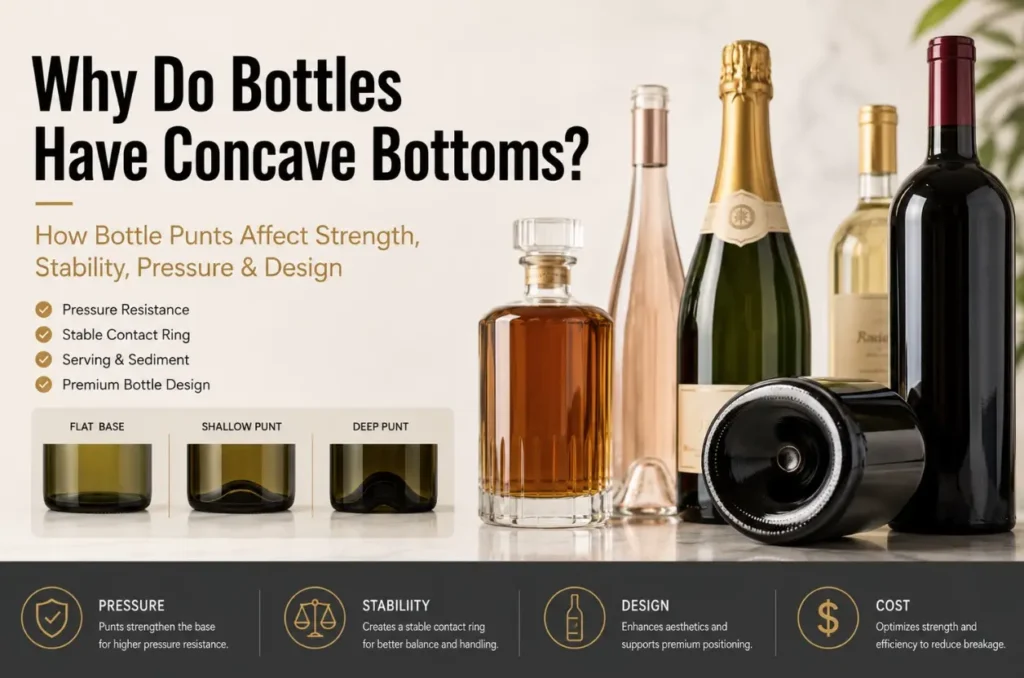
The concave bottom is usually called a punt or kick-up. It began as part of traditional glassmaking, and modern bottles keep it for several practical reasons. Sparkling bottles use it as part of a pressure-resistant design, while still wine and spirits bottles may use it for stability, handling, tradition, or branding.
Look under a wine, Champagne, or spirits bottle, and you may find a hollow center surrounded by a circular outer edge.
That hollow area is not the space where the bottle has lost glass. It is a planned part of the bottle structure.
The depth may be only a few millimeters, or it may extend far into the bottle. Some bottles have almost flat bases. Others have deep punts that become a major visual feature.
The right design depends on the product inside, the bottle weight, the production method, the filling line, the desired appearance, and the final packaging budget.
What Is the Concave Bottom of a Bottle Called?
The most common name is a punt. The term kick-up is also used, mainly in glass packaging and wine.
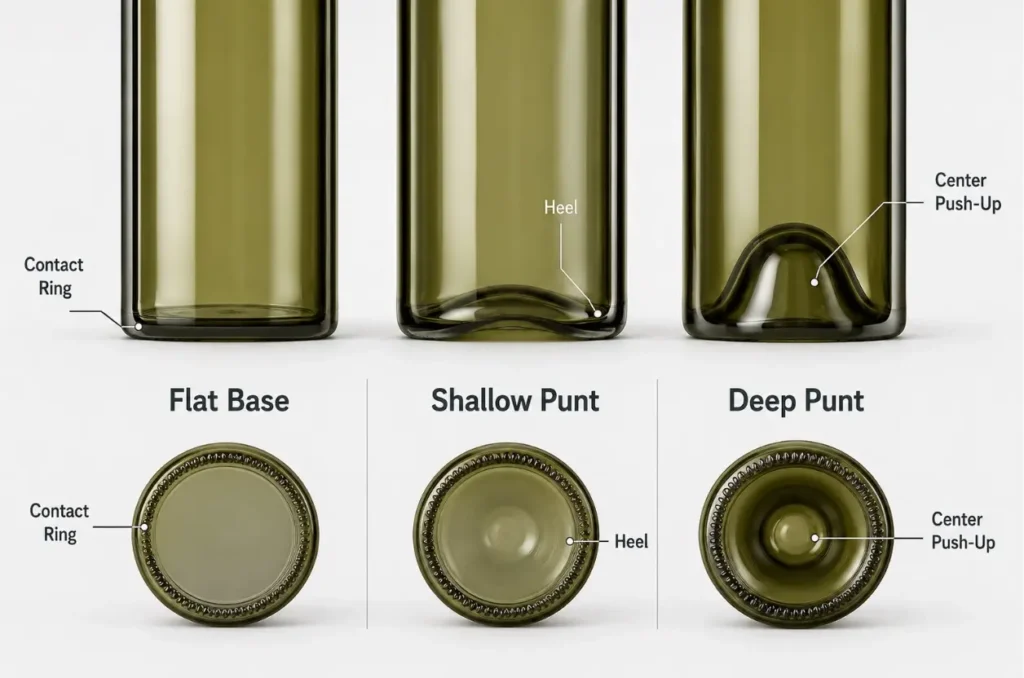
A punt is the intentional inward curve in the base of a bottle. It leaves an outer contact ring that rests on the table.
A pontil mark is different.
During traditional hand glassmaking, a glassmaker attached a solid rod, called a pontil or punty, to the base of the hot vessel. The rod held the piece while the glassmaker finished the neck and rim. Removing the rod often left an irregular or ring-shaped scar.
그 Corning Museum of Glass definition of a pontil explains this manufacturing method. The U.S. National Park Service also documents early hand-blown bottles with clear pontil marks left during finishing.
The two terms are related through glassmaking history, but they are not interchangeable.
| Term | Meaning |
|---|---|
| Punt or kick-up | An intentional concave bottle-base design |
| Pontil | The rod used to hold hot glass during hand finishing |
| Pontil mark | The scar left after the pontil rod was removed |
A modern punt does not prove that a bottle is hand-blown. Most commercial bottles are formed by machines and molds, yet many still use concave bases.
Why Do Bottles Have Concave Bottoms in Modern Packaging?
No single reason explains every bottle.
A deep Champagne punt serves a different purpose from the shallow base of a still wine bottle. A premium spirits bottle may use the shape mainly for presentation. A food bottle may need only a small push-up for stable production.
The main functions fall into several connected areas.
The Outer Ring Creates a Stable Contact Area
A completely flat bottle base must be formed very accurately.
Even a small raised point in the center can make the bottle rock. A convex center would make the problem worse.
A concave center removes the middle of the base from contact with the table. The bottle stands on the outer bearing ring around the heel.
This design gives the manufacturer a clear contact area. It can also help the bottle stand steadily when small variations exist in the center of the base.
The outer ring must still be level. A poorly formed punt does not automatically make a bottle stable.
Base flatness, glass distribution, heel shape, and verticality still need to be controlled during production.
The Curved Base Can Help Manage Internal Pressure
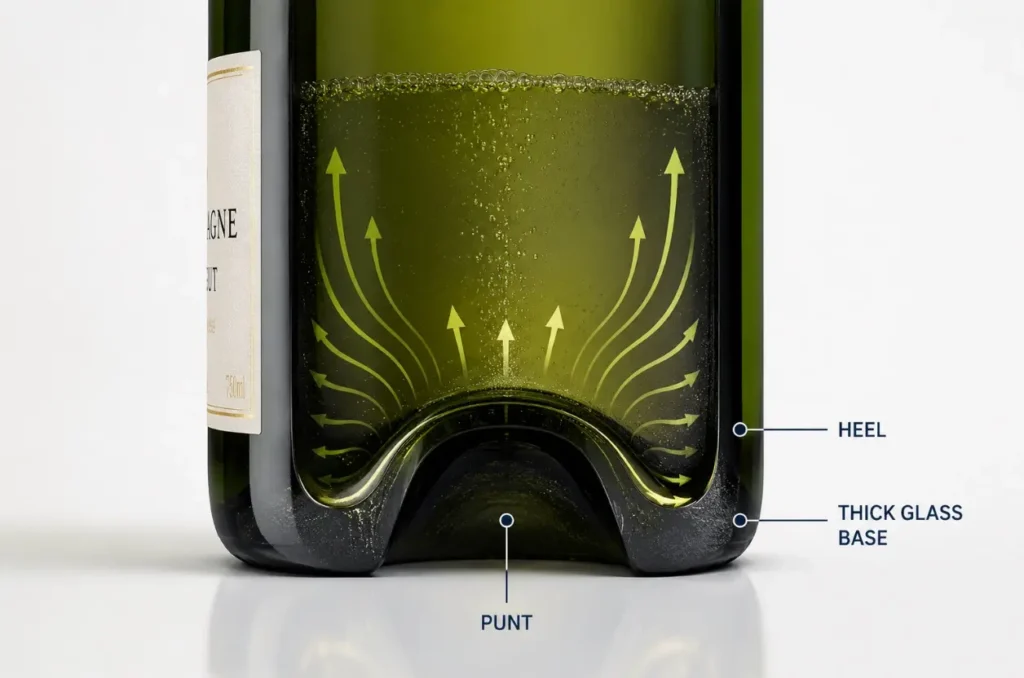
Pressure is one of the strongest reasons for using a pronounced punt.
Sparkling wine continues its production process inside the bottle. Carbon dioxide creates high internal pressure, so the container needs thicker glass and a carefully engineered shape.
The official Champagne industry states that pressure inside Champagne is normally about 5–6 bar. Modern Champagne bottles are designed to withstand much more than the normal operating pressure.
The punt is only one part of that pressure-resistant structure.
Bottle strength also depends on wall thickness, bottom thickness, heel radius, glass distribution, annealing, surface damage, and the transition between the body and base.
A finite-element study of Champagne bottles found that changing punt depth changed the tensile stress in the bottom and heel area. In the model used by the researchers, stress fell as the punt increased to a certain point. Greater depth then added mass with very little further stress reduction.
This result supports an important packaging rule:
A deeper punt is not always better. The whole bottle must be designed as one pressure system.
The Punt Can Support Production and Bottle Handling
Bottle bases must work with more than shelves and tables.
They also pass through forming machines, inspection equipment, conveyors, filling lines, packing stations, and warehouse systems.
A defined base shape can give handling equipment a consistent area to contact. The Wine & Spirit Education Trust notes that a deep punt can also help suction equipment lift sparkling wine bottles during production.
The exact benefit depends on the factory and filling system.
One line may handle a deep punt without any issue. Another may need a specific base diameter, contact ring, or conveyor support.
For this reason, a custom bottle drawing should not focus only on appearance. The technical review should also confirm the base contact area and filling-line requirements.
The Shape Can Help During Serving
A deep punt gives the hand a natural place to support the bottle.
Servers sometimes place a thumb inside the punt while holding the body with the remaining fingers. This position can provide control when presenting and pouring wine.
The Wine & Spirit Education Trust includes easier thumb support as one practical service benefit of a punt.
This serving style is not required. Many people pour from the body or lower neck.
A comfortable grip is useful, but it is not usually the main engineering reason for the bottle shape.
Sediment May Settle Around the Punt
Older wines, bottle-conditioned products, and lightly filtered drinks may form sediment.
A punt creates an annular channel around the raised center. Particles can settle in this area when the bottle stands upright.
This shape may help keep some deposit grouped around the base during careful pouring. It does not lock the sediment in place.
The bottle still needs gentle handling. The Wine & Spirit Education Trust recommends moving aged wine carefully and stopping the pour when deposit reaches the neck.
Champagne production works differently.
During riddling, the bottle is gradually turned and tilted so the sediment moves into the neck. The sediment is then removed during disgorgement. The official Champagne process does not rely on the punt to hold the final sediment.
The sediment explanation is therefore partly true, but it should not be used as the universal reason for every concave base.
The Punt Changes How the Bottle Looks
Bottle bases influence visual proportions.
A deep punt makes the internal base appear thicker and more sculpted. It can create stronger light refraction, especially in clear flint glass.
The bottle may also feel heavier and more substantial in the hand.
These effects are useful for premium spirits, wine, fragrance, and gift packaging. Brands often use base depth, heel thickness, and glass weight to support a higher-end presentation.
The punt can also make the bottle appear larger than a flat-bottom design with the same liquid capacity.
The labeled capacity does not change. A 750 ml bottle must still hold the declared volume. The body dimensions, glass distribution, or fill height must compensate for the space taken by the punt.
Does a Deeper Punt Mean a Stronger Bottle?
항상 그런 것은 아닙니다.
A deeper punt can reduce tensile stress in some bottles designed for internal pressure. It can also increase glass use, add weight, and reduce internal volume.
The result depends on the full base geometry, not punt depth alone. Wall thickness, heel shape, bottle diameter, glass distribution, and annealing quality all affect strength.
2014 finite-element study modeled Champagne bottle punt heights of 0, 10, 20, 30, and 50 mm under 0.5 MPa internal pressure. In that model, maximum tensile stress fell as the punt became deeper up to about 30 mm.
Increasing the punt to 50 mm produced almost no further reduction in maximum tensile stress. Bottle mass continued to rise, while internal volume continued to fall because the outer bottle dimensions remained unchanged.
This finding shows that deeper punts can reach a point of diminishing returns. More depth may add material and reduce usable volume without giving a meaningful strength benefit.
The study does not establish one correct punt depth for every bottle. It tested a specific Champagne bottle with a defined shape, thickness, and pressure level. A spirits bottle, food bottle, perfume bottle, or lightweight beverage bottle may need a different base.
The safest approach is to test the complete bottle design under its real filling, pressure, handling, and transport conditions. Punt depth should follow the performance requirement, not the assumption that a deeper base always means a stronger bottle.
Does a Deep Punt Mean Better Wine or Better Spirits?
아니요.
A punt is a packaging feature. It cannot prove the quality of the liquid inside.
The Wine & Spirit Education Trust states that a punt is not an indicator of wine quality. It also notes that many bottles without punts perform their job well.
Some premium brands choose deep punts because the bottles look heavier and more expensive.
This creates a visual association between deep bases and premium products. The association comes from packaging and brand positioning, not from the taste or production quality of the drink.
A low-cost product can use a deep punt.
A high-quality wine can use a shallow or flat base.
Buyers should judge the bottle design by its performance, appearance, filling compatibility, and cost rather than assuming that deeper always means better.
Why Do Some Bottles Have Flat Bottoms?
Modern manufacturing can produce stable flat or nearly flat bases.
A deep punt is not necessary for every product.
Still beverages usually create much less internal pressure than sparkling drinks. Food jars need wide, practical bases. Many beer, juice, sauce, water, and pharmaceutical containers use flat or shallow push-up designs.
Some traditional wine-bottle shapes also use very little punt. Not every wine-bottle family follows the same base design.
A flat or shallow base can offer several commercial advantages.
It may reduce glass weight. It may create more internal volume within the same outer dimensions. It may also lower transport weight and material cost.
The correct decision depends on the package rather than fashion.
| Product Type | Common Base Direction | Main Design Priority |
|---|---|---|
| Champagne and sparkling wine | Engineered, pronounced punt | Internal pressure and production handling |
| Still wine | Flat, shallow, or medium punt | Tradition, presentation, sediment, and cost |
| Whiskey, vodka, gin, and rum | Shallow to deep punt | Brand appearance, stability, and bottle weight |
| Beer and carbonated drinks | Product-specific push-up | Pressure, filling, and line performance |
| Sauce, juice, and water | Flat or shallow base | Usable volume, stability, weight, and cost |
| Perfume and cosmetic bottles | Design-specific base | Appearance, glass distribution, and decoration |
These are common design directions, not fixed rules. The final bottle should be tested for its actual product and production conditions.
How Does a Concave Bottom Affect Bottle Cost?
A punt can change cost in more than one way.
The first effect is glass weight.
A deep base often uses more glass when the rest of the bottle remains unchanged. The exact increase depends on the wall thickness, base shape, bottle diameter, and heel design.
The second effect is capacity.
The punt extends into the bottle and occupies internal space. If the bottle must still hold 500 ml, 700 ml, or 750 ml, the designer may need to increase the body height or diameter.
The third effect is packaging.
Changes in overall height and width can alter the number of bottles per carton, pallet, or container. A visually impressive base may therefore raise both manufacturing and freight costs.
The fourth effect is production.
More complex geometry can require closer control of glass distribution. Poor distribution may create heavy sections, thin areas, cooling differences, or base instability.
A punt should create enough functional or brand value to justify these effects.
A premium spirits brand may accept a heavier bottle because the package supports its retail position. A high-volume beverage brand may prefer a lighter base because transport and material efficiency matter more.
Is a Heavy Punted Bottle Less Sustainable?
Bottle weight is an important part of the environmental calculation.
More glass requires more material to melt and more weight to transport. Yet the bottle still needs enough strength for filling, shipping, storage, and consumer use.
The goal is not simply to remove the punt or make every bottle light.
The goal is to remove unnecessary glass while keeping the required performance.
The official Champagne industry reports that it reduced the standard bottle from 900 g to 835 g while maintaining the strength needed for high-pressure Champagne production. The change reduced impacts from both glass manufacturing and transport.
This example shows that base shape, wall thickness, glass distribution, and total weight must be optimized together.
A lighter bottle with poor strength is not efficient. Breakage, rejected production, and product loss can remove the expected savings.
What Should Buyers Check When Choosing a Punt?
The first question should not be, “How deep can the punt be?”
The better question is, “What does the bottle need to do?”
| Design Information | 그것이 중요한 이유 |
|---|---|
| Product type and carbonation | Shows whether internal pressure is a major factor |
| Nominal and overflow capacity | Confirms the required fill volume and headspace |
| Target bottle weight | Controls material, handling, and freight cost |
| Overall height and diameter | Affects filling lines, cartons, and pallet loading |
| Punt depth and base diameter | Affects appearance, volume, contact area, and stress |
| Heel and contact-ring design | Affects stability and base strength |
| Filling-line specifications | Confirms conveyor, suction, filling, and inspection fit |
| Packing quantity | Shows whether the shape changes landed cost |
| Brand position | Defines whether a heavier premium base adds value |
These points should be confirmed before the final mold is approved.
A reference photo can explain the desired appearance. It cannot replace a technical drawing.
The drawing should state the bottle dimensions, capacity, weight target, neck finish, punt profile, and contact-ring dimensions.
How Jingbo Glass Approaches Concave Bottle Bases
Shandong Jingbo Group Co., Ltd. reviews the base as part of the complete glass bottle, not as a separate decorative feature.
Jingbo Glass considers the product, capacity, pressure requirements, bottle weight, body shape, neck finish, filling line, packing plan, and brand position before recommending an existing mold or custom design.
A spirits brand may need a heavy visual base with a medium or deep punt. A high-volume beverage project may need a lighter and shallower structure. A pressure-sensitive product needs engineering and testing that cover the whole bottle.
Brands can review Jingbo’s existing 유리 주류병 or discuss a project with a 맞춤형 유리병 제조업체.
그 glass bottle packaging FAQ also covers molds, decoration, closures, production, and export packing.
The aim is not to make the deepest punt possible. The aim is to create a base that supports performance, shelf appearance, production, and total project cost.
자주 묻는 질문
Why Is the Bottom of a Wine Bottle Pushed In?
The pushed-in area is called a punt or kick-up. It has roots in traditional glassmaking and may now support bottle stability, production handling, serving, sediment management, and appearance. Its role depends on the bottle style.
Why Do Champagne Bottles Have Deeper Punts?
Champagne bottles hold high internal pressure. A deep punt can form part of a stronger base design, but the punt does not work alone. Glass thickness, heel geometry, glass quality, and annealing are also critical. Official Champagne sources place normal bottle pressure at about 5–6 bar.
Does the Punt Hold Wine Sediment?
It can give sediment an area around the base in which to settle, but it does not trap the deposit. Careful storage, handling, and decanting still matter. In Champagne production, riddling moves sediment into the neck before disgorgement.
Does a Deeper Punt Mean a More Expensive Bottle?
It often increases visual weight and may require more glass, but the result depends on the complete design. A deep punt can also reduce internal volume, so the bottle dimensions may need adjustment. It does not guarantee a higher-quality product.
Can a Premium Bottle Have a Flat Bottom?
Yes. Premium quality comes from the full design, glass clarity, proportions, decoration, closure, and manufacturing control. A deep punt is one design option, not a requirement.
결론
Why do bottles have concave bottoms? The answer depends on the bottle.
The punt began as part of older glassmaking practice, but modern packaging uses it for several practical and visual reasons. It can create a defined contact ring, support high-pressure bottle design, help production handling, provide a serving grip, and influence how sediment settles.
It also changes the bottle’s weight, capacity, dimensions, packing, and cost.
A deeper punt is not always stronger, more premium, or more suitable. The correct depth should match the product, filling line, pressure, bottle weight, brand position, and logistics plan.
For commercial packaging, the best base is not the deepest one. It is the one that gives the bottle the right balance of performance, appearance, manufacturability, and total delivered cost.