AQL inspection helps glass bottle buyers check a large order without checking every bottle. The method tells you how many bottles to select and how to judge the defects found in that sample.
AQL 2.5 is commonly used for major defects. However, it is not a fixed quality rule for every bottle order. The correct plan depends on the product, lot size, inspection level and quality requirements agreed by the buyer and supplier.
This article explains the AQL process from a buyer’s point of view. For the wider pre-shipment process, read our guide to checking glass bottles before shipment. Buyers who are still planning their first order can also read how to import glass bottles from China.
What Is AQL?
AQL stands for Acceptance Quality Limit. It is a sampling method used to judge a production lot.
A production lot is a group of bottles made to the same specification under similar conditions. Instead of checking the entire lot, the quality team selects a random sample. The team then compares each bottle with the approved drawing, sample, artwork and packing requirements.
The AQL table gives two numbers for each defect group:
- Ac, or acceptance number: the highest number allowed for the sample to pass.
- Re, or rejection number: the number at which the sample does not pass.
The word “rejection” only describes the sampling result. It does not automatically mean that the buyer must refuse the whole shipment. Both sides still need to review the problems and follow the terms in their purchase agreement.
AQL does not decide whether the bottle design is correct. The purchase order and approved documents must set the capacity, weight, dimensions, neck finish, color, decoration and packing requirements. AQL only provides a shared method for selecting a sample and judging the results.
The main international reference is ISO 2859-1. The buyer and supplier should name the version and sampling plan in the order or quality agreement.
Who Carries Out an AQL Check, and Is It Required?
An AQL check does not have to be carried out by ISO or a government agency. AQL is a sampling method, not a certification.
The supplier’s quality team can carry out the check before shipment. This is a first-party check because the supplier checks its own products. The report can help the buyer understand the factory’s quality results, but it is not independent.
The buyer can also send its own employee or local representative to the factory. Another option is to hire an independent third-party inspection company. Third-party checks are common for new suppliers, custom bottles and large orders because the inspector does not work for the factory.
AQL inspection is not required for every glass bottle order. ISO standards are normally voluntary. The check becomes required when it is included in the purchase order, quality agreement, customer rules or an applicable regulation.
A buyer may rely on the supplier’s report for a stable repeat order. However, a new supplier, new mold, custom decoration or high-value order may need an independent check before shipment. Products with safety risks may also need separate pressure, strength, leak or food-contact tests. AQL does not replace those tests.
What Does AQL 2.5 Mean?
AQL 2.5 is a value used to find the acceptance and rejection numbers in an AQL table. It does not mean that 2.5% of the shipment may be defective. It also does not mean that a buyer must accept 250 defective bottles in an order of 10,000.
The result depends on the sample size. Under a common plan, a sample of 200 bottles at AQL 2.5 has an acceptance number of 10 and a rejection number of 11. The sample passes with no more than 10 major defects. It does not pass when the count reaches 11.
This example can look confusing at first. Ten defective bottles in a sample of 200 equal 5% of the sample, yet the sample still passes. That does not make AQL 2.5 a 5% defect allowance. AQL comes from a sampling table, so the AQL value, sample size, Ac number and Re number must be read together.
A pass does not prove that every bottle in the order is perfect. It means that the random sample stayed within the agreed limits. If the team finds a serious safety problem, the buyer may require sorting, a larger check or another test even when other results are within their limits.
How Many Bottles Should You Check?
The sample size does not come from a fixed percentage of the order. It comes from the lot size and the chosen inspection level.
Three general inspection levels are commonly used:
| Inspection level | When it is used |
|---|---|
| General Level I | A smaller sample when a reduced check has been agreed |
| General Level II | The normal starting point for many product checks |
| General Level III | A larger sample when the buyer wants a wider check |
General Level II is the usual starting point. Level I lowers the sample size, while Level III increases it. The buyer should not choose a lower level only to save time. The level needs to match the risk of the order and the agreement with the supplier.
The standard also includes special levels S-1 to S-4. These levels use smaller samples. They are more suitable for tests that take a long time, cost more or damage the tested bottle. They are not normally used for the main appearance check.
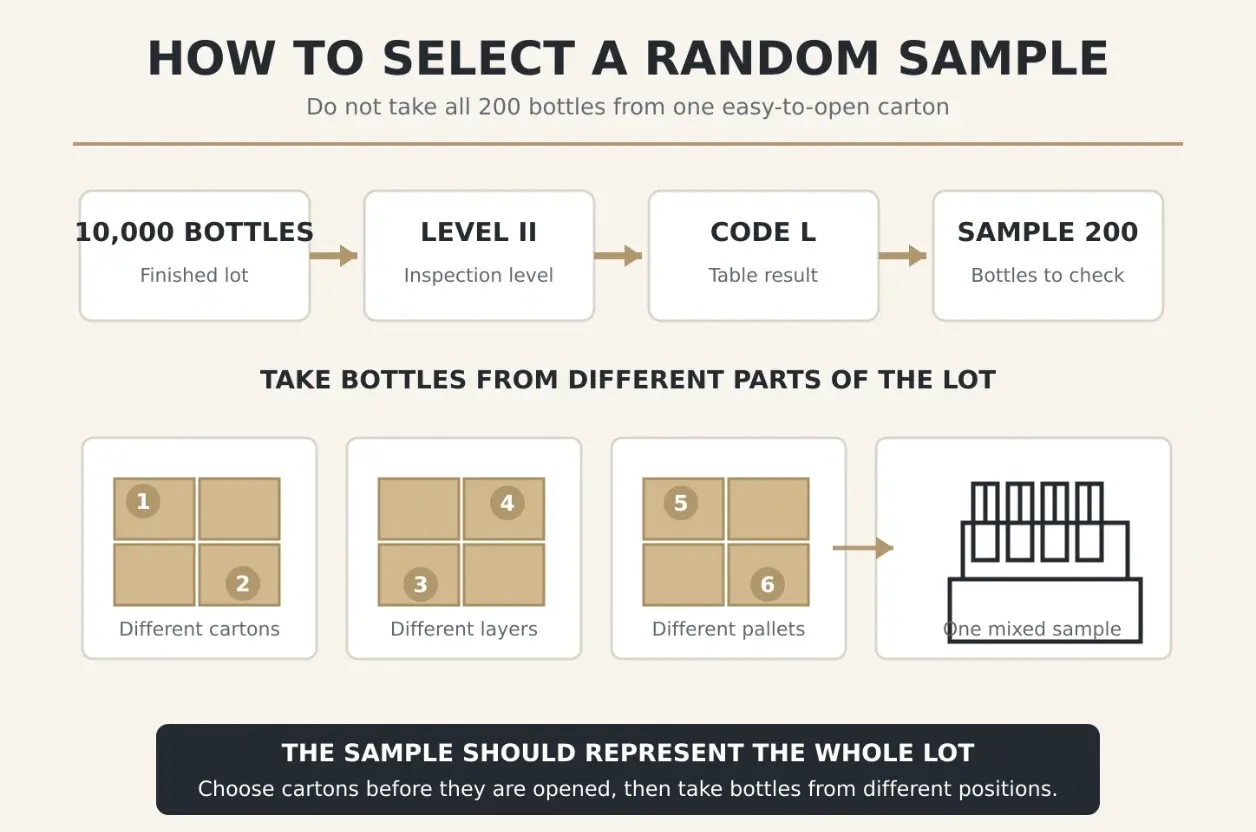
For example, take an order of 10,000 identical bottles at General Level II. The lot-size table gives code letter L. Code letter L leads to a sample of 200 bottles under the normal single-sample plan.
The quality team should select those bottles from different pallets and carton positions. A sample taken only from the easiest cartons to reach will not give a fair view of the shipment.
The order also needs to be ready. All bottles should be finished, and most cartons should be packed. This allows the team to select bottles across the finished lot. The timing should still leave enough room to correct a problem before loading.
Different products may need separate lots. Clear and amber bottles should not automatically share one sample. The same applies to different sizes, printed designs or production runs. Separate samples make the results easier to understand.
How Do You Read an AQL Chart?
Start with the table for lot size and inspection level. This table gives a code letter. Next, find that code letter in the sampling table and read the sample size, Ac number and Re number for the chosen AQL.
The example below uses three defect groups. Critical defects involve safety. Major defects affect use, sealing or sale. Minor defects are mainly small appearance problems. The next section explains these groups in more detail.
| Artigo | Agreed detail |
|---|---|
| Lot size | 10,000 bottles |
| Inspection level | General Level II |
| Code letter | L |
| Sample size | 200 bottles |
| Critical defects | Agreed Ac 0 / Re 1 rule |
| Major defects | AQL 2.5, Ac 10 / Re 11 |
| Minor defects | AQL 4.0, Ac 14 / Re 15 |
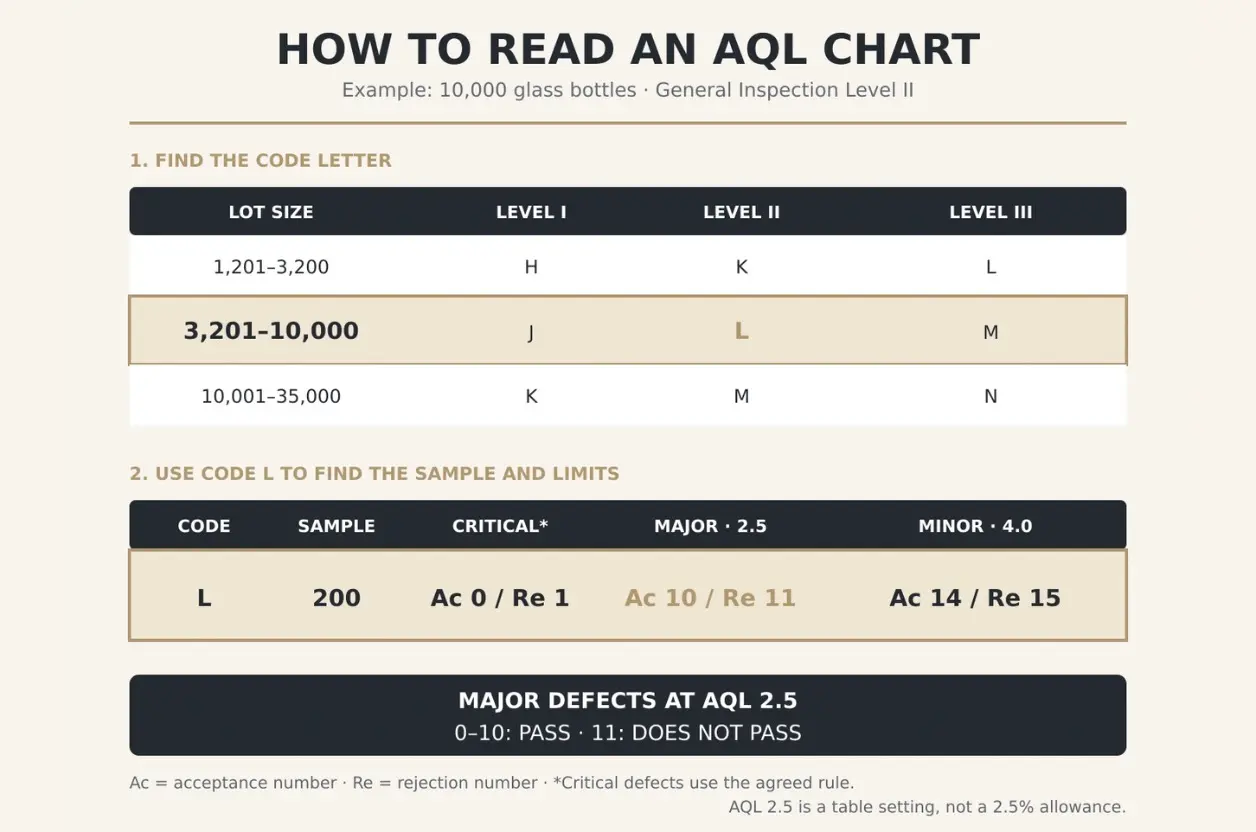
Suppose the sample contains no critical defects, eight major defects and twelve minor defects. Each count remains within its acceptance number, so the sample passes.
Now suppose the sample contains eleven major defects. That count reaches the rejection number, so the sample does not pass. The critical and minor results do not change the major-defect result.
The critical limit in this example is an agreed zero-found rule, not “AQL 0.” If one critical defect appears in the sample, the result is Re 1. This type of rule is common when a defect could create a serious safety risk, but both sides still need to agree on it.
The report should record the lot size, inspection level, sample size, AQL values and defect counts. It should include clear photos and identify the drawing, approved sample and artwork used during the check.
Online AQL calculators are useful, but their results depend on the selected standard and plan. Buyers should check which table the calculator uses instead of copying a number without context.
What Are Critical, Major and Minor Defects?
The AQL numbers only work when everyone uses the same defect definitions. A buyer, supplier and third-party company may judge the same mark differently if the order does not include a clear defect list.
| Defect group | What it means | Glass bottle examples |
|---|---|---|
| Critical | A problem that may create a safety risk | Cracks, sharp chips, loose glass inside the bottle or dangerous foreign matter |
| Major | A problem that affects use, sealing, filling or the main appearance | Wrong neck finish, wrong capacity, key dimensions outside the limit, an unstable base, closure mismatch or a serious decoration error |
| Minor | A small appearance problem that does not normally stop the bottle from being used | Light scuffs, small surface marks, a slight color difference within the agreed range or a small decoration mark |
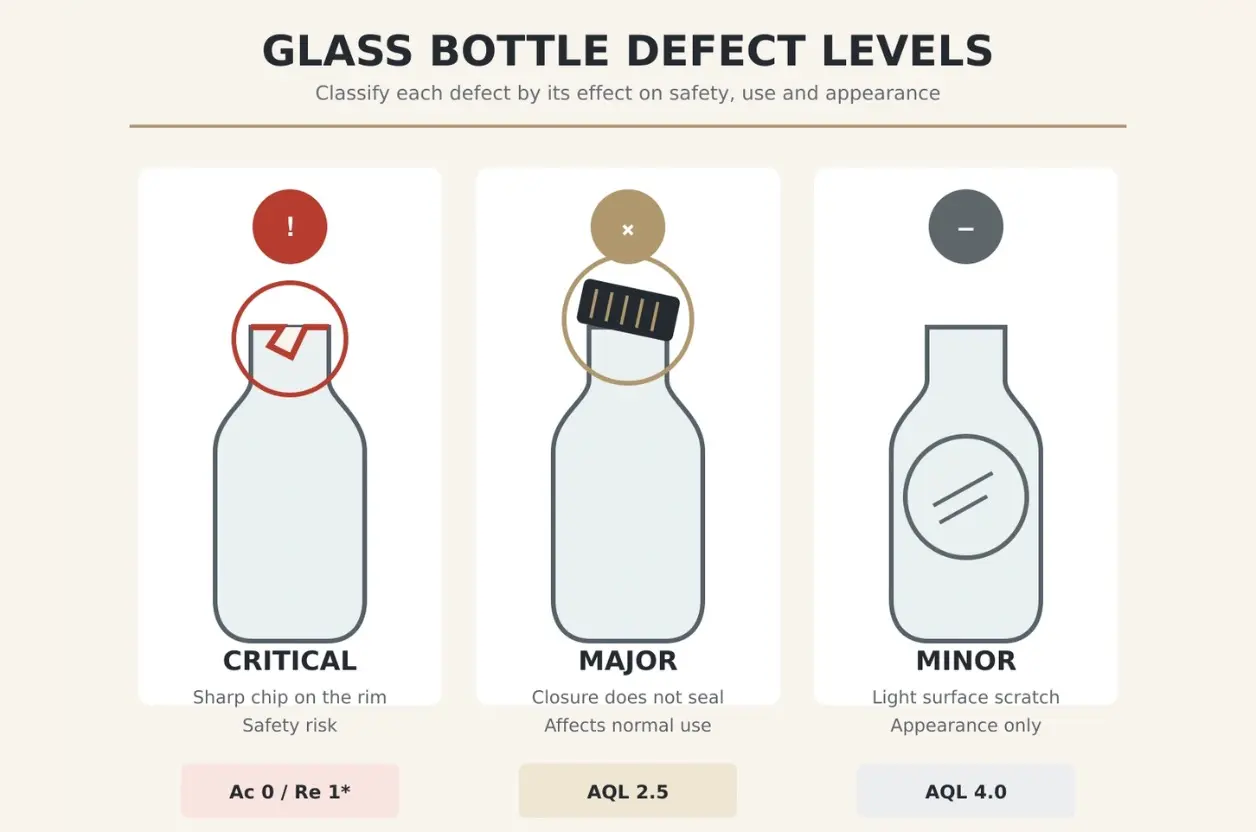
The defect name alone is not enough. Its size, position and effect also matter. A light mark near the base may be acceptable. The same mark across a logo may become a major appearance problem. A neck defect that stops the cap from sealing is more serious than a light mark on the bottle body.
The final use also matters. A crack, sharp edge or loose piece of glass needs to be treated as a safety issue. A bubble or surface line may be less serious, but its position and size still need clear limits.
Photos make a defect list easier to use. Each reference photo should name the defect and show whether it is critical, major or minor. The approved sample and drawing should provide the limits for color, dimensions and decoration.
Both sides also need one counting method. If one bottle has two print marks, does the report count one defective bottle or two defects? Many checks count defective units, but the chosen method must be written down. Otherwise, two teams can reach different totals from the same sample.
Does AQL Cover Every Part of the Check?
No. AQL covers sample selection and defect counting. A complete glass bottle check includes other work that does not fit neatly into the AQL result.
The quality team may use a separate checklist for carton quantity, shipping marks, pallet condition and packing method. These points apply to the shipment or carton rather than one bottle.
Product tests may also use their own sample sizes. Common examples include capacity, leak, cap-fit and coating checks. Pressure or strength tests need the correct equipment and a method agreed before the check.
Every measurement needs a clear limit. A drawing may give an allowed range for bottle height, body diameter, capacity and neck dimensions. Without that range, the team can record a number but cannot decide whether it passes. The tool must also suit the measurement. A simple ruler is not accurate enough for every bottle dimension.
AQL does not replace the factory’s checks during production. The factory still needs to control bottle forming, annealing, decoration and packing. If every bottle must pass an automatic camera or leak test, the buyer should write that requirement separately. It should not be hidden inside the AQL plan.
What Happens If the Sample Does Not Pass?
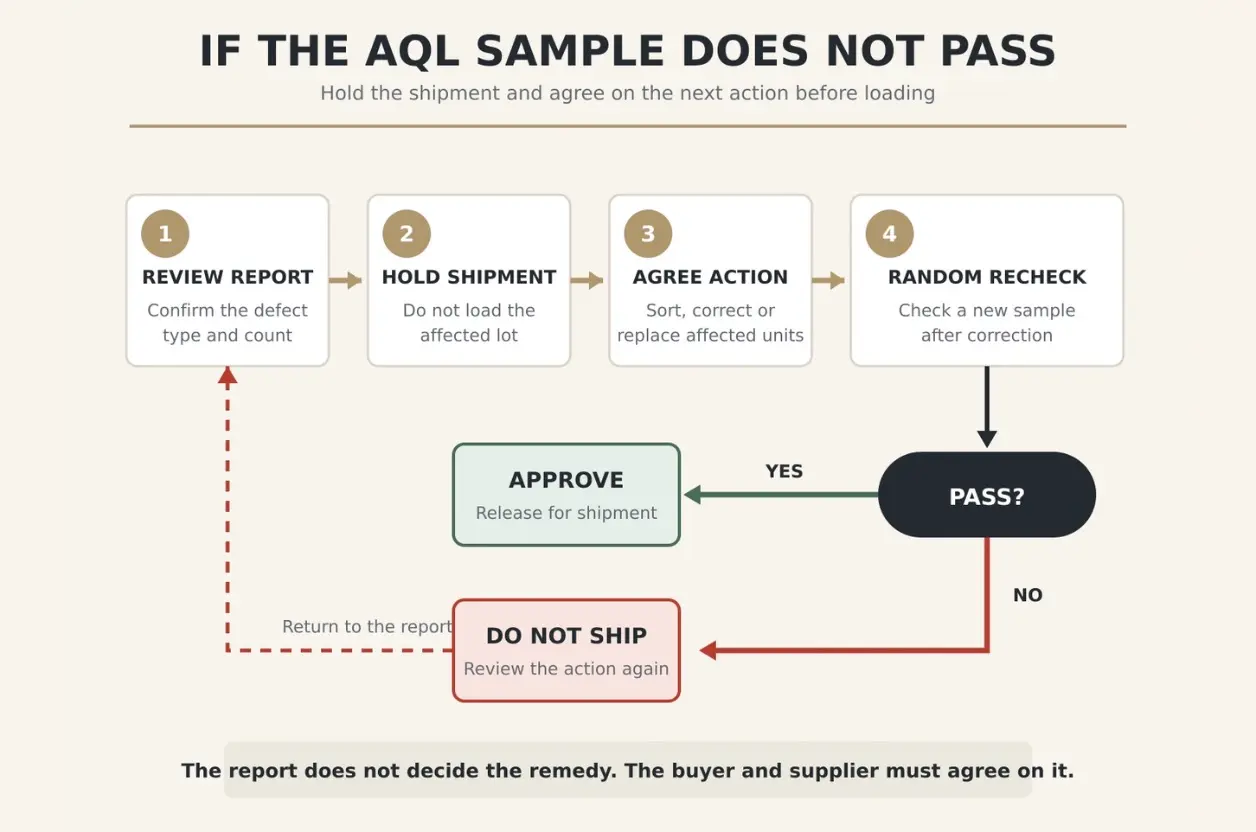
The buyer should not approve shipment until both sides have reviewed the report. They need to look at the photos, defect counts and affected cartons before choosing the next step.
The supplier may sort the lot and remove the affected bottles. The factory may also replace damaged packing or redo decoration when it can be fixed. Cracks and badly formed necks cannot be repaired, so those bottles must be removed.
After the supplier corrects the problems, the buyer may request another check. The quality team should take a new random sample from the corrected lot. It should not check only the cartons that the supplier has selected as good.
A failed sample does not decide who pays for sorting, rework, replacement or another check. That depends on the purchase agreement and the cause of the problem. The order should explain these responsibilities before production starts.
What Should Buyers Confirm Before the Check?
Clear preparation reduces disputes after the report is issued. The buyer and supplier should first confirm which bottles belong to the same production lot. They should then confirm the inspection level, sample size, AQL values and defect groups.
The quality team also needs the final purchase order, bottle drawing, approved sample, artwork, packing details and test methods. A report based on an old drawing or early artwork file may look complete while judging the wrong requirements.
When a third-party company carries out the check, the buyer or supplier must provide the final documents before the visit. Both sides should confirm that the company received the correct files. The factory’s quality team should use the same limits during production.
Special tests need separate instructions. The booking should state which tests are required, how many bottles will be tested, which tools will be used and what result counts as a pass. This prevents a general AQL check from being mistaken for a full technical test.
Conclusão
AQL inspection gives glass bottle buyers a practical way to judge a large order through random sampling. It works best when the bottle requirements, defect groups and sampling plan are clear before production.
AQL 2.5 is not a simple defect percentage, and a passing sample does not guarantee a perfect shipment. It shows that the selected sample stayed within the agreed limits. Clear documents and defect photos make that result much easier to understand.
If you need help matching your bottle specification, packing plan and quality requirements, contact Jingbo Group to discuss your project.