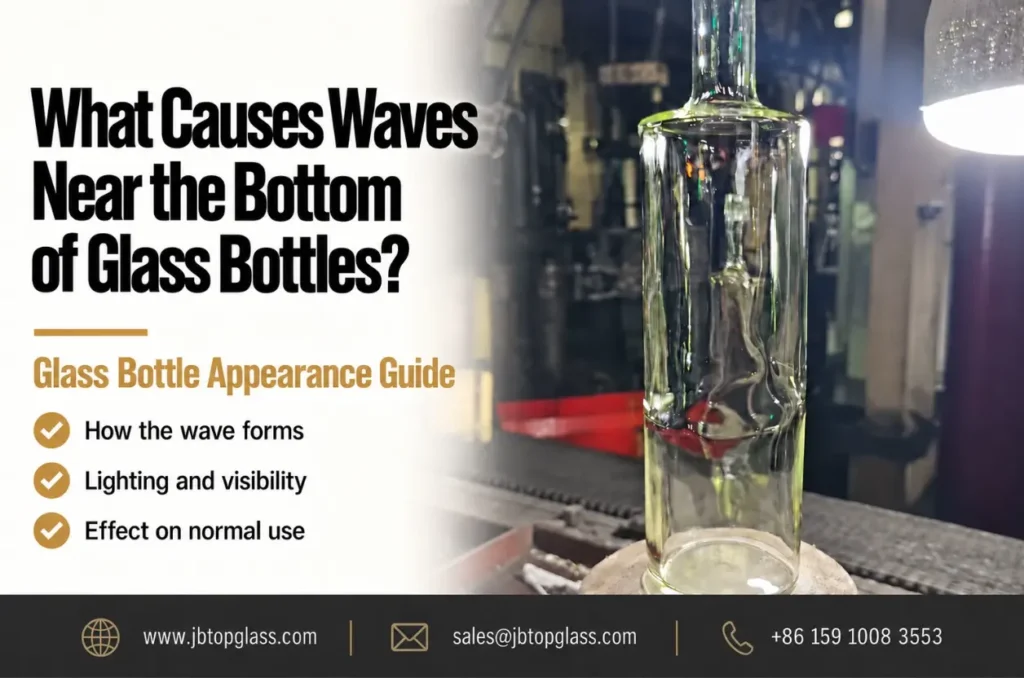
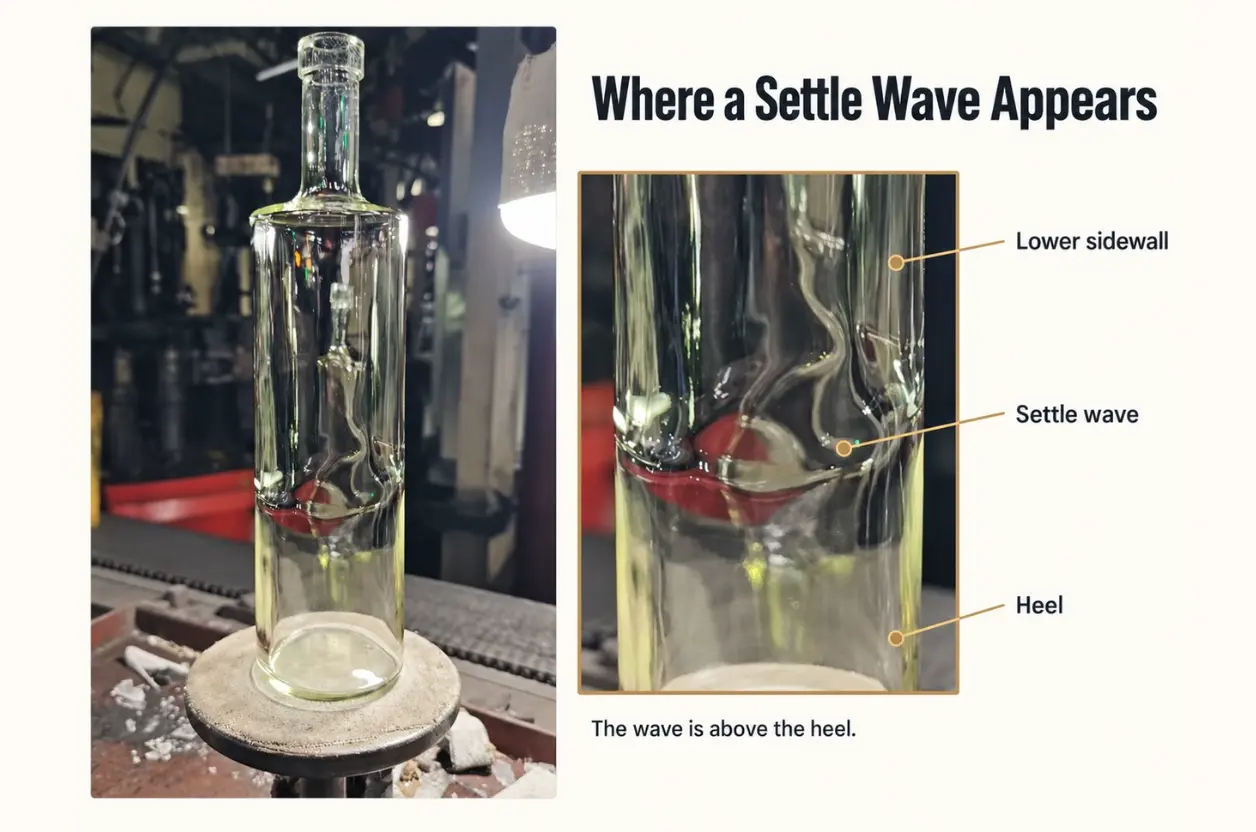
Settle wave is a wavy band in the lower sidewall of a glass bottle. It comes from a local change in wall thickness created during forming. The glass bends light differently in that area, making the bottle look rippled.
Mild settle waves are common in bottles made by the blow-and-blow process and do not normally affect use. Seeing similar waves on bottles from several factories does not, by itself, mean those factories have supplied poor-quality bottles.
Why Do Glass Bottles from Different Factories Have Similar Waves?
Different factories often use the same basic forming method. In blow-and-blow production, hot glass first takes an intermediate shape and then expands into the finished bottle. Temperature differences during this process can leave a visible band in the wall.
Factories that use this method can produce bottles with similar forming features. The shared appearance has a common physical explanation; it is not necessarily an isolated problem with one supplier.
O termo settle wave comes from the forming process. It does not mean that liquid has settled inside the bottle. An empty bottle can show the wave because the feature is part of the glass wall.
How Does a Settle Wave Form?
The finished bottle begins as hot glass that can still flow and stretch.
1. The Machine Forms an Initial Shape
A measured portion of hot glass, called a gob, enters an initial mold known as the blank mold.
The settle blow helps move glass into the neck-finish area. The counterblow then creates a hollow intermediate shape called a parison. The machine transfers this parison to the final blow mold.
2. One Ring-Shaped Region Becomes Cooler
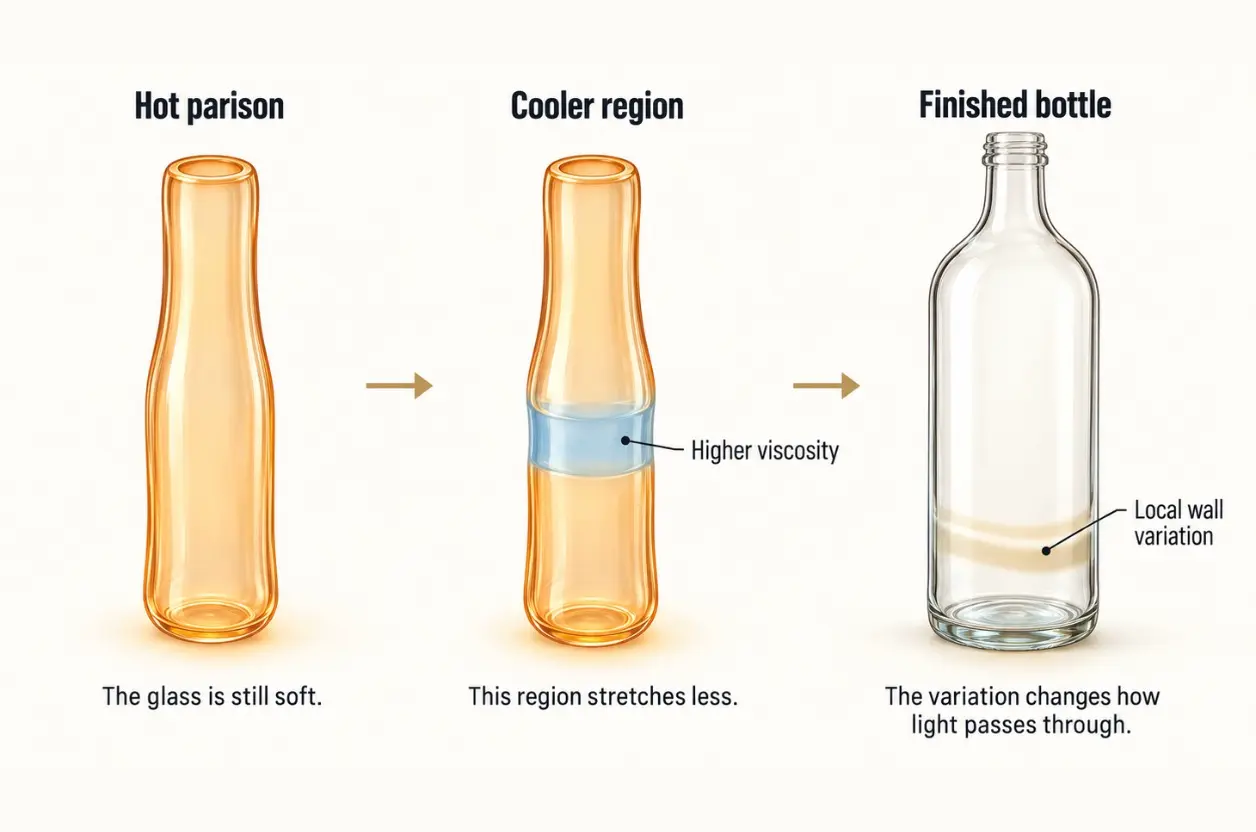
The forming equipment removes heat from the glass. One ring-shaped region can become cooler than the surrounding material.
The parison remains hot, but its temperature is not perfectly even. Some chilled areas do not regain as much heat as neighboring areas before final blowing.
Cooler glass has a higher viscosity, meaning it flows and stretches less readily. Owens-Illinois describes this uneven cooling and stretching in its technical explanation of settle-wave formation.
3. Final Blowing Leaves a Locally Thicker Band
Air expands the parison into the finished bottle shape. The hotter glass stretches more readily, while the cooler ring stretches less.
That difference leaves a locally thicker band in the finished wall. The band changes the path of light passing through it.
Why Does It Usually Appear in the Lower Sidewall?
Technical descriptions place a settle wave generally below the bottle’s middle and above the heel. The heel is the curved transition between the main bottle wall and the base.
This position relates to where the affected region of the parison ends up as it expands into the finished bottle. The wave follows a ring-shaped region of glass created during forming.
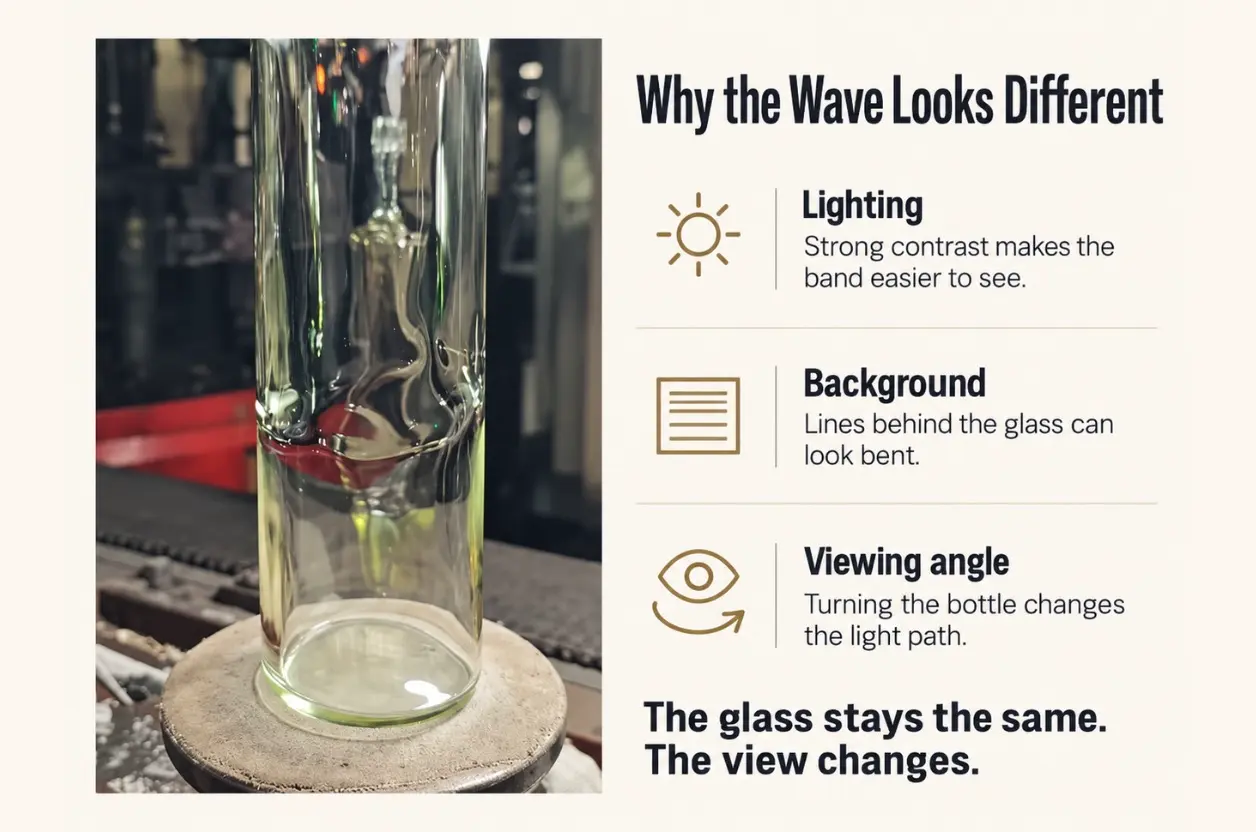
A ring around a three-dimensional bottle does not always look like a straight horizontal line in a photograph. The curved wall, viewing angle and light passing through the bottle influence its visible outline. It may look like an uneven water line or a broad rippled band.
The location is a useful clue, but a circular mark near the base can also have another cause, such as a mold joint.
Why Is the Wave More Obvious Under Certain Lighting?
Glass changes the direction of light passing through it. This effect is called refraction.
At a settle wave, the gradual change in the wall’s shape redirects the light. A straight edge behind the bottle may look bent or displaced when viewed through that area. This distortion creates the water-like appearance.
The effect is easier to see against a background with strong light-and-dark contrasts. A wave that looks faint under soft light may stand out against a bright window or a background with dark lines.
Rotating the bottle changes the light path, so the visible band appears to change. The glass is not moving; the optical effect is changing. Owens-Illinois explains this behavior in its research on optical checking.
This is why a close-up photograph can make a wave look much stronger than it does when you hold the bottle normally. The wall profile and the viewing conditions both contribute to what you see.
Does a Settle Wave Affect Normal Bottle Use?
A mild settle wave is generally an appearance feature and does not normally affect the bottle’s use. Owens-Illinois’s technical literature makes this distinction when describing the condition.
The wave itself is a variation in the glass wall, not a fracture. Seeing a light settle wave is not the same as finding a crack or a leak.
A bottle’s suitability still depends on its specification and intended application. A light wave alone does not establish a functional problem.
Appearance is a separate consideration. A brand using an exposed clear-glass panel may have stricter visual requirements than a brand covering that area with a label. A bottle can meet its functional requirements while its appearance does not suit a particular packaging design.
This explains why the same visible feature may be acceptable for one product but less suitable for another.
How Is a Settle Wave Different from Other Bottle Marks?
Several conditions create visible lines or waves in glass. Their names describe different features.
| Mark | Aspecto típico | What it represents |
|---|---|---|
| Settle wave | A wavy band, usually in the lower sidewall | A ring-shaped variation in glass wall thickness |
| Washboards | Several horizontal waves or folds | Repeated waves along the sidewall |
| Mold seam | A line following a mold joint | A mark left where mold components meet |
| Check or crack | A fracture in the glass | A break in the glass structure |
Bucher Emhart Glass describes washboards in its technical handbook. Our guide to costuras das garrafas de vidro explains why mold joints also leave visible lines.
A photograph alone may not show enough detail to distinguish every fine mark.
FAQ
Can Washing Remove a Settle Wave?
No. A settle wave is part of the glass wall. Washing removes surface dirt but does not change the wall’s shape or thickness. The wave may become more or less visible under different light, but that does not mean it has been removed.
Does Every Glass Bottle Have a Visible Settle Wave?
No. The forming method, bottle design and production conditions differ. Even where settle waves are present, they do not all look equally noticeable. The lighting and viewing angle also affect their visibility.
Conclusão
A settle wave is a forming feature that creates a rippled appearance in a glass bottle’s lower sidewall. Local differences in cooling and stretching leave a band that bends light differently.
Mild settle waves are common in blow-and-blow glass bottles and do not normally affect use. Their presence alone is not proof of poor manufacturing quality. Their visual acceptability depends on the appearance requirements of the packaging.
For questions about glass bottle appearance and packaging requirements, contact Jingbo Group.