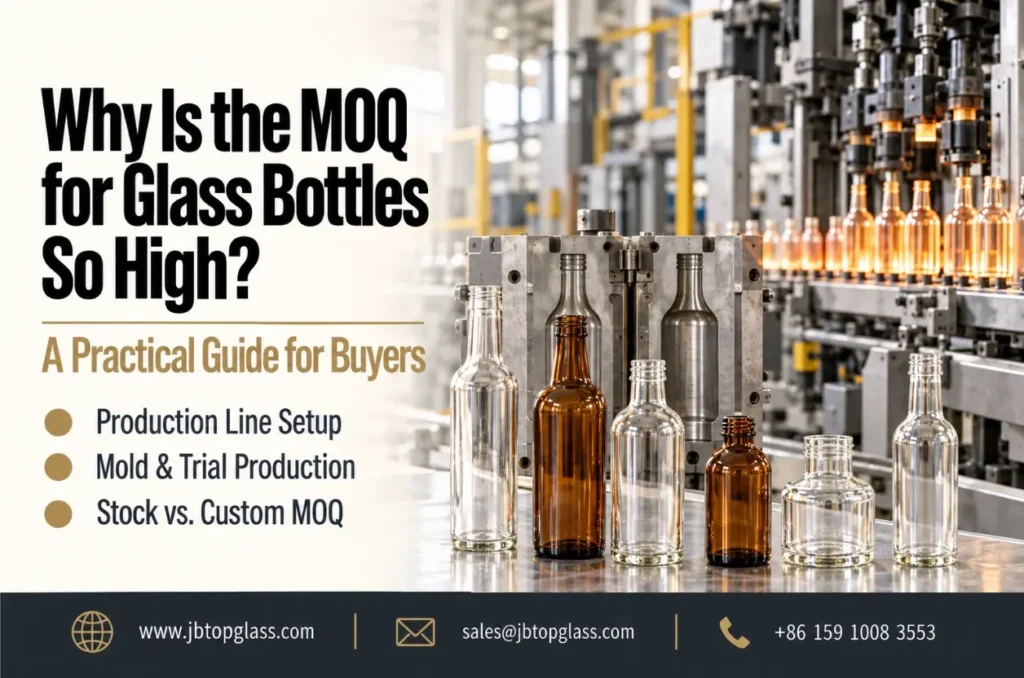
The MOQ for glass bottles is high because a factory cannot start a new bottle run for only a few hundred pieces.
The factory has to prepare the mold, set the forming machine, adjust the bottle weight and check the first bottles. The production line must run long enough to cover this work. The factory also needs to arrange quality checks, packing and warehouse space for the finished bottles.
These steps cost almost the same whether the buyer orders 3,000 bottles or 30,000 bottles. A larger order spreads the cost across more bottles. This keeps the unit price at a reasonable level.
However, not every glass bottle has the same MOQ. A bottle that is already in stock may have a much lower minimum. A bottle made with an existing mold still requires a new production run if there is no stock. A fully custom bottle also needs mold development and sample approval before production.
Understanding these differences helps buyers choose a bottle that fits both their brand and their sales plan.
What Does Glass Bottle MOQ Mean?
MOQ means minimum order quantity. It is the smallest quantity that a supplier will accept for one bottle project.
A glass bottle MOQ normally applies to one bottle design, one capacity, one glass color and one main production requirement. If you change the capacity, color or bottle shape, the supplier may treat it as another product.
The quoted MOQ may also depend on whether the bottles are available in stock or need to be produced. These are not the same situation.
For example, a supplier may have 5,000 clear bottles in its warehouse. The buyer may be able to purchase part of this stock. If the warehouse is empty, the same bottle may require a much larger order because the factory must start another production run.
That is why buyers should not ask only, “What is your MOQ?”
A better question is:
“Do you have this exact bottle in stock, or does the factory need to produce it?”
The answer tells you whether you are discussing a stock MOQ or a production MOQ.
Why Can’t a Factory Produce Only 500 or 1,000 Bottles?
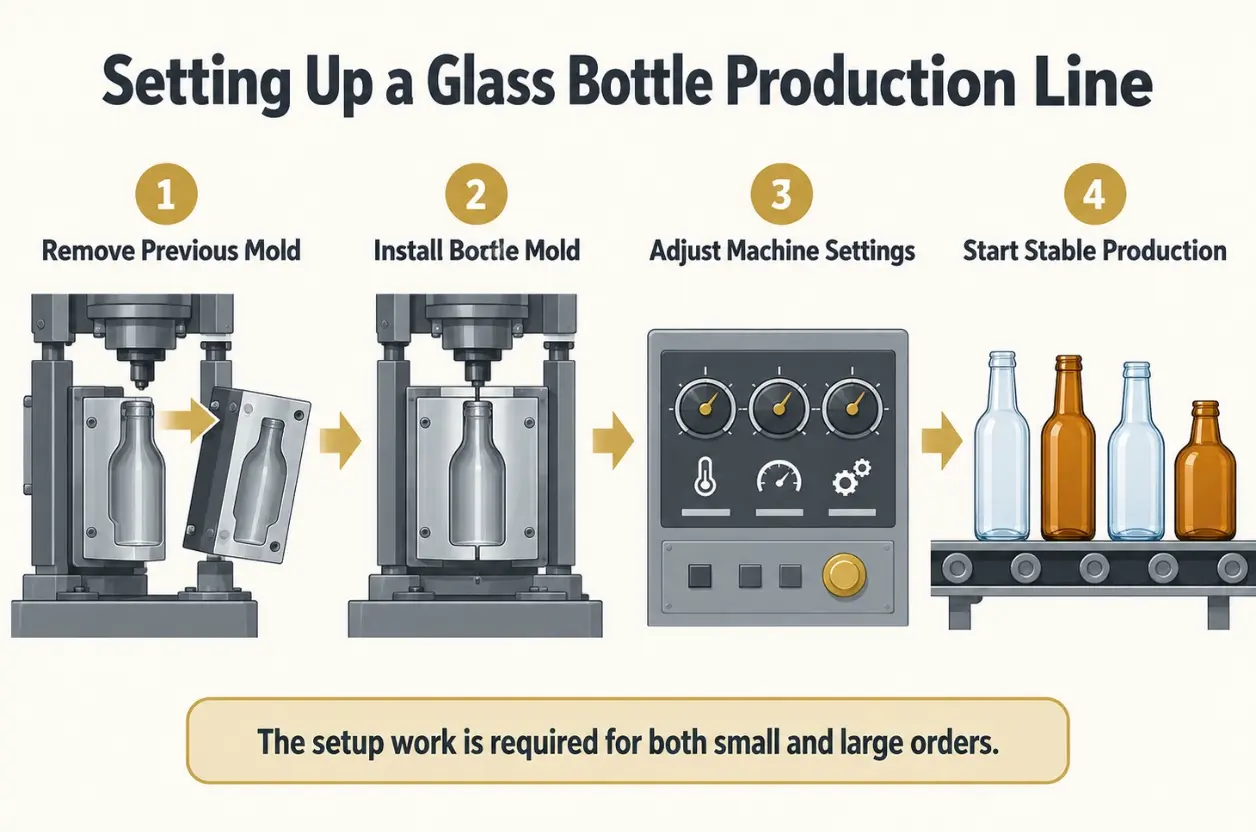
Producing another glass bottle requires more than installing a mold. The factory must prepare the line, test the first bottles and wait until production becomes stable. This work is almost the same for a small order and a large order.
The Production Line Must Be Reset
The furnace runs continuously, but the forming line is set for a specific bottle.
When the factory changes bottles, workers must replace the molds and reset the machine. They also adjust the bottle weight, forming speed, air pressure and cooling time.
The factory cannot skip this work simply because the buyer needs fewer bottles.
Trial Production Creates Some Loss
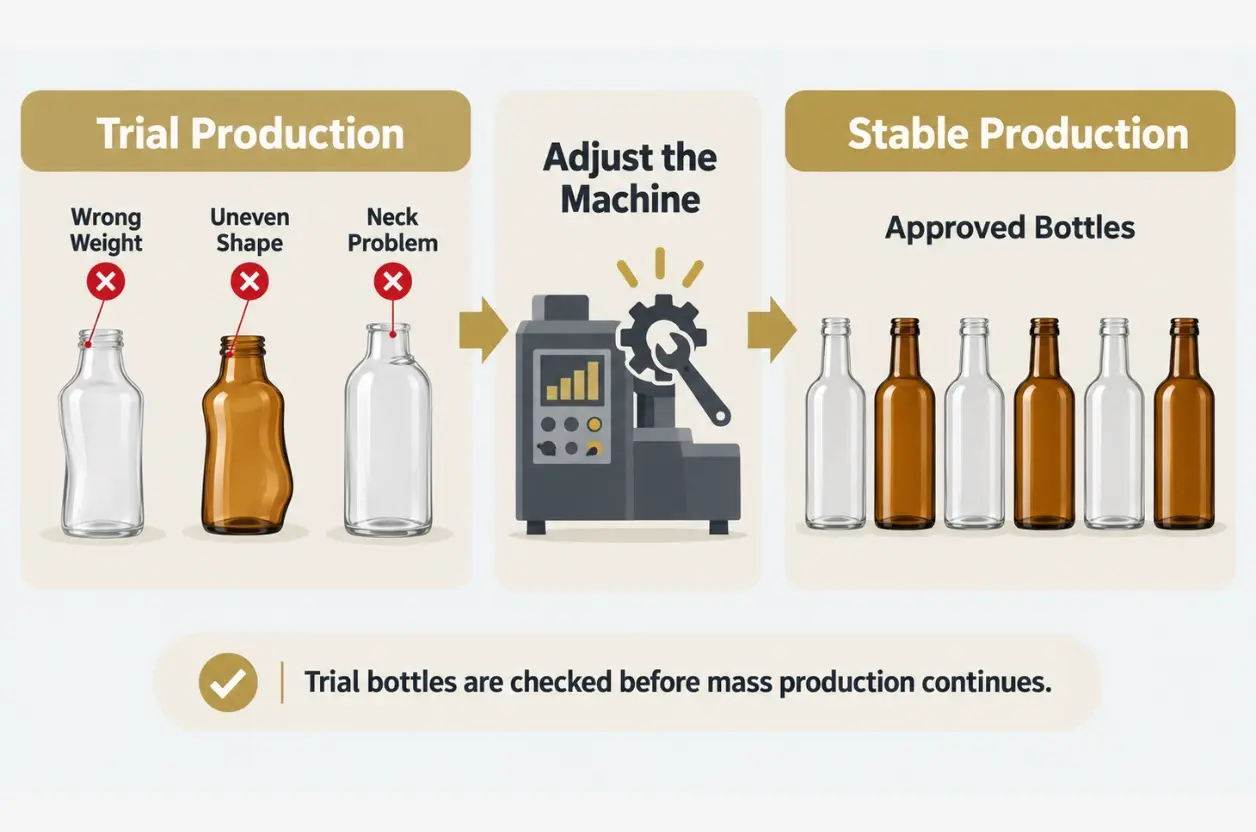
The first bottles help the factory check the new settings. Some may have the wrong weight, uneven glass or an incorrect shape.
The production team adjusts the machine until the bottles meet the approved requirements. Bottles made during this period may not be packed as finished products.
A very small order cannot spread this loss across enough saleable bottles.
Setup Costs Must Be Shared Across the Order
Mold installation, machine adjustment, trial production, quality checks and packing preparation all create costs.
If the factory produces only 1,000 bottles, each bottle carries a large share of those costs. A larger order spreads the same setup cost across more bottles and lowers the unit price.
A short run can also take less time to produce than it takes to prepare the line. This makes the order difficult to schedule, even when the buyer accepts a higher price.
For this reason, the glass bottle MOQ is not simply a number chosen by the sales team. It is the minimum quantity needed to make the production run practical.
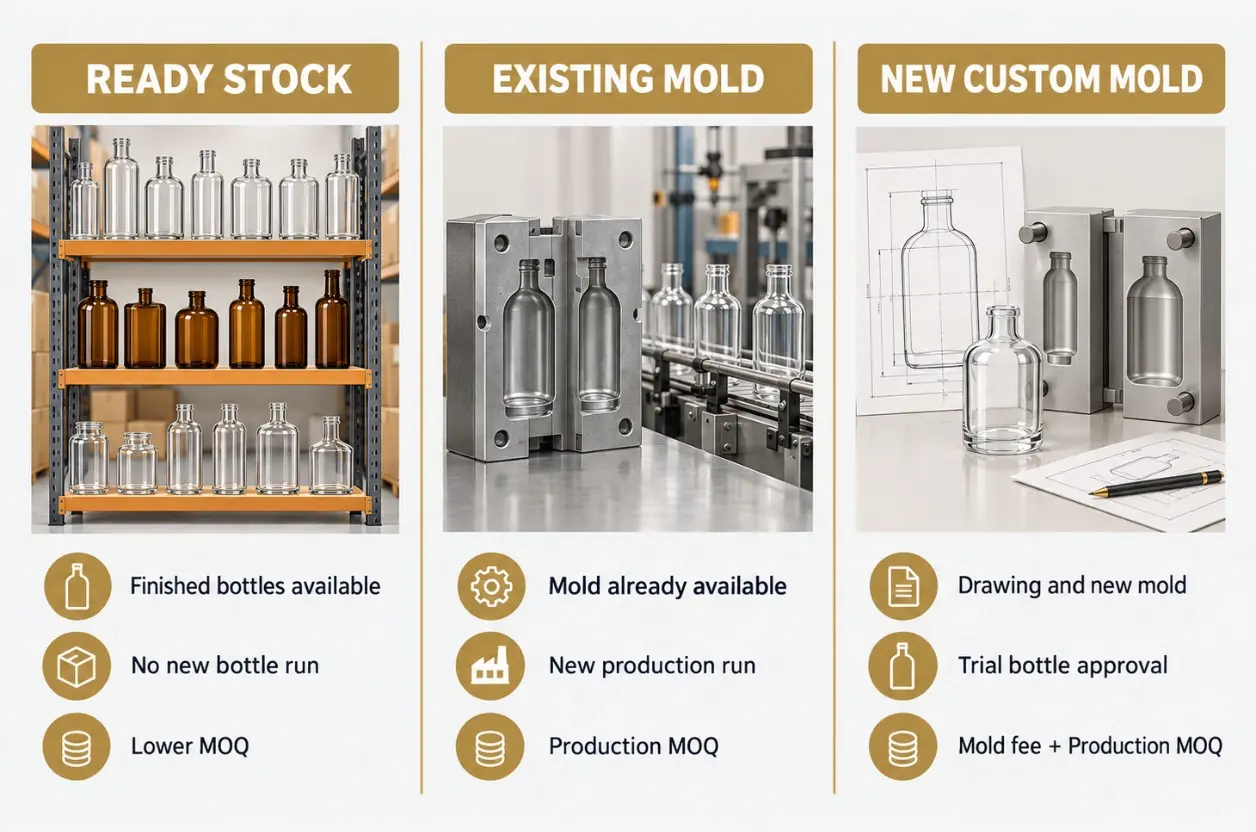
Ready Stock, Existing Mold and New Mold Have Different MOQs
Buyers sometimes use “standard bottle” and “stock bottle” as if they mean the same thing. They do not.
A standard bottle may use an existing mold, but the factory may not have finished bottles in its warehouse. The factory still needs to schedule production.
Before comparing MOQs, buyers should understand the three common order types.
Ready-Stock Bottles
Ready-stock bottles have already been produced. The bottles are stored in the supplier’s or factory’s warehouse and are available for sale.
These bottles normally offer the lowest MOQ because the factory does not need to start a new production run. The buyer only needs to confirm the available quantity, glass color, bottle condition and packing.
Stock can change quickly. A product page or old quotation does not prove that the bottles are still available. The supplier must check the current warehouse quantity before confirming the order.
Stock bottles also give the buyer fewer choices. The bottle shape, capacity, weight, neck finish and glass color have already been decided. The buyer may still add a label, screen printing, spray coating or another decoration, but the decoration may have its own MOQ.
Bottles Made with an Existing Mold
An existing mold means the factory can produce the bottle without developing a completely new shape.
This can save the mold cost and shorten the preparation time. However, it does not mean that the bottles are in stock.
If there is no inventory, the factory must install the mold and arrange another production run. The order must still meet the minimum quantity required by the production line.
This is why two suppliers may offer the same type of bottle with very different MOQs. One supplier may have stock. The other supplier may only have the mold.
Buyers should always confirm two points:
Does the mold already exist?
Are finished bottles available now?
New Custom-Mold Bottles
A new mold is required when the buyer needs a new shape, special structure, embossed logo or other changes that cannot be made with an existing bottle.
The buyer first approves the drawing and trial sample. The factory then schedules the bottle for mass production.
The mold fee and production MOQ are separate. Paying for a mold does not mean the factory can produce any quantity the buyer wants. The mold creates the bottle shape, while the MOQ covers the actual production run.
For more information about drawings, samples and mold production, buyers can read Jingbo Group’s custom glass bottle mold development guide.
Why Can a Small Bottle Have a Higher MOQ?
Many buyers expect a smaller bottle to have a lower MOQ because it uses less glass. In practice, the number of bottles may be higher.
Factories plan production by machine time, output and the amount of glass used. A small bottle uses less glass, and the machine may produce more pieces during the same production period.
This means that a short production run can still create a large number of small bottles.
Small perfume, aromatherapy and pharmaceutical bottles may therefore have a higher piece-based MOQ than a larger liquor bottle or food jar.
The bottle price may be lower, but the buyer must purchase more pieces. Buyers should consider both the unit price and the total order value when comparing options.
Does Glass Color Change the MOQ?
Glass color can affect the MOQ.
Clear, amber and common green bottles are easier to arrange when the factory already has a suitable production plan. A special glass color may require a separate schedule or a larger volume.
Buyers should also separate colored glass from spray-coated glass.
Colored glass gets its color from the glass itself. Spray coating is added to the outside of a finished bottle. A buyer may therefore start with a standard clear bottle and add a custom coating instead of producing a new glass color.
This option can reduce the glass production requirement, but the coating process will still have its own setup cost and MOQ.
The right choice depends on the required color, order quantity, product use and budget. Our guide to colored glass vs. spray-coated glass bottles explains the difference in more detail.
Do Decoration and Closures Have Separate MOQs?
The bottle is only one part of the final package.
Screen printing, spray coating, frosting, hot stamping and decal printing all require different equipment and setup work. Each process may have its own MOQ.
A buyer may find a stock bottle with a low minimum but then choose a decoration that requires a larger quantity. In that case, the final project MOQ follows the decoration requirement.
Closures can create the same problem. A standard cap may be available in stock, while a custom-colored cap needs a new production run. A custom mold, logo or surface finish can increase the minimum again.
The buyer should confirm the MOQ for the complete package, including the glass bottle, closure, liner, decoration and export packing.
The supplier should not confirm the final project MOQ from the bottle alone.
Can Different Bottle Designs Be Combined to Reach the MOQ?
Different bottle designs normally cannot be combined to meet one production MOQ.
Each bottle shape needs its own mold setup and production run. A 10,000-piece MOQ usually means 10,000 pieces of one bottle design, not 2,000 pieces each of five different bottles.
The same rule can apply to capacities and colors. A 500ml bottle and a 750ml bottle may require different molds. Clear glass and amber glass may also follow different production plans.
A supplier may combine several finished products in one shipment. This can help the buyer use container space more efficiently, but it does not remove the MOQ for each product.
Stock products are more flexible because they have already been produced. The supplier may allow the buyer to purchase several stock designs, depending on the available quantity and packing method.
Can a Buyer Pay More to Get a Lower MOQ?
Sometimes a higher unit price can support a smaller order, but it does not solve every MOQ problem.
The supplier may accept a smaller quantity when the bottles are already in stock or when a decoration line can handle a short run. The additional cost covers setup, handling and packing.
A higher price may not help when the factory must start a full glass production line. The factory still needs enough production time to run the bottle correctly.
This is why buyers sometimes receive a direct answer that a certain bottle cannot be produced below 30,000 pieces. The problem is not only the bottle price. The quantity is too low for that production run.
How Can Buyers Reduce the Glass Bottle MOQ?
Buyers cannot remove every production limit, but they can make the project easier to arrange.
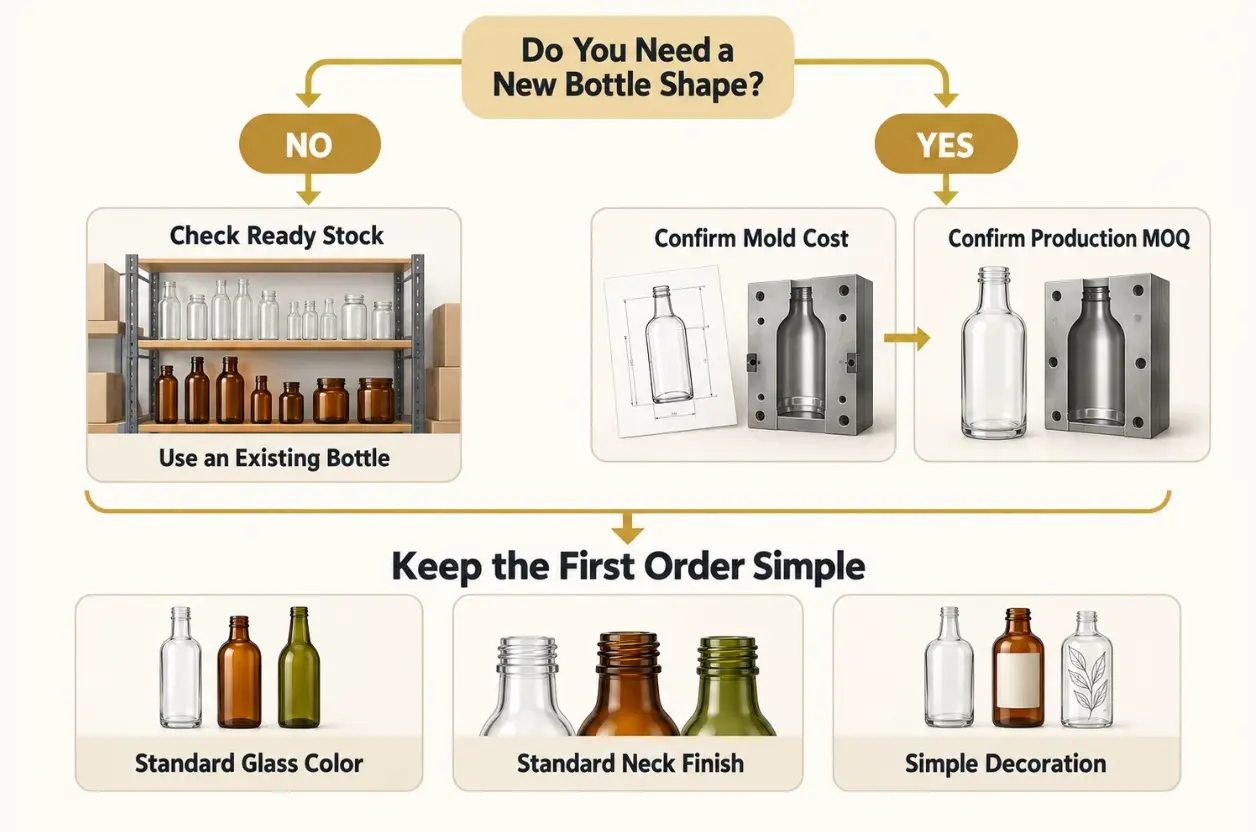
Start with a Bottle That Is Really in Stock
Ready stock gives a new brand the best chance of starting with a smaller order.
Ask the supplier to confirm the exact stock quantity before you plan the label, cap or carton. You should also ask for current bottle photos or a sample because old and new batches may have small differences.
Use an Existing Bottle Shape
A bottle made with an existing mold avoids the cost and time of new mold development.
The production MOQ may still apply if there is no stock, but the project is simpler than developing a completely new bottle.
A brand can create a different look through the label, cap, color coating or printing without changing the glass structure.
Keep the First Version Simple
Each custom detail can add another MOQ.
A new bottle mold, custom glass color, special cap, coating and multi-color printing may all come from different production lines. Combining all of them in the first order makes the project more difficult.
A new brand can begin with a standard bottle and one clear brand feature. The brand can add more custom details after sales become stable.
Choose a Standard Neck Finish and Closure
A standard neck finish gives the buyer more closure options.
The supplier may already have suitable caps, corks, pumps or droppers. A special neck finish may require both a custom bottle mold and a custom closure.
Buyers should confirm the complete bottle-and-closure combination before approving production.
Ask About the Next Production Plan
A factory may already have another run planned for the same bottle.
If the buyer’s schedule is flexible, the factory may be able to add the order to that production plan. This option depends on the bottle specification, glass color, timing and remaining production space.
The supplier cannot promise this option for every project. The buyer may also need to wait until another order is confirmed.
Use Labels Before Choosing Permanent Decoration
Pressure-sensitive labels and shrink sleeves can be practical for a first order. They allow the buyer to change product information or artwork without changing the bottle.
Permanent decoration can be added when the order volume becomes more stable.
However, the buyer still needs to check the label supplier’s MOQ and make sure that the label works on the selected bottle surface.
What MOQ Should Buyers Expect from Jingbo Group?
Jingbo Group reviews the bottle type, capacity, decoration and production method before confirming an MOQ.
Regular liquor bottle projects generally start at around 10,000 pieces. Food jar orders may start at around 20,000 pieces. Small perfume, aromatherapy and pharmaceutical bottles often require a higher quantity. Some small-bottle projects may reach 100,000 pieces because of the bottle size and production line.
Stock products may support a lower order quantity, but the bottles must be available in the warehouse. Stock cannot be promised until the current quantity has been checked.
These numbers are starting points rather than fixed rules for every product. A bottle may require a larger order if the factory needs to start a separate production run.
To receive a useful answer, the buyer should send the supplier a bottle photo or drawing, required capacity, estimated quantity, glass color, closure and decoration requirements.
常见问题
Why Do Glass Bottle Manufacturers Have High MOQs?
Glass bottle manufacturers set MOQs because every production run needs mold setup, machine adjustment, quality checks and packing.
A larger run spreads these costs across more bottles and keeps the unit price price reasonable.
Can I Order 1,000 Custom Glass Bottles?
You may be able to order 1,000 bottles if a suitable model is already in stock.
A new glass shape or a bottle that needs a separate factory run will normally require a much larger quantity.
Adding a label or simple decoration to a stock bottle is often more realistic than developing a new mold for 1,000 pieces.
Is the MOQ Based on One Bottle or the Total Order?
The MOQ normally applies to one bottle design, capacity and glass color.
Different bottle shapes usually have separate MOQs because each one requires a separate setup.
Several products can sometimes be placed in the same shipment, but combined shipping does not remove the production MOQ for each bottle.
Does a Custom Mold Have a Separate MOQ?
Yes. The mold fee pays for the tooling used to form the bottle. The production MOQ covers the factory run.
A buyer who pays for a new mold must still order enough bottles for mass production.
Can the Supplier Keep Part of the Order for Later Delivery?
Some suppliers may allow split delivery, but the factory still produces the full agreed quantity.
The buyer and supplier must agree on payment, storage time, warehouse charges, packing and the final delivery date before production.
Split delivery reduces the number of bottles received at one time, but it does not reduce the production MOQ.
What Is the Best Choice for a New Brand?
A new brand should usually begin with a stock bottle or an existing bottle design. A standard neck finish and simple decoration can also keep the first order easier to manage.
A fully custom bottle makes more sense when the brand has a clear sales plan and enough demand to use the required quantity.
结论
A high glass bottle MOQ does not come from the bottle size alone. It comes from the way the factory prepares and runs the production line.
Ready stock normally offers the most flexibility. An existing mold can save development time, but it may still require a full production run. A new custom bottle needs both mold development and a suitable production quantity.
Buyers can lower the pressure by choosing a stock or existing bottle, using a standard closure and keeping the first decoration simple.
If you need help matching a bottle to your expected order volume, contact Jingbo Group. Our team can review your required capacity, design and decoration, then explain which options are practical for your project.