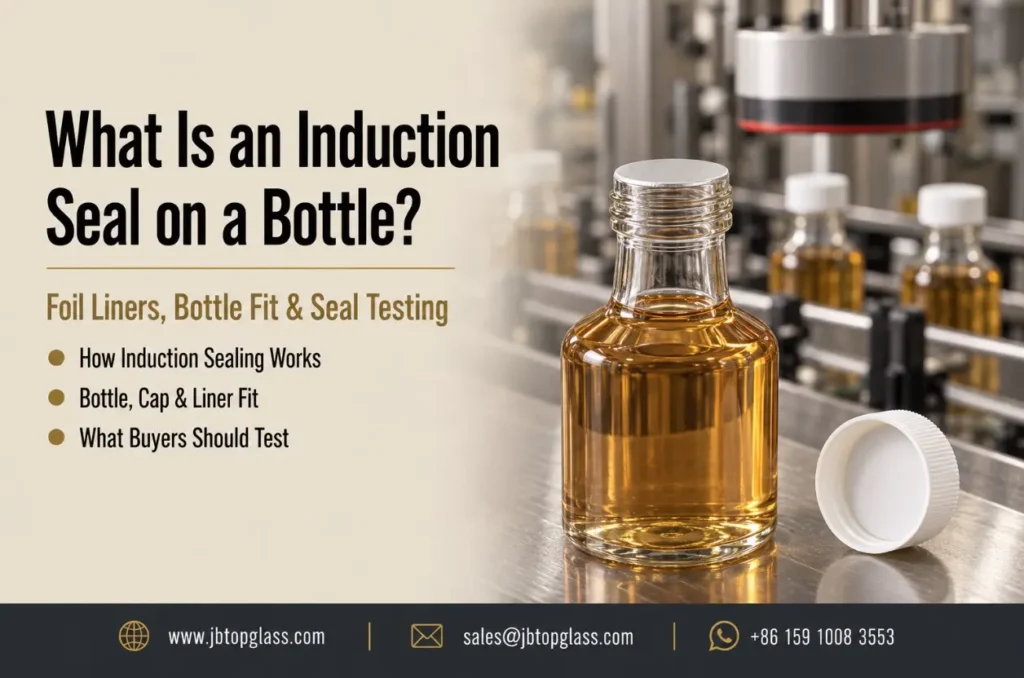
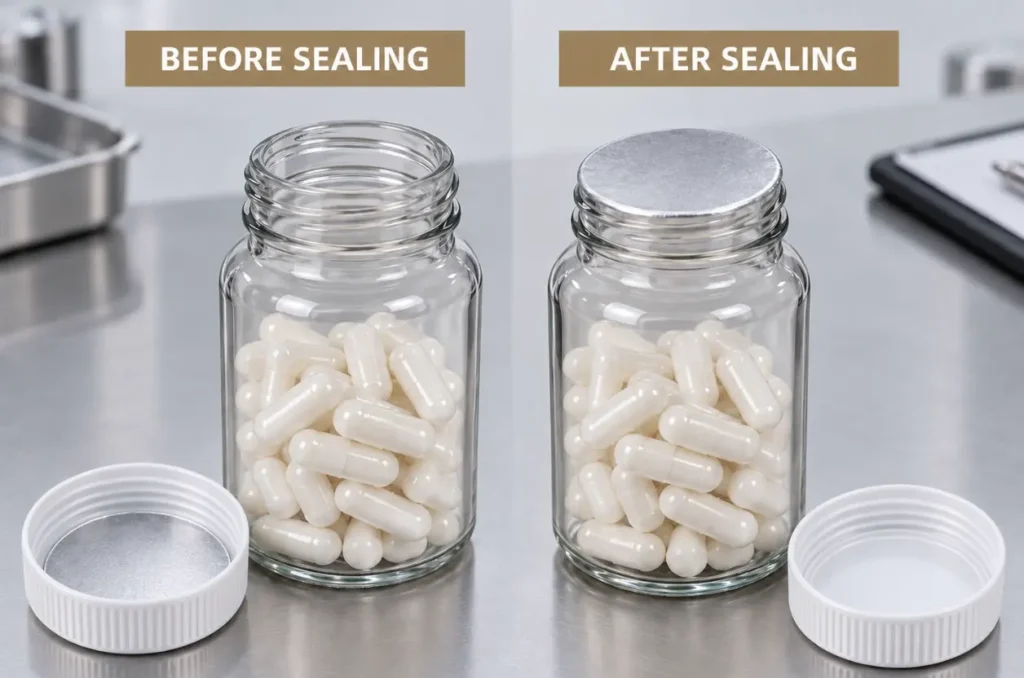
Induction seal on a bottle is a thin foil liner bonded to the bottle opening. The seal sits under the cap. A customer must peel or break the foil before using the product.
The seal helps prevent leaks and protects the product during storage. It also shows whether someone has opened the package.
Glass bottles and jars can use induction seals. However, the liner must be made for glass. The cap, bottle rim, product and sealing machine must also work together.
How Does an Induction Seal Work?
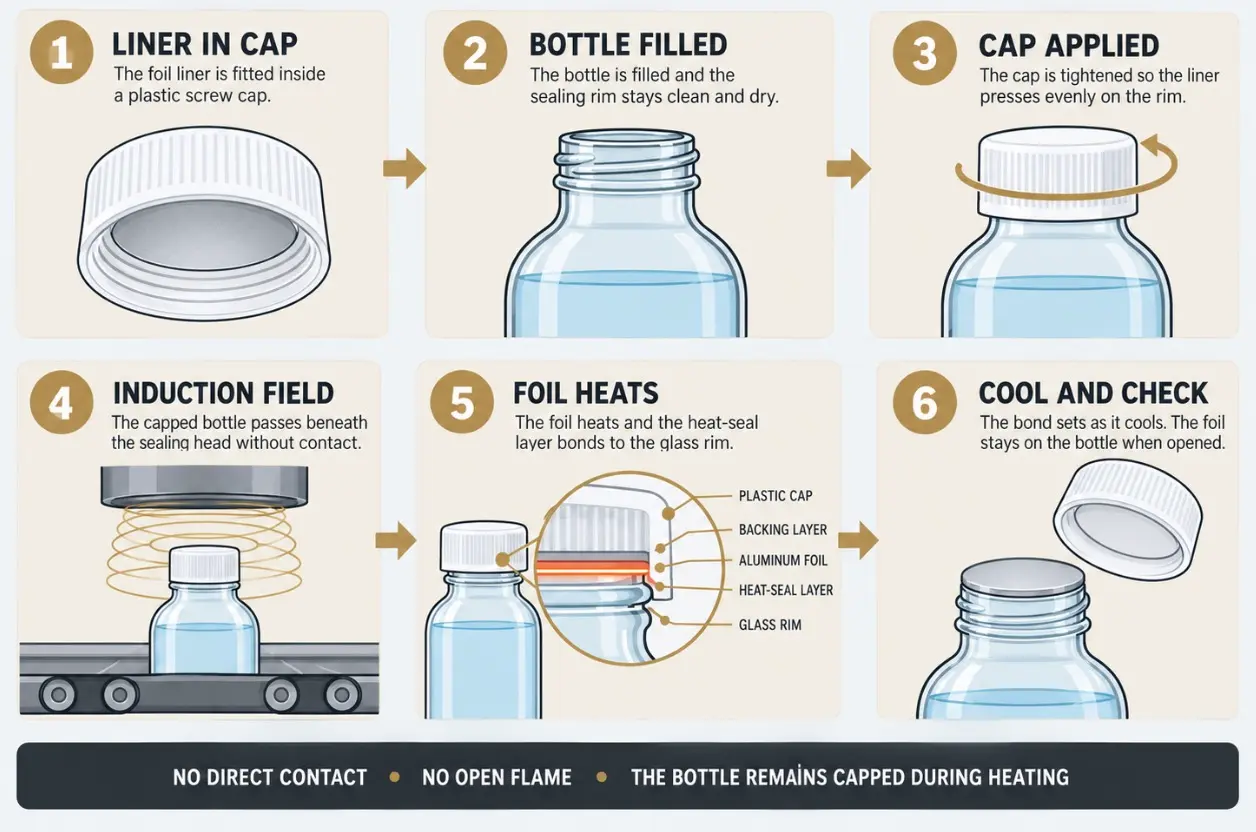
The induction sealing process starts after filling and capping.
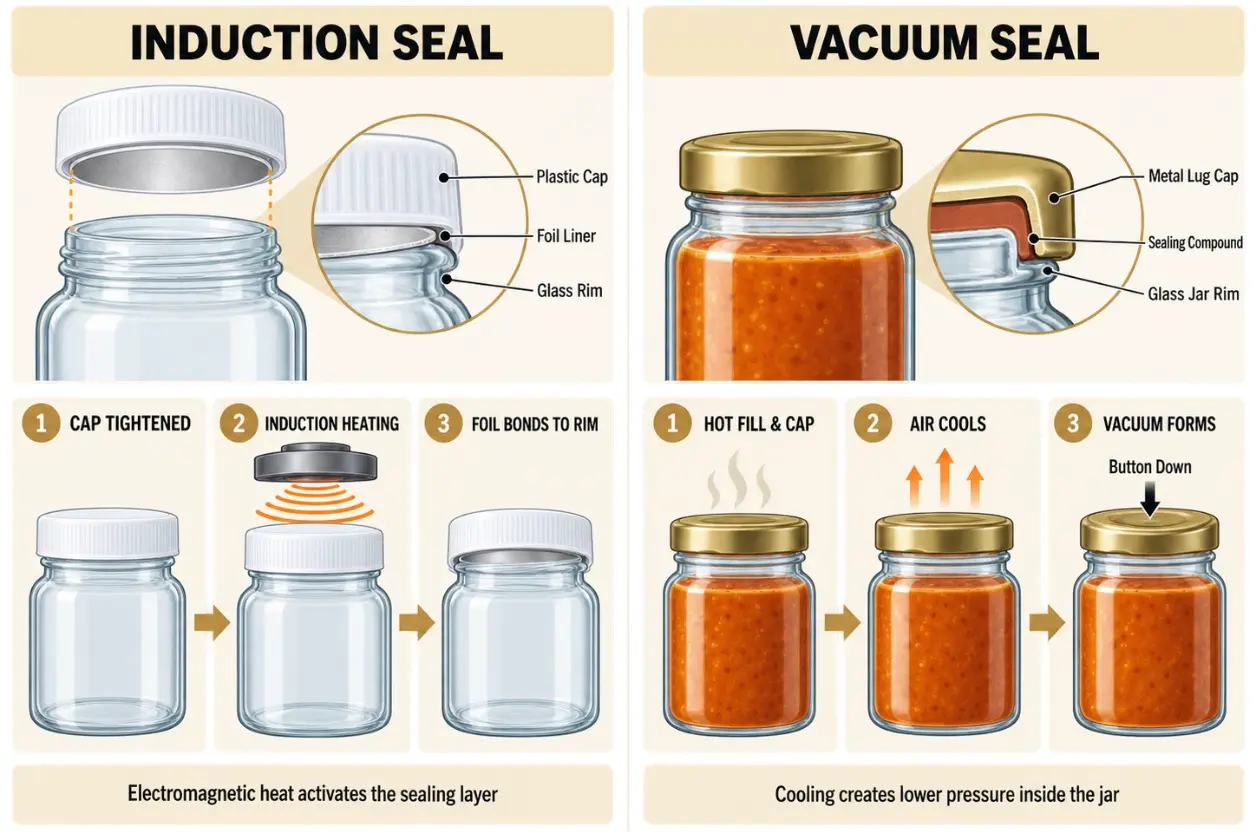
The cap holds a liner that contains aluminum foil. The closed bottle moves under an induction sealing head. The machine then creates an electromagnetic field around the foil.
The foil heats up within a short time. This heat melts the sealing layer on the underside of the liner. The cap keeps the liner pressed against the bottle rim while the bond forms.
The liner stays attached to the bottle after it cools. The machine does not touch the bottle during this process.
This induction sealing guide from Enercon explains how an electromagnetic field heats the foil and bonds it to the container.
The exact liner structure varies. Some liners also contain paperboard, foam or wax. A one-piece liner stays attached to the bottle as one unit. A two-piece liner separates during sealing. The foil bonds to the bottle, while the backing layer remains inside the cap.
Can Induction Seals Be Used on Glass Bottles and Jars?
Glass bottles and jars can use induction seals, but they need the correct liner.
The sealing layer must bond to the glass surface. A liner made for PE, PP or PET may fit inside the cap, but it may not bond to glass.
The product also affects the liner choice. Oil, alcohol, acids, sauces and dry powders affect sealing materials in different ways. A liner that works with a dry product may fail when it comes into contact with oil.
The glass rim must provide a flat sealing surface. A chip, rough edge or uneven rim can leave a small gap under the foil. Product left around the opening can cause the same problem.
The cap must hold the liner evenly against the glass. A loose cap may not provide enough pressure. A tilted cap may leave one side of the liner unsealed.
Most standard induction systems use plastic screw caps. Metal closures react differently to the electromagnetic field. A metal lug cap may need another sealing method or special equipment.
Jingbo Group can help buyers check the bottle finish and closure before sample testing. Our glass bottle closures and caps page explains why the cap and bottle should be selected as one package.
Does an Induction Seal Make a Bottle Airtight?
A properly matched induction seal can create a strong barrier across the bottle opening. However, the finished package still needs a leak test.
A seal may look complete but still have a weak area. The liner may not match the glass. The bottle rim may be uneven. The cap may not provide enough pressure. Product residue may also remain between the foil and the glass.
Tests with filled bottles provide more useful results than tests with empty containers. The product may affect the liner during storage. Heat, cold and transportation may also weaken a poor bond.
An induction seal supports the main closure. It does not fix the wrong cap or a damaged bottle finish. Our guide to bottle cap leaks explains how the neck finish, liner and capping process affect the complete package.
What Is the Difference Between an Induction Seal and a Vacuum Seal?
An induction seal and a vacuum seal use different methods.
An induction seal bonds a foil liner directly to the bottle or jar opening. The foil gives the package an inner barrier. The customer peels it away before using the product.
A vacuum seal is common on glass food jars with metal lug caps. A hot-filled product cools after the cap has been applied. The pressure inside the jar drops and pulls the cap firmly against the glass finish.
The button on a vacuum lug cap helps customers check the seal. The button normally stays down while the vacuum remains intact.
The filling process should determine which system the package needs. An extra sealing layer does not always produce a better result.
Why Does an Induction Seal Fail?
A failed seal normally points to a problem with the liner, glass rim, cap or machine setting.
| What You See | What You Should Check |
|---|---|
| The foil lifts away from the glass | The liner may not be designed for glass |
| Only part of the rim is sealed | The rim may be uneven, dirty or poorly aligned |
| The foil looks burned | The machine may use too much power or heat |
| The seal fails at higher line speeds | The sealing time or head position may be incorrect |
| The package leaks after storage | The product may not be compatible with the liner |
The production team should compare a good sample with a failed sample. The team should then change one setting at a time.
A higher power setting does not always create a better seal. Too much heat may damage the foil or cap without fixing the real problem.
Does Every Glass Bottle Need an Induction Seal?
An induction seal is not necessary for every glass bottle.
Beer bottles commonly use crown caps. Wine bottles use corks or screw caps. Spirits bottles may use bar-top stoppers or ROPP caps. Many hot-filled food jars use vacuum lug caps.
An induction seal makes sense when the product needs an inner barrier, extra leak protection or clear evidence of opening.
The FDA describes container-mouth inner seals as barriers that must be broken before a customer can access the product. Its tamper-resistant packaging guidance applies to certain over-the-counter drugs. Food and beverage brands still need to check the rules for their products and target markets.
Conclusion
An induction seal on a bottle is a foil liner bonded to the container opening. Glass bottles and jars can use this seal when the liner, cap and sealing process match.
Jingbo Group supplies glass bottles, jars and matching closures for food and beverage packaging. Please share your product type, capacity, cap, and filling conditions, and our team will help you prepare a suitable package for testing.