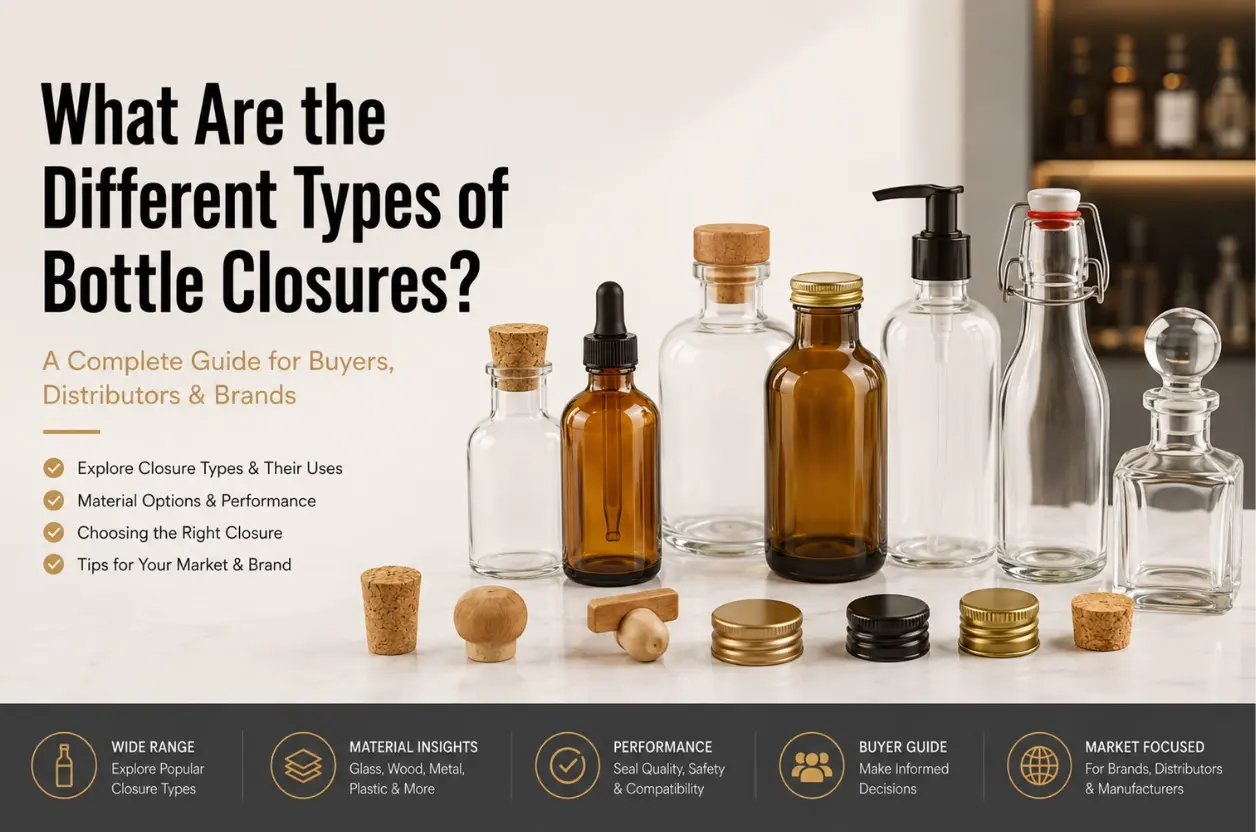
Los principales tipos de cierres para botellas son: tapones de corcho, tapones tipo «bar-top» o «T-top», tapones de rosca, tapones ROPP, cierres no rellenables, tapones corona, tapones de lengüeta, cierres «swing-top», cierres de engarce, bombas, pulverizadores, cuentagotas, tapones y tapones de cristal. La elección correcta depende del cuello de la botella, el producto, la línea de llenado, el mercado objetivo, los requisitos de sellado y el posicionamiento de la marca.
A cierre No es simplemente la pieza decorativa que se coloca en la parte superior de una botella. Es el componente que cierra o sella el envase y ayuda a controlar las fugas, la contaminación, la apertura, el dosificado y el resellado. La parte de la botella que recibe el cierre se denomina «acabado».
Para los compradores mayoristas, la pregunta principal no es “¿Qué tapón queda mejor?”. La pregunta más acertada es “¿Qué tapón se adapta a la botella, sella el producto, funciona en la línea de llenado, cumple los requisitos del mercado objetivo y refuerza el argumento de venta de la marca?”.”
Un tapón de madera de alta calidad puede resultar adecuado para el whisky, el tequila o el brandy. Un tapón de rosca puede ser más adecuado para una línea de vodka o ginebra de gran volumen. Puede ser necesario un cierre no rellenable cuando el comprador desee una mayor protección contra la manipulación o una función antirrelleno. Las bombas y los pulverizadores son más adecuados para perfumes, cosméticos y una dosificación controlada.
La botella y el tapón deben seleccionarse como un único sistema. Los compradores no deben aprobar primero la botella e intentar encontrar un tapón adecuado una vez que haya comenzado la producción.
Comparación rápida de los tipos de tapones para botellas
La tabla que figura a continuación ofrece a los compradores una primera comparación práctica.
| Tipo de cierre | Aplicaciones habituales | Principal ventaja para el comprador | Punto principal que hay que confirmar |
|---|---|---|---|
| Tapón de corcho natural | Vino, bebidas espirituosas, productos de alta gama | Aspecto tradicional y junta compresible | Dimensiones del corcho, variaciones, diámetro interior de la botella |
| Tapón sintético | Licores, vino, aceites | Material y aspecto más uniformes | Compatibilidad del producto y fuerza de extracción |
| Tope para barra o T-top | Whisky, tequila, ron, brandy | Una experiencia de apertura de primera clase | Ajuste entre el diámetro interior y el vástago del tapón |
| Tapón de rosca de rosca continua | Bebidas alcohólicas, bebidas, alimentos, cosméticos | Fácil aplicación y cierre hermético | Acabado de la rosca, revestimiento, par de apriete |
| Tapón ROPP | Licores, vino, aceites, productos de gran volumen | Indicador de manipulación y aplicación automatizada | Equipos para el acabado y el taponado correctos del cuello |
| Cierre no recargable | Exportación de bebidas espirituosas y marcas centradas en la seguridad | Indicador de manipulación y función antirrelleno | Requisitos del mercado y sistema de montaje |
| Tapón de corona | Cerveza y bebidas gaseosas | Sello de engarzado seguro | Acabado del cuello de la botella y presión de taponado |
| Tapón de rosca o de giro | Salsas, mermeladas, tarros para alimentos | Aplicación rápida y sellado de boca ancha | Acabado de las orejetas, revestimiento, proceso de llenado |
| Cierre abatible | Cerveza, bebidas, envases de regalo | Reutilizables y originales | Conjunto de alambre, junta, boca de la botella |
| Cierre de engarce | Perfumes y fragancias | Limpieza de la conexión permanente de la bomba | Diámetro de engaste y compatibilidad con la bomba |
| Bomba o pulverizador | Perfumes, cosméticos, cuidado personal | Dosificación controlada | Tubo de inmersión, salida, acabado del cuello |
| Cuentagotas, tapón o reductor de orificio | Aceites esenciales, medicamentos, líquidos sujetos a control | Caudal controlado o dosificación | Dimensiones de la abertura interior y del inserto |
| Tapón de cristal | Decantadores y regalos de lujo | Aspecto lujoso | Sello secundario y protección durante el transporte |
La lista es amplia porque los cierres para botellas se utilizan en diferentes sectores. En el caso de los proyectos relacionados con botellas de licor, los compradores suelen comparar en primer lugar los tapones de barra, los corchos, los tapones de rosca, los tapones ROPP, los tapones decorativos y los cierres no rellenables.
Tapones de corcho
Los tapones de corcho se introducen en la boca de la botella, en lugar de enroscarse en el exterior del cuello. Corcho natural Es elástico, ligero y resistente a la penetración de líquidos, por lo que cuenta con una larga trayectoria como material para tapones de botellas.
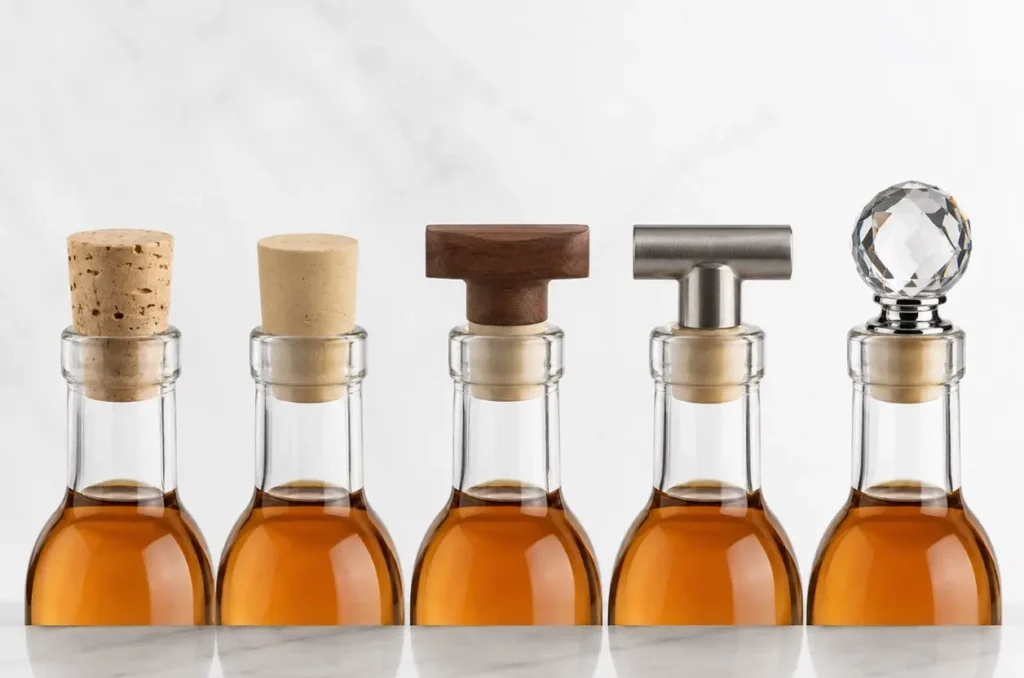
En lo que respecta al envase de bebidas espirituosas, los compradores deben distinguir entre dos tipos de tapones: el tapón de corcho completo y el tapón tipo «T-top». El tapón de corcho completo se asocia habitualmente con el vino. El tapón tipo «T-top» o «bar-top» tiene una parte superior visible fabricada en madera, metal, plástico u otro material decorativo, con un vástago de corcho o sintético insertado en el cuello de la botella.
Un tapón tipo corcho puede aportar una experiencia tradicional y de alta gama. El cliente lo retira tirando de él en lugar de desenroscarlo, lo que puede contribuir al posicionamiento de productos como el whisky, el ron, el brandy, el tequila, los licores y las bebidas espirituosas artesanales.
Sin embargo, los compradores no deben elegir un corcho solo porque tenga un aspecto de alta calidad. El diámetro interior del cuello de la botella y el vástago del tapón deben coincidir. Un tapón demasiado holgado puede provocar fugas o desplazarse durante el transporte. Un tapón demasiado ajustado puede resultar difícil de insertar o retirar.
El corcho natural también presenta una mayor variabilidad en cuanto al material que un tapón sintético totalmente moldeado. Los equipos de compras deben verificar las dimensiones del tapón, su compresión, el tratamiento de la superficie, la fuerza necesaria para extraerlo y su compatibilidad con el producto.
Tapas para bar-top y T-top
Los tapones «bar-top» y «T-top» se encuentran entre los cierres de alta gama más habituales para las botellas de licor. La parte superior puede ser de madera, metal, imitación de cristal, cerámica o plástico moldeado. La parte inferior suele ser de corcho natural, corcho microaglomerado o un material de sellado sintético.
La tapa visible contribuye a que el cierre forme parte del diseño de la marca. Una tapa de madera puede aportar un toque artesanal o tradicional. Una tapa metálica puede dar un aspecto más moderno. Una tapa grande y decorativa puede ser ideal para una botella de regalo o de edición limitada.
Para los compradores, la principal ventaja es la flexibilidad. El mismo cuello básico de la botella puede admitir varios diseños de tapón visibles una vez confirmada la compatibilidad técnica. Esto permite a las marcas y a los distribuidores crear opciones estándar, de gama alta y de regalo sin tener que modificar la forma completa de la botella.
El ajuste técnico sigue siendo más importante que la apariencia. Los compradores deben comprobar el diámetro interior de la botella, el diámetro del vástago del tapón, la profundidad de inserción, el material del sello, la fuerza necesaria para extraerlo y si se utilizará una banda de seguridad, una cápsula o un componente secundario.
Tapones de rosca
A tapón de rosca Se acopla al cuello roscado de una botella. Los tapones de rosca pueden colocarse a mano o mediante equipos automatizados, y su eficacia de sellado depende de que la rosca encaje correctamente, del revestimiento y del par de apriete aplicado.
Los tapones de rosca suelen considerarse una opción económica, pero eso es simplificar demasiado las cosas. Un tapón metálico bien diseñado puede transmitir una imagen de alta calidad si se eligen adecuadamente el color, el relieve, la impresión, el moleteado, el revestimiento interior y las proporciones del cuello.
En el caso del vodka, la ginebra, las bebidas espirituosas más habituales, los licores, los aceites alimentarios, las bebidas y otros productos de gran volumen, los tapones de rosca pueden ofrecer ventajas prácticas. Son fáciles de volver a cerrar, resultan familiares a los consumidores y son adecuados para operaciones de llenado eficientes.
El comprador no debe elegir un tapón de rosca basándose únicamente en el diámetro aproximado del cuello. Dos tapones pueden tener un diámetro similar, pero perfiles de rosca, alturas o superficies de sellado diferentes. Es necesario confirmar el código completo del tapón.
El revestimiento también forma parte del sistema de cierre. Es posible que cada producto requiera materiales de revestimiento o estructuras de sellado diferentes. El alcohol, el aceite, las salsas, los perfumes y el agua no crean las mismas condiciones de envasado.
Tapones ROPP
ROPP son las siglas de «roll-on pilfer-proof» (tapón a presión a prueba de robos). El tapón se coloca normalmente sobre el cuello de un frasco ya preparado y se moldea alrededor de la rosca y de la estructura a prueba de manipulaciones durante el proceso de taponado.
Los cierres ROPP son habituales cuando el comprador busca una aplicación automatizada, un indicador visible de manipulación y un aspecto de tapón metálico. Suelen utilizarse para bebidas espirituosas, vino, aceites y otros productos líquidos.
Una ventaja importante es que el tapón se puede decorar antes de su colocación. Las marcas pueden elegir entre impresión, relieve, color y acabado superficial. Esto permite que un tapón ROPP sirva tanto para la producción práctica como para la presentación de la marca.
La principal limitación es la compatibilidad de los equipos. La planta de embotellado debe disponer de los equipos de taponado y las herramientas adecuadas para el tipo de boca de botella y las dimensiones del tapón seleccionados. Aunque una botella y un tapón ROPP puedan ser compatibles sobre el papel, es necesario realizar pruebas en línea antes de la producción en serie.
Los equipos de compras deberían preguntar si el proveedor está presupuestando la botella, el tapón, el revestimiento interior, la banda de seguridad y los requisitos de taponado como un sistema completo.
Tapones no recargables
Un cierre no rellenable está diseñado para dificultar el rellenado no autorizado una vez abierta la botella. Estos sistemas se utilizan a menudo para bebidas espirituosas destinadas a la exportación, proyectos contra la falsificación y mercados en los que se valora una mayor seguridad del producto.
El cierre puede constar de varias piezas: una tapa exterior, una válvula interna, un inserto, un vertedor, una banda de seguridad y una interfaz con el cuello de la botella. Esto hace que el sistema sea más complejo que un simple corcho o un tapón de rosca.
Para los compradores, la ventaja radica en la seguridad del producto y en el vertido controlado. Para los distribuidores, los tapones no recargables pueden presentarse como una opción de mayor valor para aquellas marcas preocupadas por la autenticidad, el control del mercado o una presentación premium en el punto de venta.
El comprador debe confirmar si el mercado de destino exige un sistema específico de precinto de seguridad. En el caso de las bebidas espirituosas destiladas que se comercializan en Estados Unidos, las directrices de la TTB exigen que las botellas u otros envases lleven un precinto fijado de forma segura cierre a prueba de manipulaciones o un dispositivo similar.
Esto no significa que todas las botellas deban utilizar el mismo tipo de cierre. Un sistema de seguridad contra la manipulación puede integrarse en una tapa, una banda frangible, una cápsula, una tira u otra estructura adecuada. Los compradores deben confirmar los requisitos vigentes en el país donde se vaya a comercializar el producto.
Tapones de corona
A tapón de corona, también conocida como «tapón corona», es un cierre metálico poco profundo que se engarza alrededor del cuello de una botella del mismo tipo. Se asocia estrechamente con la cerveza y las bebidas carbonatadas, y fue el primer diseño de tapón de botella que tuvo éxito comercial.
Los tapones corona son adecuados cuando el envase necesita un cierre hermético y resistente y la línea de llenado ya está preparada para la aplicación de tapones corona. Son menos habituales en las botellas estándar de whisky o tequila, ya que ofrecen una experiencia de apertura diferente y requieren un cuello adaptado para este tipo de tapón.
En el caso de las bebidas espirituosas artesanales, las botellas en formato miniatura, los productos listos para consumir y las bebidas especiales, el tapón de corona puede seguir siendo una opción válida. El comprador debe valorar esta opción en función del producto y del canal de distribución, y no basándose únicamente en la categoría tradicional.
Un tapón de corona también requiere un equipo de taponado compatible. No debe considerarse intercambiable con un tapón de rosca ni con un tapón decorativo a presión.
Tapones de tirador y tapones de rosca
Las tapas de lengüetas se utilizan habitualmente en tarros de comida, botellas de salsa, productos en conserva y envases de cristal de boca ancha. En lugar de una rosca continua, cuentan con varias lengüetas cortas que encajan en el borde del tarro.
Resultan útiles cuando el envase requiere una aplicación rápida y una amplia superficie de sellado. El revestimiento, las condiciones de vacío, la temperatura de llenado y el tipo de producto influyen en el sellado final.
Este tapón no es una opción habitual para las botellas de whisky o tequila, pero resulta importante para los distribuidores que comercializan tanto envases para bebidas alcohólicas como envases para alimentos. Un proveedor puede ofrecer muchos productos de vidrio, pero cada tipo de tapón requiere su propio acabado de botella.
Los compradores no deben elegir una tapa para salientes basándose únicamente en el diámetro de la abertura. El número y la posición de los salientes, la altura del acabado, la superficie de sellado y el revestimiento deben coincidir.
Tapas abatibles
A cierre abatible o de tapa abatible utiliza un tapón sujeto mediante un sistema de alambre. Normalmente se puede abrir y volver a cerrar sin necesidad de un abrebotellas.
Este formato es habitual en cervezas, agua, bebidas especiales, siropes y envases de regalo. Ofrece una experiencia distintiva y reutilizable, y puede adaptarse tanto a un posicionamiento artesanal como tradicional.
Las desventajas son el mayor número de componentes y la complejidad del montaje. La estructura de alambre, el tapón, la junta y el cuello de la botella deben funcionar en conjunto. Además, el embalaje debe proteger el cierre contra deformaciones o golpes.
En el caso de los proyectos al por mayor, el comprador debe confirmar si el tapón viene ya montado en la botella o si se suministra por separado. Este detalle influye en la mano de obra de la línea de llenado, el embalaje y el coste final.
Bombas, pulverizadores, cuentagotas y tapones dosificadores
No todos los tapones de botella están diseñados únicamente para sellar. Muchos tapones también controlan la forma en que se dispensa el producto.
Los frascos de perfume pueden incorporar dosificadores de presión o dosificadores de rosca. Los frascos de cosméticos pueden incorporar dosificadores de loción, pulverizadores o dosificadores para tratamientos. Los frascos de aceites esenciales pueden incorporar cuentagotas, tapones o reductores de orificio. Los frascos de salsas y aceites pueden incorporar vertedores o insertos de control de caudal.
Estos proyectos requieren más información que solo el diámetro del cuello. Es posible que el comprador tenga que confirmar la abertura interior, la longitud del tubo de inmersión, el volumen de salida, el patrón de pulverización, la altura de la bomba, las dimensiones de la tapa y la viscosidad del producto.
En el caso de los frascos de perfumes y cosméticos, el tapón suele ser el único componente exterior visible. El sistema completo puede incluir el cuello del frasco, la bomba, la junta, el collarín, el componente de engaste, el actuador, el tubo de inmersión y el tapón decorativo.
Por eso los distribuidores deberían vender las bombas y los pulverizadores como sistemas integrados, en lugar de como accesorios independientes.
Tapones de cristal
Los tapones de cristal se utilizan a menudo en decantadores, botellas de regalo y envases de bebidas espirituosas de lujo. Aportan un efecto visual de alta gama y pueden combinar con los motivos decorativos de cristal del cuerpo de la botella.
Sin embargo, el tapón de cristal visible no siempre es el único componente de sellado. Puede ser necesario utilizar una junta secundaria, un manguito de plástico, un inserto de corcho u otro tipo de sellado para evitar fugas.
Los tapones de cristal también deben embalarse con cuidado. Su peso y su superficie dura pueden aumentar el riesgo de que se produzcan daños por impacto si el tapón se embala sin fijarlo bien junto a la botella.
En el caso de las ediciones limitadas y los proyectos de regalo, el valor visual puede justificar la complejidad añadida. Para los pedidos minoristas de gran volumen, los compradores deben comparar el coste, el sistema de sellado, el riesgo de sustitución y el método de embalaje antes de elegir esta opción.
Por qué no todos los tapones sirven para todas las botellas
Un cierre puede parecer correcto y, aun así, fallar.
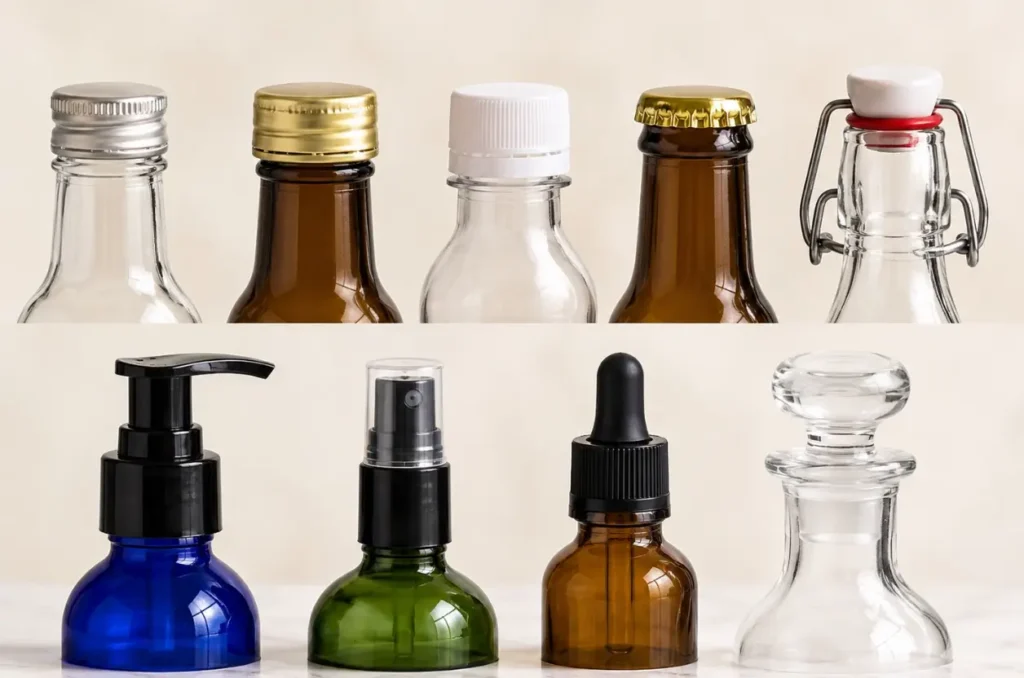
El acabado de la botella determina la superficie de fijación y sellado. Un tapón de rosca requiere una rosca exterior adecuada. Un tapón tipo «T-top» requiere un diámetro interior del cuello adecuado. Una tapa corona requiere un reborde y un acabado de engarzado adecuados. Una bomba puede requerir tanto una rosca específica como una longitud adecuada del tubo de inmersión.
Por lo tanto, los compradores deben confirmar todas las especificaciones del cuello antes de aprobar los cierres. La guía de Jingbo Group sobre diámetro del cuello de la botella explica por qué es necesario comprobar conjuntamente el acabado exterior, la abertura interior, el tipo de rosca y la estructura de cierre.
Una fotografía de referencia resulta útil para el estilo, pero no permite confirmar la compatibilidad. El proveedor debería revisar los planos técnicos o las muestras físicas.
En el caso de proyectos importantes, los compradores deben aprobar conjuntamente la botella y el tapón. De este modo se reduce el riesgo de recibir botellas que, aunque sean correctas por sí mismas, no puedan sellarse con el tapón seleccionado.
¿Cómo deben elegir los compradores los tapones para botellas?
Los compradores deberían dar prioridad a la funcionalidad antes que a la apariencia.
El producto determina las condiciones necesarias de barrera, dosificación y sellado. La planta de envasado determina qué tipo de cierre se puede aplicar de forma sistemática. El mercado objetivo determina si se requieren características de seguridad contra la manipulación u otras características reglamentarias. La marca determina el material visible, el color, la decoración y la experiencia de apertura.
| Pregunta del comprador | Por qué es importante |
|---|---|
| ¿Qué producto se va a envasar? | Afecta al revestimiento, la estanqueidad, la dosificación y la compatibilidad |
| ¿Qué tipo de boca de botella se utiliza? | Determina la familia de cierres |
| ¿Cómo se envasará el producto? | Determina el equipo de taponado o de inserción |
| ¿Hay que volver a cerrar la botella? | Ayuda a comparar tapones, tapones de rosca y sistemas de un solo uso |
| ¿Es obligatorio que el envase sea a prueba de manipulaciones? | Afecta a las bandas, los tapones ROPP, las cápsulas o los sistemas no recargables |
| ¿A qué nivel de marca se dirige? | Afecta a los materiales visibles y a la decoración |
| ¿Se exportará la botella? | Afecta al cumplimiento normativo y al embalaje |
| ¿Se trata de un proyecto de gran volumen? | Afecta a la automatización y a la coherencia de los cierres |
| ¿Se enviará el cierre por separado? | Afecta a la planificación de las líneas de montaje y de envasado |
| ¿Se ha probado el paquete completo? | Confirms real performance |
The visible style should be chosen after the technical family is confirmed. A buyer can choose a wooden, black, gold, silver, or custom-printed top, but the sealing dimensions cannot be chosen only by appearance.
What Procurement Teams Should Test
The closure should be tested under real project conditions. A dry fit in an office is not enough for a commercial order.
The procurement team should confirm application, sealing, opening, transport, and repeated use. For stopper projects, this may include insertion and removal force. For screw caps, it may include application torque and removal torque. For pumps, it may include priming, output, and leakage.
| Test Area | What the Team Should Check |
|---|---|
| Initial fit | Closure matches the approved bottle sample |
| Leakage | Package remains sealed in expected positions |
| Temperature change | Seal remains stable during storage and transport |
| Opening force | Customer can open the package as intended |
| Resellado | Reclosable systems still perform after opening |
| Filling-line application | Equipment applies the closure consistently |
| Tamper evidence | The feature breaks or changes as intended |
| Product compatibility | Liner, gasket, and closure material remain suitable |
| Transport simulation | Closure remains secure after vibration and handling |
| Decoration quality | Color, logo, and surface remain consistent |
The exact test plan depends on the product. A perfume pump, whiskey stopper, beer crown, and sauce-bottle lug cap should not use the same approval process.
How Distributors Can Sell Bottle Closures
Distributors should not present closures as an unorganized box of caps and corks. Customers buy more confidently when closures are grouped by use and price level.
A useful spirits-closure range can be divided into three levels.
| Distributor Level | Closure Direction | Suitable Customer |
|---|---|---|
| Standard | Screw cap or simple synthetic stopper | New brands and cost-sensitive products |
| Premium | Wooden T-top, metal-top stopper, decorated cap | Whiskey, tequila, rum, and brandy brands |
| Security | ROPP or non-refillable closure | Export and anti-refill projects |
For perfume and cosmetics, a distributor can create separate pump, sprayer, collar, and cap combinations. For food packaging, the range can focus on lug caps, screw caps, pourers, and inner plugs.
Sample sets are useful. A distributor can show the same bottle with several compatible closures. This helps the customer understand how the closure changes the package without changing the bottle mold.
The closure can also be coordinated with decoration. Gold printing, black coating, frosting, or a premium label may need a matching cap color and material. Buyers can review decoración de botellas de cristal when planning the complete visual system.
How Jingbo Group Recommends Bottle Closures
Jingbo Group begins with the bottle neck, product, target market, filling method, and brand level. The technical match is confirmed first. The buyer then selects the visible color, material, logo, and style.
For new spirits brands, Jingbo Group may recommend an existing bottle and its proven closure options. This reduces development time and avoids creating a new neck finish before the product plan is stable.
For premium whiskey, tequila, rum, or brandy, Jingbo may compare wooden T-tops, synthetic stoppers, metal-top closures, decorative caps, and tamper-evident secondary components.
For high-volume vodka, gin, liqueur, or oil projects, screw caps or ROPP systems may be more practical when the filling line supports them. For export or anti-refill projects, Jingbo can review non-refillable or stronger tamper-evident systems.
| Situación del comprador | Jingbo Group Usually Recommends |
|---|---|
| Fast spirits launch | Existing bottle with proven closure options |
| Premium whiskey or tequila | Wooden or decorative T-top stopper |
| High-volume vodka or gin | Screw cap or ROPP system |
| Export security project | Tamper-evident or non-refillable closure |
| Gift or limited edition | Decorative metal or glass-style stopper |
| Gama de muestras para distribuidores | Several compatible closures for one bottle |
| Perfume or cosmetic project | Matched pump, collar, and cap system |
| Food or oil project | Suitable screw cap, lug cap, plug, or pourer |
Jingbo Group’s liquor bottle range supports cork, bar-top, screw-cap, T-cork, and related closure directions, subject to the confirmed bottle-neck standard.
Buyers can review the available glass liquor bottles before requesting closure recommendations. Existing bottle and closure combinations are often the most efficient starting point for wholesale orders.
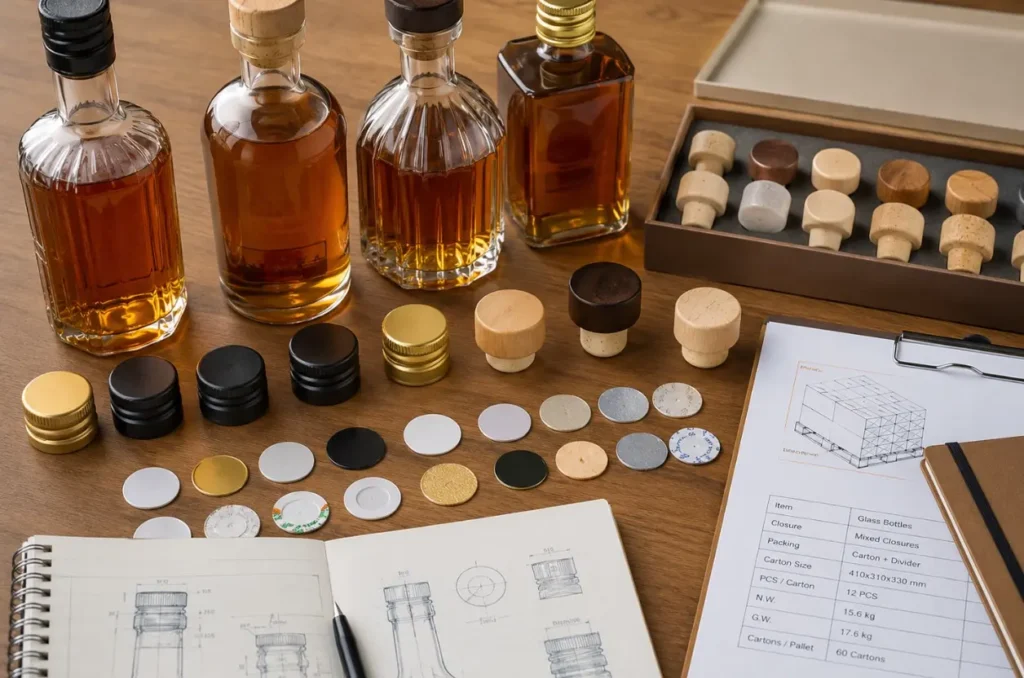
What Should Buyers Send Before Requesting a Closure Recommendation?
A useful inquiry should identify the complete packaging requirement. “I need a cap for this bottle” is usually not enough.
The buyer should provide the bottle sample or drawing, product type, order quantity, filling method, target market, preferred closure style, tamper-evident requirement, and delivery schedule.
Una pregunta clara podría ser:
“We need a closure for a 750 ml whiskey bottle with a cork-finish neck. We prefer a wooden T-top, black and gold branding, and tamper-evident protection for export. Please confirm the suitable stopper dimensions and available styles.”
This information allows Jingbo Group to check technical fit before discussing appearance. It also reduces repeated sampling and prevents the buyer from selecting a decorative closure that cannot work with the bottle.
FAQ About Bottle Closures
What are the main types of bottle closures?
The main bottle closure types include cork stoppers, synthetic stoppers, T-top or bar-top stoppers, screw caps, ROPP caps, non-refillable closures, crown caps, lug caps, swing tops, pumps, sprayers, droppers, plugs, crimp closures, and glass stoppers.
What is the best closure for liquor bottles?
There is no single best closure for every liquor bottle. Bar-top stoppers are common for premium whiskey, tequila, rum, and brandy. Screw caps and ROPP caps are often practical for high-volume spirits. Non-refillable closures can support security-focused export projects.
What is the difference between a cork and a bar-top stopper?
A cork may consist mainly of the inserted sealing material. A bar-top or T-top closure combines an inserted cork or synthetic shank with a visible decorative top made from wood, metal, plastic, or another material.
Can screw caps be used for premium spirits?
Yes. A metal screw cap can support premium packaging when the bottle, cap proportions, decoration, liner, and brand design are coordinated. Screw caps should not automatically be treated as low-end closures.
Why does the same cap not fit every bottle?
Bottle finishes differ in diameter, thread profile, height, sealing surface, inner opening, and attachment structure. A closure must match the complete neck specification, not only the approximate diameter.
What is a tamper-evident closure?
A tamper-evident closure includes a feature that shows visible evidence when the package has been opened or interfered with. The feature may be a breakable band, capsule, strip, cap component, or another structure.
What is a non-refillable liquor closure?
A non-refillable closure includes internal components that make the bottle more difficult to refill after opening. It may also provide controlled pouring and tamper evidence.
Can Jingbo Group provide matching bottle closures?
Yes. Jingbo Group can recommend compatible corks, T-top stoppers, screw caps, ROPP caps, non-refillable closures, pumps, sprayers, or related components based on the bottle neck and product requirements. The buyer can then select the preferred color, material, and visible style.
Conclusión
Bottle closures affect far more than the appearance of a package. They control sealing, opening, resealing, dispensing, tamper evidence, filling-line performance, and customer experience.
Corks and bar-top stoppers are often suitable for premium spirits. Screw caps and ROPP caps can support efficient filling and consistent sealing. Non-refillable closures can add product-security functions. Crown caps, lug caps, swing tops, pumps, sprayers, and droppers serve different beverage, food, perfume, and cosmetic applications.
The best closure is not the most decorative or the least expensive option. It is the closure that matches the bottle neck, product, production line, target market, brand level, and transport conditions.
Buyers should approve the bottle and closure as one package. Distributors should organize closures by application and price level. Grupo Jingbo recommends confirming technical compatibility first, then selecting the color, material, decoration, and style that support the brand.