
La sérigraphie consiste à appliquer l'encre directement sur une bouteille en verre. Le marquage à chaud permet de transférer une fine couche de film métallisé sur la bouteille.
La sérigraphie est généralement plus adaptée aux logos colorés, aux noms de produits, au texte et aux graphismes simples. Le marquage à chaud est quant à lui plus adapté à l'or, à l'argent et aux autres détails réfléchissants. Une bouteille peut également combiner ces deux techniques. La sérigraphie peut servir à faire figurer les informations principales, tandis que le marquage à chaud met en valeur le logo ou un autre élément important du design.
Aucun des deux procédés n'est systématiquement meilleur. Le choix approprié dépend du visuel, de la forme de la bouteille, de la finition de la surface, des exigences en matière de durabilité et du budget.
Qu'est-ce que la sérigraphie sur bouteilles en verre ?
Sérigraphie On l'appelle également « sérigraphie ». Ces deux noms désignent le même procédé de base.
La sérigraphie consiste à appliquer l'encre directement sur une bouteille en verre. L'imprimeur utilise un écran en maille sur lequel est reproduit le motif. Une raclette fait passer l'encre à travers les mailles ouvertes de l'écran pour la déposer sur le verre. L'usine procède ensuite au séchage de l'encre afin qu'elle adhère à la surface de la bouteille.
Chaque couleur nécessite son propre pochoir. Un flacon avec un logo blanc ne nécessite qu’un seul pochoir, tandis qu’un motif comprenant du blanc, du rouge et du noir en nécessite trois. L’usine doit veiller à ce que chaque couleur soit correctement positionnée tout au long de la production. Si les couleurs ne sont pas bien alignées, les bordures fines et les motifs reliés entre eux peuvent paraître flous.
La sérigraphie est particulièrement adaptée aux couleurs unies, aux logos, au texte et aux graphismes simples. Elle est largement utilisée sur les flacons en verre destinés aux parfums, spiritueux, boissons, produits alimentaires et cosmétiques. Les visuels comportant des photographies, des dégradés doux ou de nombreux petits changements de couleur peuvent se prêter davantage à l'impression par décalcomanie ou à l'impression numérique.
Comment Jingbo Group imprime-t-il des motifs multicolores ?
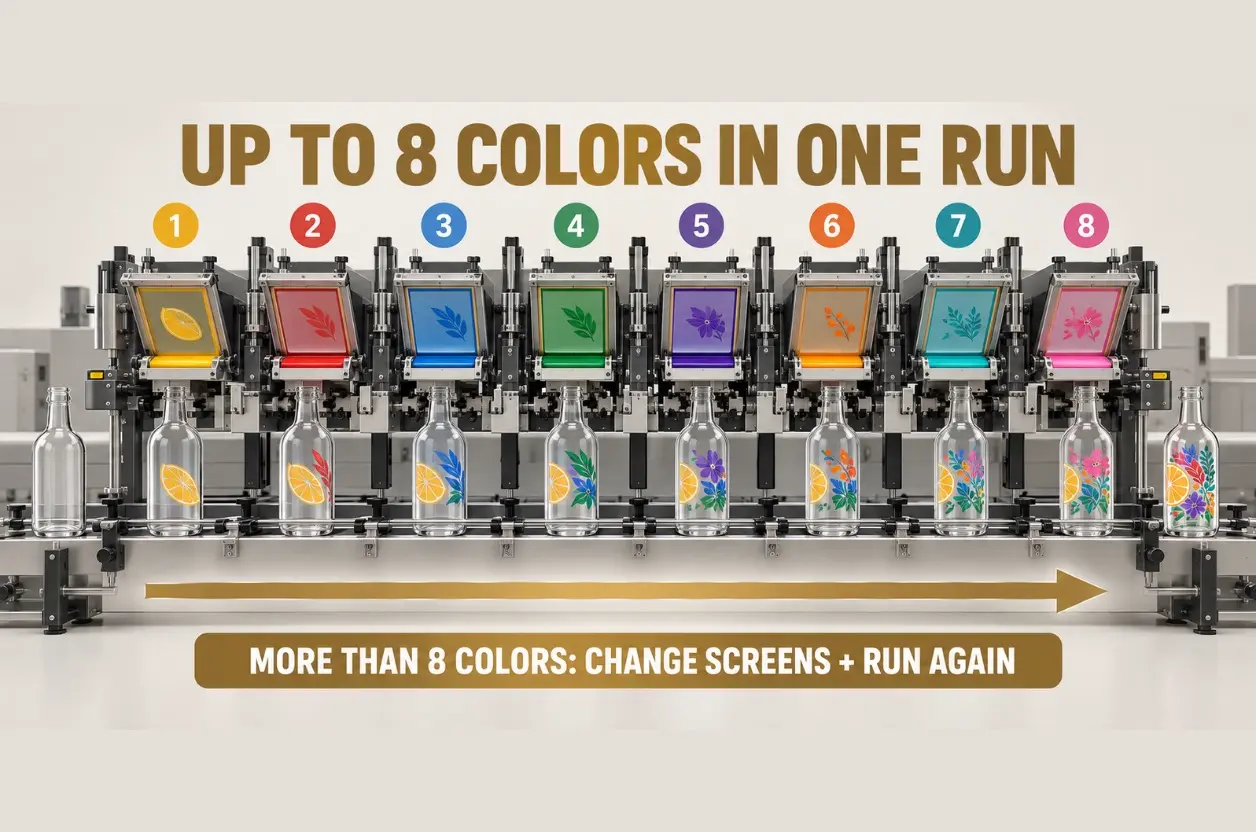
Jingbo Group utilise des machines de sérigraphie à huit couleurs pour la décoration des bouteilles en verre. Chaque couleur dispose de son propre écran et de son propre poste d'impression. La machine peut réaliser des motifs comportant jusqu'à huit couleurs au cours d'un seul cycle de production continu.
Cette configuration permet de réduire les chargements répétés et les réglages de la machine. Elle aide également l'usine à maintenir les couleurs dans une position plus stable. Cet avantage est important lorsque le visuel comporte des lignes contiguës, des bordures ou de petits détails.
Si un motif comporte plus de huit couleurs, l'usine doit changer les pochoirs et faire repasser les bouteilles dans la machine. Ce passage supplémentaire allonge le temps de production et rend l'alignement des couleurs plus difficile.
Jingbo Group examine le visuel avant d'établir un devis et de réaliser un échantillon. Notre équipe peut vérifier si toutes les couleurs sont indispensables ou si le design peut être simplifié sans en altérer l'aspect général.
Encre organique et émail céramique
La sérigraphie sur bouteille en verre peut être réalisée à l'aide d'encre organique ou d'émail céramique. Ces deux matériaux nécessitent des méthodes de durcissement différentes.
L'encre organique sèche généralement à basse température ou sous l'effet des rayons UV. Elle offre une large gamme de couleurs et facilite la reproduction de couleurs personnalisées. Elle peut également être utilisée sur des bouteilles dépoliées ou recouvertes d'un revêtement par pulvérisation, à condition que l'encre soit compatible avec la surface.
L'émail céramique nécessite une cuisson à haute température. Le processus de cuisson permet de lier étroitement le motif décoratif au verre. Cette méthode offre généralement une meilleure résistance à l'humidité, au lavage, aux rayures et au contact avec des produits chimiques.
Cependant, l'émail céramique ne convient pas à tous les types de goulots. Les températures élevées peuvent altérer le revêtement par pulvérisation, la brillance ou toute autre décoration déjà appliquée sur la bouteille. L'usine doit choisir l'encre et la méthode de séchage en fonction de la conception globale de la bouteille.
Qu'est-ce que l'estampage à chaud sur les bouteilles en verre ?
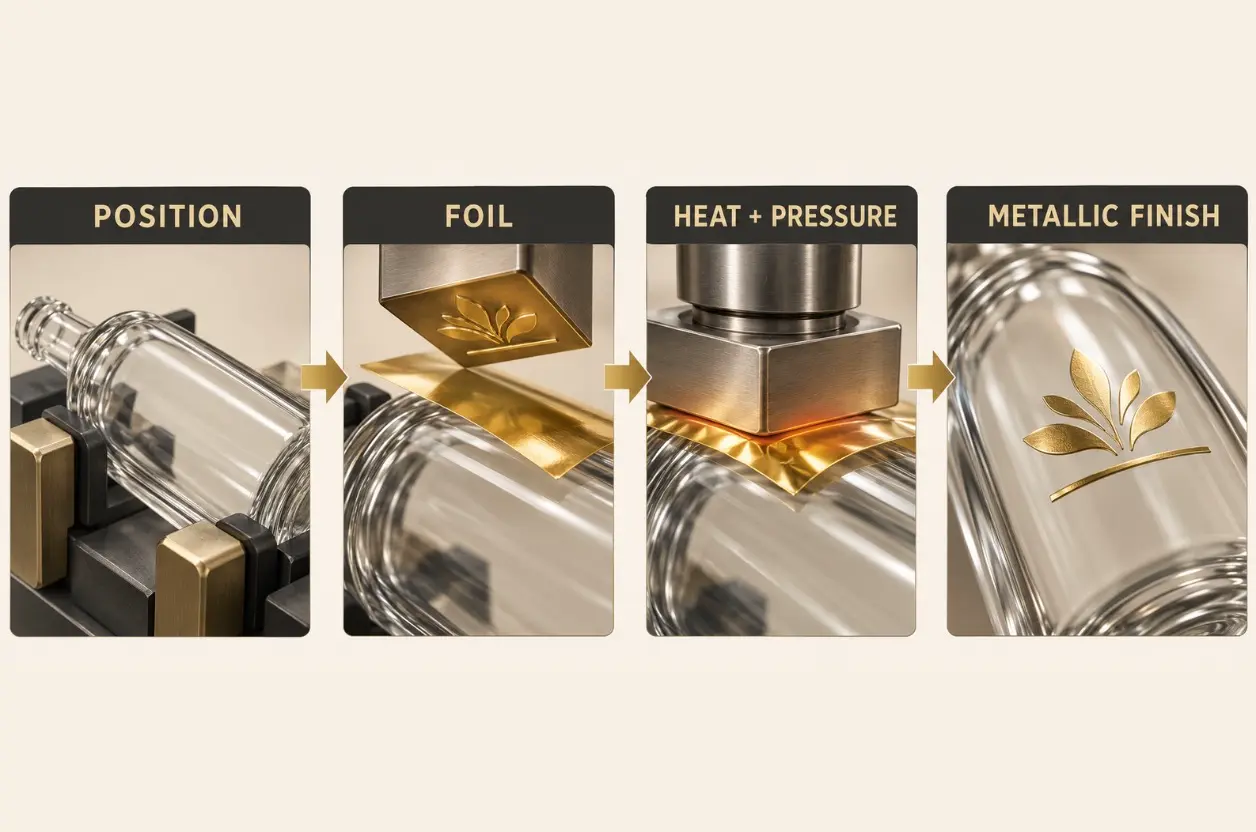
Estampage à chaud transfère une couche décorative depuis une feuille métallique sur la bouteille. Une matrice ou un rouleau presse la feuille contre la zone souhaitée. Sous l'effet de la chaleur et de la pression, la couche décorative se détache de son support et adhère à la surface préparée.
L'or et l'argent sont les finitions les plus courantes. Les fournisseurs peuvent également proposer des films en or rose, en cuivre, métallisés colorés, nacrés et holographiques.
L'estampage à chaud donne généralement un résultat plus brillant et plus réfléchissant que l'encre métallisée utilisée en sérigraphie. Les marques y ont souvent recours pour les logos, les noms de produits, les bordures et les petits détails graphiques.
Un logo estampé à chaud « or » ne contient généralement pas d'or véritable. Ce terme fait généralement référence à la couleur et à l'aspect métallique de la feuille. L'acheteur doit demander un échantillon de la feuille si la nuance exacte de l'or est importante.
L'estampage à chaud ne permet pas toujours un transfert direct sur du verre non traité. Certains systèmes de production utilisent un apprêt compatible, un revêtement ou une couche adhésive appliquée par sérigraphie. Par exemple, un procédé dans lequel un apprêt UV est d'abord appliqué par sérigraphie et où la feuille adhésive n'adhère qu'à cette zone préparée.
D'autres usines peuvent utiliser un système de film ou de transfert différent. L'acheteur doit demander au fournisseur de lui expliquer l'ensemble du processus, plutôt que de supposer que toutes les bouteilles estampées à chaud sont produites de la même manière.
Sérigraphie ou estampage à chaud : principales différences
| Comparaison | Sérigraphie | Estampage à chaud |
|---|---|---|
| Matériaux de décoration | Encre | Feuille de transfert |
| Aspect général | Couleur unie imprimée | Finition réfléchissante ou métallisée |
| Utilisation optimale | Logos, textes et illustrations simples | Logos, lignes et accents haut de gamme |
| Correspondance des couleurs | Les couleurs personnalisées sont plus faciles à assortir | La couleur dépend de la feuille disponible |
| Nombre de couleurs | Chaque couleur nécessite généralement un écran supplémentaire. | Chaque couleur de feuille peut nécessiter une étape supplémentaire |
| Grande surface de décoration | Généralement plus adapté | Généralement plus adapté aux détails spécifiques |
| Bouteilles courbées | Suitable when the machine can rotate the bottle | More sensitive to uneven contact |
| Main cost factors | Number of colors, size and bottle shape | Die, foil type, size and bottle shape |
| Common problems | Poor adhesion, rough edges and color movement | Missing foil, broken edges and peeling |
| Typical applications | Spirits, beverages, food, perfume and cosmetics | Premium spirits, perfume and gift packaging |
The table gives a general comparison. The final result still depends on the bottle, artwork and production method.
Which Process Is Better for Colored Logos and Text?
Screen printing is usually the better choice when the design uses a solid brand color.
The factory can mix the ink according to a Pantone number or an approved physical reference. This makes screen printing suitable for logos that need to match other parts of the packaging.
The bottle color still affects the final result. White ink may look bright on clear glass but less even on a dark coating. The factory may need to adjust the ink opacity or print thickness.
Small text also needs enough space. Very thin lines may lose sharpness, especially on a textured or sharply curved surface. The supplier should check the artwork on the bottle drawing before making the screen.
Screen printing also works well when the bottle needs more than a decorative logo. Beverage, sauce, oil and spirit bottles may need the brand name, product type or volume directly on the glass.
Screen printing is less suitable for photographs, detailed color gradients and artwork with many small color changes. A decal, label or digital printing process may be more suitable for that type of design.
Which Process Is Better for Gold or Silver?
Hot stamping is usually the better choice when the brand wants a bright, mirror-like gold or silver effect.
Metallic screen-printing ink can also create a gold or silver appearance. However, it normally looks more like metallic paint. The ink contains reflective particles, so the finish may appear softer or slightly textured.
Hot-stamping foil creates a smoother and more reflective surface. It stands out clearly on matte black, white, dark green, blue and frosted bottles.
This effect is often used on premium whiskey, vodka, perfume and cosmetic bottles. A small metallic detail can attract attention without covering the entire package.
A large area of hot stamping is more difficult to transfer evenly. Dust, surface differences and uneven pressure may leave small missing areas. Hot stamping often gives a better result when the brand uses it for a logo, line or controlled design detail.
If the design needs a mirror-like finish over a large part of the bottle, metallization may be more suitable. Hot stamping and metallization are not the same process. Hot stamping transfers selected artwork, while metallization can create a larger reflective surface.
How Does Bottle Shape Affect the Result?
The bottle shape determines how the screen, die or roller contacts the surface.
A flat bottle panel is usually easier to print or stamp. The decoration tool can apply even pressure across the artwork.
A round bottle can also support screen printing. The bottle rotates while the screen transfers the ink. The equipment needs a clear position point so that the artwork begins and ends in the correct place.
Square bottles often have rounded corners. A logo placed too close to the corner may become distorted because the screen or stamping tool cannot maintain even contact.
Bottles with deep curves, raised patterns, recessed areas or changing diameters require more attention. The factory may need to reduce the artwork size or move it to a flatter area.
Hot stamping is usually more sensitive to shape than screen printing. One part of a logo may transfer clearly while another part appears incomplete if the surface pressure is uneven.
The buyer should send the artwork before approving the decoration area. The supplier can place the design on the bottle drawing and check whether the equipment can reach the complete area.
How Does the Bottle Surface Affect Printing?
Clear glass, frosted glass and spray-coated glass do not have the same surface.
An ink that bonds well to clear glass may not bond equally well to a matte coating. A foil that transfers well onto a glossy coating may give a different result on a rough surface.
The factory must match the ink, primer or foil with the actual bottle finish. The order of production also matters. The bottle normally receives its base color or frosting before the factory adds the logo. However, the exact order depends on the selected materials.
A spray coating must cure fully before the next decoration step. If the factory prints or stamps the bottle too early, the logo may peel or the coating may become marked.
The buyer should request a sample that includes every planned finish. A logo printed on untreated clear glass does not prove that the same logo will work on a coated bottle.
Le groupe Jingbo glass bottle surface decoration page compares screen printing, spray coating, frosting, hot stamping and other decoration options.
Is Screen Printing More Durable Than Hot Stamping?
Screen printing is not always more durable, and hot stamping is not automatically easy to remove.
The final result depends on the glass surface, ink, foil, primer and curing method.
High-temperature ceramic enamel usually provides strong resistance because the firing process bonds the decoration closely with the glass. Organic screen-printing ink can also resist scratching, moisture and chemical contact when the factory uses the correct ink and curing method.
Hot stamping can remain stable during normal handling when the foil transfers evenly and bonds to a suitable surface. However, thin lines and sharp edges may be more sensitive to repeated rubbing.
The buyer should not accept a general statement such as “the decoration is permanent.” The buyer and supplier should agree on the required tests and acceptable results before mass production.
Which Process Costs More?
Neither process has one fixed price.
Screen-printing cost mainly depends on the number of colors, artwork size, bottle shape and order quantity. Each additional color requires another screen, ink preparation and printing step.
A one-color logo is therefore simpler than a four-color design. Multi-color artwork also creates a greater risk of position differences between colors.
Hot-stamping cost depends on the die, foil type, stamping area and bottle shape. A small gold logo on a flat surface is easier to produce than a large design that extends across a curved bottle.
Special foil colors may cost more or require a higher minimum quantity. The supplier may need to order the foil before sampling or production.
Both processes include setup costs. A larger order spreads those costs across more bottles and normally reduces the decoration cost per unit.
What Problems Can Occur with Screen Printing?
Poor adhesion may cause the ink to peel from the bottle. Dust, oil, moisture, incompatible ink or incomplete curing can cause this problem.
Rough edges can make small text difficult to read. The artwork, screen condition, ink thickness and bottle surface all affect edge quality.
Pinholes appear as small empty spots inside a printed area. Surface contamination, bubbles or uneven ink transfer may cause them.
Color variation may occur when the factory does not keep the ink mixture and print thickness consistent. The approved sample should provide the color reference for mass production.
Multi-color artwork may also show position differences. Each color needs to align with the previous printing step. Thin outlines and closely connected colors make small differences easier to see.
What Problems Can Occur with Hot Stamping?
Missing foil appears when part of a letter or logo does not transfer. Dust, low pressure, surface differences or poor contact may cause this problem.
Broken edges make thin text look rough. A larger or simpler design may produce a more stable result.
Too much pressure may spread the foil beyond the artwork. Too little pressure may leave the design incomplete.
Curved or uneven bottles can produce different results across the same logo. The supplier may need to change the transfer head, die or artwork position.
Foil may also peel when the bottle surface, primer and foil do not work together. Increasing the temperature does not always solve the problem. The supplier needs to check the complete material combination.
Can Screen Printing and Hot Stamping Be Used Together?
Yes. Many premium glass bottles use both processes.
Screen printing can carry the main information, while hot stamping highlights the brand name or another important detail. A whiskey bottle may use white screen-printed text with a small gold-stamped logo.
A perfume bottle may use black screen printing for the fragrance name and silver hot stamping for a line or symbol. An olive oil bottle may use cream-colored printing with a copper metallic accent.
The two processes should have different jobs. Screen printing provides readable information and brand colors. Hot stamping draws attention to selected areas.
Each additional process adds another production step. It also creates another chance for position movement, surface damage or color variation. The brand should only combine the two methods when each one adds a clear visual purpose.
Three Common Glass Bottle Projects
Clear Beverage or Food Bottle with a Colored Logo
Screen printing is usually the practical choice. The process provides clear color and works well for a brand name, symbol or short product information.
Matte Black Spirit or Perfume Bottle with a Gold Logo
Hot stamping is usually the stronger choice. The gold reflection creates clear contrast against the dark matte surface. The supplier still needs to test foil adhesion on the coating.
Frosted Bottle with White Text and a Metallic Detail
The project can combine both methods. Screen printing creates readable white text, while hot stamping adds a gold or silver highlight.
What Should Buyers Send for an Accurate Quote?
The buyer should send the bottle model or drawing together with the final artwork. Editable AI, EPS or PDF files are usually more useful than a screenshot.
The artwork should show the required size and position. The buyer should also provide a Pantone number for printed colors or select a foil from a physical sample chart.
The supplier needs to know whether the bottle will remain clear or receive frosting, spray coating or another finish. The buyer should also explain what the bottle will contain when chemical resistance is important.
These details allow the buyer to compare quotations based on the same decoration plan.
Conclusion
Choose screen printing when the bottle needs solid colors, readable text or a specific brand color. It is usually the more practical choice for logos, product names and simple graphics.
Choose hot stamping when the design needs a bright metallic logo or premium detail. It works best when the bottle has a suitable surface and a stable decoration area.
Choose both when screen printing needs to carry the main information and hot stamping needs to highlight one part of the design.
Jingbo Group provides screen printing, hot stamping, spray coating, frosting and other decoration services for perfume, spirits, beverage, food and cosmetic glass bottles. Contacter Jingbo Group to review your bottle, artwork and required finish before sampling.