Glass milk bottles are most practical when the bottle size matches the product price, serving amount and sales channel.
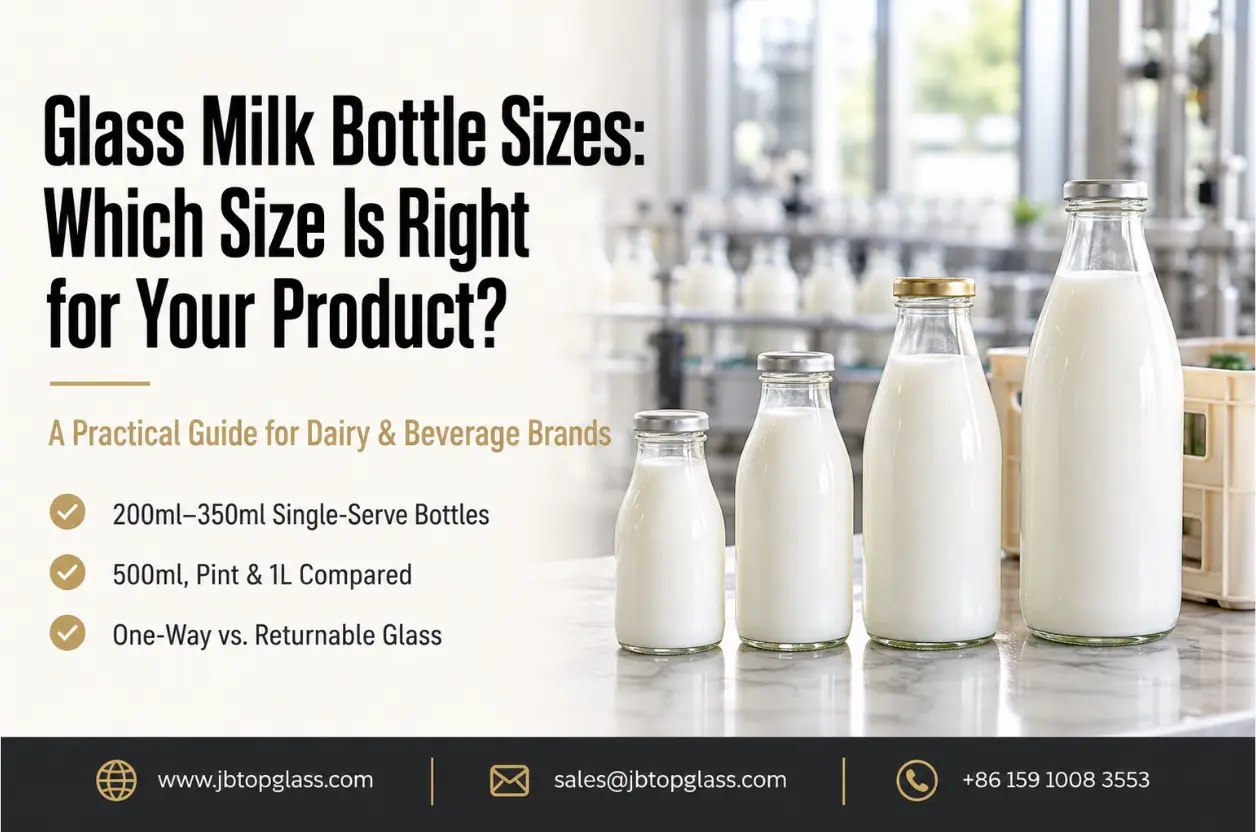
Small bottles between 200ml and 350ml work well for flavored milk, yogurt drinks and other single-serve products. A 500ml bottle offers a larger serving and gives the brand more room for labels and decoration.
Glass bottles in 750ml and 1-liter sizes are also available. However, they are less common for ordinary low-price milk. A large glass bottle is heavy and may cost too much if the brand uses it only once.
Large glass milk bottles make more sense for premium products, local delivery or a returnable bottle program.
There is no single standard milk bottle size for every country. Buyers need to check the exact capacity, market units, bottle dimensions and filling requirements before ordering.
What Are the Common Glass Milk Bottle Sizes?
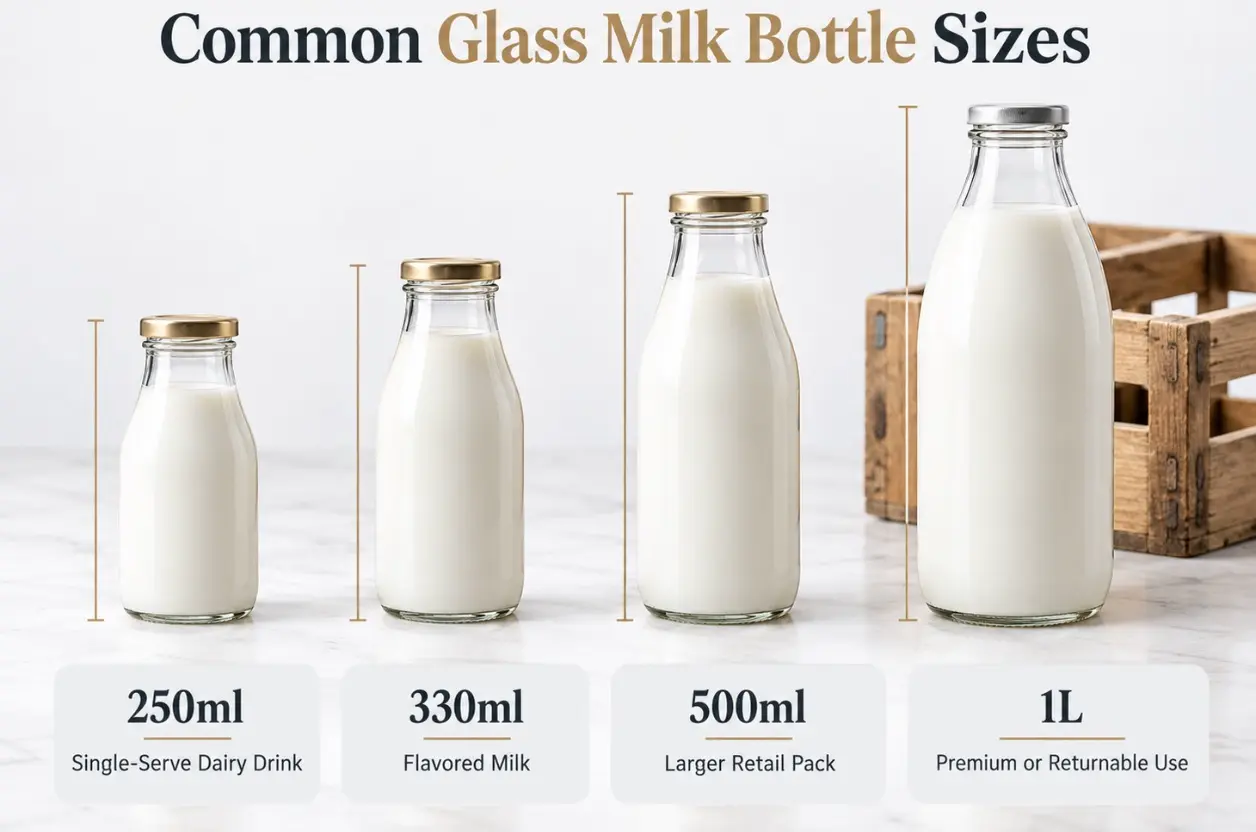
Glass milk bottles are available in many capacities. The following ranges show how different sizes may be positioned.
These are practical examples rather than fixed industry standards.
| 定員 | Approximate US fluid ounces | Possible use |
|---|---|---|
| 100–150ml | 3.4–5.1 fl oz | Samples, cream and small specialty drinks |
| 200ml | 6.8 fl oz | Small dairy and yogurt drinks |
| 250ミリリットル | 8.5 fl oz | Single-serve milk and ready-to-drink products |
| 300–350ml | 10.1–11.8 fl oz | Flavored milk and larger individual drinks |
| 473ml | 16 fl oz | US pint-size products |
| 500ミリリットル | 16.9 fl oz | Larger individual or small shared packs |
| 568ml | 1 imperial pint | Some UK returnable milk bottles |
| 750ミリリットル | 25.4 fl oz | Premium or shared products |
| 946ml | 32 fl oz | US quart-size products |
| 1 liter | 33.8 fl oz | Larger premium or returnable products |
A buyer should not select a bottle only because its capacity appears in this table. The product, bottle price and distribution method still determine whether the size makes sense.
Are 100ml to 150ml Glass Milk Bottles Common?
Glass bottles between 100ml and 150ml are specialty sizes rather than normal retail milk packs.
A brand may use them for tasting sets, hotel service, coffee cream, product samples or concentrated dairy drinks. The small bottle creates a controlled portion and can give the product a premium appearance.
However, the bottle, closure and decoration can cost a large amount compared with the product inside. The label area is also limited.
A small glass bottle works best when the product price and presentation can support the packaging cost. It is less suitable for low-price everyday milk.
When Should You Use a 200ml or 250ml Milk Bottle?
A 200ml or 250ml glass bottle is a practical option for single-serve dairy and beverage products.
This range can suit flavored milk, drinking yogurt, breakfast drinks and other ready-to-drink products. The bottle is small enough to carry but large enough to provide a complete individual serving.
A 250ml bottle also gives the brand more room than a 100ml bottle for ingredients, nutrition information and product branding.
The buyer should still check the final label area. Two 250ml bottles can have very different body shapes. A tall bottle may have a narrow label panel, while a shorter bottle may provide more width.
The packaging cost per liter will be higher than it is for a larger bottle. Four 250ml bottles need four bottles, four closures and four labels to package one liter of product.
The brand needs to compare this cost with the expected selling price.
Are 300ml to 350ml Bottles Good for Flavored Milk?
The 300ml to 350ml range works well for larger single-serve drinks.
A brand may use this range for flavored milk, protein drinks, yogurt drinks, plant-based beverages or other refrigerated products. The consumer receives more product than in a 200ml bottle, but the package remains easy to carry.
The 355ml capacity is close to 12 US fluid ounces. A brand selling in the United States may therefore choose a 355ml bottle instead of converting a 350ml bottle into an inaccurate ounce claim.
Bottle shape plays an important role in this range. A tall bottle can create a modern beverage appearance. A bottle with rounded shoulders can create a more traditional dairy look.
The brand should choose the capacity first and then compare shapes that can hold that amount.
Is 500ml a Practical Glass Milk Bottle Size?
A 500ml bottle is one of the more practical larger sizes for glass beverage packaging.
It can hold fresh milk, flavored milk, yogurt drinks, plant-based beverages and similar products. The bottle provides enough room for branding and required product information.
A 500ml bottle can serve as a large individual drink or a small shared pack. Its final use depends on the product and target customer.
However, 500ml is not the same as 16 US fluid ounces.
A 16 oz bottle holds about 473ml. A 500ml bottle holds about 16.9 US fluid ounces. The buyer needs to state the exact required volume when asking for a quotation.
The buyer should also check the filled package weight. A 500ml glass bottle already becomes much heavier after the product and closure are added.
Are Large Milk Bottles Usually Made of Glass?
Most mass-market large milk packs do not use single-use glass bottles.
Plastic bottles and cartons are lighter. They also cost less to move through normal retail distribution. For low-price fresh milk, an empty glass bottle may represent a large share of the total package cost.
A large glass bottle also increases the case weight. The distributor needs to handle the filled bottles, protect them from contact and manage the risk of breakage.
These factors become more important as the bottle moves from 500ml to 750ml, 1 liter or larger.
Glass bottles in these sizes still exist, but the business model is different.
When Can a Large Glass Milk Bottle Make Sense?
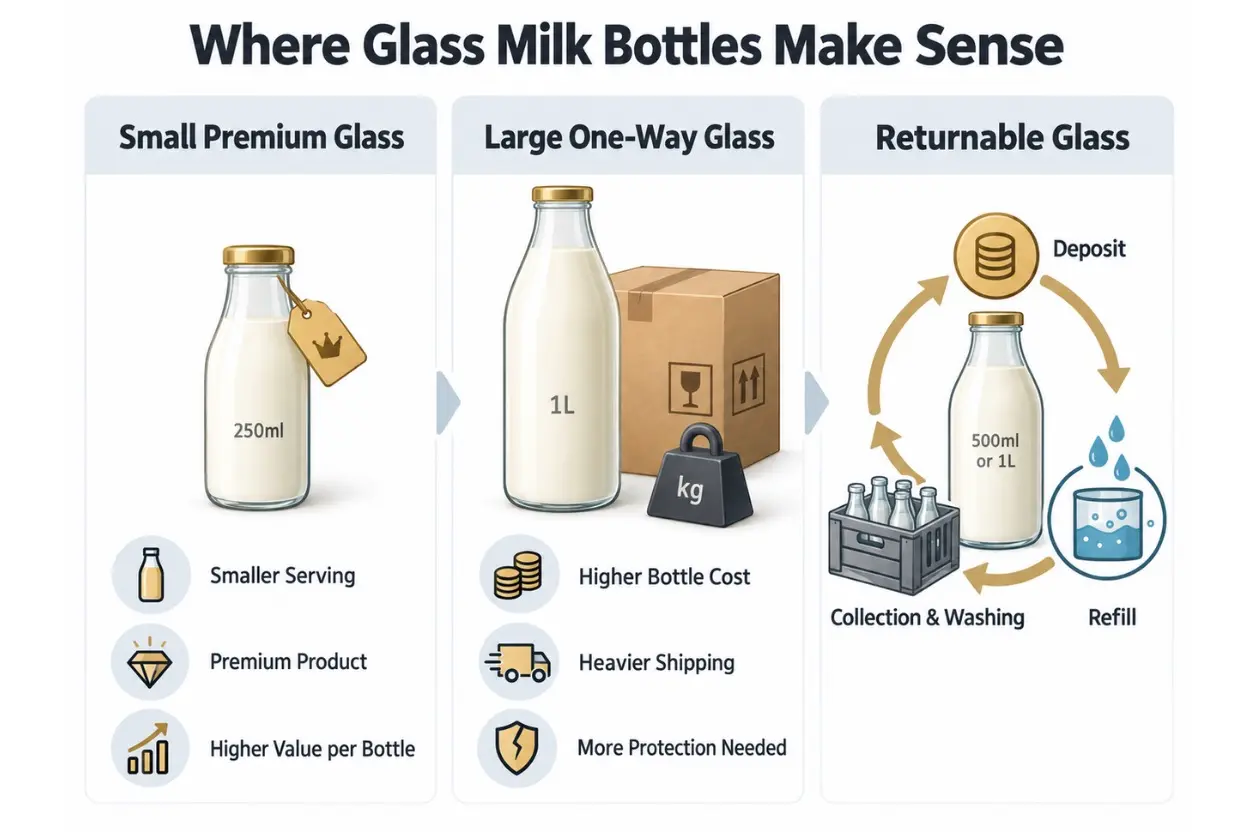
A 750ml or 1-liter glass bottle may work for premium milk, local dairies, farm shops and home-delivery services.
The bottle can also work when the dairy charges a deposit and collects the empty bottles. The dairy can then wash, check and refill bottles that were designed for the returnable system.
This type of system spreads the bottle cost across several uses. It also requires local collection, suitable crates, washing equipment and a reliable bottle-return rate.
The FAO explains that the high initial cost of a glass milk bottle makes it difficult to use as a one-way package. The cost depends heavily on how many times the dairy gets the bottle back and uses it again.
A current example is Straus Family Creamery in the United States. The company sells milk in reusable glass bottles, charges a refundable deposit and sends returned bottles back for washing and reuse. This is a controlled return program, not ordinary single-use glass packaging.
Is a 1-Liter Glass Milk Bottle a Standard Family Pack?
No. A 1-liter glass milk bottle is available, but it is not a universal family-pack standard.
A 1-liter carton or plastic bottle is more common in many retail markets. Glass is more likely to appear in a premium or returnable product line.
A dairy brand considering a 1-liter glass bottle should calculate the bottle cost, closure cost, carton weight and distribution distance. The brand should also decide whether the bottle will be used once or returned.
Without a return system or a premium selling price, a large glass bottle may not make financial sense.
How Many Ounces Are in a Glass Milk Bottle?
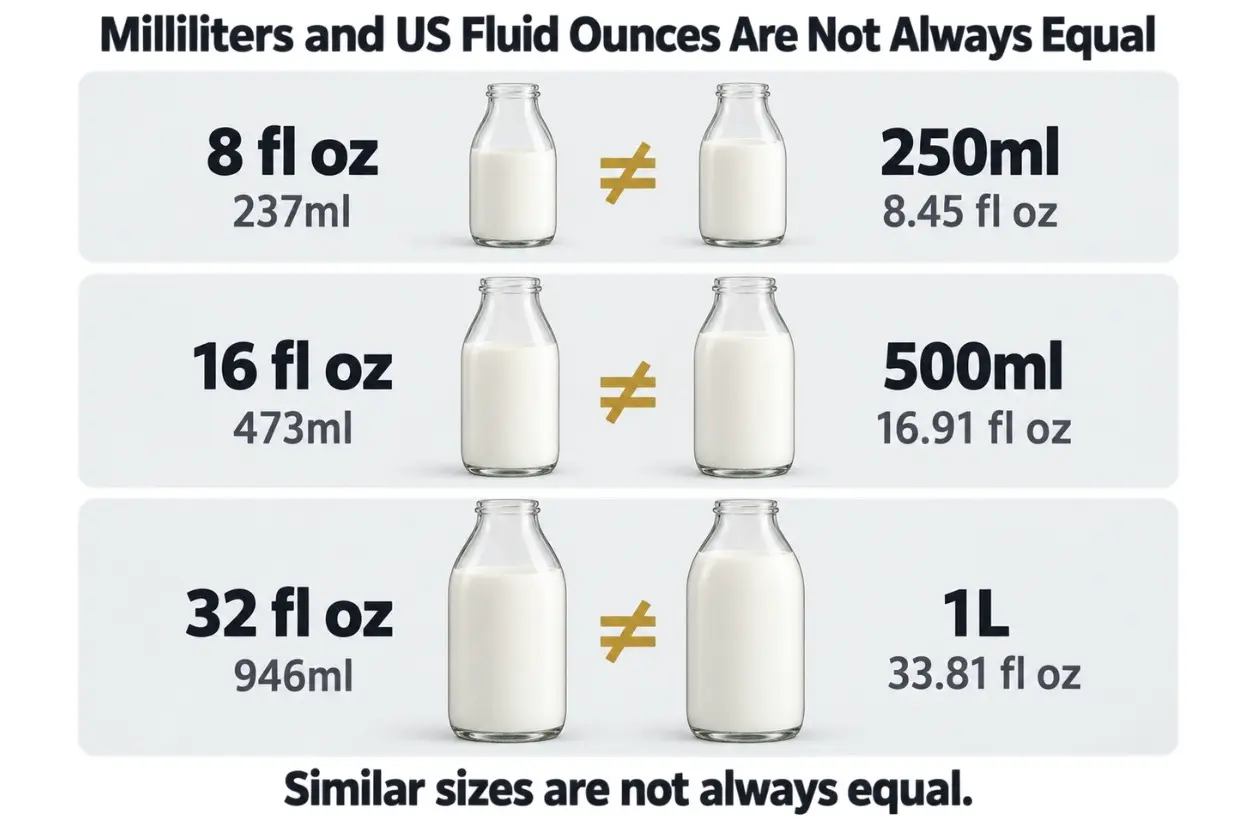
Milliliters and US fluid ounces do not convert into equal round numbers.
The US National Institute of Standards and Technology gives a conversion of approximately 29.57ml for one US fluid ounce.
| Metric capacity | US fluid ounces |
|---|---|
| 200ml | 6.76 fl oz |
| 250ミリリットル | 8.45 fl oz |
| 300ml | 10.14 fl oz |
| 330ml | 11.16 fl oz |
| 350ml | 11.83 fl oz |
| 473ml | 16 fl oz |
| 500ミリリットル | 16.91 fl oz |
| 750ミリリットル | 25.36 fl oz |
| 946ml | 32 fl oz |
| 1 liter | 33.81 fl oz |
A buyer should not call a 250ml bottle “8 oz” without checking the label claim. Eight US fluid ounces equal about 237ml.
The same issue applies to 500ml and 16 oz. These sizes are close, but they are not equal.
The UK pint creates another difference. Milk in some returnable containers may still be sold by the imperial pint. One imperial pint is approximately 568ml, not 473ml.
The buyer should always provide the required capacity in milliliters when requesting bottle specifications. The label can show another unit if the destination market requires it.
Does the Milk Product Affect the Bottle Size?
The product type does not create a fixed bottle size, but it changes what the buyer needs from the package.
Fresh Milk
Fresh milk competes in a price-sensitive market. A single-use glass bottle can add too much cost, especially in larger sizes.
Glass packaging is more suitable when the brand has premium positioning, short local distribution or a returnable system.
The bottle does not replace the required cold chain. The milk producer still needs to control processing, filling, storage and delivery.
Flavored Milk and Dairy Drinks
Flavored milk and other ready-to-drink dairy products can support smaller glass bottles more easily.
These products may sell as individual drinks rather than basic household milk. A 200ml, 250ml, 300ml or 350ml bottle can create a clear serving size and a premium appearance.
The brand should select the capacity based on its product price and target customer.
Drinking Yogurt
Drinking yogurt commonly uses smaller portions because the product is thicker and may be consumed as a single serving.
A small glass bottle can work, but the buyer needs to check the opening size and filling method. A narrow opening may not suit every product or filling machine.
The supplier needs information about the product and filling process before recommending a bottle.
Plant-Based Drinks
Oat milk, almond milk and other plant-based drinks may use the same general bottle shapes as dairy beverages.
However, the brand still needs to check the product thickness, filling temperature, closure and storage conditions.
A bottle that holds milk does not automatically suit every plant-based product.
Which Glass Milk Bottle Shape Is Best?
The best shape depends on the product position, label and packing method.
Capacity alone cannot show how the finished bottle will look or how much space it will use.
Round Milk Bottles
Round bottles provide a familiar beverage appearance. They are available in many capacities and shoulder styles.
A traditional rounded shoulder can create a dairy or farm-style look. A straight-sided round bottle can appear more modern.
Round bottles leave curved spaces between units when packed together. However, the final carton quantity depends on the bottle diameter, dividers and carton dimensions.
The buyer should use the supplier’s actual packing data instead of assuming how many bottles will fit in a carton.
Square Milk Bottles
Square bottles provide flatter areas for labels and printing. They can create a modern shelf appearance.
A square bottle may use shelf or carton space more efficiently, but this is not guaranteed. Rounded corners, shoulder width and protective dividers affect the final layout.
The buyer should compare the actual carton size and bottle quantity for each design.
Traditional Dairy-Style Bottles
Traditional dairy bottles normally have a wider body, rounded shoulder and short neck.
This shape can help a premium milk brand create a familiar or local-farm image. The shape is a design choice rather than a capacity standard.
Similar dairy-style bottles may hold 200ml, 250ml, 500ml or another amount.
Large Bottles with Handles
A handle can make a large bottle easier to pour, but handled glass milk bottles are a specialist option.
The handle adds width and changes the carton layout. The mold and production cost may also be higher than they are for a simple round bottle.
A handled bottle should be considered only when the sales model can support the added cost.
Does Bottle Capacity Equal the Filling Volume?
必ずしもそうとは限りません。.
Bottle drawings may show nominal capacity and overflow capacity.
Nominal capacity is the amount of product the brand plans to sell. A bottle sold as a 500ml bottle may have a nominal filling volume of 500ml.
Overflow capacity is the maximum amount that the bottle can hold when it is filled to the top.
A 500ml bottle may have an overflow capacity of 525ml, 530ml or another amount. The exact number depends on the bottle shape and internal design.
The space above the normal liquid level is called headspace. The product and filling process determine how much headspace the package needs.
The buyer should not select headspace by copying another product. The filling plant needs to check the real product and process.
Jingbo Groupのガイド: overflow and brimful capacity explains the difference in more detail.
Does a Heavier Milk Bottle Mean Better Quality?
No. Bottle weight alone does not prove strength or quality.
A heavier bottle contains more glass, but that glass may not be distributed evenly. Bottle shape, wall distribution, annealing and production quality also affect performance.
A thick base may make a bottle feel more premium, but it also adds weight and can reduce the internal capacity when the outside dimensions stay the same.
A lighter bottle can reduce packaging and shipping weight. However, the bottle still needs to meet the requirements of the filling line and distribution process.
The buyer should review the complete design instead of comparing bottles only by grams.
What Should Buyers Check Besides Capacity?
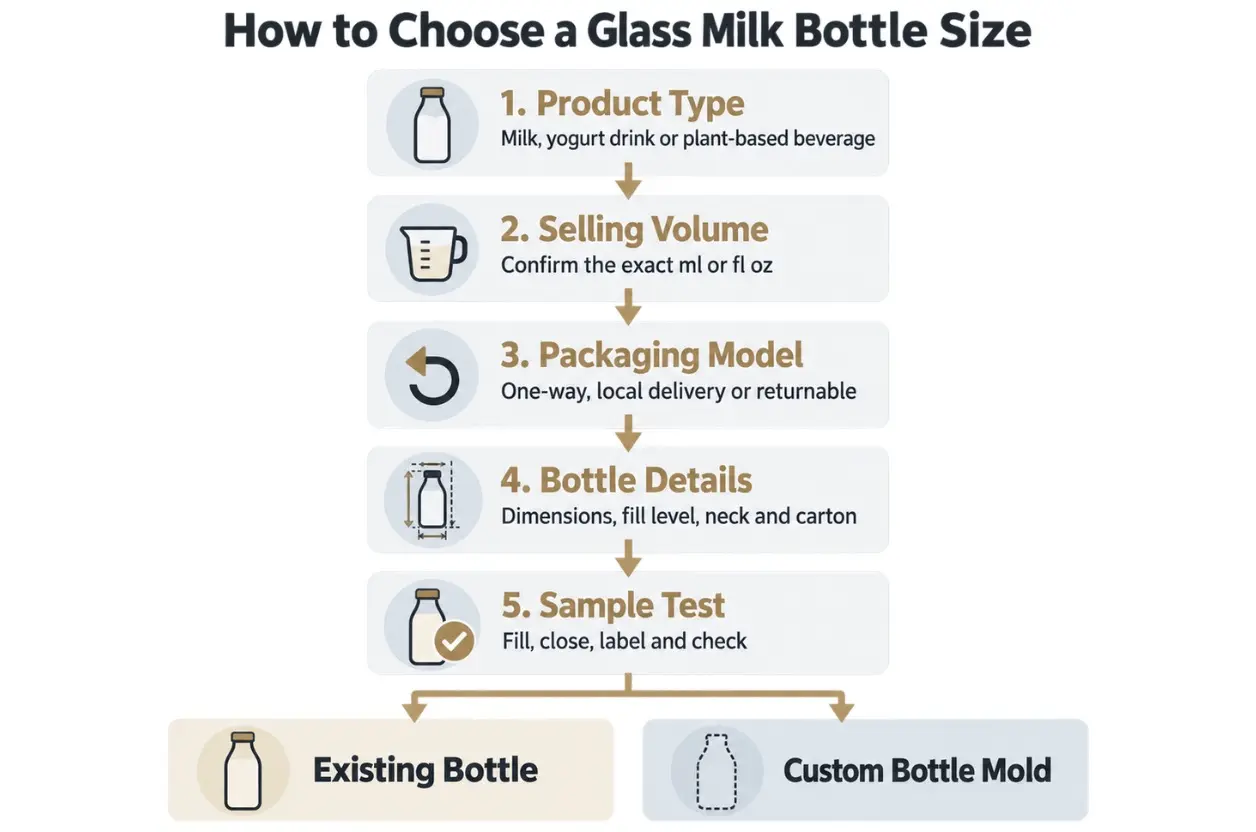
The buyer should start with the amount of product that will appear on the label. The supplier can then look for an existing bottle with enough internal volume.
The buyer also needs the bottle drawing. The drawing should show the main dimensions, capacity, weight and neck finish.
The bottle height and diameter need to match the filling line, label and carton. The neck finish needs to match the selected closure.
The supplier also needs to know the filling temperature and whether the filled product receives any later heat treatment.
A bottle that works with one dairy process may not work with another. Buyers can read our guide to food-safe glass bottles for more information about product and filling conditions.
The buyer should then test a sample with the real product. The test should confirm the fill level, finished weight, label area and closure fit.
A product photo cannot replace these checks.
Can Any Glass Milk Bottle Be Reused?
No. A buyer should not assume that every glass milk bottle is suitable for an industrial return-and-refill program.
A returnable bottle needs to work with repeated collection, washing, checking, filling and transport. The bottle design, glass weight, crate and washing process all form part of the system.
The dairy also needs a practical way to get empty bottles back. A deposit, local delivery route or store-return program may support this process.
A brand cannot create a returnable packaging system simply by telling customers to reuse a normal bottle.
If the project requires a returnable bottle, the buyer needs to state this requirement before the supplier recommends a design.
Should You Use an Existing Bottle or Create a Custom Size?
An existing bottle is the better starting point when its capacity, dimensions and neck finish already suit the product.
The brand can add a label, screen printing, coating, frosting or another decoration without changing the bottle structure.
A custom mold becomes useful when existing bottles cannot provide the required size, shape, grip or brand feature.
The buyer should have a clear reason for creating a custom capacity. A small change from 500ml to 510ml may not justify a new bottle mold.
The bottle design also needs to leave enough internal space for the target fill volume and headspace.
Jingbo Group can compare the required specifications with available bottle molds before the buyer decides whether custom mold development is necessary.
よくある質問
What Is the Most Common Glass Milk Bottle Size?
There is no single worldwide standard. Sizes between 200ml and 500ml are practical for many small and premium beverage products. Returnable milk systems may also use pint, quart or 1-liter bottles.
What Size Is a Traditional Glass Milk Bottle?
The answer depends on the country. A traditional UK returnable milk bottle may hold one imperial pint, or approximately 568ml. Other markets use half-liter, liter, pint or quart formats.
Is a 250ml Milk Bottle the Same as 8 oz?
No. A 250ml bottle holds approximately 8.45 US fluid ounces. Eight US fluid ounces equal approximately 237ml.
Is a 500ml Milk Bottle the Same as 16 oz?
No. A 500ml bottle holds approximately 16.9 US fluid ounces. Sixteen US fluid ounces equal approximately 473ml.
Is a 1-Liter Milk Bottle the Same as 32 oz?
No. One liter equals approximately 33.8 US fluid ounces. Thirty-two US fluid ounces equal approximately 946ml.
Why Is Milk Rarely Sold in Large Single-Use Glass Bottles?
Large glass bottles cost more, weigh more and need more protection during transport. The cost is difficult to support for an everyday low-price product. Large glass bottles are more suitable for premium products or controlled returnable systems.
Can the Same Bottle Hold Milk and Drinking Yogurt?
It may, but the buyer needs to check the product thickness, opening size, filling process and closure. Capacity alone cannot confirm that the same bottle suits both products.
Can a Brand Order a Custom Milk Bottle Size?
Yes. A manufacturer can develop a custom bottle when an existing mold cannot provide the required capacity or design. The order quantity and mold cost need to support the project.
結論
Glass milk bottles make the most sense for smaller portions, premium beverages and controlled returnable programs.
Sizes between 200ml and 350ml suit many single-serve milk and yogurt drinks. A 500ml bottle provides more product while remaining practical for premium retail and local dairy products.
Glass bottles in 750ml and 1-liter sizes are available, but they are less common for ordinary mass-market milk. Their weight and price make them more suitable for premium products or returnable systems.
Buyers should compare the product volume, bottle cost, dimensions, filling process and sales channel before selecting a size.
Jingbo Group supplies custom glass beverage bottles for flavored milk, yogurt drinks, plant-based beverages and other ready-to-drink products. Contact Jingbo Group to compare existing bottle sizes or discuss a custom design.