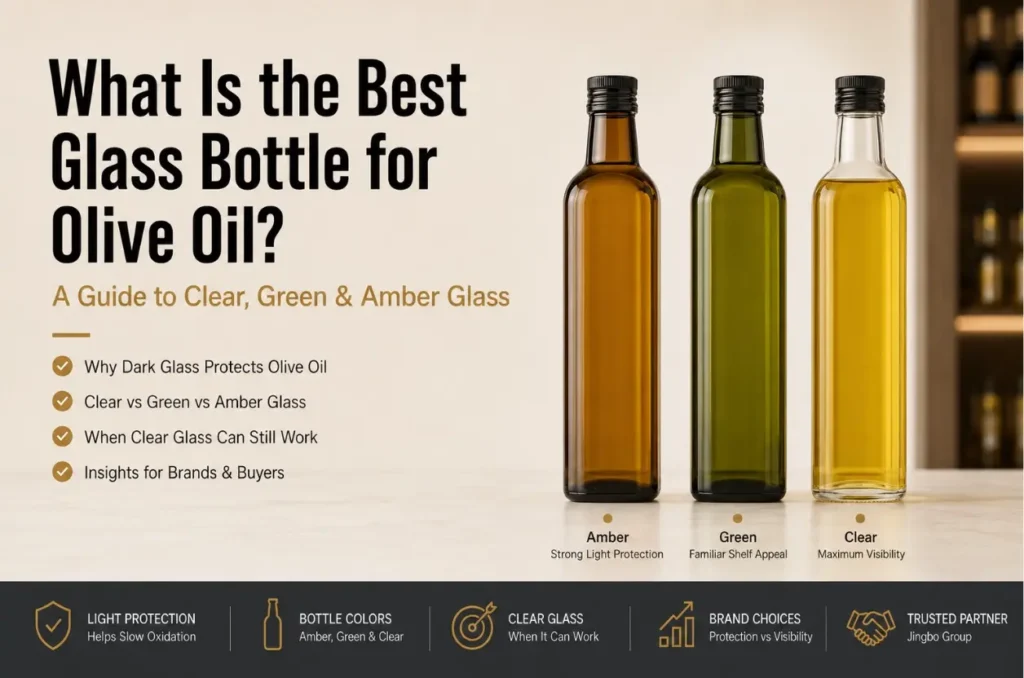
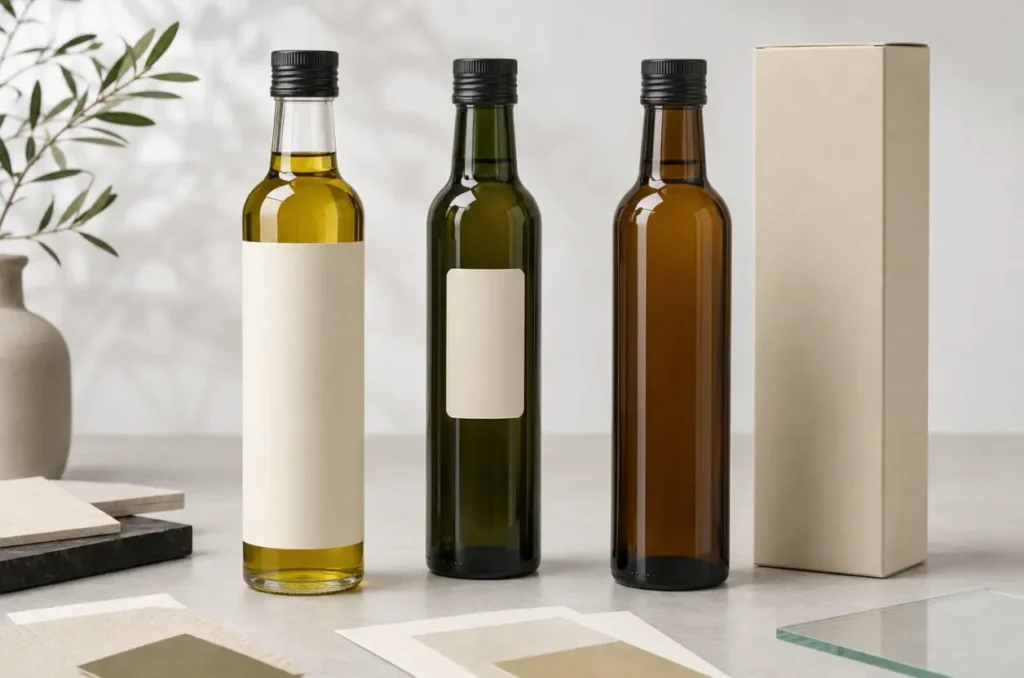
The best glass bottle for olive oil is usually a dark-colored bottle with a secure closure. Dark green and amber glass reduce the amount of light that reaches the oil, helping it retain its flavor, aroma, and quality for longer.
Clear glass can also be used for olive oil. It does not react with or contaminate the oil. Its main disadvantage is transparency. When a clear bottle is exposed to sunlight or strong artificial lighting, the oil receives less protection from light-induced oxidation.
This does not make every dark bottle good or every clear bottle unsuitable. The final result depends on the darkness of the glass, the amount of light exposure, storage temperature, closure performance, initial oil quality, and expected shelf life.
For most olive oil sold through retail distribution, dark green or amber glass is the safer general choice. Clear glass makes more sense when product visibility is important and the brand can control light exposure through labels, cartons, coatings, or storage conditions.
Why Does Bottle Color Matter for Olive Oil?
Olive oil gradually oxidizes during storage. Oxygen is part of this process, but light and heat can make it happen faster.
As oxidation progresses, the oil may lose some of its fresh aroma and flavor. Fruity, grassy, bitter, and peppery notes can become weaker. With further deterioration, the oil may develop stale or rancid characteristics.
Extra virgin olive oil needs particular care because its value depends heavily on its original sensory qualities and natural antioxidants. A bottle cannot stop all changes, but suitable packaging can slow them down.
その International Olive Council’s olive oil storage guidelines identify light, oxygen, and high temperature as major factors that should be controlled. The guidelines recommend packaging that protects olive oil from light, including dark glass bottles and fully protected clear bottles.
Glass already offers one useful advantage. It is nonporous, so oxygen does not pass through the bottle wall as it can with some plastic packaging. However, transparent glass still allows light to reach the oil. This is why glass color remains important even when the packaging material itself is suitable.
What Color Glass Is Best for Olive Oil?
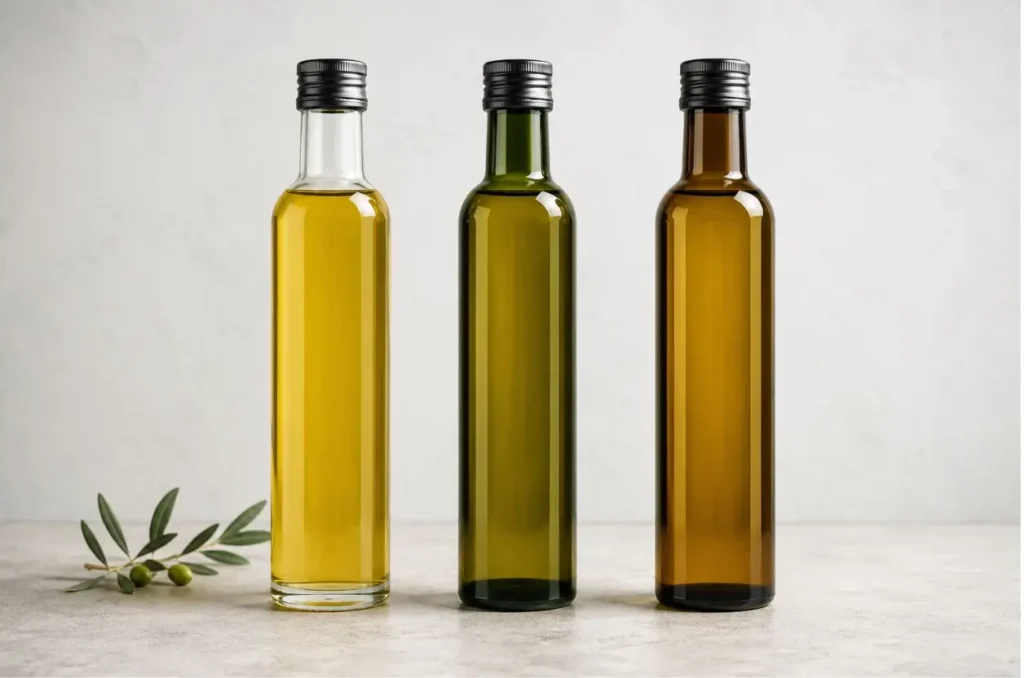
Dark glass is generally better for olive oil because it limits light exposure. Amber and dark green are the most common choices, but neither color should be judged by its name alone.
The actual protection depends on how much light the glass transmits. Glass thickness, color intensity, and formulation can all affect the result. A very pale green bottle may provide less protection than a much darker green bottle. The same variation can occur between different amber bottles.
The most accurate answer is therefore not simply “amber” or “green.” The best color is a sufficiently dark, consistent glass color that provides the required light barrier for the product’s expected storage and distribution conditions.
琥珀色のガラス瓶
Amber glass is commonly used when light protection is a priority. Its brown tone can reduce the transmission of a broad range of light, depending on the exact glass specification.
The color also gives the bottle a natural, traditional, or functional appearance. It can work well for extra virgin olive oil, organic oils, infused oils, and products positioned around freshness or protection.
However, not every amber bottle performs identically. A light amber bottle and a deep brown bottle will not necessarily transmit the same amount of light. Buyers with strict shelf-life requirements should evaluate actual bottle samples instead of relying only on a color name or digital image.
Dark Green Glass Bottles
Dark green is strongly associated with olive oil packaging. It creates the familiar Mediterranean appearance seen across many retail markets and can provide useful protection from light.
Green glass also offers flexibility in branding. It can look traditional with a paper label and metal cap, or more modern with simple graphics and a clean bottle shape.
The important word is “dark.” Pale green or highly transparent green glass may not provide the same protection as a deeper color. When comparing samples, the buyer should hold the bottle against a strong light source and look at how easily light passes through the body.
This simple check does not replace formal shelf-life testing, but it can quickly reveal whether two bottles described as “green” are actually similar.
Clear Glass Bottles
Clear glass gives consumers a direct view of the olive oil. They can see the oil’s color, fill level, and any visible ingredients in an infused product. This can make clear glass attractive for gift oils, flavored oils, foodservice bottles, and products built around visual presentation.
Its weakness is that it provides little built-in protection from light. UC Davis explains in its olive oil packaging guidance that clear glass exposes the oil to light. The same guidance notes that a large label or suitable protective coating can improve protection.
Clear glass is therefore a design choice with a trade-off. It improves visibility but places more responsibility on the rest of the packaging.
Is Amber Glass Always Better Than Green Glass?
Amber glass is often described as the best color for light-sensitive products. For olive oil, however, it is safer not to make a universal claim based only on color.
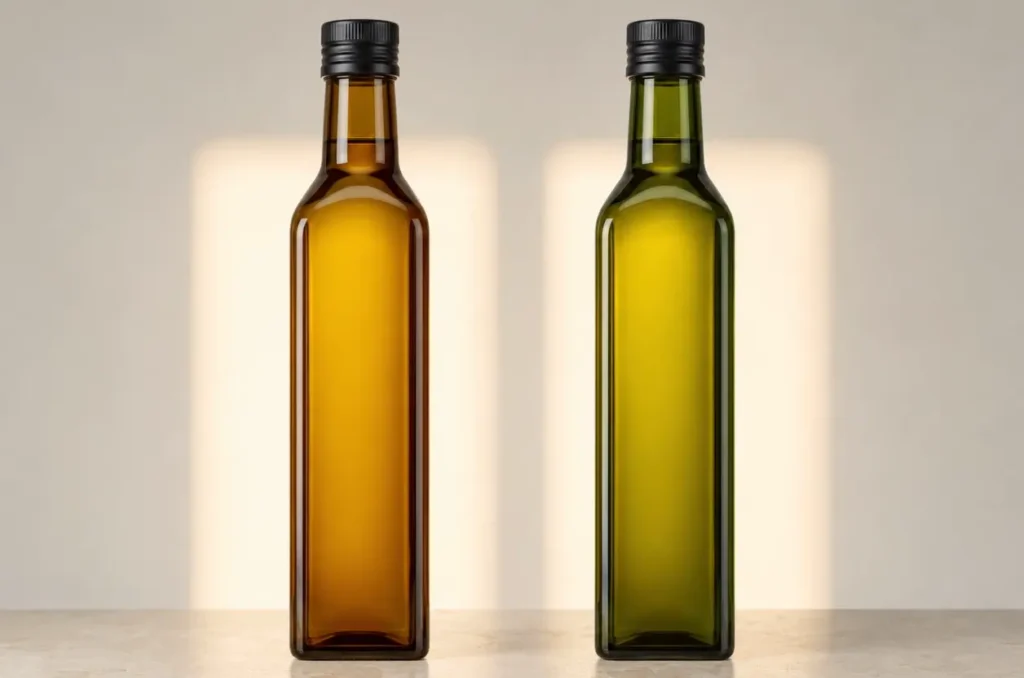
A dark amber bottle may provide stronger light protection than a light green bottle. A very dark green bottle may perform better than a pale amber bottle. The result depends on the actual glass rather than the color category printed in a catalogue.
Published olive oil packaging guidance consistently supports dark glass over clear glass, but direct comparisons between every shade of amber and green are limited. Bottle color also varies between manufacturers and production batches.
For general packaging selection, either dark amber or dark green can be suitable. Brands that need a specific shelf life should test the finished package with the actual oil, closure, label, and storage conditions.
This approach is more reliable than choosing a color based on appearance alone.
Can Olive Oil Be Stored in a Clear Glass Bottle?
Yes, olive oil can be stored in a clear glass bottle. Clear glass is a suitable container material, but it does not protect the oil from light as effectively as dark glass.
The storage environment determines how serious this limitation becomes. A clear bottle kept inside a closed carton or dark cupboard receives very little light. The same bottle placed beside a window or under bright retail lighting may allow the oil to deteriorate more quickly.
A clear bottle is more practical when the product is kept inside protective secondary packaging, a large label covers most of the bottle, or the glass has a verified light-blocking treatment. It may also work for products with short distribution periods or fast turnover.
These measures do not make the glass darker, but they reduce the amount of light that reaches the oil.
The International Olive Council includes sleeves that completely cover clear glass bottles and cardboard secondary packaging among its recommended light-protection options. This shows that transparency itself is not an automatic reason to reject a bottle. What matters is how the finished package manages light.
What Happens If Olive Oil Is in a Clear Bottle?
Clear glass does not immediately change olive oil. The problem develops when light passes through the bottle over time.
Olive oil contains natural pigments, including chlorophyll-related compounds. When these compounds are exposed to light, they can participate in reactions that accelerate photo-oxidation.
The first changes may be difficult to notice. The oil can gradually lose freshness, aroma, and flavor intensity. Its natural antioxidants may also decline. If oxidation continues, stale or rancid notes can develop.
The rate of change is not the same in every situation. Direct sunlight is especially undesirable, but long exposure to artificial shelf lighting can also affect the oil. Heat and oxygen can make the problem worse.
A clear bottle displayed in a bright shop for several months faces more risk than one stored in a closed box. This difference explains why some clear glass olive oil packages work successfully while others are poorly suited to long retail distribution.
The bottle is only one part of the storage environment. Light exposure is the real issue.
How Long Can Olive Oil Be Stored in Clear Glass?
There is no single number that applies to every clear glass bottle.
The possible storage period depends on the original quality of the oil, light exposure, temperature, oxygen in the package, closure performance, filling conditions, and whether the bottle has been opened.
A sealed clear glass bottle stored in complete darkness is very different from one displayed under bright lighting. When light is removed from the environment, the transparency of the bottle becomes much less important. When light is present, clear glass provides less protection and the oil may lose quality sooner.
The International Olive Council recommends limiting the best-before date to 24 months after bottling, even for high-quality olive oil kept under rigorous storage conditions. This is a general upper recommendation. It does not mean that every olive oil in a clear bottle will maintain its original quality for 24 months.
The producer should establish the final best-before date using the actual olive oil and finished packaging. A realistic evaluation should include the bottle, closure, label coverage, expected temperature, distribution time, and retail lighting.
For this reason, claims such as “olive oil lasts six months in clear glass” or “clear bottles are safe for two years” are too simple. Neither statement considers the conditions that control oxidation.
Does a Dark Bottle Completely Protect Olive Oil?
No. Dark glass reduces light exposure, but it cannot protect olive oil from every cause of deterioration.
Heat can still accelerate quality loss. Oxygen may remain in the headspace or enter when the bottle is opened. A poorly fitted closure can allow more contact with air. Long storage will also affect the oil even when the bottle remains in darkness.
Dark glass should therefore be understood as one protective element, not a complete shelf-life solution.
The bottle should remain away from direct sunlight, windows, radiators, cooking equipment, and other heat sources. The closure should also fit the neck finish correctly and maintain a dependable seal.
This is why a dark bottle stored badly may perform worse than a clear bottle kept inside a closed carton in a cool, dark place. Bottle color matters, but storage conditions still matter after the color has been selected.
When Does Clear Glass Make Sense for an Olive Oil Brand?
Clear glass makes the most sense when seeing the product adds real value.
Some customers want to see the natural color of the olive oil before buying it. Infused oils may contain herbs, peppers, garlic, or other visible ingredients that form part of the product presentation. Gift packaging may also use clear glass because the bottle remains inside a protective box until it is opened.
Restaurants and foodservice businesses may use the oil quickly enough that long shelf exposure is less important. Clear glass can also work for direct-to-consumer sales when the bottle remains inside shipping packaging through most of the distribution process.
In each case, the brand should still consider where the bottle will be stored after delivery. A clear bottle should not be presented as light-protective simply because it is made from glass.
If the product may remain for months on an uncovered retail shelf, dark glass is usually the more cautious choice. If transparency is essential, a large label, outer carton, or verified protective treatment can reduce the risk.
How Should Buyers Compare Olive Oil Glass Bottles?
The first comparison should be light protection. Buyers should place clear, green, and amber samples under the same light rather than judging them from catalogue images.
The second consideration is whether the glass color fits the product’s sales environment. A dark bottle is generally more suitable for long retail distribution. Clear glass may work for fast turnover, controlled storage, or products supported by protective outer packaging.
Closure compatibility also matters because the bottle and cap work as one package. A dark glass body cannot compensate for a cap that does not seal properly.
The final choice should be tested with the actual olive oil. Empty bottle samples help buyers compare appearance and color, but they cannot establish the finished product’s shelf life.
Jingbo Groupの供給 glass bottles for olive oil and vinegar in clear and colored designs. Buyers can compare existing bottles, glass colors, closures, and decoration options according to the product’s protection and branding needs.
The aim is not to select the darkest bottle in every case. It is to find the right balance between light protection, product visibility, brand appearance, and the expected sales environment.
結論
The best glass bottle for olive oil is normally a dark green or amber bottle with a secure closure. Dark glass reduces light exposure and provides a safer general choice for products that may remain in storage or retail distribution for an extended period.
Clear glass can still be used when product visibility is important. It works best with controlled storage, substantial label coverage, a protective carton, or another verified way to limit light.
Amber is not automatically better than every green bottle, and dark glass does not solve every storage problem. The bottle’s actual light transmission, closure, storage temperature, and expected shelf life should be considered together.
For most brands, the practical decision is simple: choose dark glass when protection comes first, and choose clear glass only when visibility provides enough value to justify the additional light-control measures.