
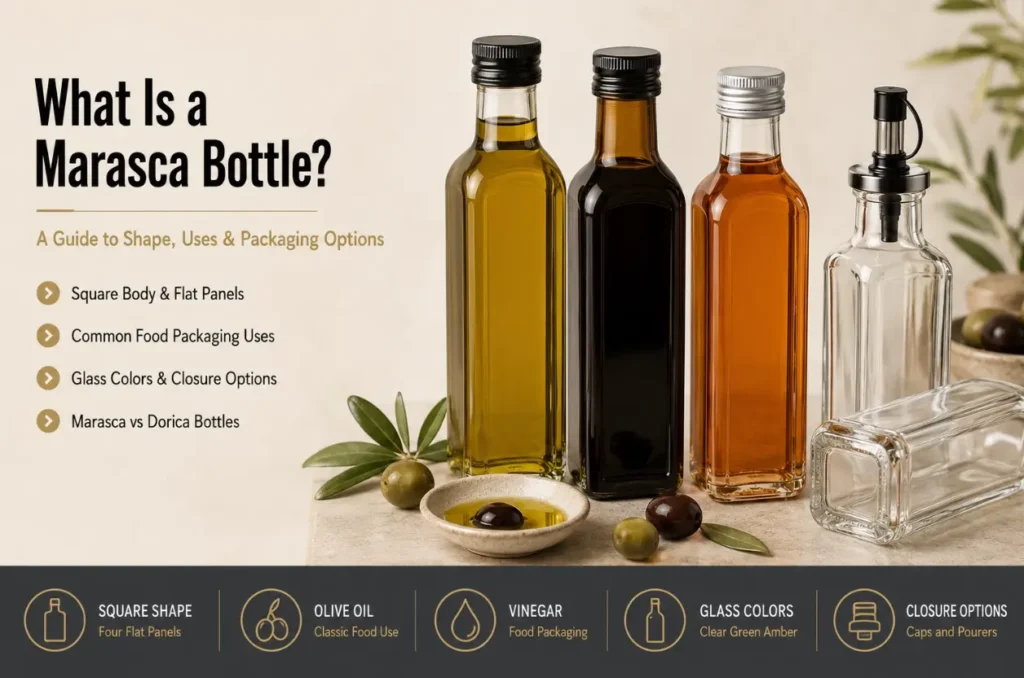
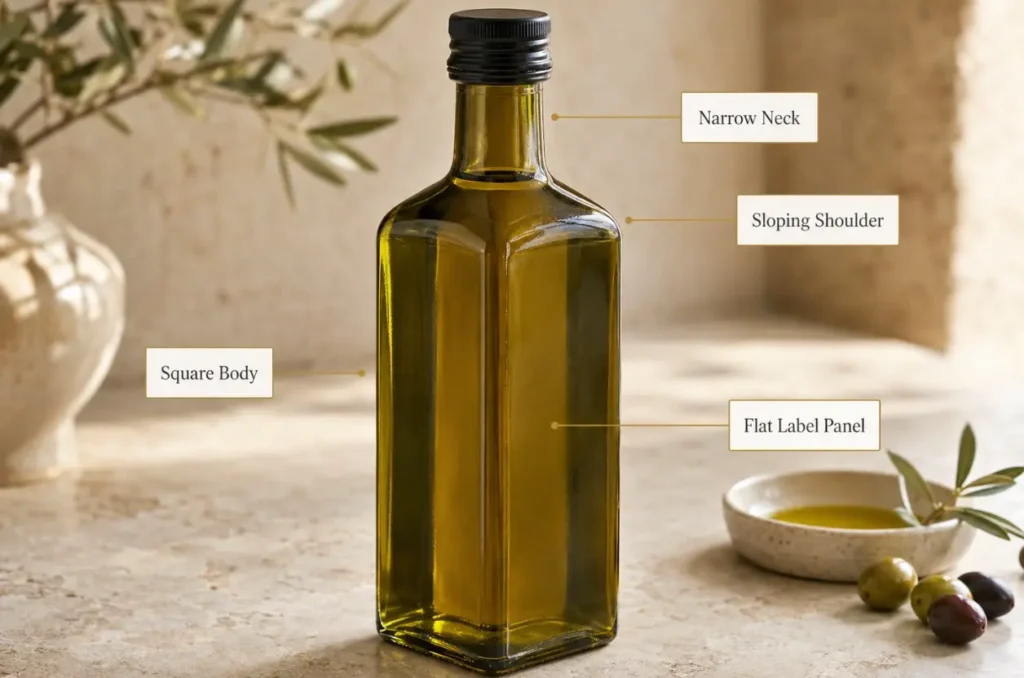
Marasca bottle is a tall glass bottle with a square or rectangular body, four defined side panels, sloping shoulders and a narrow neck. It is widely used for olive oil, vinegar, dressings, syrups and other specialty products. Its flat sides create clear areas for labels, while its structured shape gives the package a traditional, premium appearance.
“Marasca” describes a bottle style rather than one fixed specification. Capacity, dimensions, weight, color and neck finish vary by model, so buyers still need to check the drawing and samples.
What Does a Marasca Bottle Look Like?
The easiest way to recognize a Marasca bottle is to look at its body from above. A typical Marasca has a square or slightly rectangular cross-section rather than a round one. The four sides are usually joined by rounded corners, so the bottle is not a sharp glass box. Those corner radii help the shape move from one panel to the next and are part of the bottle’s molded structure.
The shoulder slopes inward toward a narrow neck. Some versions have angular shoulders, while others use a softer transition. Stability depends on the bottle’s height, footprint and filled weight.
Flat side panels give the bottle a defined front, back and two side faces. The front can carry the main branding, while the back holds product information. The usable label area is smaller than the full panel because labels should not run too close to curved corners, shoulders or the base radius.
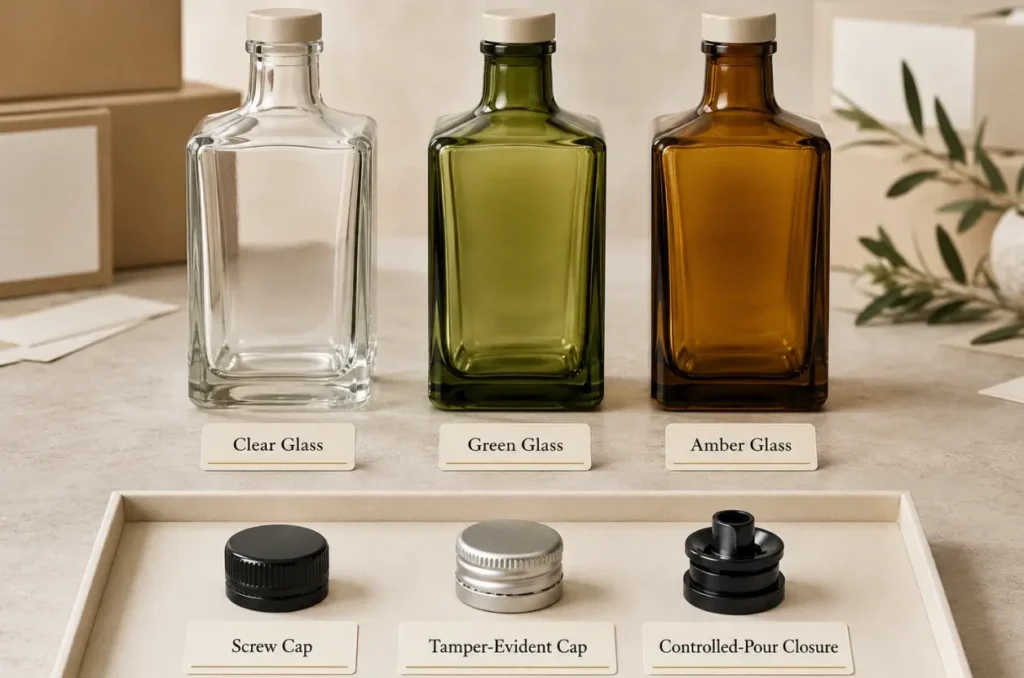
Marasca bottles are often produced in clear, green or amber glass. They may use a screw finish, a tamper-evident metal cap, a cap with a pouring insert or another closure designed for the exact neck.
Marasca vs Dorica Bottles: What Is the Difference?
Marasca and Dorica bottles are both familiar in oil and vinegar packaging, and both usually have a tall body and narrow neck. The main difference is the cross-section. A Marasca bottle is square or rectangular. A Dorica bottle is round and cylindrical.
| Особенность | Marasca bottle | Dorica bottle |
|---|---|---|
| Body shape | Square or rectangular with four panels | Round and cylindrical |
| Shoulder | Usually angular or clearly sloped | Usually curved or gently sloped |
| Main label area | Defined flat front and back panels | Curved surface suitable for front, back or wraparound labels |
| Line orientation | May need panel alignment before labeling or printing | Can often rotate more freely, depending on decoration and equipment |
| Carton arrangement | Rectangular footprint may use carton space efficiently | Round footprint creates a different divider and pallet pattern |
| Внешний вид полки | Structured, traditional and architectural | Slender, simple and flowing |
| Common applications | Olive oil, vinegar, dressings, syrups, sauces and specialty products | Olive oil, vinegar, dressings, liqueurs and specialty products |
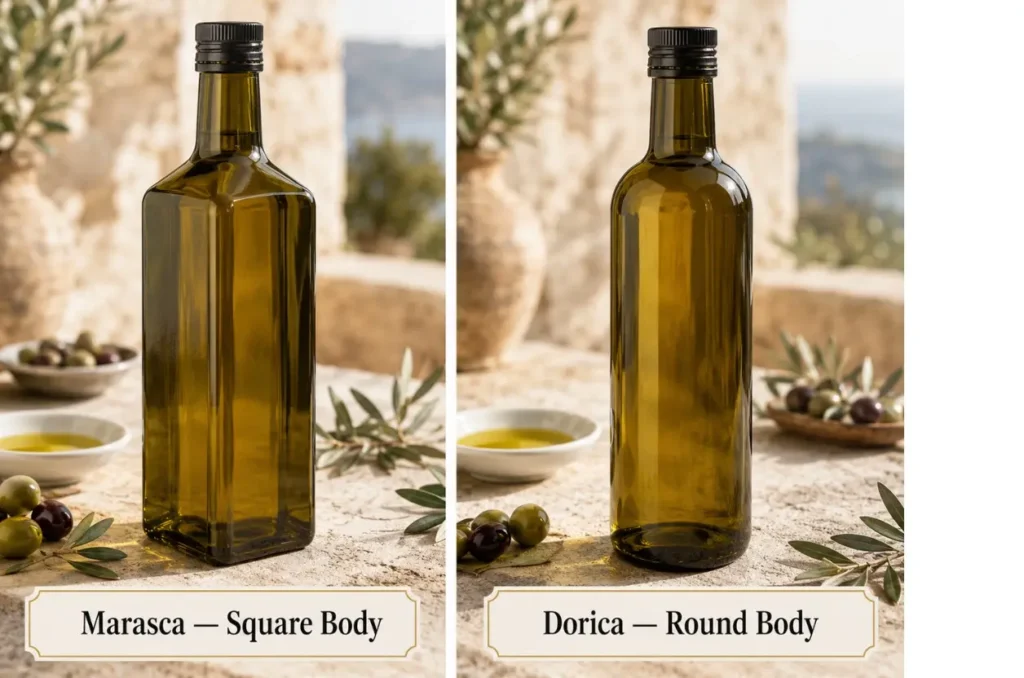
These are general differences, not promises about every bottle. Two Marasca models can differ greatly in height, corner radius, shoulder angle and weight. The same is true for Dorica bottles. A buyer should compare actual technical drawings rather than approve a bottle from its trade name alone.
Shape and Shelf Appearance
A Marasca bottle presents the product in a structured way. Its front panel faces the customer directly when aligned on a shelf, while the corners create clear visual edges. This suits products that need a strong rectangular silhouette.
A Dorica bottle has a continuous round surface and often appears slimmer. It works with a narrow front label, wraparound label or direct decoration. Neither shape is automatically more premium; proportions, closure and artwork matter more.
Labeling and Line Handling
Flat Marasca panels create a clear front and back, but they may introduce an orientation requirement. If a label must sit in the center of one panel or align with embossing, the line must present each bottle in the same direction.
A round Dorica can often rotate on the line, which may simplify some label applications. A Dorica with embossing or registered print may still require orientation.
Send the drawing and samples to the filling partner. Confirm the height, body width, base, neck finish and any front-panel alignment requirement.
Cartons and Pallet Patterns
The square footprint of a Marasca can use a rectangular carton efficiently, especially with individual dividers. The actual carton count still depends on outside dimensions, corner radii, bottle weight and required separation.
Round Dorica bottles use a different divider pattern. Neither shape always uses less space. The reliable comparison is a packing drawing based on the selected models.
Product Protection
Shape alone does not determine product protection. Light exposure depends mainly on glass color, coating, label coverage and storage. Oxygen exposure is influenced by the closure, seal, headspace and use after opening.
For olive oil, dark or opaque packaging is normally safer under retail or warehouse lighting. A UC Davis review of olive oil packaging notes that it reduces the light exposure that can accelerate oxidation. Choose shape for branding and handling, then evaluate color and closure separately.
What Products Are Marasca Bottles Used For?
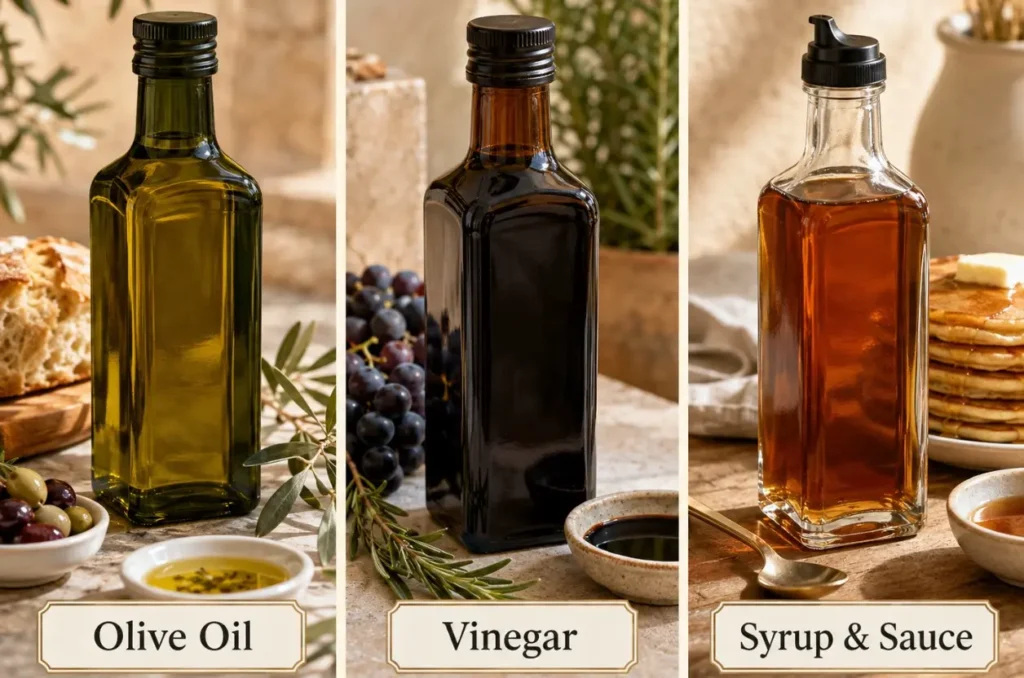
Olive oil is the application most closely associated with the Marasca bottle. The narrow neck supports controlled pouring, while the square body creates a recognizable shelf shape. Small bottles can be used for samples, infused oils and gift sets. Larger retail formats can hold everyday cooking oils or premium extra virgin olive oil.
The bottle shape does not make clear glass suitable for every oil. If light protection is important, dark green or amber glass is usually a better starting point. Clear glass can still be chosen when product visibility is part of the brand design, but storage, label coverage and secondary packaging should be considered. Our guide to the best glass bottle for olive oil explains this choice in more detail.
Vinegar is another common use. Marasca bottle can suit balsamic vinegar, wine vinegar, fruit vinegar and flavored vinegar. Its flat panels provide space for origin information, ingredients and brand artwork. The closure must be compatible with the product and should provide the required seal during transport and storage.
Dressings, marinades, syrups and some sauces may also be packed in Marasca-style bottles. Here, the product’s flow behavior matters. A narrow opening that works well for olive oil may be too restrictive for a thick dressing or sauce. Particles, herbs and spices can also affect the required opening and pourer. The bottle supplier and filling partner should review the product before the neck finish is confirmed.
Marasca bottles are sometimes used for liqueurs, infused spirits and specialty beverages. The square panels create a distinctive alternative to a round spirits bottle. If the product contains alcohol, the closure liner, decoration and destination-market requirements still need separate review. The same bottle should not be assumed suitable for oil, vinegar and spirits only because the outside shape is similar.
Choosing the Capacity, Glass Color and Closure
The best Marasca bottle is not determined by shape alone. Capacity, glass color and closure have a direct effect on how the package looks and works.
Вместимость
Commercial Marasca bottles are available in several capacities. Examples often include 100 ml, 250 ml, 500 ml, 750 ml and 1 L, but these are not universal Marasca standards. A manufacturer may have some sizes in existing molds and other sizes only as custom projects.
Capacity should match the product, sales channel and destination. Small formats suit samples, gifts and flavored oils. Larger bottles may fit household or food-service use, but they increase filled weight and change pouring comfort.
Do not select a size from a photo. Ask for nominal and overflow capacity, dimensions, weight and neck finish. Two 500 ml Marasca bottles can have different proportions, affecting labels, cartons and filling equipment.
Glass Color
Clear glass shows the natural color and clarity of the product. It can be attractive for vinegar, syrup, infused oil and products where visual appearance supports the sale. It also allows more light to reach the contents, so it needs more careful evaluation for light-sensitive oils.
Antique green and dark green glass are strongly associated with olive oil. They reduce light transmission and create a traditional shelf appearance. Amber glass offers another dark option and can help a brand stand apart from the large number of green oil bottles. Actual light transmission varies with glass composition, color depth and bottle wall, so color names alone should not be treated as performance data.
Coating can change a clear bottle’s appearance, but it must suit the product, filling process and transport conditions. If light protection is critical, request relevant test information rather than relying on appearance.
Отделка горловины и застежка
Many Marasca bottles use screw-type neck finishes. Depending on the model, the closure may be a plastic screw cap, an aluminum cap, a tamper-evident cap or a cap combined with a pouring insert. A decorative stopper may be possible on a bottle designed for it, but it should not be fitted to a screw-finish bottle without engineering confirmation.
The finish name and nominal diameter do not guarantee a match. Thread profile, sealing surface, liner and pourer dimensions matter. A cap that appears to fit may still leak or fail on the capping machine.
For oils and vinegars, a controlled-pour insert can improve use after opening. The insert must match the neck and the product’s viscosity. A tamper-evident feature may also be required by the brand, retailer or destination market. Buyers can compare common крышки и пробки для стеклянных бутылок before confirming the bottle finish.
Test the bottle, cap, liner, insert and filled product together, including transport and opening tests.
Labeling and Decorating a Marasca Bottle
The four panels create a clear visual hierarchy. The front can carry the logo and product name, while the back holds ingredients, origin, instructions and legal information.
Pressure-sensitive paper or film labels are common. The label should fit inside the usable flat area and avoid crossing the rounded corners unless the material and application method have been tested for that shape. A label that is too wide may lift at the edges or show wrinkles where the panel begins to curve.
Direct screen printing can place a logo or simple artwork on one or more panels. Decals can support more detailed graphics. Spray coating, frosting and hot stamping can also change the appearance, while embossing or debossing must be included in the bottle mold. Jingbo Group’s glass bottle surface decoration page compares these options.
Designers should use the final bottle drawing, which shows the true panel width, shoulder and base radius. A physical sample is still important because glass reflections and product color change the finished appearance.
For olive oil, the label also has a legal function. Product name, net contents, origin and other required information depend on the destination market. The International Olive Council’s current standards and methods and applicable national rules should be checked before artwork is approved. The bottle supplier can provide the label area, but the brand owner or importer remains responsible for final labeling compliance.
Should You Choose an Existing Marasca Bottle or Create a Custom One?
An existing Marasca bottle is usually the practical starting point. Buyers can evaluate its defined capacity, dimensions, neck finish and label panels before preparing the package.
Jingbo Group’s existing square Marasca glass bottle is one example that buyers can review when comparing bottle proportions and screw-finish options. Availability, order quantity and decoration choices should still be confirmed for the actual project.
A custom design makes sense when existing bottles cannot provide the required capacity, proportions, neck finish or identity. Changes to shoulders, panels, embossing or the base should be reviewed for forming, line handling, labeling and packing—not appearance alone.
If you already have a cap, label, carton or filling-line limit, include those specifications at the beginning. A good индивидуальный дизайн стеклянной бутылки should be built around the complete packaging system. It is much harder to adjust the bottle after the mold and artwork have been approved.
Часто задаваемые вопросы
Is a Marasca Bottle Always Square?
In packaging trade terminology, a Marasca bottle normally has a square or rectangular body with four defined panels. The corners are usually rounded rather than sharp. A tall cylindrical oil bottle is generally described as a Dorica bottle.
What Is the Difference Between a Marasca Bottle and a Dorica Bottle?
Marasca bottle has a square or rectangular cross-section. A Dorica bottle is round and cylindrical. This difference changes the label area, shelf appearance, line orientation and carton layout. It does not by itself determine product protection.
Are Marasca Bottle Sizes Standardized?
No. Marasca describes the general shape, not one fixed capacity or set of dimensions. Common commercial capacities may include 100 ml, 250 ml, 500 ml, 750 ml and 1 L, but availability varies by manufacturer and mold.
Is a Marasca Bottle Good for Olive Oil?
Yes. Marasca bottles are widely used for olive oil because they offer a recognizable shelf shape, a narrow neck and defined label panels. For light-sensitive oil, glass color and storage conditions should be evaluated as carefully as the bottle shape.
Can Clear Marasca Bottles Be Used for Olive Oil?
They can be used when product visibility is important, but clear glass allows more light to reach the oil. Dark green or amber glass is normally a safer starting point for longer storage or bright retail conditions. A full label, carton or controlled storage may provide additional protection, but the complete package should be tested.
What Closure Is Used on a Marasca Bottle?
Many Marasca bottles use screw caps or tamper-evident metal caps, sometimes with a pouring insert. The correct closure depends on the exact neck finish, product, filling process and market requirements. Always test the bottle and closure together.
Can Marasca Bottles Hold Sauces and Syrups?
Yes, when the opening and closure suit the product. Thick sauces, dressings with particles and viscous syrups may need a wider opening or a different dispensing system than olive oil. The product and filling method should be reviewed before choosing the bottle.
Can a Marasca Bottle Be Customized?
Yes. Existing bottles can often be customized with labels, printing, coating, frosting, closures and export packaging. A new mold can be developed when the project requires different proportions, capacity, neck finish, embossing or another structural feature.
Заключение
Marasca bottle is defined mainly by its tall square or rectangular body, flat panels, sloping shoulders and narrow neck. Compared with a round Dorica bottle, it creates a more structured shelf appearance and a different approach to labeling, line orientation and packing. The final choice should also consider capacity, glass color, closure, filling conditions and export packaging.
Jingbo Group manufactures glass bottles for oils, vinegars, sauces, syrups and specialty products. We can help you compare an existing Marasca bottle with a custom design and match it with suitable decoration, closures and export packaging. Свяжитесь с нашей командой with your product, capacity, quantity and target market for review.