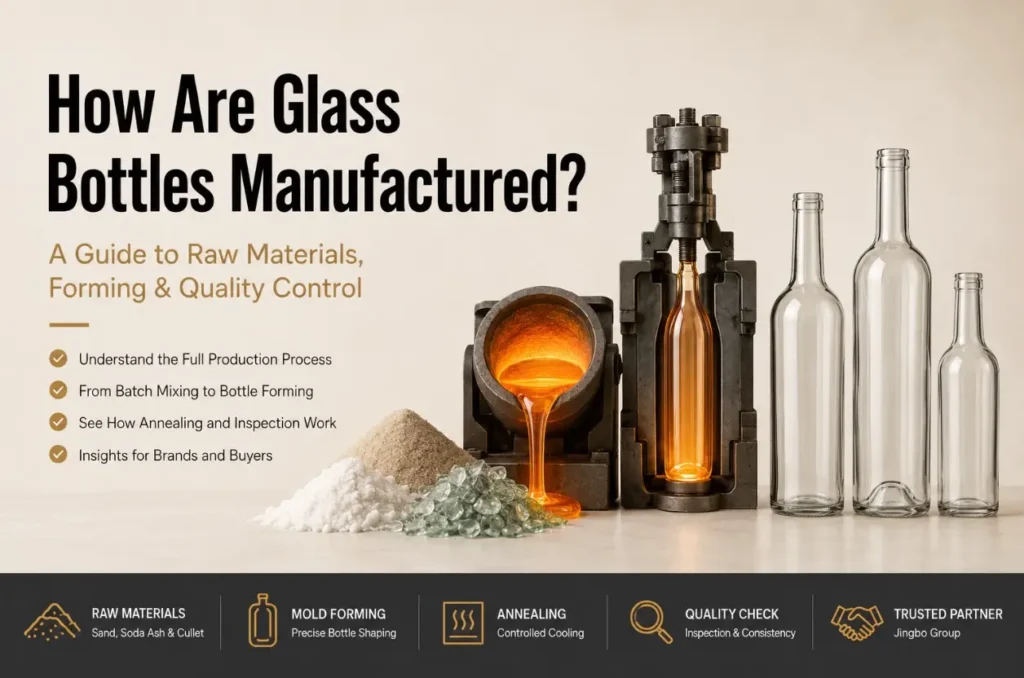
Glass bottles are manufactured by mixing silica sand, soda ash, limestone, and recycled glass. The mixture is melted in a high-temperature furnace and divided into measured pieces called gobs. Each gob is shaped inside metal molds, cooled gradually in an annealing lehr, inspected for defects, and decorated when required.
Every stage needs careful control. A small change in the raw materials, glass temperature, gob weight, mold condition, or cooling rate can affect the finished bottle.
Modern bottle production usually runs as a continuous process. Raw materials enter at one end, while formed and inspected bottles leave at the other. Depending on the project, the finished bottles may be clear, amber, green, or another color. They can also be round, square, oval, flask-shaped, or fully customized.
What Are Glass Bottles Made From?
Most packaging bottles are made from soda-lime glass. This is the standard glass used for beverage bottles, liquor bottles, perfume bottles, cosmetic containers, food jars, and many other types of packaging.
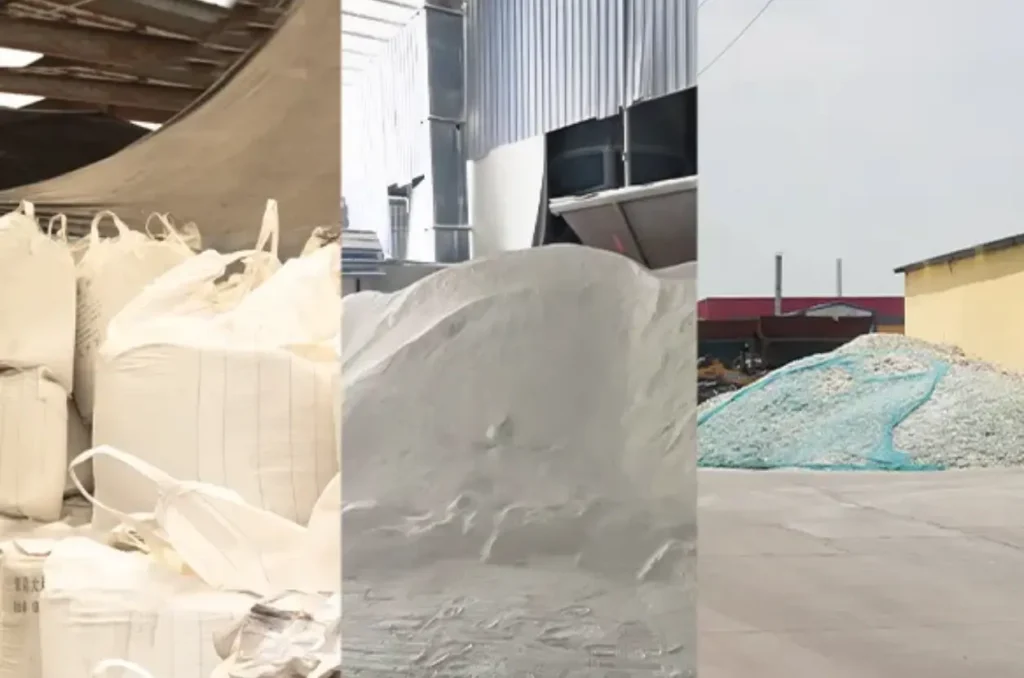
Its main ingredients are silica sand, soda ash, limestone, and cullet. Cullet is clean, crushed glass that can be melted and used again.
The Glass Packaging Institute explains that container glass is mainly made from sand, soda ash, limestone, and processed recycled glass. Manufacturers may also add small amounts of other materials to control color, melting behavior, and final glass quality. More information is available in its guide to what glass is made from.
| Raw Material | Main Role in the Glass |
|---|---|
| Silica sand | Forms the main glass structure |
| Soda ash | Helps the batch melt at a lower temperature |
| Limestone | Improves durability and chemical stability |
| Cullet | Melts more easily and replaces part of the new raw materials |
| Minor additives | Control color, refining, and other glass properties |
Each material must meet controlled specifications. Purity, particle size, moisture, and chemical consistency can all affect how evenly the batch mixes and melts.
Cullet also needs careful preparation. It is normally sorted by color, crushed, screened, and cleaned. Metals, ceramics, heat-resistant glass, and other contaminants must be removed because they can create defects in new bottles.
How Are Glass Bottles Manufactured Step by Step?
Each stage prepares the glass for the next. A problem that begins during mixing or melting may remain visible in the finished bottle, so manufacturers monitor both the material and the production conditions throughout the process.
Step 1: Raw Materials Are Measured and Mixed
Production begins in the batch house, where the factory stores, measures, and combines the main glass ingredients.
Silica sand normally makes up the largest part of the mixture. Soda ash, limestone, and clean cullet are added in controlled amounts according to the required glass formula and color.
Automatic weighing systems measure each ingredient before the materials are mixed into a uniform batch. Consistent mixing matters because the glass needs a stable chemical composition.
Poor material distribution can make melting more difficult. It may also affect glass color, clarity, viscosity, strength, or chemical stability.
Coloring materials can be added at this stage. Carefully controlled amounts of iron, chromium, cobalt, and other compounds can produce amber, green, blue, or other glass colors.
Step 2: The Batch Is Melted in a Furnace
The prepared batch enters a large glass furnace that operates continuously at a very high temperature.
Container-glass furnaces commonly run at about 1,500°C. At this temperature, the sand and other materials react and become molten glass.
The glass must become more than simply liquid. It needs to be uniform and free from unmelted particles, large bubbles, and obvious chemical differences.
As the molten glass moves through the furnace, the materials have time to melt, mix, refine, and become more consistent. The furnace usually stays in operation between production orders because cooling and reheating such a large structure would require considerable time and energy.
Step 3: The Molten Glass Is Conditioned
Glass leaving the main furnace is normally too hot and too fluid for stable bottle forming.
It therefore moves through a channel called a forehearth. The forehearth brings the molten glass to a controlled temperature and helps keep that temperature even before the glass reaches the forming machine.
The correct forming temperature depends on the glass composition, bottle weight, shape, and production method. The material must be soft enough to move through the mold, but controlled enough to maintain an even distribution.
Glass viscosity changes quickly with temperature. If the glass is too hot, it may spread unevenly. If it is too cool, it may not fill the mold properly.
Step 4: The Glass Is Cut Into Gobs
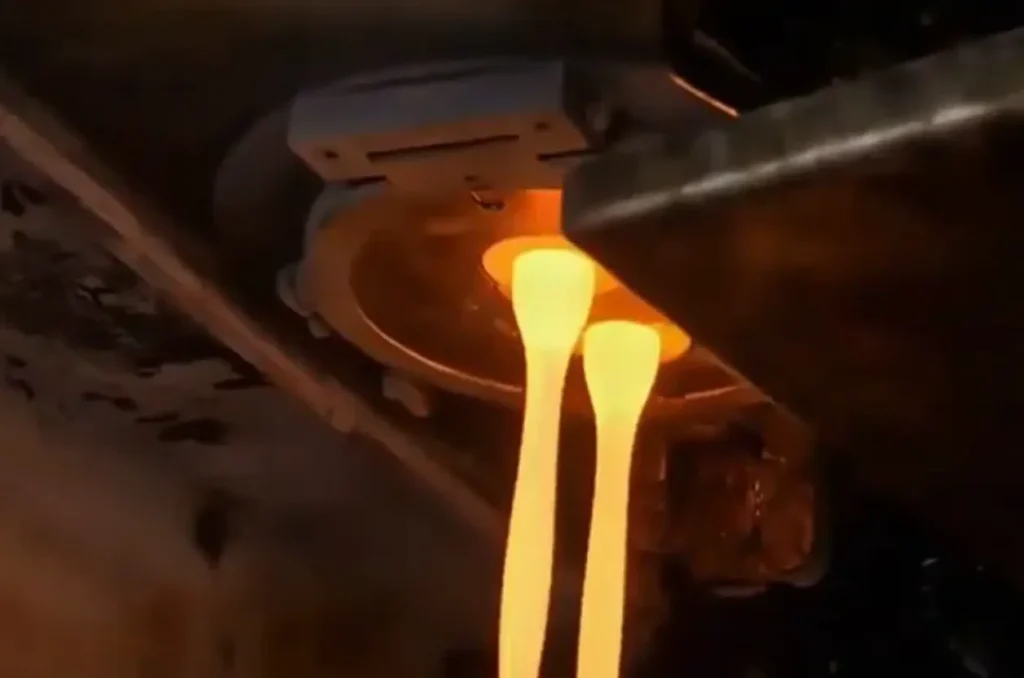
At the end of the forehearth, molten glass flows through an opening. Mechanical shears cut the stream into individual pieces called gobs.
Each gob contains the amount of glass needed to form one bottle.
Gob weight must remain consistent. An oversized gob may create an overweight bottle or leave too much glass in one area. An undersized gob may cause thin walls, low capacity, or incomplete forming.
Temperature and shape also matter. The gob must enter the forming machine smoothly and reach the correct position inside the first mold.
A delivery system guides each gob into the appropriate section of the forming machine.
Step 5: The Bottle Is Formed Inside Molds
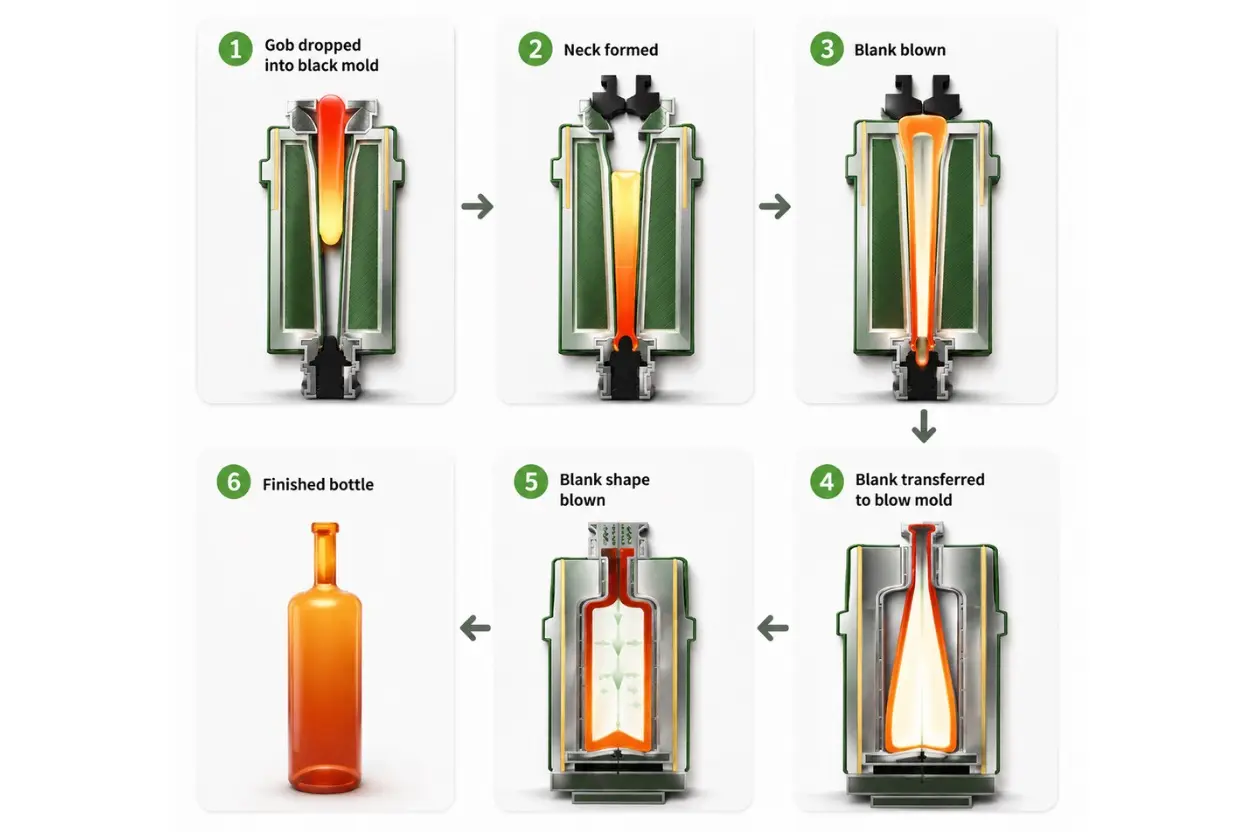
The gob first enters a blank mold, where the machine forms an initial hollow shape called a parison.
The parison is not yet a finished bottle. It already has the basic neck and internal cavity, but its body remains smaller and thicker than the final container.
The machine transfers the parison into a final blow mold. Compressed air expands the hot glass until it reaches the walls of the mold. At this point, the bottle takes on its final body shape, shoulders, base, and molded surface details.
Commercial container production mainly uses blow-and-blow, press-and-blow, and narrow-neck press-and-blow methods. Emhart Glass explains that manufacturers select the forming process according to the container opening, shape, weight, and required glass distribution. Its overview of glass container forming methods provides more detail.
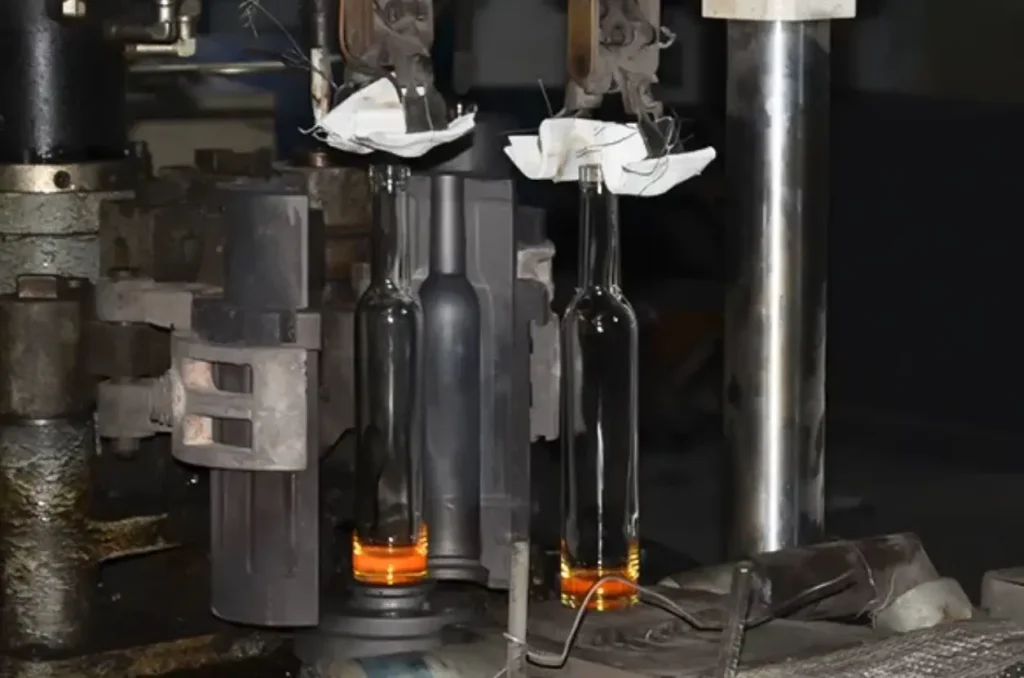
Blow-and-Blow Forming
The blow-and-blow process uses compressed air during both main forming stages.
Air first creates the hollow parison inside the blank mold. The machine then transfers the parison into the final mold, where a second air supply expands it into the finished bottle.
This method is commonly used for narrow-neck containers, including many beverage, liquor, pharmaceutical, and food bottles.
Press-and-Blow Forming
The press-and-blow process uses a metal plunger to form the parison inside the blank mold.
The plunger presses into the hot gob and creates the initial internal cavity. The parison then moves to the final mold, where compressed air expands it into the completed container.
This method is widely used for jars and other containers with wider openings. The plunger gives the machine direct control over the first glass shape.
Narrow-Neck Press-and-Blow Forming
Narrow-neck press-and-blow, often shortened to NNPB, applies a smaller controlled plunger to narrow-neck containers.
Compared with traditional blow-and-blow production, NNPB can give manufacturers more control over glass distribution. This may help reduce unnecessary bottle weight while maintaining the required performance.
Lightweighting does not mean simply removing glass. The remaining glass still needs to be distributed correctly around the body, heel, shoulders, base, and neck.
| Forming Method | How the Parison Is Made | Common Application |
|---|---|---|
| Blow-and-blow | Compressed air | Narrow-neck bottles |
| Press-and-blow | Metal plunger | Jars and wide-mouth containers |
| Narrow-neck press-and-blow | Smaller controlled plunger | Lightweight or controlled narrow-neck bottles |
Step 6: The Bottles Are Annealed
A newly formed bottle remains extremely hot. Its inner and outer surfaces do not cool at exactly the same rate.
If the glass cools too quickly, internal stress can remain trapped inside it. The bottle may then become more likely to crack during handling, filling, storage, or temperature changes.
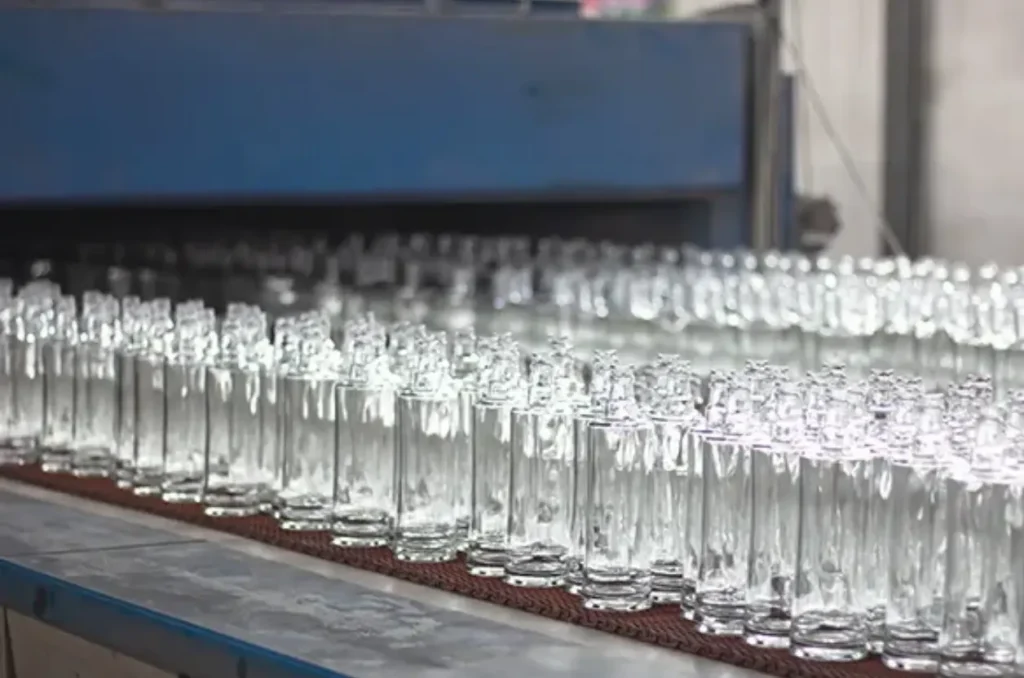
To prevent this, the hot bottles enter an annealing lehr. A lehr is a long, temperature-controlled oven with several heating and cooling zones.
As the bottles move through the lehr, the temperature falls gradually. This controlled cooling allows internal stress to relax throughout the glass.
When the bottles leave the lehr, they are cool enough for normal handling and inspection.
Annealing cannot correct a badly formed bottle. It reduces stress created during cooling, but the bottle still needs the right shape and glass distribution before entering the lehr.
Step 7: Protective Surface Treatments May Be Applied
Glass bottles often receive very thin protective treatments during production.
A hot-end coating may be applied while the bottle is still hot. A cold-end treatment can be added after annealing.
These coatings are different from decorative spray coatings. They are usually transparent and are intended to reduce scratching as bottles move against one another during production and handling.
Glass performs well under compression, but surface scratches can reduce its practical strength. Protecting the outer surface helps bottles move through inspection, storage, and later use with less damage.
The treatment is extremely thin and should not noticeably change the bottle’s appearance.
Step 8: The Bottles Are Inspected
Finished bottles must pass inspection before they are approved for use.
Modern factories use cameras, sensors, gauges, and mechanical testing systems. These systems can check the bottle dimensions, neck finish, verticality, wall thickness, base, cracks, stones, bubbles, and other visible or structural defects.
Inspection requirements depend on the application. A perfume bottle, food jar, still-water bottle, beer bottle, and pressure-rated sparkling-wine bottle do not need exactly the same tests.
Common inspection points include:
- body shape and dimensions;
- bottle height and verticality;
- neck opening and sealing surface;
- cracks around the finish or base;
- thin or uneven glass areas;
- bubbles, stones, and inclusions;
- base stability;
- capacity and weight;
- pressure, impact, or thermal-shock performance when required.
A small cosmetic bubble may be acceptable for some projects. A sharp crack, damaged sealing surface, or serious glass-distribution problem can make the bottle unsuitable for use.
Inspection helps separate minor visual variation from defects that may affect filling, sealing, safety, or appearance.
How Are Glass Bottles Decorated After Manufacturing?
The basic bottle is complete after forming, annealing, and inspection. Some bottles are supplied in this plain condition, while others move to a separate finishing process.
Decoration changes the surface appearance without altering the main glass structure. Common options include screen printing, frosting, spray coating, hot stamping, labels, decal printing, and metallization.
Embossing is different because the raised or recessed design is usually created by the bottle mold. It must therefore be planned before forming begins.
Brands comparing different finishes can read Jingbo Group’s guide to 玻璃瓶装饰.
Decoration should not be used to hide serious manufacturing defects. The undecorated bottle must first pass the required inspection.
Can Recycled Glass Be Used to Make New Bottles?
Yes. Clean recycled container glass can be crushed into cullet and melted to produce new bottles and jars.
Cullet melts more easily than completely new raw materials. It can reduce the amount of sand, soda ash, and limestone required in the batch.
The Glass Packaging Institute reports that every 10% increase in cullet can reduce furnace energy requirements by about 2–3%. It also states that container glass can be recycled repeatedly without losing its basic quality or purity. More information is available in its glass recycling facts.
Not every broken glass product belongs in a container-glass furnace. Mirrors, ceramics, drinking glasses, laboratory glass, ovenware, and other heat-resistant products may have different melting properties.
Cullet must therefore be sorted and cleaned before use. Contamination can create stones, streaks, weak areas, or other defects in the new glass.
How Are Colored Glass Bottles Manufactured?
Manufacturers can create colored glass bottles in two main ways.
The first method adds controlled coloring materials to the batch before melting. This produces color throughout the glass itself.
Amber and green beverage bottles are often made this way. Because the color is part of the glass composition, it remains visible even if the bottle surface is scratched.
The second method forms a clear bottle first and then applies a colored surface coating. Coating gives brands access to a wider range of shades, gradients, opaque effects, pearl finishes, and other decorative styles.
Colored glass and coated glass are not the same. One contains color throughout the glass, while the other has a decorative layer on the finished surface.
Buyers should confirm which method is being quoted because the appearance, decoration process, cost, and performance can differ.
Why Do Glass Bottles Have Lines or Seams?
Most machine-made bottles have visible mold seams.
A final blow mold normally consists of several metal sections. Where those sections meet, they may leave a thin vertical line along the bottle body.
Circular lines may also appear near the base or around the neck finish. These marks come from the points where different mold parts meet during forming.
A smooth, controlled seam is a normal part of machine production. It does not automatically mean the bottle is defective.
A seam may become a quality problem if it is unusually sharp, thick, uneven, cracked, or outside the approved tolerance.
Custom embossing and decorative panels should be planned around the mold seams. A seam that runs through a logo or main display area may affect the final appearance.
How Are Heavy-Bottom Glass Bottles Made?
A heavy-bottom bottle contains more glass around the base.
The effect begins with the bottle design and mold engineering. Gob weight, parison shape, mold cavity, forming process, and cooling conditions all influence where the glass moves.
The forming process must direct enough material toward the base while keeping the walls and shoulders properly formed.
A thick-looking bottom is not always solid glass. Some bottles use an internal push-up or recessed base to create a deeper visual effect.
The manufacturer must calculate the outer design and internal capacity together. Adding more glass to the base can change bottle weight, volume, cooling behavior, and production stability.
How Long Does It Take to Manufacture a Glass Bottle?
The actual forming stage is fast because automatic machines work in continuous cycles.
However, the complete production process cannot be described with one simple time. Raw materials must first be melted and conditioned. After forming, the bottles still need to pass through annealing, inspection, and any required decoration.
Once a line is running steadily, it can produce many bottles in a short period. The overall order schedule also depends on mold preparation, quantity, glass color, production planning, inspection, and finishing requirements.
A standard bottle made from an existing mold is usually easier to schedule than a completely new design.
A custom bottle requires design review, mold development, sample production, testing, and approval before bulk manufacturing can begin.
How Jingbo Group Manufactures Glass Bottles
Jingbo Group uses automated blow-and-blow and press-and-blow methods to manufacture packaging bottles. Mold engineering and inline inspection help control bottle shape, glass distribution, mouth dimensions, and visible quality.
After the bottle is formed, Jingbo Group can provide screen printing, hot stamping, frosting, spray coating, metallization, labels, and other finishing processes. Customers can select an existing mold or develop a new custom bottle for a long-term packaging project.
More information about the company’s manufacturing and finishing capabilities is available on the Jingbo Group factory page.
Frequently Asked Questions About Glass Bottle Manufacturing
Are Glass Bottles Blown by Hand?
Most commercial packaging bottles are not blown by hand. Automatic machines use molds, compressed air, and plungers to produce bottles consistently at high speed.
Hand-blown glass is still used for artistic glassware, decorative bottles, prototypes, and some low-volume specialty products.
What Temperature Is Used to Make Glass Bottles?
The raw materials are melted at about 1,500°C, although the exact temperature depends on the glass composition and furnace conditions.
Before forming, the molten glass is cooled and conditioned to a more controlled temperature.
Why Can Glass Bottles Not Cool Naturally?
Rapid and uncontrolled cooling can leave internal stress inside the glass. A bottle may look normal but become more likely to crack later.
An annealing lehr lowers the temperature gradually and helps release this stress.
Are Mold Seams a Glass Bottle Defect?
A thin, smooth mold seam is normal on machine-made bottles.
It may become a defect if it is sharp, excessively thick, cracked, badly misaligned, or outside the approved appearance standard.
Can Old Glass Bottles Become New Bottles?
Yes. Clean, correctly sorted container glass can be crushed into cullet and melted again.
The recycled material must be free from ceramics, metals, heat-resistant glass, and other contaminants.
Are All Glass Bottles Made From the Same Glass?
Most packaging bottles use soda-lime glass, but the exact composition can vary.
Manufacturers may adjust the formula for color, clarity, melting behavior, chemical durability, or a specific application.
What Is a Parison?
A parison is the first hollow glass shape created inside the blank mold.
It is transferred to the final mold, where compressed air expands it into the finished bottle.
Why Do Some Bottles Have Uneven Glass Thickness?
Bottle geometry naturally requires different amounts of glass in different areas. However, excessive variation may result from incorrect gob temperature, forming conditions, mold cooling, or parison design.
Controlled glass distribution is important because very thin areas may reduce bottle performance.
结论
The glass bottle manufacturing process turns sand, soda ash, limestone, and recycled glass into finished packaging through melting, gob cutting, mold forming, annealing, and inspection.
Every stage influences the final result. Stable materials, controlled temperatures, accurate molds, gradual cooling, and reliable inspection are all necessary for consistent production.
京博集团 combines automated glass forming, custom mold development, quality inspection, and in-house decoration to support both standard bottles and custom packaging projects.