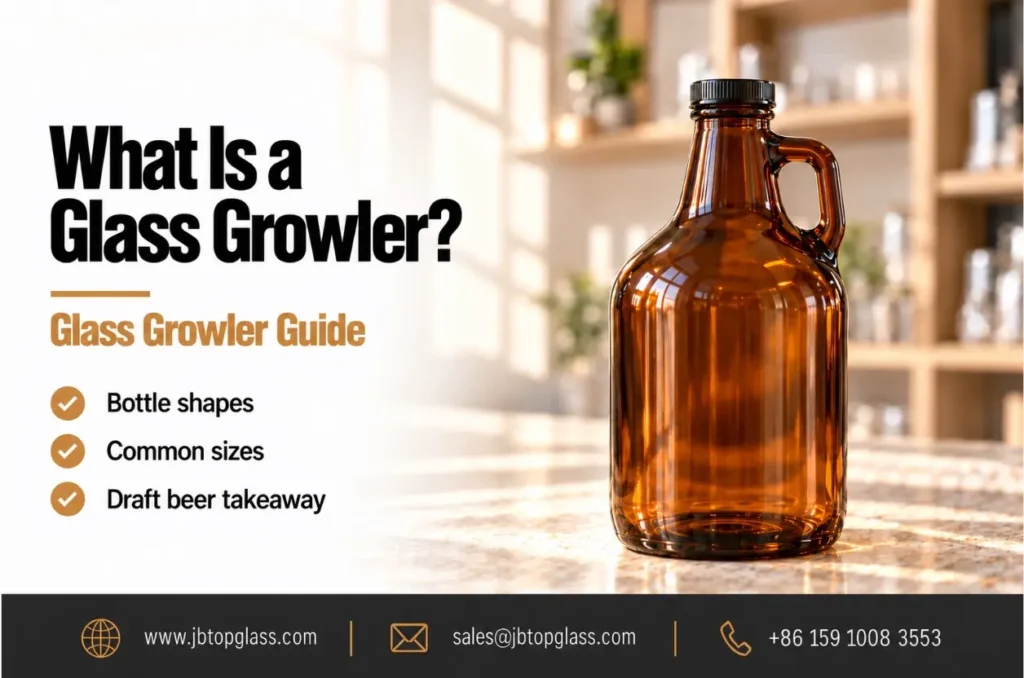
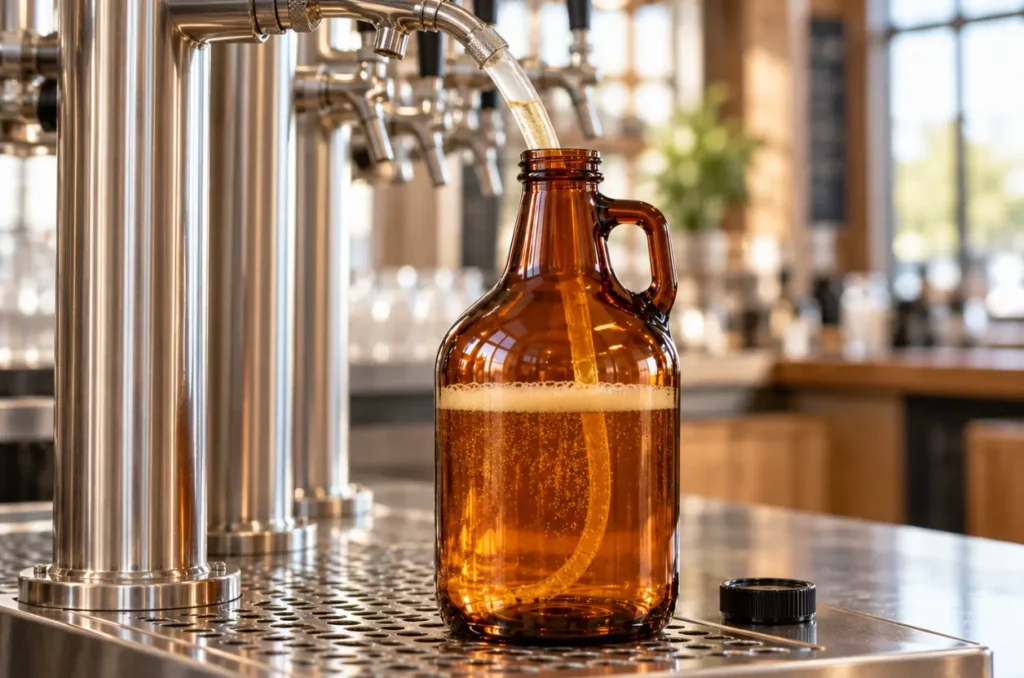
A glass growler is a bottle or jug used to take draft beer home from a brewery, taproom or beer retailer. A familiar example is the amber glass jug with a rounded body and a small handle near the neck. Other designs have taller bodies, swing-top closures or no handle at all.
Picture a customer trying a beer at a brewery and wanting to take some home. The brewery fills a growler with that beer, closes it and sells it as a takeaway purchase. Where a refill service is available, the customer may bring the container back for another fill.
That everyday use explains the product better than its shape alone. Glass growler bottles give breweries a takeaway format for beer served on draft. For buyers exploring this category, the main differences to understand are capacity, bottle design and how the brewery plans to use the container.
What Does a Glass Growler Look Like?
The traditional jug-style growler has a broad body, sloping shoulders and a relatively short neck. A molded glass handle sits near the neck, giving the container its recognizable jug-like appearance.
You will also find growlers that look more like oversized beer bottles. Some are tall and narrow, while others have a short, rounded body. Handles vary too: one model may have a small finger loop, another a larger handle, and another none.
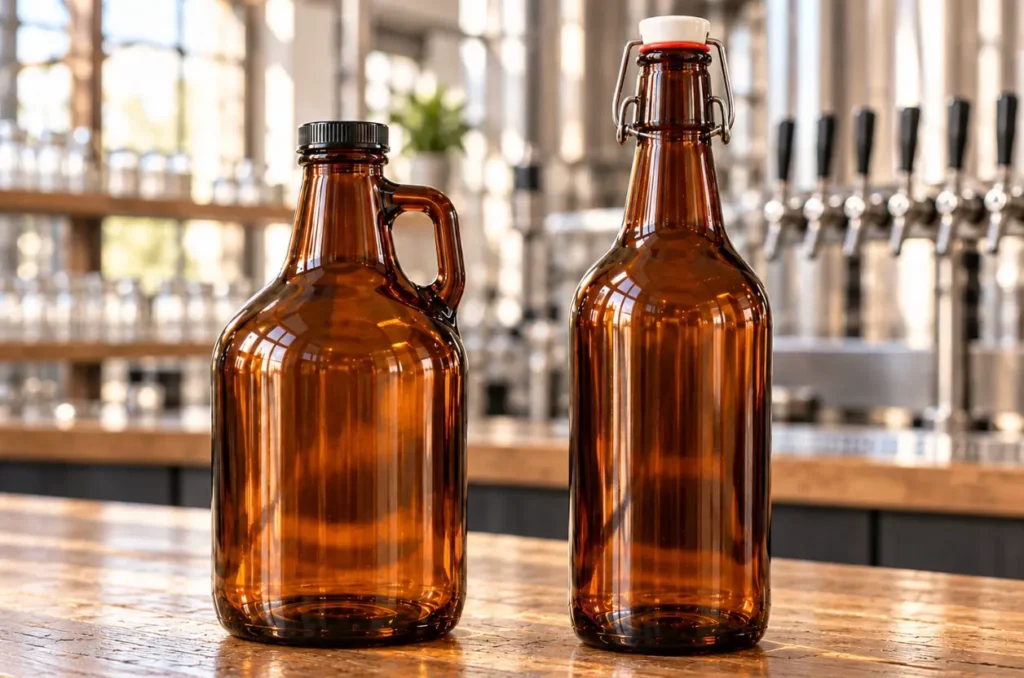
These differences explain why growlers from two suppliers may look quite unlike each other. The name covers a category of containers used for draft beer takeaway, rather than one fixed bottle shape.
“Glass” identifies the material. Growlers are also made from stainless steel and ceramic, so a search for beer growlers can bring up products that look very different from glass bottles.
When browsing a catalogue, the photographs show the bottle style. The capacity and dimensions tell you which version you are looking at. A tall bottle is not necessarily larger in volume than a short, broad jug.
How Is a Growler Different from a Regular Beer Bottle?
A regular retail beer bottle is usually filled during a bottling run and distributed as a packaged product. A growler is commonly filled from a draft beer system for takeaway sale.
For example, a brewery might sell its regular bottled range through retail stores while offering growler fills at its taproom. Customers can choose a beer from the draft selection and take home a larger quantity in a growler.
That makes growlers useful for beers already being served on tap, including releases that are not offered in the brewery’s regular bottled range.
Size alone does not define the category. A large beer bottle filled for retail distribution does not automatically become a growler. The familiar handle is not a requirement either.
Some businesses also fill growlers before customers arrive, so filling at the moment of purchase is not a universal rule.
For a packaging buyer, the useful distinction is how the bottle fits the brewery’s sales. A growler serves its draft beer takeaway offer; a conventional beer bottle serves its bottled product range. The same brewery may need both.
What Sizes Do Glass Growler Bottles Come In?
Glass growler bottles are available in U.S. fluid-ounce sizes and metric capacities. Formats include 32 U.S. fl oz, 64 U.S. fl oz, 1L and 2L.
The ounce figures here mean U.S. fluid ounces, which measure volume. They should not be confused with ounces used to describe bottle weight.
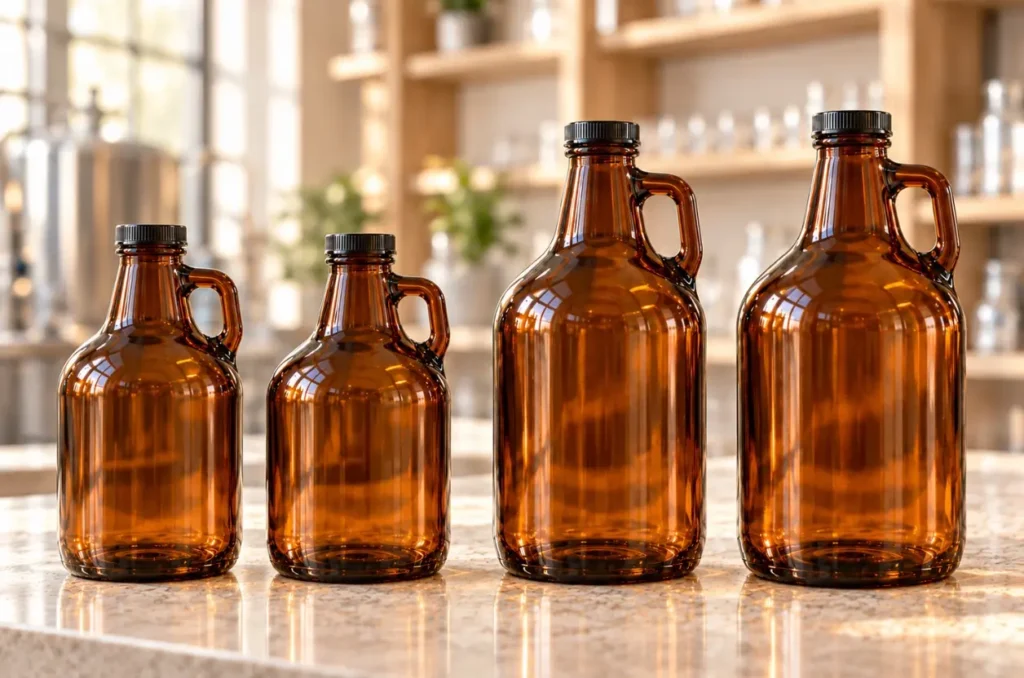
32 U.S. fl oz: Approximately 946 ml
A 32 fl oz growler holds about 946 ml. It offers a smaller takeaway quantity than a 64 fl oz growler, which can be useful when customers want less beer in one container.
A brewery may offer a smaller format alongside a larger one, giving customers a choice at the counter.
Although 32 fl oz is close to one liter, it is approximately 54 ml less. A distributor listing both sizes should keep them as separate products so the bottle description matches the quantity the brewery plans to sell.
64 U.S. fl oz: Approximately 1.89L
The 64 fl oz glass growler is a familiar format in the U.S. market. It holds half a U.S. gallon, or approximately 1.893L.
Amber glass jugs with handles are a recognizable example, although other designs can hold the same amount.
Compared with a smaller growler, this format gives customers more beer in one container. The filled package is also heavier, so its grip and pouring feel deserve attention when comparing samples.
A 64 fl oz growler holds about 107 ml less than a 2L model.
1L and 2L: Metric Formats
Metric sizes such as 1L and 2L glass growlers are also used by breweries.
These capacities may be a straightforward choice for a business that already sells its growler fills by the liter. They also let a brewery offer two quantities within the same service.
The size choice should follow the amount customers are expected to buy. A smaller growler offers a lower-volume purchase, while a larger one provides more beer for sharing. Both need to be practical to carry and pour when full.
Neither size requires one particular shape. Two 2L growlers can have quite different heights, widths and handles.
Filling Capacity Is Different from Brimful Capacity
The amount of beer a brewery sells is different from the bottle’s total volume when filled to the very top.
A growler needs space above its intended fill. The correct filling level comes from the bottle specification, rather than the point where liquid would overflow.
This is the distinction between nominal and brimful capacity. Nominal capacity describes the intended product volume; brimful capacity describes the bottle’s maximum internal volume.
When comparing a drawing with a catalogue listing, check which capacity the figure represents. That keeps the intended beer quantity separate from the bottle’s total internal space.
What Does the Bottle Design Change?
Body Shape and Handling
A short, broad growler and a tall, narrow bottle can hold the same quantity while feeling different in use.
The broader model has a jug-like profile. A taller bottle changes where the customer supports the container when carrying and pouring it.
Handle position also matters. A small loop near the neck provides a different grip from a larger handle beside the body. A bottle without a handle relies on the body shape for its grip.
These are easier differences to understand with a physical sample than with a front-view photograph. A handle may extend beyond the main body without being obvious in that image.
For space planning, the overall width should include the handle. For handling, the sample should represent the experience of using the filled container. Capacity tells you how much beer it holds, while the shape determines how that volume is presented and handled.
Amber or Clear Glass
Amber glass helps protect beer from light that can produce a light-struck, or “skunky,” flavor. Clear glass shows the beer’s color but does not provide the same protection.
This makes glass color a functional choice as well as a visual one.
A brewery may already have a policy on which containers it accepts for growler fills. An attractive clear bottle with the correct capacity could still fall outside that policy.
Amber glass does not provide insulation, so it should not be treated as a way to keep beer cold.
Neck Finish and Bottle Style
Glass growlers come with different neck finishes, including designs for screw closures and swing-top systems.
The neck finish is the shaped part of the glass that works with the closure. Two bottles with the same capacity can have different neck designs and require different closing systems.
This detail is easy to miss when comparing full-bottle photographs. A handled screw-neck jug and a tall swing-top bottle may both be sold as growlers, but they remain different glass products.
The brewery’s existing filling and closing setup helps determine which design makes sense for its service.
Suitability for Carbonated Beer
A growler used for carbonated beer must withstand the pressure from the beer and the filling method. The specific bottle model needs to suit both.
A jug intended for a still liquid may look similar. Its appearance does not establish that it can hold carbonated beer.
Amber glass, a heavy base and a familiar growler shape cannot confirm a pressure rating. Buyers need that information for the actual model being considered.
الـ bottle and filling method need to be assessed together, particularly when the brewery uses a pressurized filling system.
How Do Breweries and Retailers Use Glass Growlers?
Draft Beer to Take Home
A growler service lets customers take away beer that is already available on draft.
For example, a customer tries a seasonal beer at a taproom and wants to share it at home. The brewery can sell a growler fill through its draft service, even if that beer is not available in its regular small-bottle range.
The container becomes part of that purchase. Customers see its shape at the counter, carry it home and use it to pour the beer.
A brewery can therefore offer growlers alongside its existing bottles and cans. Each format serves a different kind of purchase.
This is the main reason to consider the category: the brewery has a draft beer takeaway service to supply.
Refill Services
Some businesses sell a growler with the customer’s first beer purchase and accept it for later refills. Others run an exchange service, taking back an approved empty container and supplying a filled one.
The arrangements vary between businesses. A bottle accepted by one brewery may not be accepted by another.
Many glass growlers are offered for refill services, but the name alone does not confirm that a particular model is designed for repeated use. The glass manufacturer should confirm its suitability for that purpose.
For containers entering a reuse system, the design and testing need to support repeated use. There is no single refill count that applies to every glass growler.
A brewery planning to accept bottles back should make that requirement clear when discussing the bottle model. A one-time takeaway purchase and an ongoing refill service place different demands on the container.
Draft Beer Retailers
Growler filling is also offered by some retailers with draft beer systems.
Customers choose from the beers available at the counter and buy a takeaway quantity in the retailer’s accepted container.
The bottle may be plain glass with a product label or carry the retailer’s branding. In either case, it becomes the package the customer takes home.
For distributors supplying these businesses, the useful product details are concrete: capacity, shape, glass color, neck finish and whether the model meets the customer’s filling and reuse requirements. Keeping those details clear makes different growler models easier to identify.
How Long Does Beer Stay Fresh in a Glass Growler?
A glass growler does not come with one shelf life that applies to every beer and filling process.
The amount of oxygen introduced during filling affects beer quality. The seal and storage temperature matter too. A bottle filled at a draft counter should not automatically receive the same shelf-life claim as beer from a controlled bottling line.
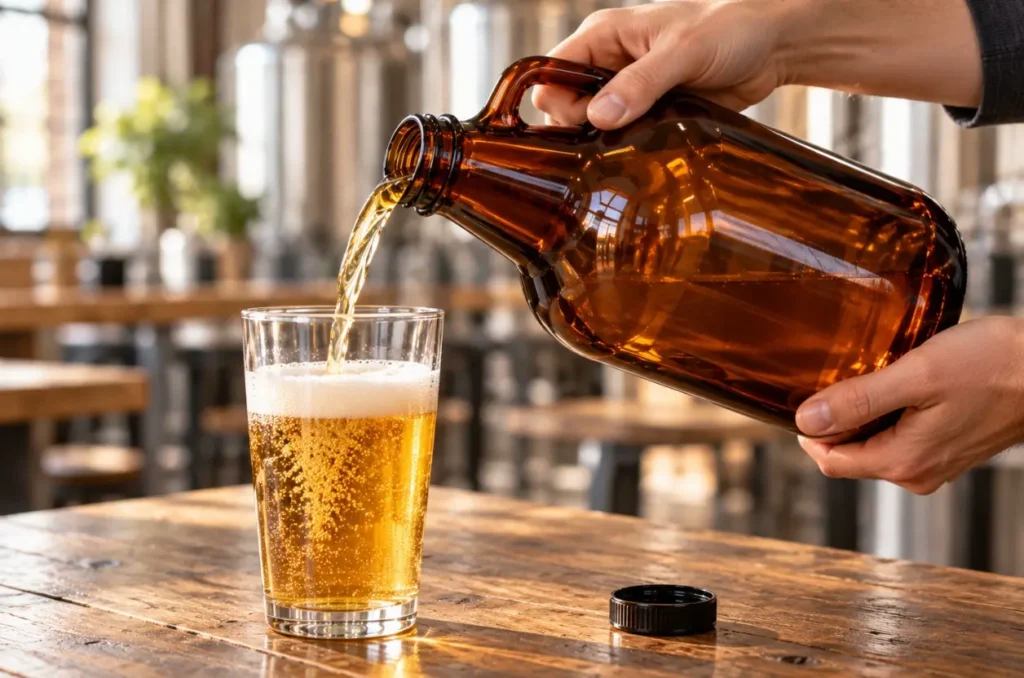
Opening creates another change. As beer is poured out, air enters the container and the remaining beer loses carbonation over time. Closing it again does not restore the conditions before opening.
The brewery’s storage and drinking guidance should therefore reflect its actual beer, filling process and package.
Freshness also helps explain why capacity deserves thought. A larger growler provides more beer in one container, but customers may take longer to finish it after opening. A smaller format offers less beer to use during that period.
The right quantity depends on how the brewery’s customers are likely to buy and enjoy the beer. Glass capacity alone cannot establish a freshness period.
الأسئلة الشائعة
Do All Glass Growlers Have Handles?
No. Handles are common on jug-style growlers, but other designs have taller bottle shapes without handles. The term describes their draft beer takeaway use, so a handle is not a requirement.
Can a Glass Growler Run on an Existing Beer Bottling Line?
That needs to be checked for the specific bottle and equipment. Its height, body width, neck finish and any handle can affect how it fits the line. A bottle used successfully in a taproom filling setup is not automatically compatible with another filling system.
What Is the Difference Between a Growler and a Crowler?
A glass growler is a bottle or jug used for draft beer takeaway. A crowler is a can filled with draft beer and sealed for takeaway. Their similar names refer to different packaging formats.
Does a Glass Growler Keep Beer Cold?
An ordinary glass growler is not insulated. It does not provide the temperature protection of a purpose-built insulated container, so filled beer still needs appropriate chilled handling and storage.
الخاتمة
Glass growler bottles give breweries and draft beer retailers a way to sell beer for customers to take home. The familiar amber jug is one design within a category that includes several shapes and capacities.
The most useful starting point is the service the bottle will support. The intended beer quantity, filling method and plans for refilling help narrow down the capacity and design.
Contact Jingbo Group to discuss bottle shapes, capacities and customization options for your brewery’s glass packaging project.