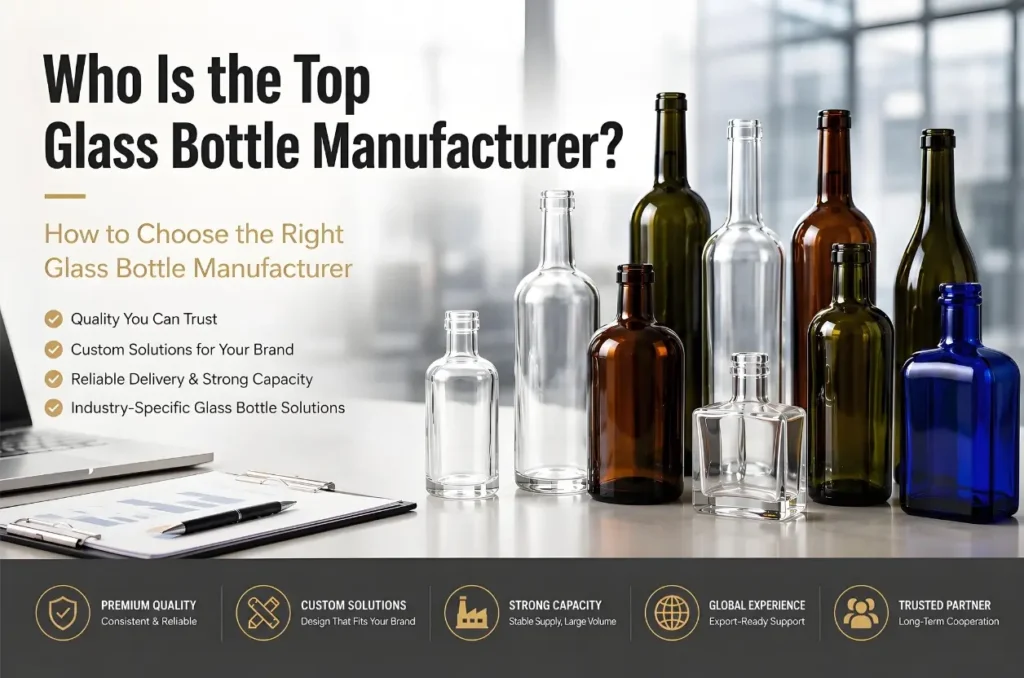
Glass bottles are used in alcohol production, beverage plants, cosmetics brands, perfume houses, food companies, and wholesale distribution. They hold spirits. They hold juice. They hold cream and serum and fragrance. They sit on shelves. They travel across oceans. They pass through filling lines. They end up in a customer’s hand.
But not all glass bottle manufacturers produce the same quality. Some factories have modern kilns and strict inspection. Others have older equipment and higher rejection rates. Some carry ISO and FDA certifications. Some do not. Some can design a custom mold in-house. Some outsource it.
Jingbo Group finds that choosing a glass bottle supplier is not only about price. It is about production capacity, certification, mold capability, surface treatment, delivery reliability, and communication speed. The wrong choice can lead to delayed shipments, failed compliance tests, or bottles that look different from sample to sample.
This guide compares five of the most frequently cited glass bottle manufacturers in global sourcing. It also explains what to check before you commit, what mistakes to avoid, and how each manufacturer fits different industries.
How to Evaluate a Glass Bottle Manufacturer Before You Commit
Google “glass bottle supplier” and you will get hundreds of results. Most of them look similar. Product photos. Company intro. Contact form. But behind those websites, the difference between a supplier that delivers and one that disappoints comes down to a few things.
Production Capacity and Turnaround Time
Buyers often underestimate capacity. Place a 500,000-bottle order with a factory that runs only two production lines. Your lead time stretches from weeks into months. Find out how many kiln lines the factory operates. Find out what the daily output is. Multiple kilns mean the factory can handle rush orders and seasonal spikes without pushing back your delivery date.
Turnaround time also depends on whether the mold already exists. A custom shape adds 15 to 30 days for mold design and testing before production starts. Get this timeline in writing.
Kiln technology matters too. Modern kilns produce glass with fewer defects. They produce glass with better color consistency. Older kilns still work. But they generate higher rejection rates. That slows your order. That raises your cost per usable unit. If your brand needs consistent bottle appearance across thousands of units, find out whether the factory uses automated inspection to catch defects before shipping.
This does not mean old kilns are automatically disqualifying. Some well-run factories with older equipment still produce acceptable glass. But the buyer should know what they are getting into.
Quality Certifications and Compliance
Selling into the US, the EU, or the Middle East? Your bottles must meet food-contact and safety regulations in those markets. Check for these certifications before you sign anything:
- ISO 9001 — quality management system
- ISO 14001 — environmental management system
- FDA food-contact compliance — required for the US market
- EU Regulation 1935/2004 — required for the European market
If a supplier has these, they have already done the testing and paperwork. If they cannot show you current certificates, you will be the one dealing with the gap later.
Jingbo Group finds that certification gaps are one of the most common reasons B2B buyers switch suppliers. It is not that uncertified factories cannot make good glass. It is that uncertified glass cannot enter certain markets. The buyer carries that risk.
Custom Mold Design and OEM Flexibility
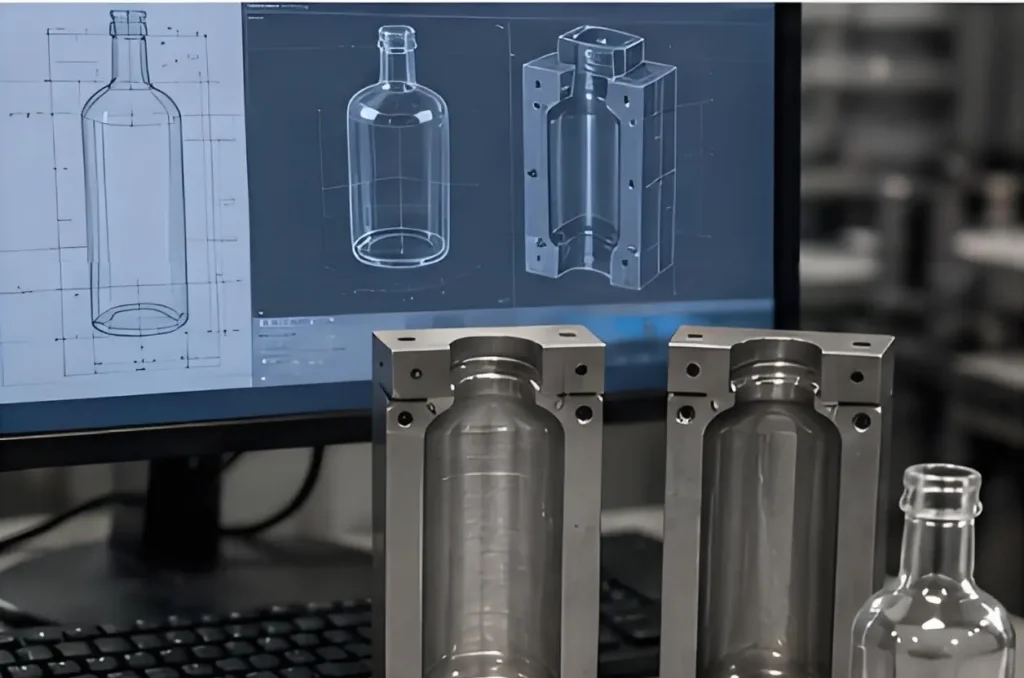
Standard bottles work fine for some brands. But if your product needs a signature shape — a square whiskey bottle, say, or a tapered perfume flask — you need a factory that designs molds in-house. Outsource the mold and you add a middleman. That means slower revisions. That means less control over quality.
Also check the minimum order quantity for custom glass bottle runs. Some factories set the MOQ at 100,000 units. That prices out smaller brands or test batches. Others go as low as 5,000 to 10,000. That lets you try a new product line without going all in.
This does not mean low MOQ is always better. A factory that accepts very small custom runs may have less experience with complex molds. The buyer should ask to see previous custom work samples before committing.
Top Glass Bottle Manufacturers Worldwide: Side-by-Side Comparison
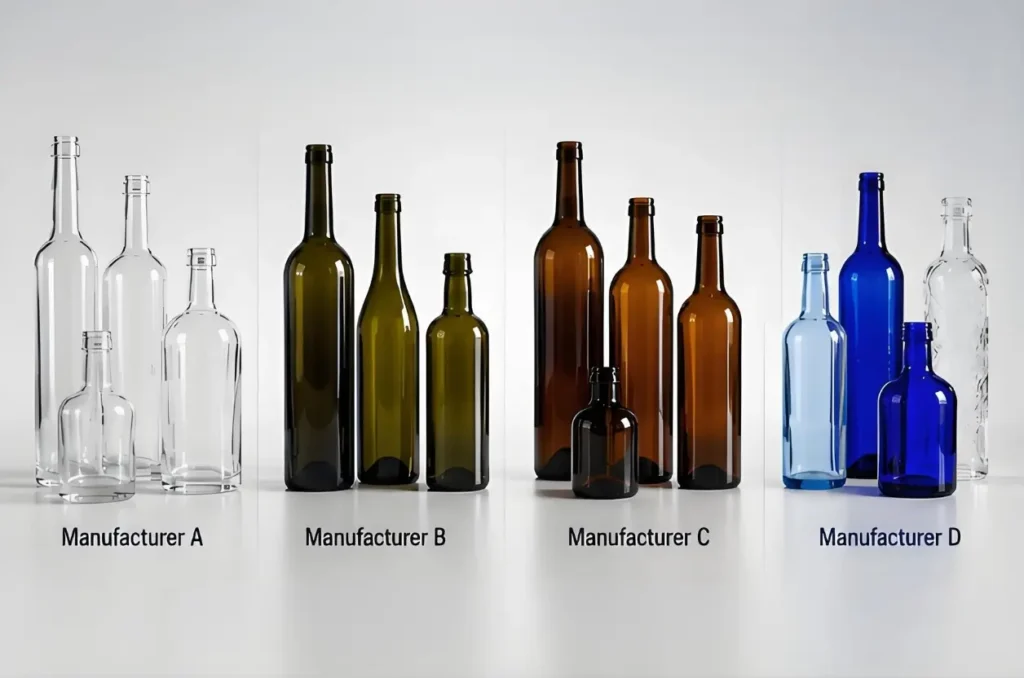
Five names come up again and again in global glass bottle sourcing. The table below lines them up side by side.
| الشركة المصنعة | Headquarters | Production Scale | Specialty Industries | Export Regions | Key Certifications |
|---|---|---|---|---|---|
| O-I Glass | USA | 70+ plants in 19 countries; 45B+ containers/year | Beverages, food, spirits | Global (Fortune 500) | ISO, food-contact compliance |
| Ardagh Group | Luxembourg | Multiple plants across Europe and Americas | Food, beverages, spirits | عالمي | ISO, food safety certifications |
| Verallia | France | Leading position in Europe | Food, beverages, cosmetics | Europe, growing global reach | ISO, food-contact compliance |
| Piramal Glass | India | Specialty and large-scale production | Cosmetics, perfumes, pharma, food | عالمي | ISO, FDA certified |
| Jingbo Group | China | Large-scale integrated facility, 1000+ custom mold designs | Spirits, wine, beer, cosmetics, perfume, food | Americas, Europe, Asia, Middle East | ISO 9001, ISO 14001, SGS, FDA |
O-I Glass
O-I Glass (formerly Owens-Illinois) is the biggest glass packaging manufacturer in the world by volume. The Fortune 500 company runs more than 70 plants across 19 countries. It produces over 45 billion glass containers each year. O-I is strong in beverage and food packaging. Its size gives it logistics reach that smaller manufacturers cannot match.
If you are a very large buyer who needs containers in multiple regions at once, O-I is where most people start. But O-I may not be the best fit for buyers who need small custom runs or highly specialized bottle shapes. Its strength is scale. Its tradeoff is flexibility.
Ardagh Group
Ardagh Group operates across Europe and the Americas. Its product range covers food, beverages, and spirits. The company holds ISO and food safety certifications. It has made public commitments to cut emissions in its production process.
If you want a European or Americas-based supply chain and prefer not to source from Asia, Ardagh is a natural fit. But if your priority is per-unit cost on large volumes, Asian manufacturers may offer better pricing.
Verallia
Verallia is a major European glass container producer. It has strong positions in France, Spain, Italy, and Brazil. The company focuses on food, beverages, and increasingly cosmetics.
Where Verallia stands out is design innovation and shorter lead times for European customers. If you sell mainly in Europe, put Verallia on your shortlist. If you need bottles shipped to the Americas or Asia, other manufacturers may offer better logistics.
Piramal Glass
Piramal Glass, part of the Piramal Group, focuses on cosmetics, perfume, and pharmaceutical glass packaging. The company holds ISO and FDA certifications. It ships globally from its production base in India.
Piramal works well for buyers who need small-to-medium runs of premium or specialty bottles, particularly in fragrance and pharma. But if your main need is high-volume beverage bottles, Piramal’s specialty focus may not be the most cost-effective choice.
Jingbo Group
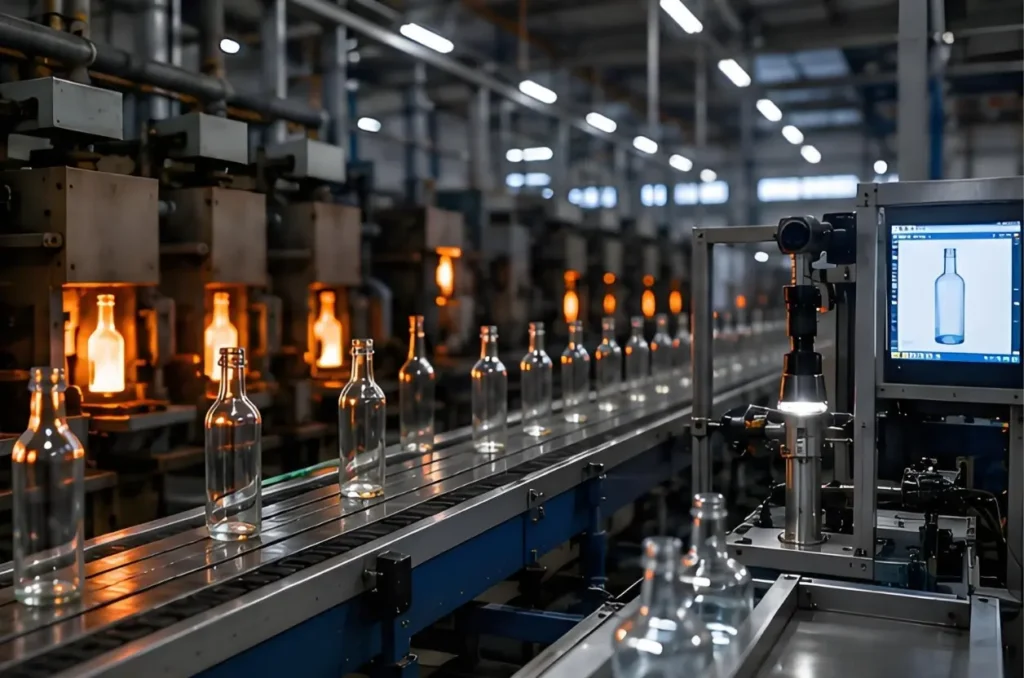
Jingbo Group runs a large-scale, integrated glass bottle factory in Heze, Shandong, China. The company makes bottles for spirits, wine, beer, perfume, cosmetics, food jars, and water bottles. Capacities range from 50 ml to 3,000 ml. Jingbo has over 1,000 custom mold designs on file. It does deep-processing work — decal printing, spray coating, screen printing — in-house. The factory holds ISO 9001 and ISO 14001 certifications. It ships to the Americas, Europe, Asia, and the Middle East.
Jingbo Group finds that many B2B buyers want one supplier that can cover multiple product lines. A distillery may need spirit bottles and wine bottles. A distributor may need food jars and cosmetic containers in the same shipment. Jingbo’s breadth of catalog is one of its main advantages.
But this does not mean Jingbo is the right choice for every buyer. If you need a purely European supply chain, Verallia or Ardagh may make more sense. If you need very small niche runs in pharma glass, Piramal may be a closer match. The right manufacturer depends on what you make, where you sell, and how much you order.
Which Manufacturer Fits Your Industry?
A distillery does not evaluate bottles the same way a cosmetics brand does. What you care about depends on what you make and who buys it.
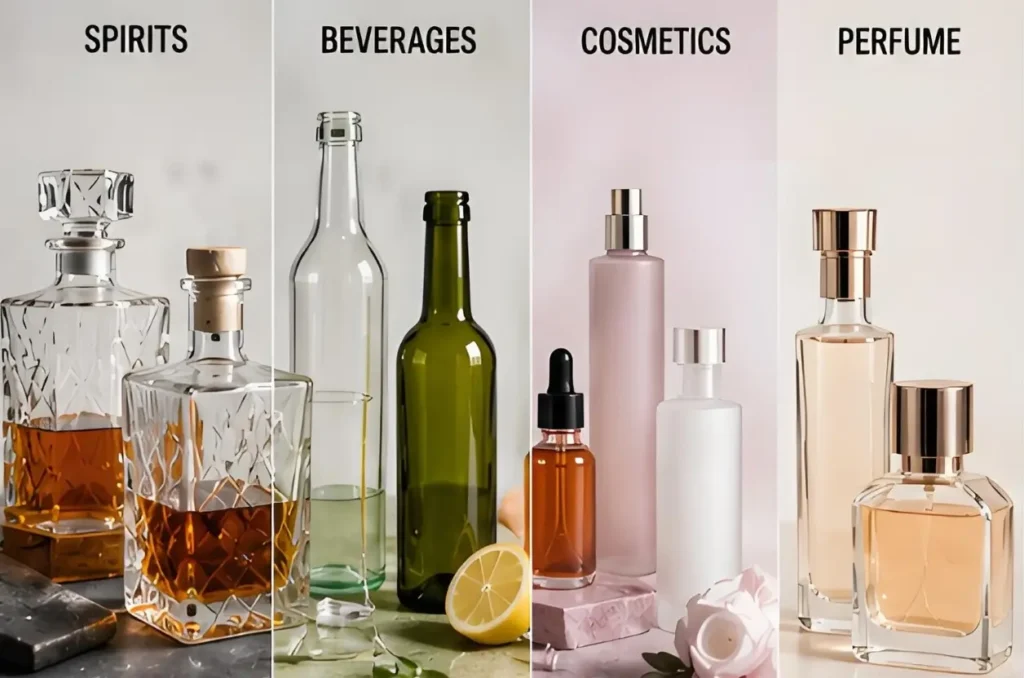
Distilleries and Spirit Brands
Spirit producers need bottles that hold high-alcohol liquids without leaching or cracking. The glass must meet food-contact standards for alcoholic beverages. But compliance is just the baseline. Distilleries also care a lot about shelf presence. A distinctive bottle shape can define a brand as much as the liquid inside.
Jingbo Group finds that liquor bottle manufacturers who have worked with whiskey, vodka, and rum before already know the weight and closure specs these products need. Find a factory that offers custom mold design with low MOQs on new shapes. Make sure it can do deep-processing work like frosting or metallic spray.
One thing that catches many distilleries off guard: closure compatibility. Spirits bottles often use cork stoppers, wooden caps, or premium glass stoppers. If your bottle factory cannot supply those closures, you end up buying them from a second vendor. That means two purchase orders. That means two quality checks. That means a risk of mismatch at the filling line.
Getting the bottle and the closure from the same supplier cuts out that hassle. But this does not mean every factory can supply every closure type. Check before you commit.
Beverage and Juice Companies
Beverage producers run on volume and consistency. A juice brand that orders 2 million bottles per quarter cannot afford batch-to-batch variation in color or thickness. Production capacity and quality stability come first.
Beverage glass bottle supplier should show you consistent output data from long runs. It should hold food-contact certifications for non-alcoholic beverages. Need pasteurization-compatible glass? Confirm that upfront. Closure options matter too. Screw caps, crown caps, and swing tops each suit different product lines.
Hot-fill and cold-fill processes put different stress on glass. If your beverage goes through a hot-fill cycle at 85°C or higher, the bottle walls have to be thick enough to take thermal shock without cracking. Not every factory engineers bottles for this. Double check that your supplier knows hot-fill specs before you order.
The same goes for carbonated beverages. They need bottles rated for internal pressure. A supplier that has already made beer or soda bottles will have those specs ready.
A beverage line may face hot fill, cold fill, carbonation, pasteurization, and long-distance shipping in the same product family. The bottle should be designed for the most demanding condition it will face.
Cosmetics and Skincare Brands
Cosmetics packaging does two jobs. It protects the formula. It signals the brand’s price point.
A cosmetic glass bottle manufacturer needs to offer surface treatments — frosting, gradient coating, silk screening. It needs to support small batch customization for limited-edition launches. Many cosmetics brands test new products in runs of 5,000 to 10,000 units before scaling up. Pick a factory that can handle that range without forcing you into a 100,000-unit minimum.
This does not mean small batch always costs more per unit. Some Chinese manufacturers offer competitive pricing on smaller runs because their labor and overhead costs are lower. But the buyer should still compare. Small batch pricing varies more between factories than large batch pricing.
Perfume and Fragrance Houses
Perfume bottles are the hardest glass packaging to get right. You need crystal-grade clarity. You need precise mold detail for decorative shapes. You need compatibility with fine-mist sprayers.
Perfume bottle manufacturer also needs to handle very small batch sizes. Some fragrance houses order as few as 1,000 to 3,000 units for a niche launch. Check whether the factory can produce super flint glass. That is the highest clarity grade. Check whether it supplies matching caps and sprayer assemblies.
Color accuracy matters a lot in fragrance packaging. Perfume brands often specify exact Pantone or CMYK values for bottle coatings. The factory needs to hit that color consistently across the whole batch. Spray coating and electroplating create different visual effects. Have your supplier explain which technique matches what you are after. And whether they can repeat it on reorder.
But color consistency is not only about technique. It is also about process control. A factory that tracks color readings batch by batch is more likely to deliver repeatable results than one that adjusts by eye.
Wholesale Distributors and Packaging Traders
Distributors look at glass bottle manufacturers differently from brand owners. You want breadth. One supplier that can fill orders across spirit bottles, food jars, cosmetic containers, and more. Price competitiveness matters too, because your margin sits between the factory and the end buyer.
A manufacturer with a wide product range and flexible MOQs across categories saves you the trouble of juggling multiple suppliers. Consolidating mixed-product shipments into one delivery cuts freight costs.
Chinese manufacturers like Jingbo Group often work well in this role. They carry broad product lines. They give competitive per-unit pricing on combined orders. But this does not mean every Chinese factory is the same. Product range, surface treatment capability, and export experience vary a lot. The buyer should ask specific questions about each product category, not assume that one factory can do everything equally well.
5 Mistakes B2B Buyers Make When Sourcing Glass Bottles
These are the mistakes that come up most often when B2B buyers source glass bottles.
1. Choosing the cheapest quote without checking certifications. A low price will not help you if your bottles fail food-contact testing in your target market. Verify certifications first. Then compare prices.
2. Ignoring mold costs. Custom molds come with a one-time fee. It ranges from a few hundred to several thousand dollars depending on complexity. Add this to your total cost. It matters most for small runs where the mold fee per unit is highest.
3. Skipping factory audits or sample runs. Website photos do not prove production quality. Order samples. Check the glass clarity, wall thickness, and closure fit. For large orders, schedule a factory visit or hire a third-party inspection service before you commit to a full run.
4. Not clarifying closure and accessory compatibility. The bottle is only half the package. If your factory cannot supply matching caps, pumps, or sprayers, you will have to source them separately. Extra time. Extra cost. Extra risk of mismatch.
5. Assuming all glass grades are the same. Glass quality runs from normal flint to high flint to super flint. The grade changes clarity, weight, and how the bottle feels in a customer’s hand. Lock in the grade before production starts.
Jingbo Group finds that mistakes 1 and 5 are the ones that cause the most expensive problems later. A cheap bottle that fails certification wastes the entire order. The wrong glass grade can make a premium product look cheap on the shelf. These are not areas to cut corners.
How to Request a Quote That Gets You a Real Answer
Vague inquiries get generic replies. If you want a precise quote, put these six details in your first message:
- Bottle type and shape — round, square, tapered, or custom design
- الطاقة الاستيعابية — specific volume in ml or oz
- الكمية — your expected order size and frequency
- Target market — which country or region the product sells in (this drives certification needs)
- Surface treatment — clear, frosted, coated, printed, or embossed
- Delivery timeline — when you need the first batch
Give a factory all six and you get a real price and a real timeline instead of a form letter. The more specific you are, the faster the conversation moves from “we can help” to “here is your quote.”
For buyers, the key lesson is practical. A good quote is not only about price. It is about whether the factory understood what you need. If the quote comes back with wrong specs or missing items, that tells you something about their communication quality.
الأسئلة الشائعة
Can a glass bottle manufacturer produce both standard and custom molds?
Yes. Most established manufacturers have a catalog of standard shapes and can also design custom molds. Custom molds require a one-time tooling fee and add 15 to 30 days to your lead time for the first run.
What is the typical minimum order quantity (MOQ) for custom glass bottles?
It varies a lot. Large international manufacturers may set custom-run MOQs at 50,000 to 100,000 units. Chinese manufacturers and mid-size factories often go down to 5,000 to 20,000 for custom designs.
How long does it take from mold design to first production run?
For a new custom mold, expect 20 to 45 days from design approval to the first production batch. That covers mold fabrication, sample production, and your sign-off before full-scale manufacturing begins.
Do Chinese glass bottle manufacturers meet FDA and EU food contact standards?
Many do. Reputable Chinese glass bottle manufacturers in China hold ISO 9001, ISO 14001, and sometimes FDA or EU food-contact certifications. Request current certificates and test reports for your product type before you order.
What surface finishing options are available?
The usual options are acid frosting (matte finish), spray coating (color or gradient), silk screen printing, decal application, hot stamping, and embossing or debossing on the glass surface. Not every factory does all of these, so check availability before you commit.
Buyer Checklist Before Ordering Glass Bottles
Before you order from a glass bottle manufacturer, prepare the answers to these questions.
| Question | لماذا هذا مهم؟ |
|---|---|
| What product will the bottle hold? | Spirits, juice, cream, and perfume each need different glass specs. |
| What is the target market? | US, EU, and Middle East each have different certification requirements. |
| Do you need a custom mold? | Custom molds add 15-30 days and a tooling fee. |
| What is your expected order quantity? | MOQs vary from 5,000 to 100,000 depending on the factory and the design. |
| What surface treatment do you need? | Frosting, coating, and printing capabilities vary between factories. |
| Do you need closures or accessories? | Not every bottle factory supplies caps, pumps, or sprayers. |
| What glass grade do you need? | Normal flint, high flint, and super flint differ in clarity and cost. |
| Is a sample run planned? | Samples let you check quality before a large commitment. |
This checklist helps buyers avoid the most common sourcing mistakes.
الخاتمة
Choosing a glass bottle manufacturer is not only about finding the lowest price. It is about matching the right supplier to your product, your market, and your order scale.
Jingbo Group finds that the best approach is to evaluate the full system. Production capacity, kiln technology, certifications, mold design capability, surface treatment, closure compatibility, and communication speed all matter. One weak link can cause problems for the whole order.
The comparison table in this guide is a starting point. O-I Glass works for very large buyers who need global logistics. Ardagh suits buyers who want a Western supply chain. Verallia is strong for European customers. Piramal serves niche fragrance and pharma needs. Jingbo Group covers a broad product range with competitive pricing on custom work.
Jingbo Group supplies glass bottle solutions for distilleries, beverage companies, cosmetics brands, perfume houses, food producers, and wholesale distributors. If you need spirit bottles, wine bottles, beer bottles, perfume bottles, cosmetic containers, food jars, or water bottles, Jingbo Group can help you choose the right packaging solution.