Mason jar sizes help you compare how much each jar can hold. The mouth and body shape also matter: whole pickles need a different opening from a smooth sauce, and jars with the same capacity can have different dimensions. This guide explains the common sizes, how they suit different foods, and what to compare when choosing or replacing a jar.
What Are the Common Mason Jar Sizes?
Common mason jar sizes are 4, 8, 12, 16, 24, 32, and 64 US fluid ounces. The smaller sizes are often used for spreads and small portions. Pint and quart jars give you more room for sauces, vegetables, and larger packs.
| Mason jar size | Common name | Approximate capacity | Typical products |
|---|---|---|---|
| 4 US fl oz | Quarter pint | 118 mL | Mustard, dipping sauces, small jam portions |
| 8 US fl oz | Half pint | 237 mL | Jam, jelly, chutney |
| 12 US fl oz | Three-quarter pint | 355 mL | Larger packs of jam and marmalade |
| 16 US fl oz | Pint | 473 mL | Salsa, sauces, relish |
| 24 US fl oz | Pint and a half | 710 mL | Pickles, asparagus, taller food pieces |
| 32 US fl oz | Quart | 946 mL | Pickles, fruit, larger sauce packs |
| 64 US fl oz | Half gallon | 1,893 mL | Bulk dry foods and storage |
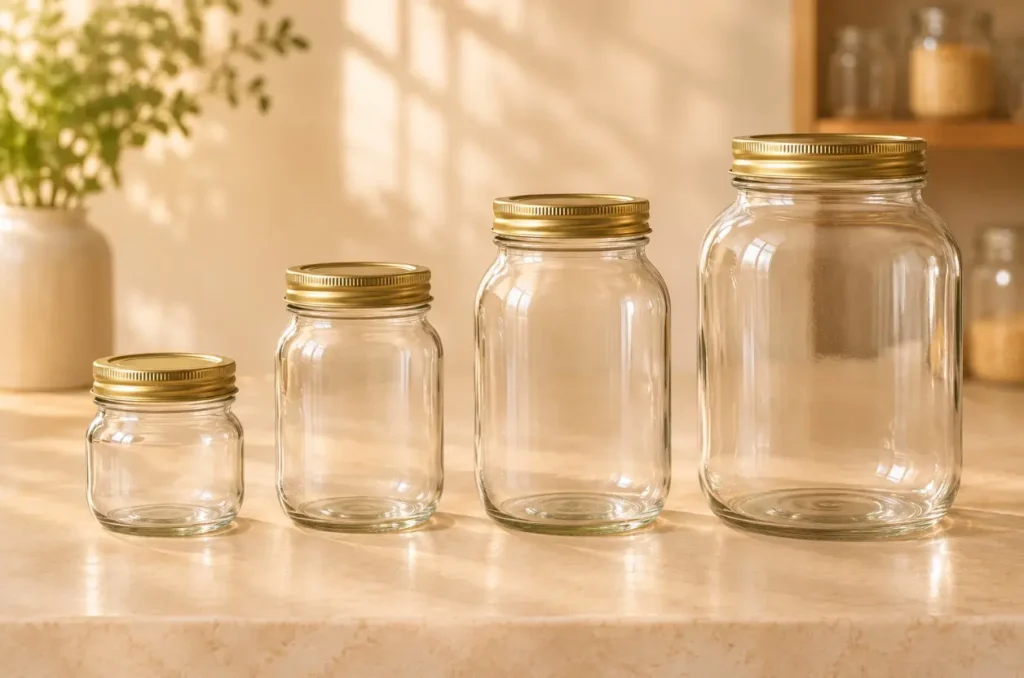
These are common mason jar sizes, rather than a complete list of every Mason-style jar available. You will also find metric capacities and custom designs between these sizes.
The chart uses US fluid ounces. According to NIST’s volume conversion table, one US fluid ounce is approximately 29.5735 mL. The milliliter figures above are rounded conversions, not the dimensions or tested filling capacities of a particular model.
Is a 500 mL Jar the Same as a Pint Jar?
A US pint is about 473 mL, so it is close to 500 mL but not identical. The same applies to an 8 oz jar and a 250 mL jar, or a 32 oz jar and a 1,000 mL jar.
If your sauce pack needs a 500 mL fill, look for a jar designed to hold that amount with the required space below the lid. Do not assume that a jar listed as 16 oz provides the same filling capacity.
For example, Jingbo Group’s offers square glass Mason-style jars in capacities such as 250, 500, and 750 mL. Comparing mason jar sizes is easier when you keep the original capacity units and ask what each listed volume represents.
How Much Product Will Fit in a Mason Jar?
The jar’s capacity tells you a volume. Your product label may state a weight. This is why choosing a jar for jam is different from choosing one for a measured volume of sauce.
If your product is sold as 250 g of jam, that does not automatically mean you need a 250 mL jar. The space occupied by that jam depends on its density. Fruit pieces and trapped air can also affect the result.
Weigh the intended amount of your actual product into a sample jar. Then look at where the food sits. It should leave the space required by your filling process without making the pack look noticeably underfilled.
Filling Capacity and Brimful Capacity
The volume measured to the top of the jar is its brimful capacity. You may also see it called overflow capacity. A jar filled to that point has no room left below the rim.
The normal product fill is lower. The space between the product and the lid is called headspace, and the required amount depends on the food, closure, and process. Our explanation of brimful capacity and normal filling capacity covers this distinction in more detail.
When two suppliers quote the same mason jar size, establish whether both numbers describe the normal fill or the volume to the rim. A jar with 500 mL brimful capacity is not the same as one designed for a 500 mL product fill.
Regular Mouth vs. Wide Mouth Mason Jars
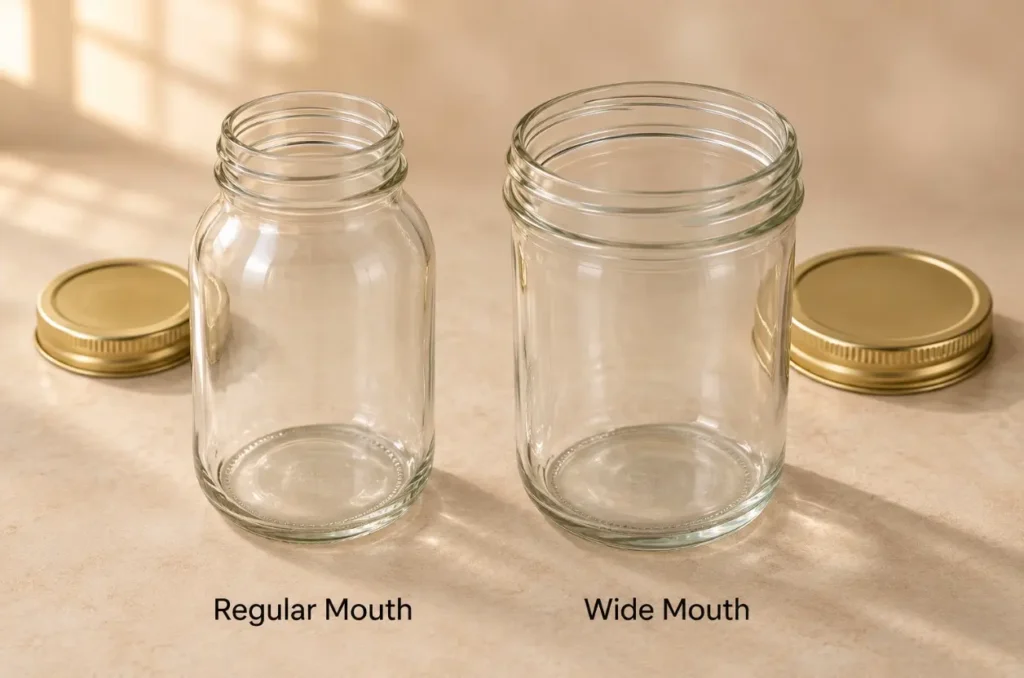
Regular mouth and wide mouth describe the opening at the top. They do not describe how much the jar holds. You can have a pint jar with either mouth type.
A regular mouth is often suitable for jam, jelly, and smooth sauces. A wide mouth makes it easier to pack whole vegetables, larger fruit pieces, or foods that need to be lifted out with a fork or spoon.
| Feature | Regular mouth | Wide mouth |
|---|---|---|
| Approximate opening for food to pass through | 2⅜ inches, about 60 mm | 3 inches, about 76 mm |
| Common nominal lid-size description | 70 mm | 86 mm |
| Main advantage | Suitable for many pourable or spoonable foods | More room for larger pieces and easier access |
| Examples | Jam, jelly, relish, smooth sauces | Whole pickles, halved fruit, chunky products |
The opening measurements follow the National Center for Home Food Preservation’s jar guidance. The 70 mm and 86 mm lid descriptions are different measurements. They refer to the closure size, not the open space inside the glass rim.
Which Mouth Is Better for Your Product?
If your product is a smooth sauce, jelly, or jam with finely chopped fruit, a regular-mouth jar is usually suitable. These foods can pass through the smaller opening without large pieces getting caught.
Choose a wide-mouth jar for whole pickles, halved fruit, or sauces with large chunks. The larger opening gives you more room to pack the pieces and makes them easier to remove when serving.
For thick jam and other spreads, a wide mouth can also make serving easier. A spoon has more room to move inside the jar and reach the product near the bottom.
How Do Height and Diameter Vary Between Mason Jar Sizes?
Capacity does not give you a fixed jar height or width. A manufacturer can make a jar wider and shorter, or narrower and taller, while keeping the same internal volume.
This matters when you compare two 500 mL jars. The wider version takes up more space across a shelf or inside a case. The taller version needs more vertical clearance. Both may hold the required amount, but they occupy different spaces.
| Measurement | What it tells you | Why it matters |
|---|---|---|
| Overall height | Distance from the base to the top | Shelf clearance, carton height, filling-line setup |
| Maximum body diameter | Widest part of a round jar | Space between jars, guides, case arrangement |
| Width and depth | Outside measurements of a square jar | Packing layout and handling |
| Mouth opening | Space available through the top | Food-piece size and filling access |
A broad body does not necessarily mean a wide mouth. A jar can have a wide lower body and shoulders that narrow towards the neck.
The shape also changes the label area. A short jar may give you a broad front panel but little label height. A taller jar may offer more vertical space. Raised lettering, curved shoulders, and a rounded base can reduce the smooth area available for artwork.
When comparing mason jar sizes, separate the internal capacity from these outside measurements. Use the actual model’s dimensions for an existing carton or production line; a general capacity chart cannot tell you whether it will fit.
Which Mason Jar Sizes Suit Jam, Sauces, and Pickles?
Start with the amount of product you want to sell. Then choose a shape and opening that make that product easy to pack and use.
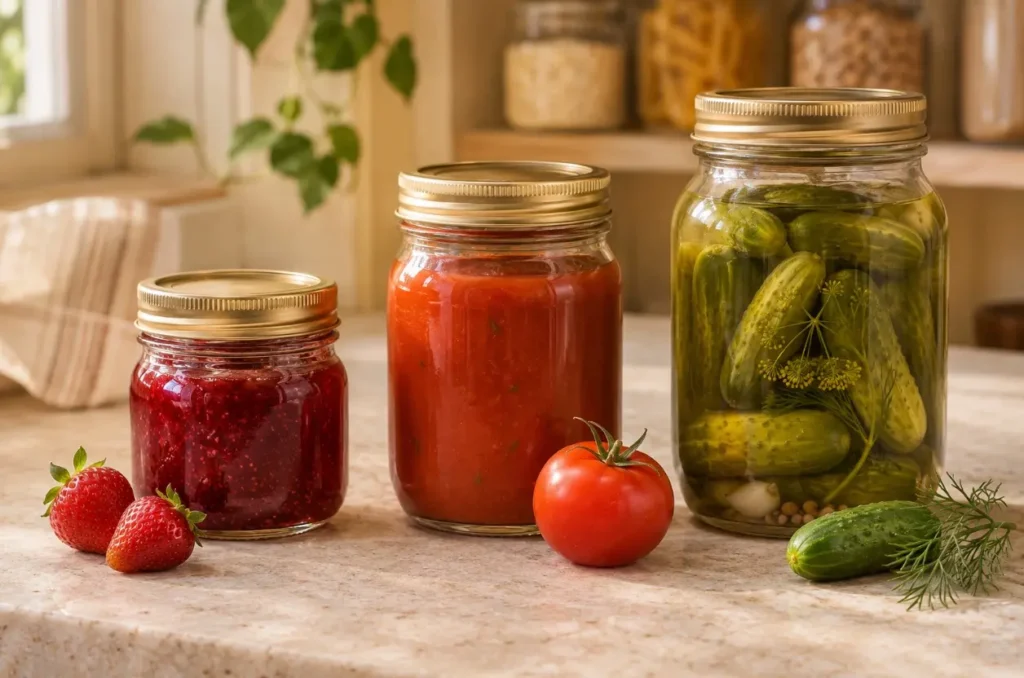
Jam and Other Spreads
The 4 oz and 8 oz mason jar sizes are useful for small portions, tasting packs, and products used a little at a time. A 12 oz jar provides a larger pack without moving to a full pint.
For a thick spread, a short body and accessible opening can make serving easier. A tall, narrow jar may hold the same amount, but it takes a longer spoon to reach the bottom.
The finished pack should also look right at its intended net weight. Compare samples containing the same amount of jam. This shows whether one shape leaves a low food level or too little space beneath the lid.
Sauces, Salsa, and Relish
Pint mason jars are a useful starting point for sauces and salsa. Smaller capacities may suit concentrated sauces, while quart jars provide a larger pack where the product and filling process allow it.
Smooth sauce mainly needs an opening that suits filling and serving. Salsa needs room for both liquid and solid pieces. If the pieces catch at the mouth, increasing the jar’s capacity alone will not solve the problem.
Jingbo Group offers wide-mouth glass storage jars in capacities such as 500, 750, and 1,000 mL. If you need a different size or shape, we can customize the jar’s capacity, body, and opening to suit your product.
Pickles and Whole Vegetables
The 24 oz and 32 oz mason jar sizes give you more room for larger pieces. A wide mouth helps with placing whole pickles or fruit into the jar and removing them later.
For long vegetables, compare the usable space inside the jar. The overall outside height includes the glass base and neck, so it does not tell you the longest piece that will fit below the required filling level.
Pack a sample with the actual vegetables and brine. The spaces between whole pieces also need liquid. If your product specification includes a drained weight, check that alongside the total fill so the larger jar does not simply contain more brine.
How Do You Match an Existing Mason Jar?
If you already use a Mason jar, its approved specification is the best starting point for a replacement. A capacity name such as “16 oz” gives you only part of the information.
Compare the dimensions that affect the pack you already have:
| Item to compare | What can change with a replacement |
|---|---|
| Normal fill and brimful capacity | Product level and space beneath the lid |
| Body height and width | Fit on the line, shelf, or inside the carton |
| Opening and neck thread | Filling access and lid compatibility |
| Body shape and smooth label area | Appearance and fit of the artwork |
For example, a replacement can hold the same volume but have a wider body. It may need a different case arrangement. Another jar may look similar in a photo but use a different thread, so the existing lid will not fit.
An existing model is one route to a suitable replacement. A manufacturer can also develop a custom Mason-style jar around your required capacity and dimensions. A reference sample helps explain the shape, while a drawing records the measurements to reproduce.
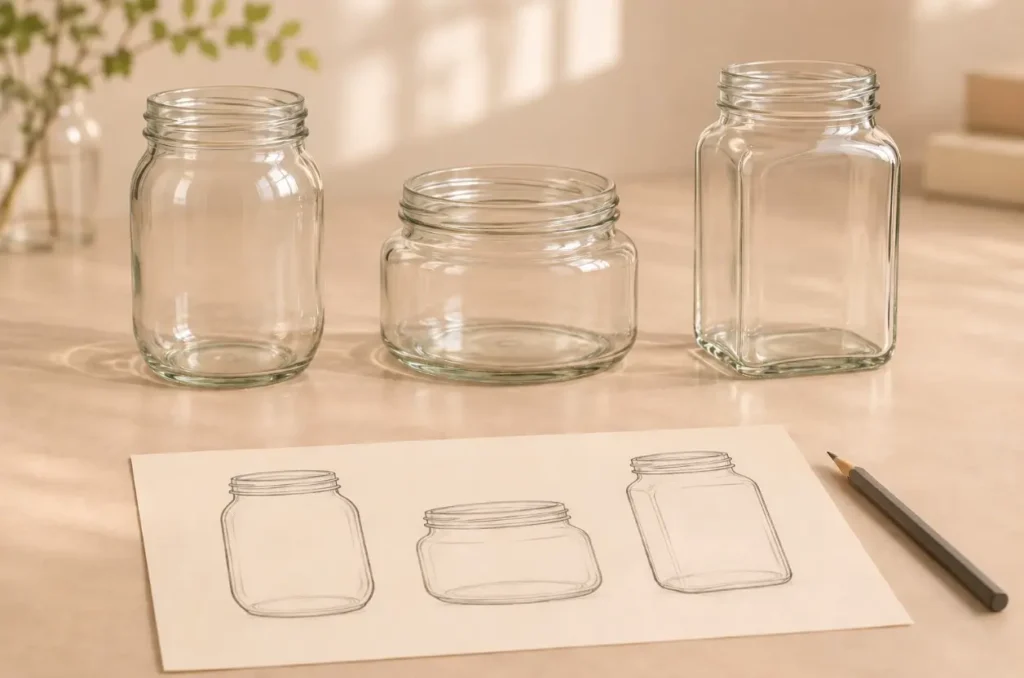
Before switching, fill the proposed jar with your product and use the planned closure. For a production-line change, include a trial on the actual equipment. This shows how the complete pack performs beyond its appearance.
Frequently Asked Questions
How Do You Measure the Capacity of an Existing Mason Jar?
Fill the empty jar with water to the level you want to measure, then pour that water into a graduated measuring jug. Measuring to the rim gives you brimful capacity; measuring to the normal product level gives you that fill volume. Record which method you used. This avoids comparing a full-to-the-rim measurement with a supplier’s normal filling capacity.
Does an 8 oz Mason Jar Hold 8 oz of Jam?
Not necessarily. An 8 oz mason jar normally describes a volume of 8 US fluid ounces. An 8 oz net-weight claim describes the weight of the jam inside. The two are not interchangeable. Weigh your intended amount of jam into a sample and check the food level, because the recipe’s density affects how much space that weight occupies.
Can Different Mason Jar Sizes Use the Same Lid?
Yes, if they have the same compatible neck finish. An 8 oz and a 16 oz regular-mouth jar may use the same lid even though their bodies differ in size. A wide-mouth version needs its matching closure. For commercial jars, compare the thread specification as well as the nominal lid diameter; two lids described as 70 mm may serve different finishes.
Can a Mason-Style Jar Use a One-Piece Lid?
Yes. Commercial Mason-style jars can use a matching one-piece screw lid. Traditional home-canning jars commonly use a flat sealing lid held by a separate screw band. These arrangements should not be chosen by appearance alone. The lid must match the jar’s thread and sealing surface, and the complete jar-and-lid combination must suit the intended food and filling process.
How Much Headspace Should You Leave in a Mason Jar?
Headspace is the gap between the food and the lid. Its required size depends on the product and process, so there is no single allowance for every Mason jar. For home canning, follow the tested recipe’s headspace instructions. For commercial filling, use the approved product and closure requirements, then confirm the resulting fill level in the actual jar.
Can Mason Jars Be Made in Custom Sizes?
Yes. Common mason jar sizes are familiar options, but they do not cover every possible capacity or body shape. A custom jar can be developed around a required fill, height, width, or opening. The design still needs enough internal space for the product and headspace, with a suitable closure. A drawing and glass samples let you review those details before production.
Final Thoughts
Choose mason jar sizes based on how much you need to pack, then compare the opening, body dimensions, and final fill level. Jingbo Group can supply existing designs or help develop a custom glass jar. Send your required capacity and a reference sample, image, or drawing. Once you approve the design drawing, we can make sample jars for you to check before bulk production.