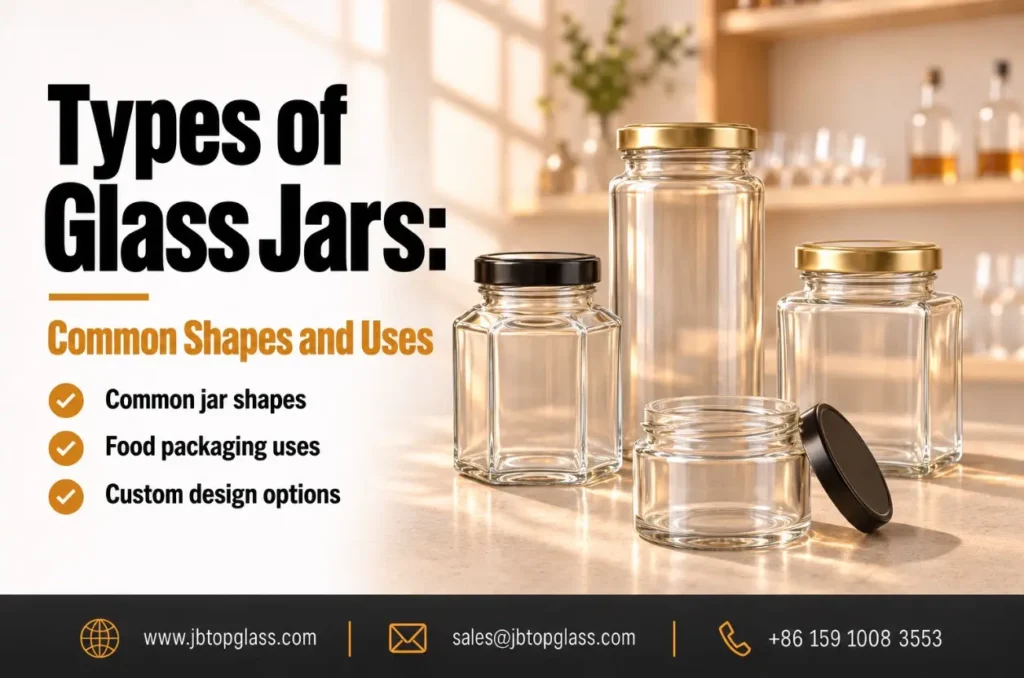
Common types of glass jars include straight-sided, round-shouldered, hexagonal, square, Paragon, and Mason-style jars. The body shape affects the look of your packaging. The opening affects how you fill the jar and remove the food inside. This guide explains how to identify each style, its common food uses, and what you can change when you need a custom glass jar.
What Are the Main Types of Glass Jars?
Glass jar types are named in several ways. Round, square, and hexagonal describe the body shape. Straight-sided describes the sides of the jar. Paragon and Mason-style are names for particular jar styles.
These names can overlap. A Paragon jar can also have straight sides, for example. The table below compares common types of glass jars used for food packaging.
| Glass jar type | How to recognize it | Common food uses |
|---|---|---|
| Straight-sided | Straight walls with little or no shoulder | Jam, honey, nut butter, dips |
| Round with shoulders | Round body that curves inward below the neck | Sauces, pickles, preserves |
| Hexagonal | Six sides around the body | Honey, jam, chutney |
| Square | Four main sides, usually with rounded corners | Sauces, spices, honey, dry foods |
| Paragon | Tall, narrow, round body | Olives, pickles, preserved vegetables |
| Mason-style | Traditional preserving-jar look, often with molded details | Preserves, honey, pickles, dry foods |
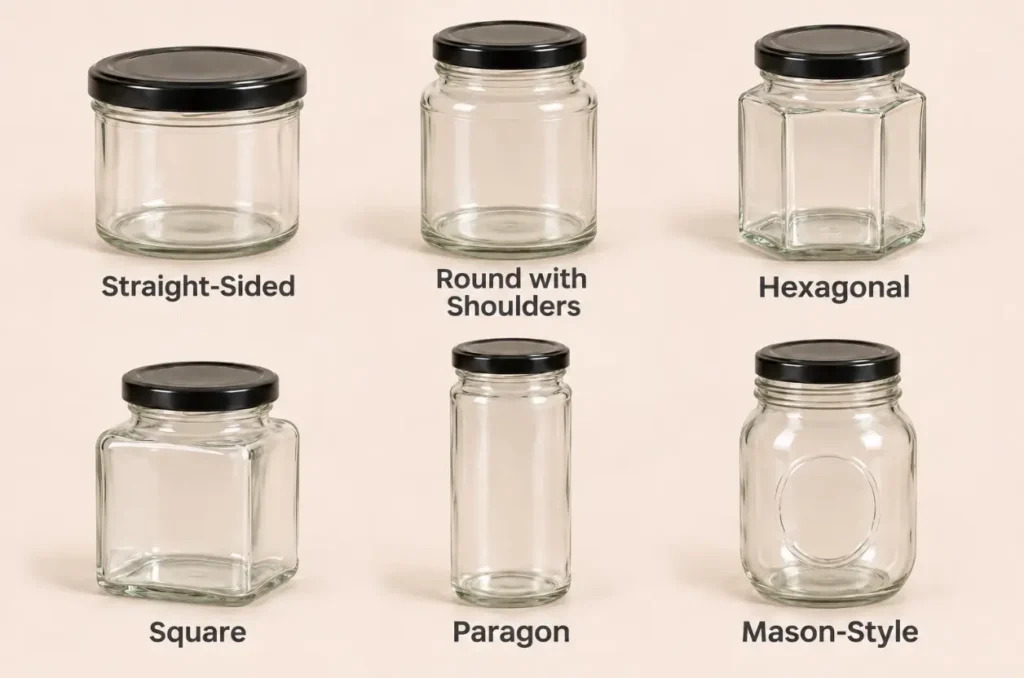
These are examples of use. You can package the same food in several different types of glass jars.
Straight-Sided Glass Jars
Straight-sided glass jars have walls that run almost straight from the base to the top. They have little or no shoulder, which is the curved area below the neck. In many designs, the opening is nearly as wide as the body.
This gives you easy access to the food. A spoon can reach along the inside wall without a large shoulder getting in the way. That makes straight sided jars a useful starting point for thick foods such as jam, peanut butter, and dips.
The smooth, round body also gives you room for a wraparound label. You can use a small front label or a label that wraps around the jar. Keep the artwork within the straight area, above the curved base and below the top edge.
These straight-sided cylindrical glass jars show the basic shape. The height, width, and opening can vary between designs, so a straight-sided jar does not always mean a short, wide jar.
Round Glass Jars with Shoulders
Round glass jars with shoulders have a body that curves inward before it reaches the neck. Look at the jar from the side to see this change. The shoulder may be broad and rounded or quite short.
This is a common shape for sauces, preserves, and pickled foods. Keep a wraparound label on the straight part of the body. If it extends onto the shoulder, the curved glass can make the label wrinkle.
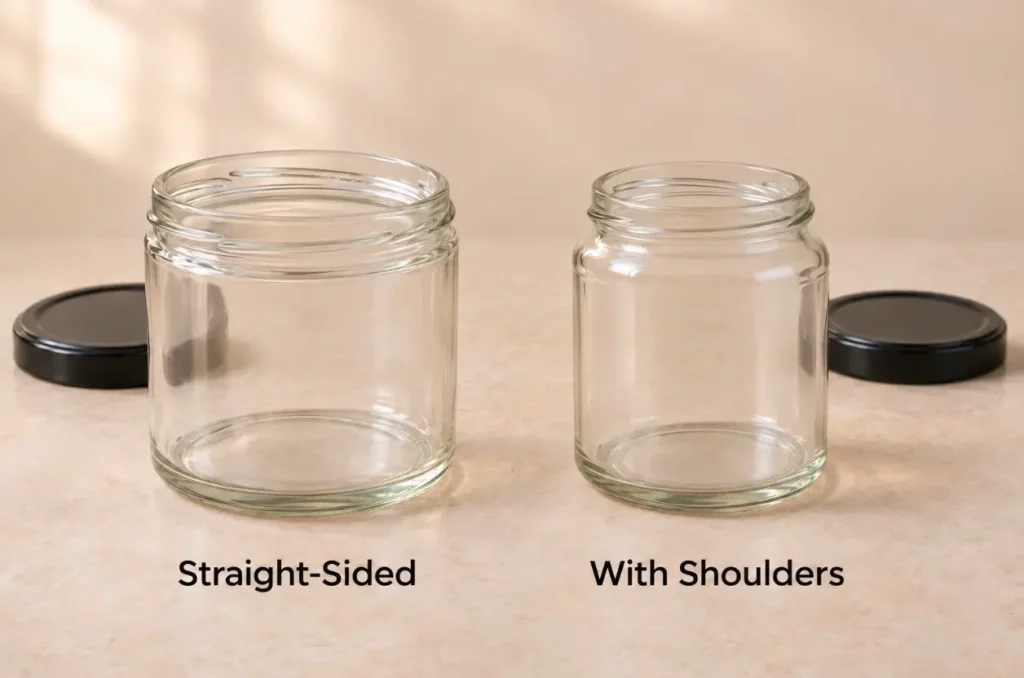
When comparing these types of glass jars, look at the opening as well as the body. A large round jar can still have a relatively small mouth. Whole food pieces must pass through that opening, even when there is plenty of space inside.
For thick spreads, also consider the area under the shoulder. Food can collect there and be harder to reach with a spoon. A jar with a wider opening or a smaller shoulder may give you easier access.
Hexagonal Glass Jars
Hexagonal glass jars have six sides around the body. They are also called hex jars or hexagon jars. Viewed from above, the body has six corners rather than a round outline.
This is a familiar shape for glass honey jars. It is also used for jam, chutney, spices, and other foods. You can leave some faces free of labels to show the color and texture of the food.
Each side provides a separate area for a label. If you want the label to sit on one face, size it for that face. A label that is too wide will extend over the corners.
You can see the six-sided body in these hexagonal glass jars. When choosing a design, compare the width of the faces and the size of the opening. Two hexagonal jars can look similar while having different proportions and label space.
Square Glass Jars
Square glass jars have four main sides. Most designs have rounded corners, so the body is not a sharp-edged cube. The sides can be straight or slightly curved, depending on the design.
The front face gives you a clear area for a product name and logo. The side and back faces can hold other information. This can suit sauces, spices, honey, and dry foods where you want a defined front to the pack.
Look closely at the flat area when planning a label. The full width of the jar includes the corners, but a label placed on one face needs to fit between them. Place the artwork on the drawing at its intended size.
A square body can still have a round opening and round lid. The body and mouth serve different purposes. Choose the body for the appearance you want, then choose an opening that suits filling and serving.
Paragon Glass Jars
Paragon jars have a tall, narrow, round body. Their sides are usually fairly straight, with a small shoulder near the top. Their height compared with their width is the main feature that sets them apart from shorter round jars.
Paragon glass jars are commonly used for olives, pickles, and preserved vegetables. The tall body can suit long pieces, such as asparagus or beans. Clear glass lets you show how those pieces are arranged inside.
For this type of food, compare both the internal height and the opening. The jar needs room for the pieces to stand inside, and the pieces need to pass through the mouth. A tall jar with a small opening may not suit the food you want to pack.
The narrow body also affects your label design. It gives you height for artwork, but less width on the front than a broader jar. Check that the product name stays easy to read when the label curves around the sides.
Mason-Style Glass Jars
Mason-style glass jars have the familiar look of traditional preserving jars. Common features include a threaded neck, rounded shoulders, and molded details on the body. Some designs have raised lettering or volume marks, while others have a plain surface.
These types of glass jars are used for preserves, honey, pickles, sauces, and dry foods. You can choose the style for its appearance, then adjust the details around your product. A large front panel, for example, leaves more room for a paper label.
Raised glass details need their own space. If lettering sits where the label should go, the label will not lie on a smooth surface. A design can instead place the raised detail above, below, or beside the label panel.
Which Type of Glass Jar Suits Your Product?
Start with the food and how people will remove it from the jar. Then compare the glass jar shapes that meet those needs. This helps you choose between types of glass jars based on use as well as appearance.
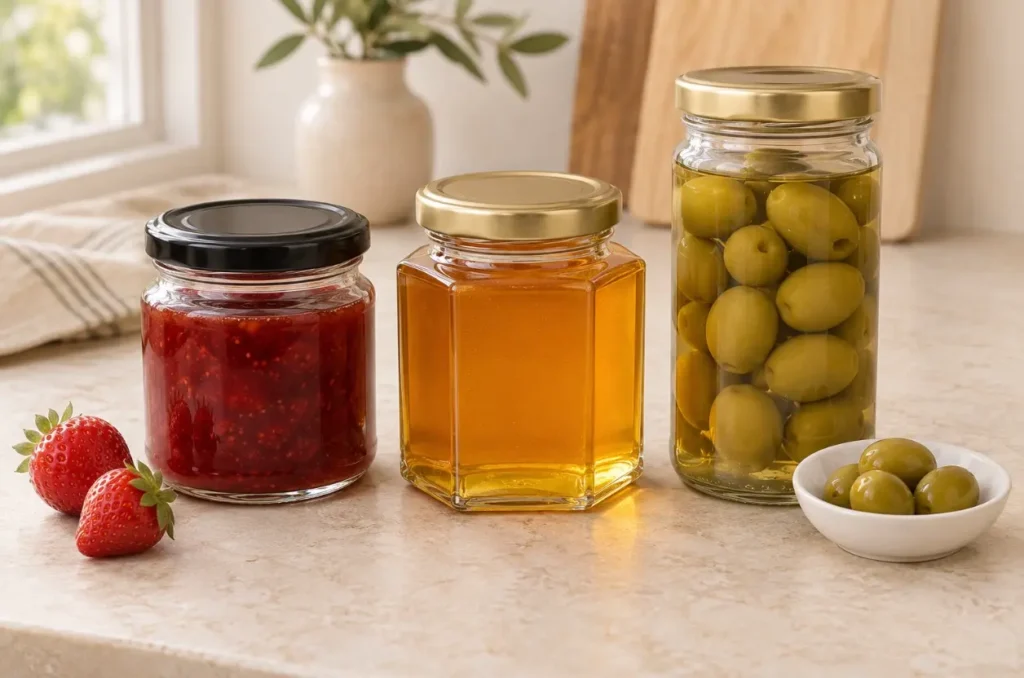
Jam, Honey, and Thick Spreads
When choosing glass jars for jam or nut butter, look for easy spoon access. Wide mouth glass jars give you room to move the spoon. A short body with little shoulder also helps you reach the sides and bottom.
Glass honey jars offer more freedom in body shape. Round, square, and hexagonal designs are all possible. If your honey is sold as a thick or creamed product, consider the space needed for a spoon as well as the way the jar looks.
You can then compare the label areas of the styles that remain. A round jar provides a curved surface. A square or hexagonal jar gives you separate faces. Choose the format that fits both the food and the artwork.
Whole Pickles, Olives, and Vegetables
For glass pickle jars, the size and shape of the food matter early in the choice. Long pieces need enough internal height. Large pieces need enough room at the opening to enter without being forced through.
A tall Paragon jar may suit upright vegetables. A broad round or square jar may suit mixed pieces that settle in different directions. Think about the finished pack you want to show through the glass.
Check the usable opening rather than judging it from the lid. The lid covers the outside of the neck, so its width does not tell you the clear space inside. This distinction matters when your food pieces are close to the size of the mouth.
Spices, Nuts, and Other Dry Foods
For dry foods, start with the intended use. Will people pour, shake, scoop, or take the food out by hand? Ground spices, whole nuts, and tea leaves can need different openings even when their jars hold a similar volume.
A wide mouth helps when you need space for a scoop. A narrower opening may be useful for controlled pouring. Round glass jars and square glass jars can both be designed around these uses.
Also check the capacity needed for the stated product weight. Grams describe the amount of food; milliliters describe volume. The same weight of two different foods may need different jar capacities.
Can You Customize the Shape and Size of a Glass Jar?
Yes. Common types of glass jars provide a starting point for a custom design. You can change the capacity, height, width, shoulder, opening, and surface details. You can also develop a new shape rather than choose only from existing models.
For custom glass jars, start with a photo, sketch, sample, or description of the shape you want. Add the food you will pack and the required fill amount. If part of the design matters most, such as a broad front face or a wide opening, make that clear.
These details help turn an idea into a usable glass jar design. A request for a “square honey jar,” for example, still leaves several choices. The body can be tall or short, the corners can be more rounded, and the opening can be wider or narrower.
Jingbo Group can help you design custom glass food jars around those requirements. We can check whether an existing mold suits the design or whether a new mold is needed. Existing product photos are examples, rather than limits on the shapes and sizes you can request.
Types of Glass Jars FAQ
Are Mason-Style Glass Jars Always Round?
No. Mason-style glass jars can have round or square bodies. The name refers to a preserving-jar style rather than one body shape. For example, square Mason jars combine a square body with a round opening. If you want that style, describe the body shape as well as the Mason details, such as raised lettering or molded marks.
Are Hexagonal Jars and Honeycomb Jars the Same?
Not necessarily. Hexagonal jars have six sides around the body. Honeycomb glass jars may instead have a pattern of small hexagons molded into the surface. That pattern can appear on a round jar. Look at the outline from above to identify the body shape, then look at the surface to see whether it also has a honeycomb texture.
What Is a Fluted Glass Jar?
Fluted glass jars have repeated grooves or ridges around the body. Similar designs may be described as ribbed glass jars. These terms describe the surface, so the jar can still have a round or another body shape. If you need a paper label, include a smooth label area in the design rather than placing it over deep grooves.
What Does Lug Finish Mean on a Glass Jar?
A lug finish is a type of jar opening with short, separated sections of thread. A matching twist-off lid grips those sections when turned. The finish is the part that holds the closure. It describes the neck, rather than the body shape. Round, square, and hexagonal food jars can all be designed with a lug finish.
Can All Types of Glass Jars Be Used for Home Canning?
No. A food storage jar is not automatically a home-canning jar. The National Center for Home Food Preservation recommends purpose-made Mason-type home-canning jars and suitable lids. A similar appearance does not establish the same use. For commercially processed food, choose the jar and closure for that specific process rather than relying on a home-canning recommendation.
Final Thoughts
Understanding the main types of glass jars helps you describe the packaging you need. Start with the body shape, then consider the opening, food, and label area. Jingbo Group can help you develop a suitable design and make samples after drawing approval. Share your preferred style, required fill amount, and expected quantity through our contact page to discuss your glass jar project.