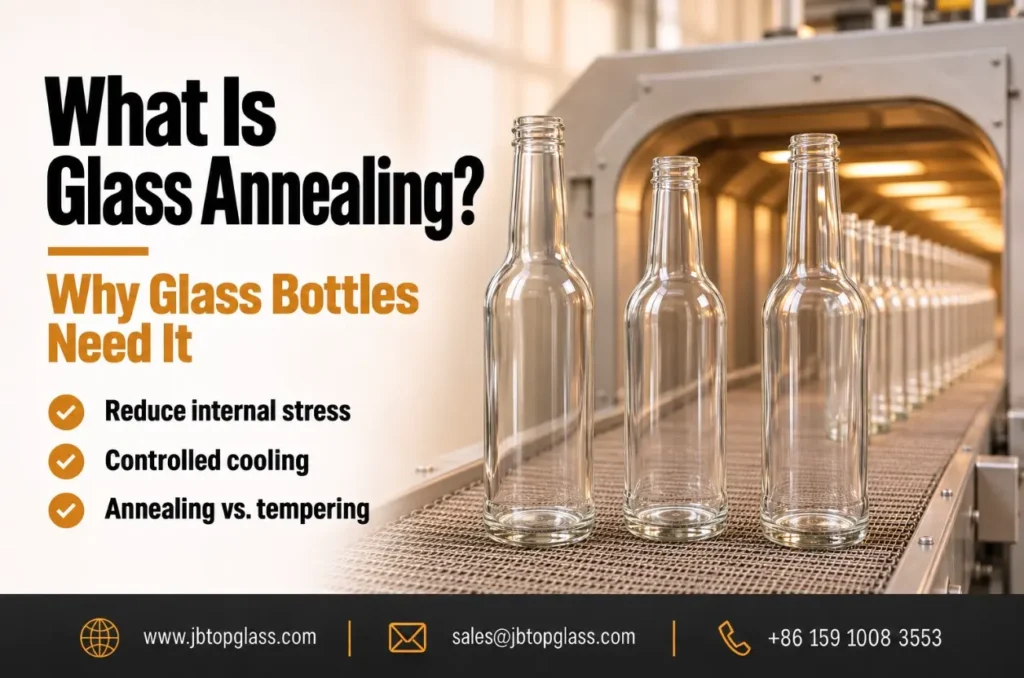
Glass annealing reduces the internal stress that can build up as a bottle cools after forming. The factory controls the heating and cooling cycle to lower this stress before the bottle moves on to normal handling. This guide explains how glass annealing works, why temperature and time matter, and how it differs from tempering.
What Is Glass Annealing?
Glass annealing is a heat treatment carried out after glass has been shaped. It reduces residual stress, which means the pushing and pulling forces that can remain inside the glass after it cools. A bottle can contain these forces even when its surface looks smooth and its shape appears correct.
During the treatment, the glass stays at a suitable temperature long enough for this stress to relax. It then cools at a controlled rate so that excessive stress does not build up again. The bottle keeps its formed shape throughout the process.
You may also see the term “annealed glass” in a product description. This means the glass has received the treatment. A bottle can be both soda-lime glass and annealed glass: soda-lime describes its material, while annealed describes how it was processed.
The Corning Museum of Glass describes annealing as a controlled cooling process. It explains that glass cooled too quickly can remain highly stressed and may break during cooling or later use.
Glass annealing therefore follows the shaping stage. The mold gives the bottle its form; the controlled heat treatment deals with the stress that cooling can leave behind.
Why Do Glass Bottles Need Annealing?
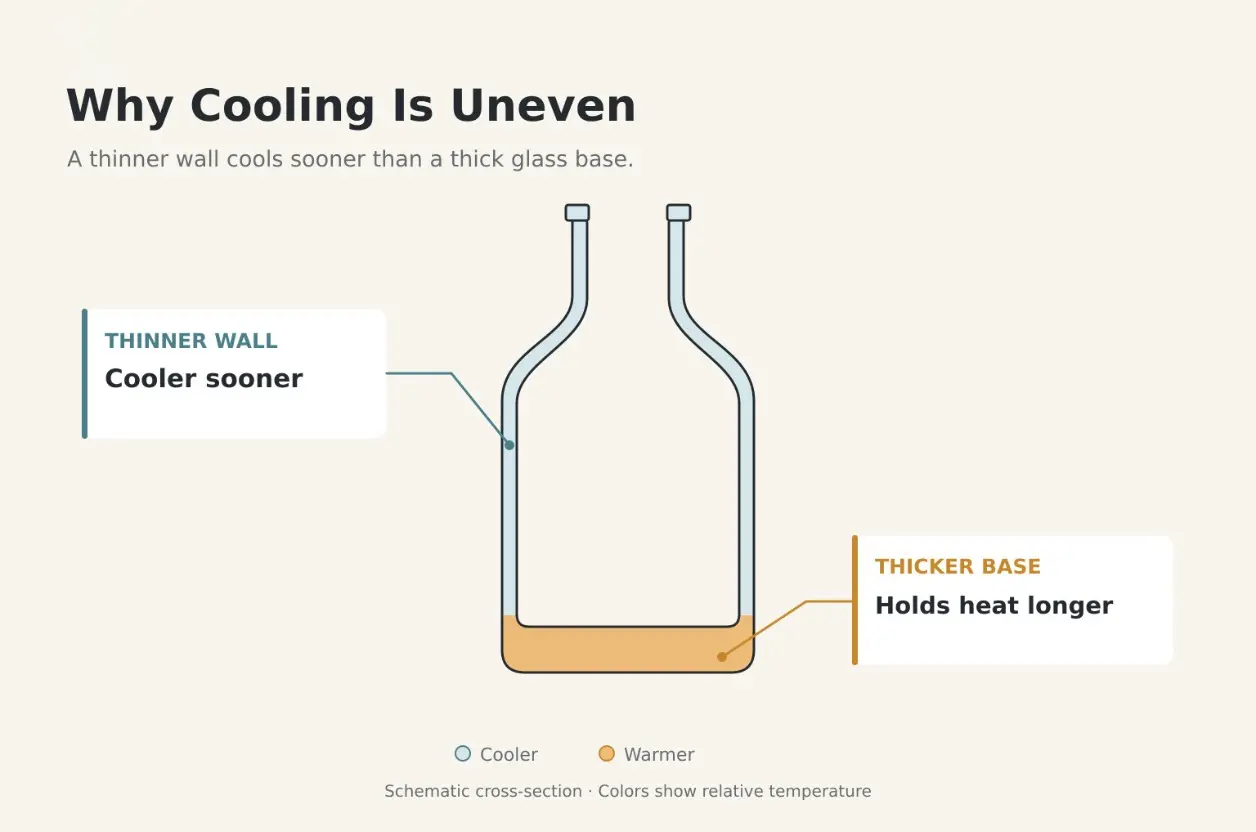
Glass contracts as it cools, but the different parts of a bottle do not cool at the same speed. The surface loses heat before the glass deeper inside. Thin sections can also cool sooner than thick ones.
For example, a bottle with a thick base and thinner sidewalls holds more heat in its base. The cooler sections begin to shrink while the thicker glass is still hotter. Because these sections are joined together, they cannot shrink independently. Stress can remain when the glass becomes rigid.
Glass bottle annealing controls this part of the cooling process. It gives the glass time to release stress while its internal structure can still adjust. The aim is to leave a low, acceptable level of residual stress in the finished container.
This matters when the bottle moves through later handling and use. A knock against another object creates mechanical shock. A sudden change in temperature creates thermal shock, as one part of the glass heats or cools faster than another. Excessive residual stress can make the bottle less able to cope with either.
The effects may only become apparent later. A bottle can leave production looking clear and well formed, then crack when it faces an additional load or temperature change. A normal appearance alone therefore tells you little about glass annealing quality.
The same need for controlled cooling applies to glass beer bottles 그리고 유리 식품 용기. Each container needs a process suited to its shape and glass thickness.
Annealing is still only one part of bottle quality. Surface scratches, forming defects, excessive pressure, and unsuitable handling can also lead to breakage. When a bottle fails, these factors need to be considered alongside its residual stress.
How Does Glass Annealing Work?
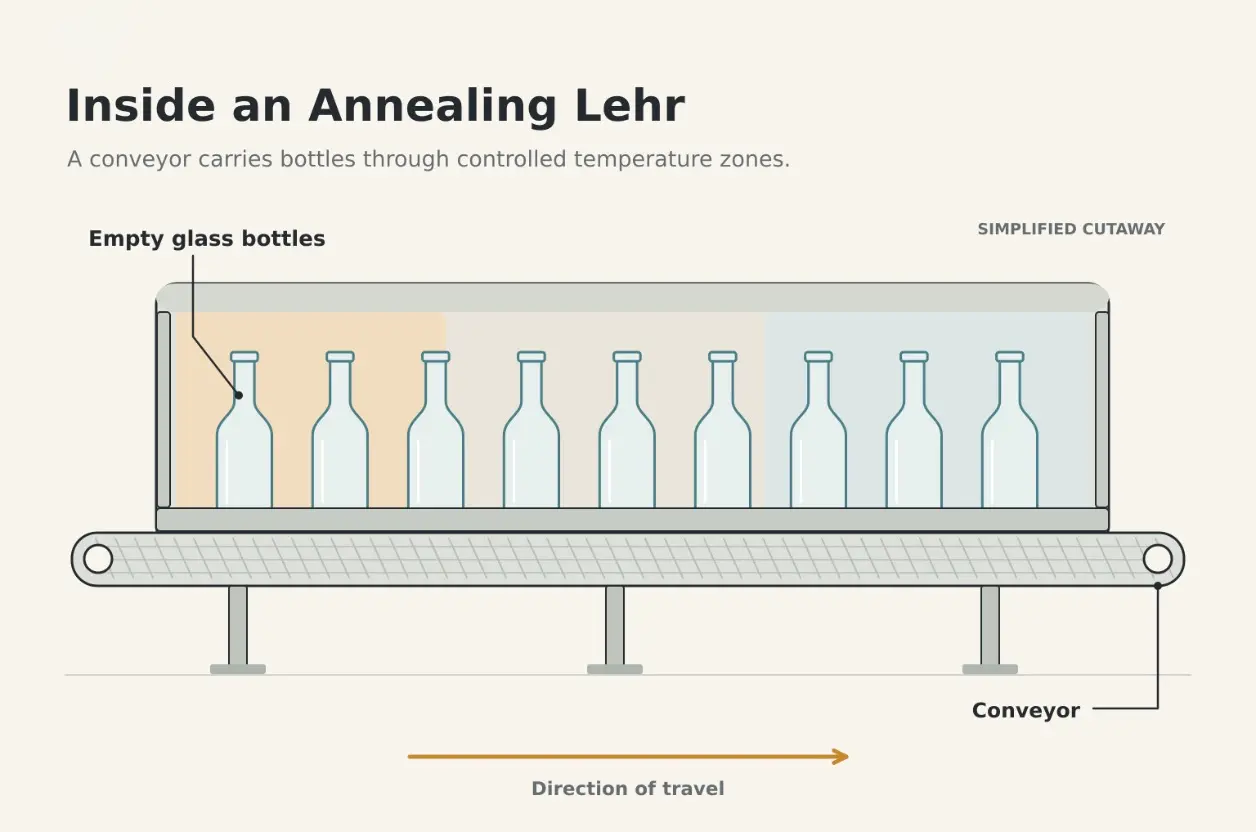
In continuous bottle production, hot containers move from the forming machines into an annealing lehr. This is a long industrial oven with a conveyor that carries bottles through heating and cooling zones.
The conditions change as the bottles move along the conveyor. Early zones provide the heat needed for stress relief. Later zones control how quickly the glass cools. Together, they create the temperature profile, or the pattern of temperature changes over time.
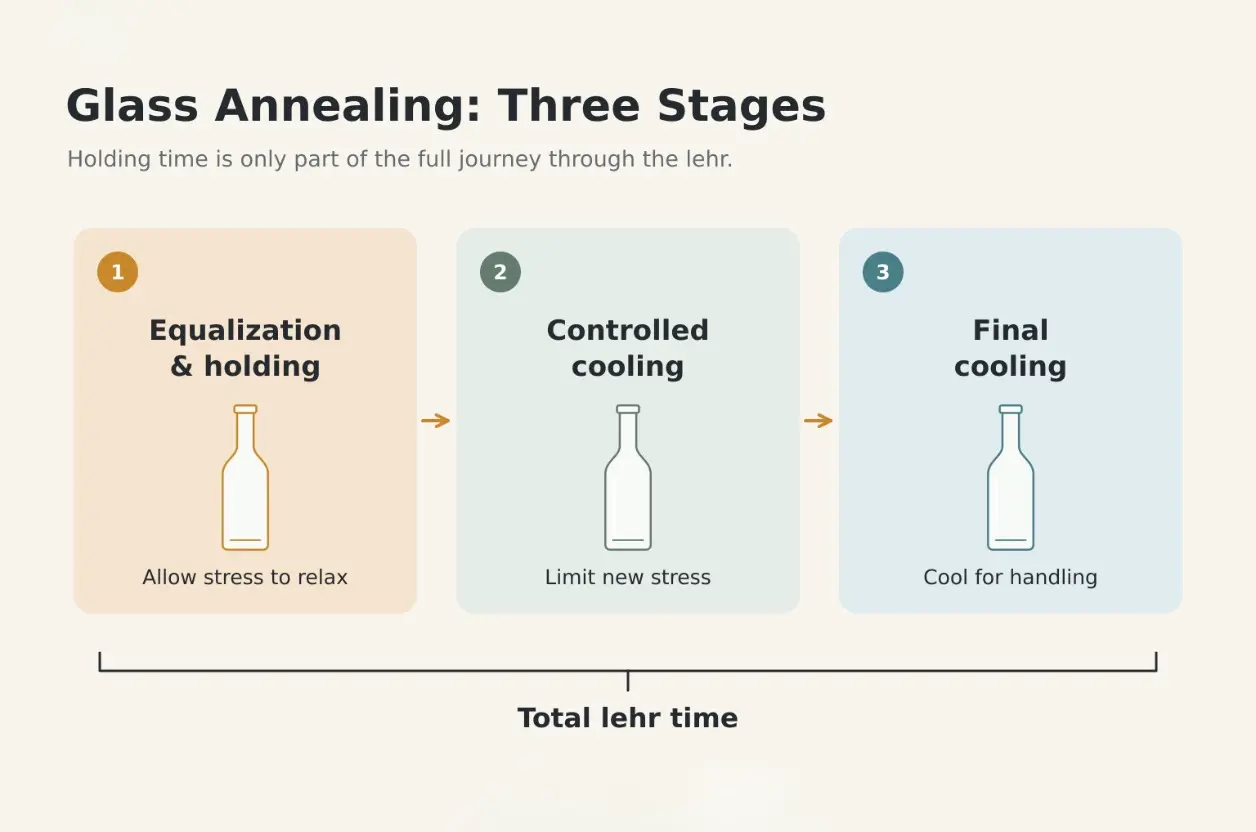
The glass annealing process has three main stages. First, the temperature across the glass becomes more even and the stress has time to relax. The bottles then cool slowly through the critical range before moving into final cooling.
Temperature Equalization and Holding
The first job is to bring the different parts of the bottle closer to an even temperature. A thick base and a thin wall may enter the lehr at different temperatures, so the process needs to allow for both.
The glass is held under suitable conditions while its internal structure adjusts. This holding period allows stress to relax without remelting the bottle or changing its shape. The treatment must provide enough time for the whole glass section, including its thicker areas.
This is where holding time becomes important. The surface may respond to the heat before the center of a thick section does. If the process moves on too soon, a substantial temperature difference may remain within that section.
The glass annealing schedule sets the temperature and time needed for this stage. The bottles then move into controlled cooling, where the aim is to avoid building up excessive stress again.
Controlled Cooling Through the Annealing Range
The next stage lowers the temperature while limiting the difference between hotter and cooler parts of the glass. This needs particular care as the material becomes less able to release stress.
Two reference temperatures help explain why. At the annealing point, stress can relax relatively quickly. At the lower strain point, that relaxation is much slower. Both points depend on the glass composition.
The temperature range between these points is especially important during glass annealing. As the bottle cools through it, the glass gradually loses its ability to adjust. The cooling rate must allow for this change.
Cooling too quickly can introduce excessive residual stress again, even if the earlier holding stage was suitable. The work done during heating and holding would then be partly lost.
Controlled cooling protects that result. It keeps temperature differences within the glass low enough as the structure becomes rigid. Once the bottle has passed through the critical range, it can move into the final cooling stage.
Final Cooling
After the critical range, stress relaxation becomes much slower. The main task is now to cool the bottle enough for the next production stages, including normal handling and inspection.
The cooling rate can usually increase at this point. It still needs to suit the container, because a large temperature difference across the glass can create temporary thermal stress and cause breakage during cooling.
For example, a thick section may still hold heat after its surface has cooled. Faster cooling must remain within what that section can tolerate. Passing the strain point does not make the bottle immune to sudden temperature changes.
After final cooling, the bottle can move on to inspection. Getting it to this point requires a complete schedule: the holding temperature, time at that temperature, and cooling rate all have to suit the glass and the container.
What Affects Glass Annealing Temperature and Time?
The right glass annealing temperature and time depend on the glass, the container, and the production conditions. A UNIDO report on glass manufacturing gives a soda-lime glass process example that reaches about 550°C before controlled cooling. This is a reference example, rather than a fixed setting for every bottle.
Start with the material. Different glass formulations have different annealing and strain points. A temperature suitable for one formulation may not suit another, which is why soda-lime glass annealing and borosilicate glass annealing can require different schedules.
The thickness of the glass then affects how long heating and cooling take. A thin wall responds sooner to a change in oven conditions. Heat takes longer to move through a thick base, so that area may need more time to reach an even temperature.
This is also why capacity alone cannot determine the schedule. Two 750 ml bottles may have different base thicknesses, wall distributions, and shapes. They hold the same amount of liquid, but the glass itself can respond differently as it passes through the lehr.
The delay in heating the glass also explains the difference between an oven setting and the actual bottle temperature. A controller measures conditions at its sensor. It does not mean the center of every thick glass section has reached the same temperature at that moment.
Production settings must account for this. Conveyor speed determines how long bottles remain in each zone. Air circulation and the arrangement of containers affect how heat reaches them and how it leaves during cooling.
These factors work together. Changing the time spent in a zone can change the bottle’s temperature when it reaches the next one. The full schedule needs to suit the container as it moves through the line.
When you compare descriptions of glass annealing time, check what each figure includes. One may describe only the holding period. Another may include slow cooling, and a third may describe the full journey through the lehr. Knowing which stage is being discussed makes those figures much easier to understand.
Glass Annealing vs. Tempering: What Is the Difference?
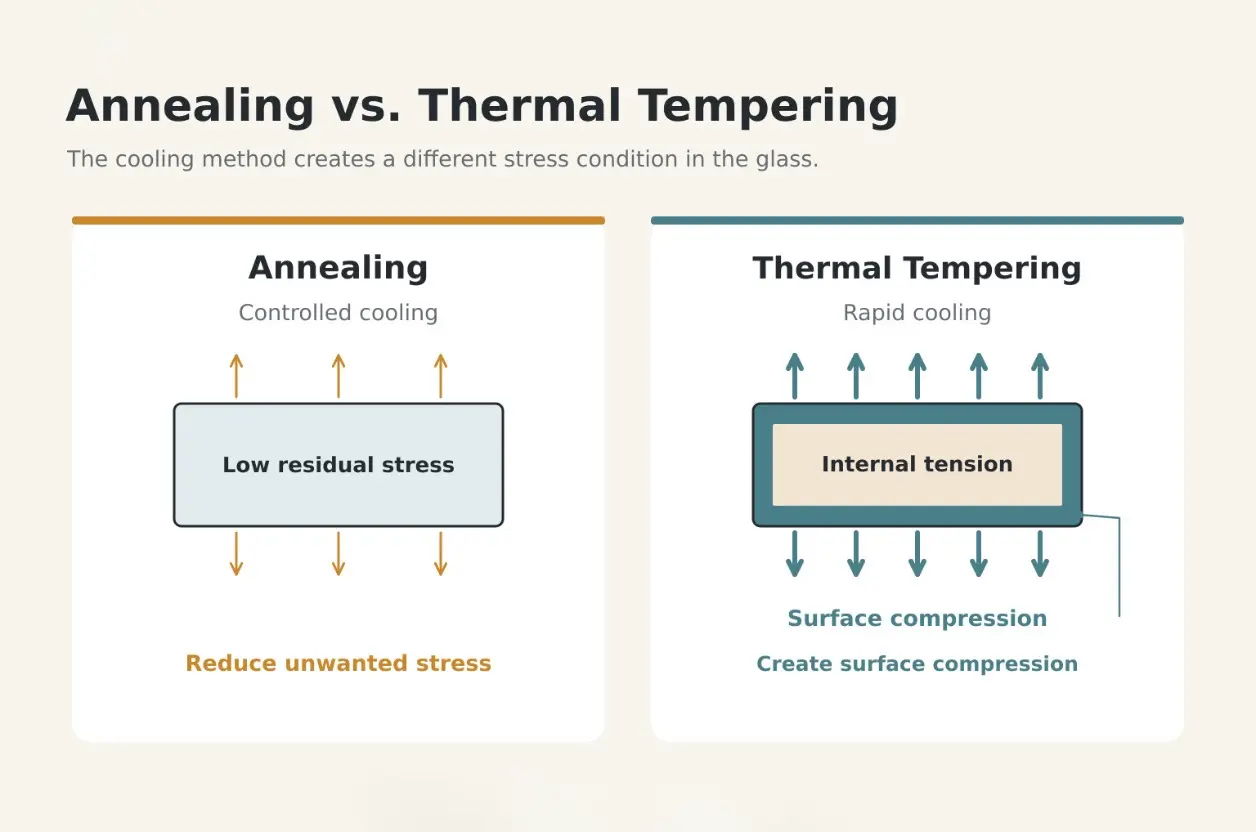
Glass annealing aims to leave a low, acceptable level of residual stress. Thermal tempering uses heating followed by rapid cooling to create surface compression, with balancing tension inside the glass.
Compression means forces pushing together, while tension means forces pulling apart. The compressed surface helps tempered glass resist certain loads. This is a different result from reducing unwanted stress through annealing.
The two processes therefore need different cooling arrangements. During annealing, cooling through the critical range is carefully limited to keep residual stress low. During thermal tempering, rapid, controlled cooling creates the strengthening stress pattern.
| Point of comparison | 어닐링 | Thermal tempering |
|---|---|---|
| 주요 목적 | Reduce unwanted residual stress. | Create a strengthening stress pattern. |
| Cooling approach | Controlled cooling through the critical temperature range. | Rapid, controlled cooling after heating. |
| Intended stress condition | Low, acceptable residual stress. | Surface compression with balancing internal tension. |
| Meaning for a bottle | A normal part of container manufacturing. | A separate treatment that must be confirmed for the specific product. |
For ordinary glass packaging, annealing is a basic manufacturing step. A description of annealed glass bottles tells you that this treatment has been carried out. It does not describe a separate glass recipe or confirm that the bottles have been tempered.
You also need to keep the application in mind when comparing annealed vs. tempered glass. A strength figure for a flat building panel cannot be transferred directly to a bottle. The bottle’s shape, wall thickness, surface condition, and intended use all affect its performance.
Neither “annealed” nor “tempered” gives you a complete pressure or temperature rating by itself. For packaging, the useful information is how the specific bottle performs under its intended conditions. The treatment, material, and bottle design all contribute to that result.
자주 묻는 질문
Can You Tell Whether a Glass Bottle Is Properly Annealed by Looking at It?
No. A smooth surface and an even shape do not reveal the residual stress inside a bottle. Glass annealing quality can be assessed through specialized optical checks. ASTM C148 describes polariscopic examination of glass containers, which looks at optical effects associated with residual stress. A normal product photograph cannot show this, even when the bottle looks perfectly formed.
Can Annealing Remove Bubbles or Repair Cracks?
No. Normal glass annealing reduces internal stress while keeping the bottle’s existing shape. It does not remove bubbles or join cracked glass back together. Those changes would require different conditions from ordinary bottle annealing. A cracked bottle still needs to be rejected, even if it has passed through a lehr. The same treatment cannot correct an incorrectly formed neck or unsuitable wall thickness.
Are Glass Bottles Annealed Before or After Printing?
Bottles are normally annealed before printing and other later decoration. After forming, they pass through the lehr, then move on to inspection and any finishing work. Some printing inks or decorative coatings need another heating or curing cycle afterward. That later cycle follows the needs of the ink or coating, so its conditions can differ from the original stress-relief treatment.
Can Glass Be Annealed More Than Once?
Yes. Reannealing glass involves reheating it under suitable conditions and then cooling it under control again. This may be useful when a later forming operation has introduced new stress. Whether it is suitable depends on the article and its condition. Reannealing does not repair cracks or make a damaged bottle safe to reuse. Existing decoration and heat-sensitive parts also need to be considered before another treatment.
Does Annealing Make a Bottle Suitable for Hot Filling?
Annealing alone does not confirm hot-fill suitability. A hot-fill glass bottle also needs the right material, shape, wall distribution, and thermal shock resistance for the intended process. The closure and filling conditions matter as well. Check the planned filling and cooling temperatures against the bottle’s approved use. Performance information should apply to that specific design and process, rather than annealed glass bottles as a whole.
마무리 말
Glass annealing reduces the internal stress left as a bottle cools after forming. The holding stage, cooling rate, and full temperature profile all contribute to the result. Jingbo Group manufactures glass bottles and jars for commercial packaging. 저희 팀에 문의해 주세요 with your product, required capacity, expected quantity, and filling conditions to discuss a suitable bottle and samples.