
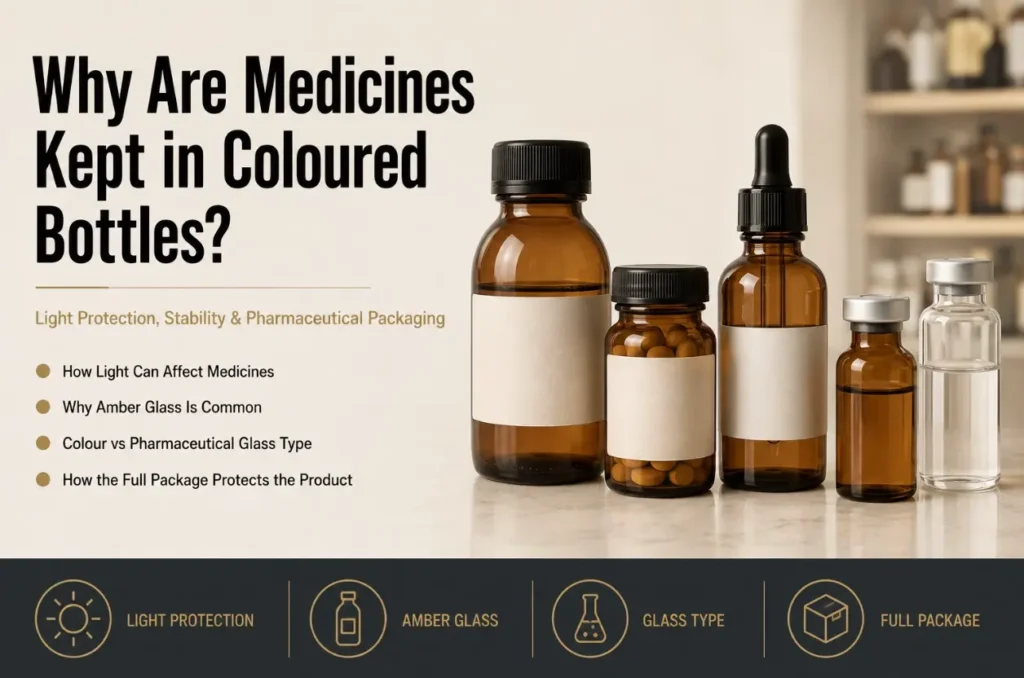
Medicines are kept in coloured bottles mainly to reduce their exposure to light. Some active ingredients and excipients can change when they absorb ultraviolet or visible light. A suitable coloured container—most often amber—limits the light reaching the product and can help the medicine remain within its approved quality specifications throughout its shelf life.
That does not mean every brown bottle offers the same protection, or that every medicine needs one. The correct package depends on the formulation, dosage form, expected storage conditions and photostability test results. In some cases, a clear bottle inside an opaque carton is suitable. In others, the primary container itself must provide light protection.
The colour is therefore functional, not merely traditional. But it is only one part of the complete pharmaceutical packaging system.
Why Can Light Damage Some Medicines?
Light carries energy. When a drug substance or another ingredient absorbs that energy, a photochemical reaction may begin. This process is generally called photodegradation.
The exact reaction varies by formulation. Light exposure may break chemical bonds, promote oxidation or produce degradation compounds. A liquid may change colour, become cloudy or form a precipitate. A tablet coating may fade. The assay, dissolution behaviour or impurity profile may also change even when the difference is not obvious to the eye.
This is why a medicine cannot be judged by appearance alone. A solution that still looks normal may not necessarily remain within its approved specification. Conversely, a slight colour change does not by itself explain whether a medicine is safe or effective. Laboratory testing is required.
Sunlight is not the only possible source of exposure. Medicines may encounter daylight through windows, fluorescent lamps, retail lighting, hospital lighting and illumination on packaging or inspection lines. The relevant risk depends on the wavelengths absorbed by the formulation, the intensity of the light and the duration of exposure.
그 FDA’s ICH Q1B photostability guidance describes a systematic approach that can test the exposed drug product, the product in its immediate pack and, when necessary, the product in its final marketing pack. The objective is to demonstrate that the proposed package protects the specific product adequately.
Not all medicines are equally light-sensitive. Some remain stable in clear containers under their intended conditions. Others need a light-resistant bottle, an opaque blister, an overwrap, a carton or special storage instructions. The package should follow the evidence.
Why Is Amber Glass Common for Medicine Bottles?
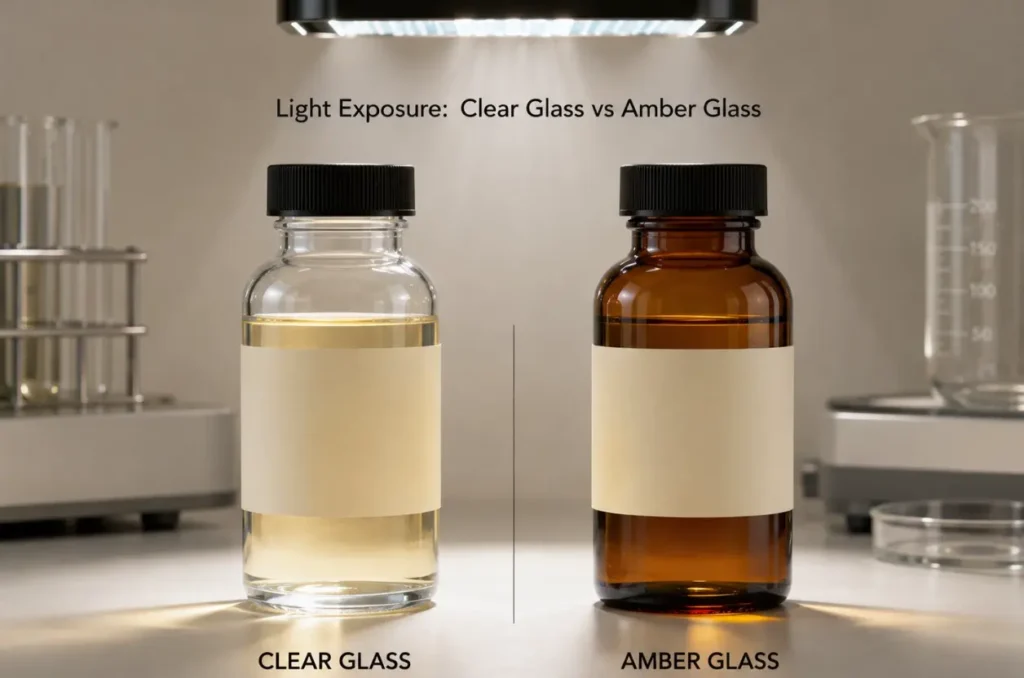
Amber glass is common because it reduces the transmission of parts of the ultraviolet and visible spectrum while still allowing the container and its contents to be inspected. It offers a practical balance between light protection, visibility, production and familiar pharmaceutical presentation.
The amber colour is produced in the glass rather than being merely printed on the surface. When the glass composition and manufacturing process are properly controlled, the colour extends through the container wall. Scratches on the outside therefore do not remove the underlying tint in the way they might damage a decorative surface coating.
This does not make amber glass completely opaque. Some light can still pass through it, and the transmitted amount varies with the glass composition, colour intensity, wall thickness and wavelength. A pale amber bottle and a dark amber bottle should not be assumed to perform identically just because both look brown.
Pharmaceutical standards therefore evaluate measurable performance, not colour names alone. The United States Pharmacopeia discusses spectral transmission testing for coloured glass containers used with light-sensitive drug products. Its published material on the protective properties of amber glass containers also shows why wall thickness and spectral transmission matter when protection is specified.
Amber is widely recognised by pharmacists and consumers, but familiarity is not a substitute for qualification. A buyer should request an agreed colour standard, dimensional specifications and applicable test documentation. The pharmaceutical company must then establish that the finished container-closure system is suitable for the particular medicine.
Jingbo Group의 amber glass medicine bottle with a screw cap illustrates the familiar narrow-neck format used for products such as oral liquids, syrups, supplements and healthcare preparations. The final application, however, must always be confirmed against the product’s stability and regulatory requirements.
Are All Coloured Medicine Bottles the Same?
No. “Coloured bottle” is a broad description, not a performance class.
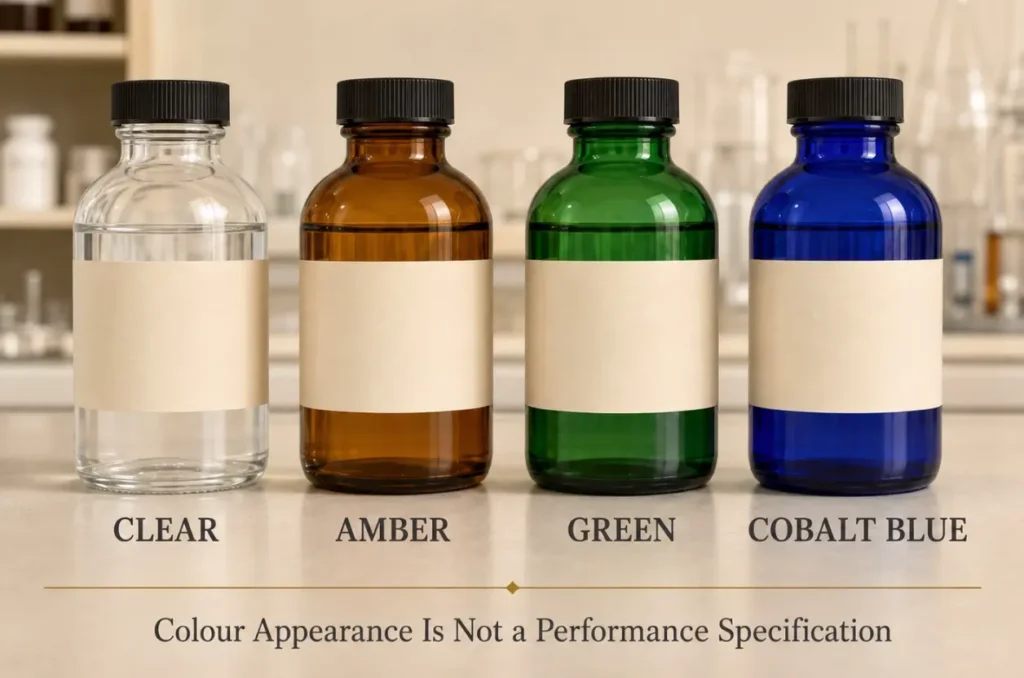
Amber, green and blue glass have different spectral transmission profiles. Two shades within the same colour family may also behave differently. A cobalt-blue bottle may look darker than a light amber bottle, yet appearance alone cannot show which wavelengths each container transmits. The correct comparison comes from a defined test method and an agreed specification.
The method used to create the appearance also matters:
- Integral coloured glass obtains its colour from the glass composition. The tint continues through the container wall.
- Surface-coated glass starts with a glass container and receives a coloured coating. Coatings can support branding or provide a particular visual finish, but they should not be claimed as pharmaceutical light protection unless their performance, durability and compatibility have been qualified.
- Sleeves, labels and cartons may cover part or all of a container. They can contribute to light protection, but their coverage, seams and condition in real use must be considered.
Wall thickness can influence transmission too. Pharmaceutical bottles and vials do not have perfectly uniform geometry; the heel, shoulder, body and neck may differ in thickness. This is one reason why approving a colour chip is not the same as qualifying a finished container.
The practical lesson is simple: do not specify only “amber”, “blue” or “green” on a purchase order. Define the required colour range and the light-transmission or packaging performance criteria relevant to the target market and formulation. Control samples and batch-to-batch comparison can help maintain visual consistency, while the appropriate laboratory methods address functional protection.
Does Coloured Glass Mean a Pharmaceutical Glass Type?
No. Bottle colour and pharmaceutical glass type describe different properties.
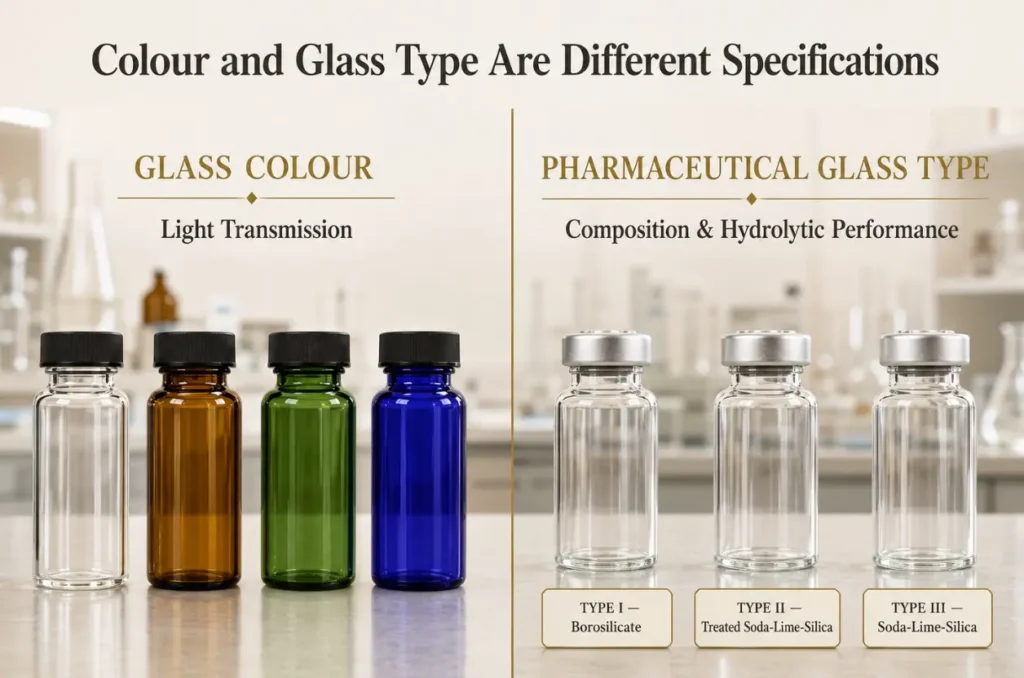
Colour mainly concerns how the container interacts with light. Pharmaceutical glass classifications such as Type I, Type II and Type III concern the glass composition or its hydrolytic performance—the resistance of the glass surface to attack by water under defined test conditions. A bottle can be amber and Type I, amber and Type III, or clear and Type I. The shade does not identify the type.
그 USP description of glass containers distinguishes the traditional categories as follows:
- Type I glass is borosilicate glass with high hydrolytic resistance and high thermal-shock resistance arising from its composition.
- Type II glass is soda-lime-silica glass whose inner surface has been treated to raise its hydrolytic resistance.
- Type III glass is soda-lime-silica glass with moderate hydrolytic resistance.
These classifications are important because a medicine remains in direct contact with the inner glass surface. The formulation’s pH, route of administration, storage time and other characteristics affect the required level of chemical compatibility.
The distinction is especially important for injectable products. The FDA’s container-closure guidance notes that injectable dosage forms carry a higher packaging concern than solid oral tablets and that their packaging information is generally more detailed. A bottle suitable for an oral supplement should never be assumed suitable for an injectable drug merely because both containers are amber.
The buyer therefore needs two separate answers:
- Does the container provide the required light protection?
- Is the glass composition and inner-surface performance suitable for contact with this formulation and route of administration?
Both answers must be supported. Colour cannot answer the second question, and glass type alone cannot answer the first.
Which Medicines May Need Light-Protective Packaging?
There is no universal list that allows a packaging buyer to choose a coloured bottle without formulation data. Products within the same dosage form can have different sensitivities. Nevertheless, light-protective packaging is considered across several common categories.
Oral liquids and syrups
Oral solutions and suspensions place the formulation in continuous contact with the container. Liquids may also be more vulnerable to oxidation or other interactions than many dry products. If photostability testing shows sensitivity, an amber bottle, opaque container or protective secondary pack may be appropriate.
The closure is particularly important for liquids. Glass is relatively impermeable, but protection can be compromised by a poor seal. The liner, torque, neck finish and dispensing feature must work together to limit leakage, solvent loss and unwanted gas or moisture exchange.
Tablets and capsules
Solid medicines can also be light-sensitive, although not every tablet or capsule requires a dark bottle. Protection may come from an amber bottle, an opaque plastic container, a blister material or a carton. Moisture protection can be just as important as light protection, so the final selection may need to address both.
Repackaging can change the level of protection, so a dispensing container should not be assumed equivalent to the original market pack.
Eye and ear preparations
Drops may be packaged in plastic droppers or glass containers depending on the formulation and delivery system. When a product is sensitive to light, the bottle, label and carton may all contribute. Sterility, drop delivery and container-closure integrity remain essential; colour does not replace those requirements.
Injections and biological products
Some injectable or biological products require protection from light, but this is a high-risk application that needs detailed material, compatibility, sterility and stability evidence. Amber vials are one possible solution. Clear vials protected by cartons, trays, overwraps or light-resistant bags are also used when supported by the approved packaging system.
An amber appearance alone is never sufficient evidence for parenteral use. Glass type, extractables or leachables where applicable, container-closure integrity, stopper compatibility, processing conditions and regulatory documentation all require specialised evaluation.
Vitamins, botanical extracts and healthcare products
Vitamins and natural ingredients are often marketed in amber containers, but these products vary widely. Their packaging should follow stability data, product claims and the rules of the destination market. Being sold in a pharmacy does not by itself establish pharmaceutical suitability.
Why Are Some Medicines Kept in Clear Bottles?
A clear bottle does not automatically mean that the medicine is poorly protected. It may be the correct choice for several reasons.
First, the formulation may be sufficiently photostable under its intended storage and use conditions. If testing shows that light does not cause an unacceptable change, a coloured primary container may add no functional benefit.
Second, protection may come from another component. The FDA’s guidance on container-closure systems notes that light protection is commonly provided by an opaque or amber container or by opaque secondary packaging such as a carton or overwrap. A clear vial in a light-resistant carton can therefore be part of a valid system.
Third, visibility may be important. Clear glass allows healthcare professionals or users to inspect a solution for particles, colour or clarity when the product instructions require it. The final design may balance inspection needs with a label, carton or storage instruction that limits exposure before use.
The correct question is not “Is amber always better than clear?” It is “Does the complete package keep this particular medicine within specification through manufacture, distribution, storage and use?”
Is Bottle Colour Enough to Protect a Medicine?
Usually not. A coloured bottle addresses light transmission, but pharmaceutical packaging has more than one job.
Under 21 CFR § 211.94, drug product containers and closures must not be reactive, additive or absorptive in a way that alters the product beyond established requirements. The container-closure system must also provide adequate protection against foreseeable external factors that could cause deterioration or contamination.
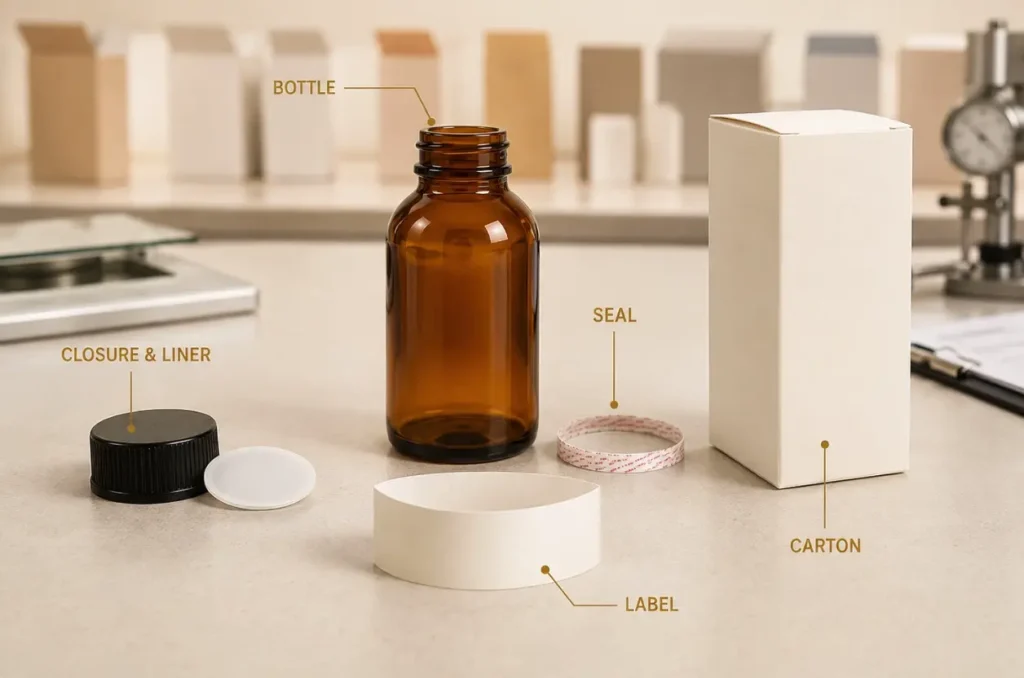
That complete system can include the bottle or vial, cap, liner, stopper, seal, label, overwrap and carton. Each component may affect performance.
Closure and seal
A closure must fit the neck finish and maintain the required seal through filling, transport, storage and repeated use where applicable. Child-resistant or tamper-evident functions may also be required. For liquid medicines, the closure may carry a liner, dosing insert, dropper or measuring feature.
Glass itself is a strong barrier to gases and moisture, but the package is only as effective as the seal at its opening. Buyers should evaluate the assembled container rather than ordering the bottle and cap as unrelated parts. Jingbo Group’s overview of 유리병 마개 및 캡 provides a useful starting point for discussing neck finish and closure compatibility, although pharmaceutical qualification remains product-specific.
Label and carton
A wraparound label can reduce the exposed glass area. An opaque carton can provide broader protection before the package is opened. However, protection may decrease if a patient discards the carton or removes a label. The approved instructions and expected user behaviour should be considered during package development.
The label also carries identity, strength, storage and use information. A dark bottle without a legible, durable label would create a different safety problem.
Compatibility and stability
The medicine may interact with the glass surface, closure liner, rubber stopper, adhesive or ink. Temperature, oxygen, moisture, headspace and storage orientation can influence those interactions. Full shelf-life stability studies on the proposed packaging system are the ultimate evidence that the package is suitable for its intended use.
How Should Pharmaceutical Buyers Choose a Coloured Bottle?
Start with the medicine, not with a bottle catalogue. Packaging requirements should be translated from formulation and stability information into measurable specifications.
1. Define the product and route of administration
Record the dosage form, formulation, fill volume, headspace, pH range, dosing method and storage conditions. The risk and documentation expected for an oral supplement are not the same as those for a sterile injectable.
2. Use photostability data to set the protection requirement
Determine whether the product is photostable, photolabile or dependent on the marketing pack for protection. ICH Q1B describes progressive testing outside the immediate pack, in the immediate pack and in the marketing pack as necessary. This approach helps identify whether the bottle, secondary package or both must provide protection.
Avoid copying a competitor’s bottle colour. Similar-looking products may use different active ingredients, concentrations, antioxidants, headspace conditions and shelf lives.
3. Specify glass colour and glass type separately
State the amber shade or other colour using an agreed reference and define the applicable spectral transmission requirement. Separately identify the required glass composition or pharmacopoeial performance and the relevant edition of the standard.
If a surface coating is proposed, treat it as a separate material. Its adhesion, abrasion resistance, light-transmission performance and compatibility with labels, cleaning and handling should be assessed.
4. Qualify the full container-closure system
Match the neck finish, cap or stopper, liner and tamper-evident feature. Check dimensional drawings and critical tolerances. Conduct appropriate seal, torque, leak, distribution and compatibility evaluations. Confirm that the bottle works with filling, capping, labelling and inspection equipment.
5. Confirm documentation for the target market
Applicable pharmacopoeias and regulations vary by product and destination. Ask for the documents needed to support incoming quality control and regulatory submissions. Do not rely on vague statements such as “medical grade” or “UV-proof”. They do not replace a defined standard, test method or acceptance criterion.
6. Verify production consistency
Approve representative samples, not only digital images. Define colour limits, dimensions, cosmetic criteria and packaging configuration. Establish incoming checks and change-control expectations. A qualified package should remain consistent across commercial batches.
자주 묻는 질문
Why are medicine bottles usually brown?
Many medicine bottles are brown because amber glass reduces the amount of ultraviolet and visible light reaching the product. It is widely used for formulations that need light protection, but the required performance must be demonstrated for the specific medicine.
Does amber glass block all light?
No. Amber glass reduces light transmission; it is not necessarily opaque. Its performance depends on the glass composition, shade, wall thickness, wavelength and finished container. A carton or other secondary pack may still be required.
Are blue or green medicine bottles as protective as amber bottles?
Not automatically. Blue, green and amber glass transmit different parts of the spectrum. Visual darkness cannot prove equivalent protection. Compare tested spectral transmission and validate the complete package with the product.
Can a clear bottle protect a light-sensitive medicine?
It can when another qualified component, such as an opaque carton, overwrap, blister or label, supplies the required protection. Photostability testing should demonstrate that the market package works under the proposed conditions.
Is every amber bottle pharmaceutical grade?
No. Amber is a colour, not a pharmaceutical grade. Pharmaceutical suitability also depends on glass composition or hydrolytic performance, dimensions, manufacturing quality, the closure system, dosage form, route of administration and supporting test data.
Should patients transfer medicine into a dark bottle?
Patients should not assume that transferring medicine into another dark container makes it safer. The new bottle may have the wrong closure, label, moisture barrier or light-transmission performance. The FDA advises people to keep medicines in their original labelled containers whenever possible and to follow the storage directions. Ask a pharmacist if a different container is needed.
Why are some tablets packed in blisters instead of bottles?
Blisters can protect individual doses and may provide barriers to light, moisture or oxygen depending on their materials. They can also support dose tracking and tamper evidence. The choice between a blister and a bottle depends on the product, required barrier, manufacturing process, distribution system and intended use.
결론
Medicines are kept in coloured bottles when the packaging needs to reduce light exposure and help maintain product quality. Amber glass is common, but colour alone does not establish protection or pharmaceutical suitability. Glass type, closure performance, labels, cartons and formulation-specific stability data all matter.
For healthcare packaging projects, 징보 그룹 can review bottle colour, shape, neck finish, closure and decoration requirements and provide samples for evaluation. Final pharmaceutical suitability, testing and regulatory compliance must be confirmed for the specific formulation and target market.