
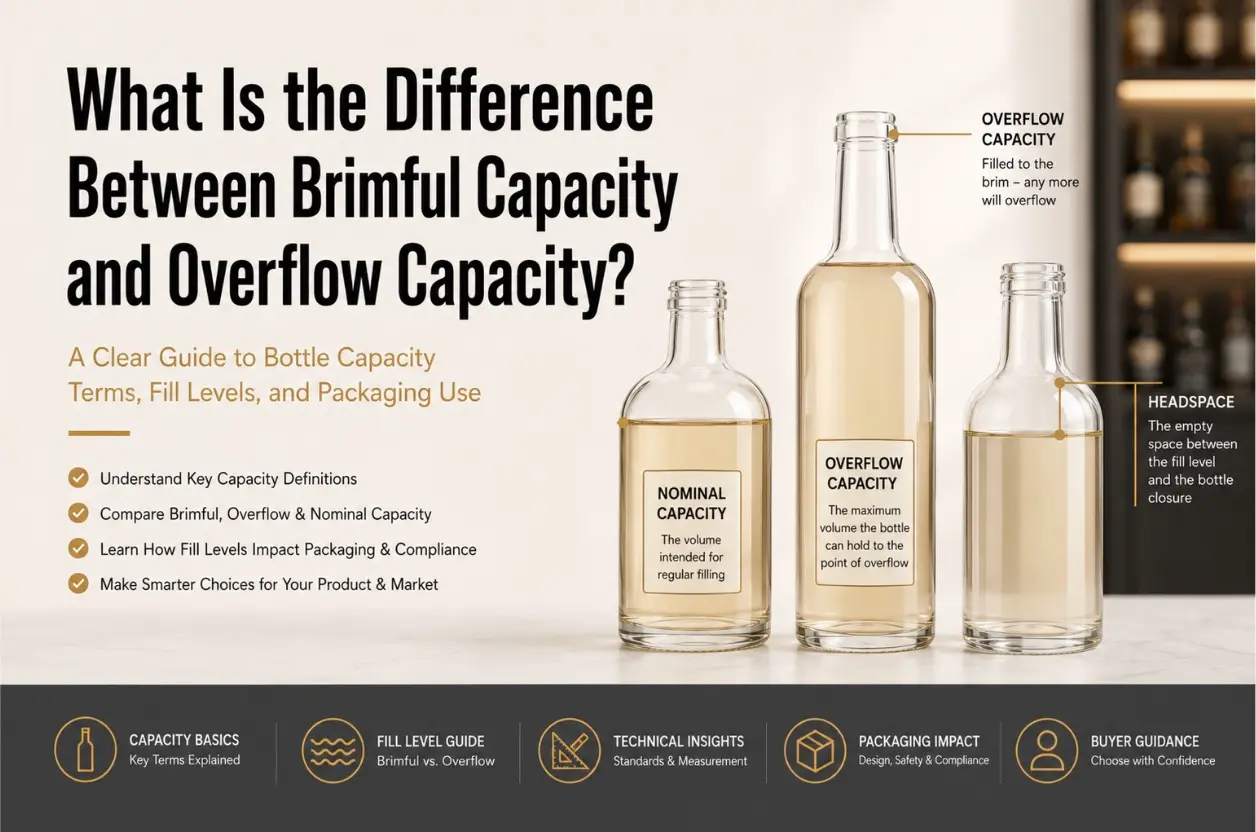
Capacidade de excedente é o volume máximo que uma garrafa pode conter quando é enchida até ao topo. Na maioria dos projetos com garrafas de vidro, equivale à capacidade até à borda. Ambos os termos diferem da capacidade nominal, que se refere ao volume de enchimento normal declarado.
A capacidade de uma garrafa parece simples, mas muitas vezes gera confusão em projetos reais de embalagem. Um comprador pode pedir uma garrafa de vidro de 500 ml. Um fornecedor pode referir uma capacidade de transbordamento de 530 ml. Um desenho técnico pode indicar a capacidade nominal, o nível de enchimento, o espaço livre, a capacidade até à borda e a capacidade total. Estes termos são semelhantes, mas não devem ser confundidos.
Na maioria das cotações de embalagem de garrafas, a capacidade até à borda e a capacidade de transbordamento significam a mesma coisa. Ambas descrevem o volume interno máximo de uma garrafa quando esta é enchida até ao topo. A diferença mais importante é entre a capacidade de transbordamento e a capacidade nominal. A capacidade nominal é o volume de enchimento normal declarado, enquanto a capacidade de transbordamento é o espaço máximo no interior da garrafa.
Esta diferença é importante para os compradores de garrafas de vidro. Afeta a precisão do enchimento, as indicações no rótulo, o espaço livre, o ajuste da tampa, a expansão do produto, o aspeto na prateleira e o desenho técnico final. Para os compradores B2B, a capacidade de transbordamento não deve ser estimada a partir de uma fotografia da garrafa. Deve ser confirmada através do desenho do fornecedor, da medição de uma amostra ou de uma especificação aprovada.
O que é a capacidade de excedente?
A capacidade de transbordamento é o volume interno total de uma garrafa quando esta está cheia até ao topo. Em termos simples, é a quantidade máxima de líquido que a garrafa pode conter fisicamente antes de transbordar pela abertura.
Por exemplo, uma garrafa pode ser concebida para um enchimento normal de 500 ml. Mas quando é enchida até ao topo, pode conter 530 ml. Nesse caso, a capacidade de transbordamento é de 530 ml. Isto não significa que a garrafa deva ser enchida com 530 ml de produto durante a produção normal. Significa que a garrafa tem 530 ml de espaço interno total.
A capacidade de excesso é utilizada principalmente no desenho de garrafas, nos desenhos técnicos, na verificação da capacidade e no controlo da produção. Ajuda o comprador e o fornecedor a confirmar se a garrafa tem capacidade para conter o volume pretendido do produto, com espaço suficiente acima do líquido. Esse espaço vazio é denominado espaço livre, ou ullage em muitas discussões sobre embalagens de líquidos e relacionadas com o vinho. Um design correto da garrafa requer tanto o enchimento adequado do produto como o espaço livre adequado.
O que é a capacidade máxima?
A capacidade até à borda refere-se ao volume que uma garrafa pode conter quando está cheia até à borda. É por isso que, no contexto do acondicionamento em garrafas, a capacidade até à borda é normalmente igual à capacidade de transbordamento. Os dois termos descrevem a mesma condição física a partir de perspetivas ligeiramente diferentes.
“Capacidade até à borda” refere-se ao facto de a garrafa estar cheia até à borda. “Capacidade de transbordamento” refere-se ao facto de a garrafa estar cheia ao ponto de o líquido transbordar.
Em muitas cotações de fornecedores, desenhos e discussões sobre produtos, ambos os termos são utilizados para designar o volume interno máximo. A formulação pode variar consoante o fornecedor, o país ou a categoria do produto. O comprador deve, ainda assim, perguntar como é que o fornecedor o mede.
A pergunta mais segura é simples:
Este número corresponde ao volume máximo quando a garrafa está cheia até ao topo?
Se a resposta for sim, o fornecedor está normalmente a referir-se à capacidade máxima ou à capacidade de transbordamento.
A «capacidade máxima» e a «capacidade de transbordamento» são a mesma coisa?
Na maioria dos projetos com garrafas de vidro, sim.
A capacidade até à borda e a capacidade de transbordamento referem-se normalmente ao mesmo volume interno máximo da garrafa.
A diferença reside principalmente na formulação.
| Termo | Significado comum nas embalagens de garrafas |
|---|---|
| Capacidade de excedente | Volume máximo quando cheio até ao topo |
| Capacidade máxima | Volume máximo quando cheio até à borda |
| Capacidade total | Costuma ser utilizado para designar o mesmo conceito, mas é necessário confirmar |
| Capacidade total | Costuma ser utilizado para designar o mesmo conceito, mas é necessário confirmar |
| Capacidade máxima | Normalmente significa a mesma coisa, mas deve ser confirmado |
O que é mais importante é o seguinte:
A capacidade de transbordamento não é o mesmo que a capacidade nominal.
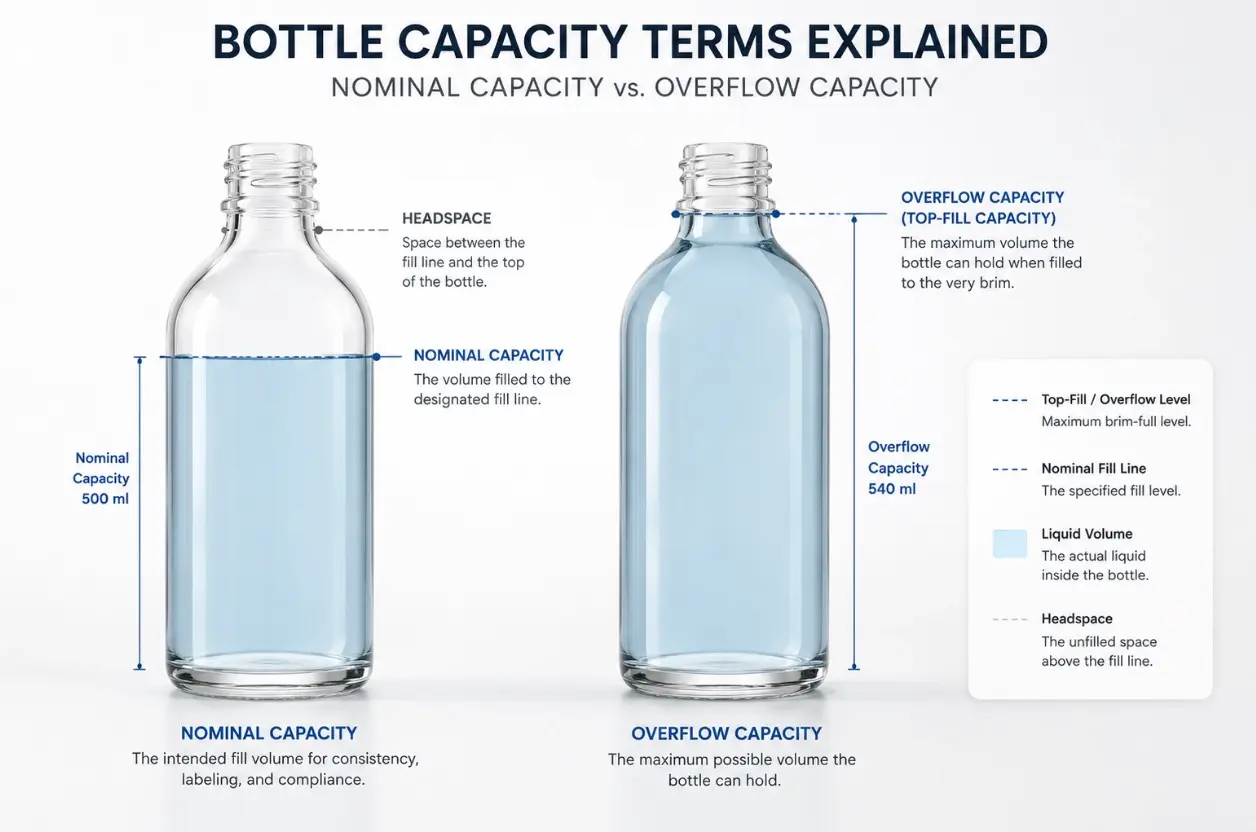
A capacidade nominal de uma garrafa pode ser de 500 ml, enquanto a sua capacidade de transbordamento pode ser de 530 ml. O espaço adicional permite que a garrafa seja enchida, selada, armazenada, transportada e utilizada sem ter de ser enchida até ao topo.
Este espaço é importante porque o produto no interior da garrafa não se mantém estável em todas as condições. O nível do líquido pode variar em função da temperatura, da velocidade de enchimento, da espuma, da viscosidade, da carbonatação e do manuseamento.
A garrafa precisa de espaço suficiente para poder ser utilizada na prática.
O que é a capacidade nominal?
A capacidade nominal corresponde ao volume de enchimento normal declarado.
Se uma garrafa for vendida como uma garrafa de 500 ml, 500 ml é normalmente a capacidade nominal. Se uma garrafa de bebidas espirituosas for vendida como uma garrafa de 750 ml, 750 ml é, normalmente, a capacidade nominal. A capacidade nominal é a quantidade de produto que a marca prevê encher e indicar no rótulo. Este é o valor que importa para a embalagem do produto, a rotulagem no retalho e o controlo de quantidades.
As orientações internacionais em matéria de metrologia legal utilizam o termo “quantidade nominal” para designar a quantidade do produto declarada no rótulo. A norma OIML R 87 explica também que algumas regulamentações nacionais podem designar esta quantidade como quantidade líquida, conteúdo líquido, massa líquida ou volume líquido. (Para referência, consulte OIML R 87 Quantidade do produto em embalagens pré-embaladas.)
É por isso que os compradores não devem confundir a capacidade nominal com a capacidade de transbordamento. A capacidade nominal corresponde ao volume normal do produto. A capacidade de transbordamento corresponde ao volume interno total da garrafa.
Capacidade de transbordamento vs. capacidade nominal
Esta é a comparação fundamental que os compradores precisam de compreender.
| Artigo | Excesso / Capacidade máxima | Capacidade nominal |
|---|---|---|
| Basic meaning | Maximum internal volume | Normal declared fill volume |
| Fill position | Filled to the top | Filled to the designed fill level |
| Used for | Bottle design and capacity check | Label claim and product filling |
| Usually higher? | Sim | Não |
| Practical headspace left? | Não | Sim |
| Exemplo | 530 ml total capacity | 500 ml fill volume |
A 500 ml bottle should not normally have only 500 ml of total internal capacity. There would be no headspace. The product may expand, foam, spill, or create closure problems. The package may also look overfilled. This is why overflow capacity is usually higher than nominal capacity.
Why Does Headspace Matter?
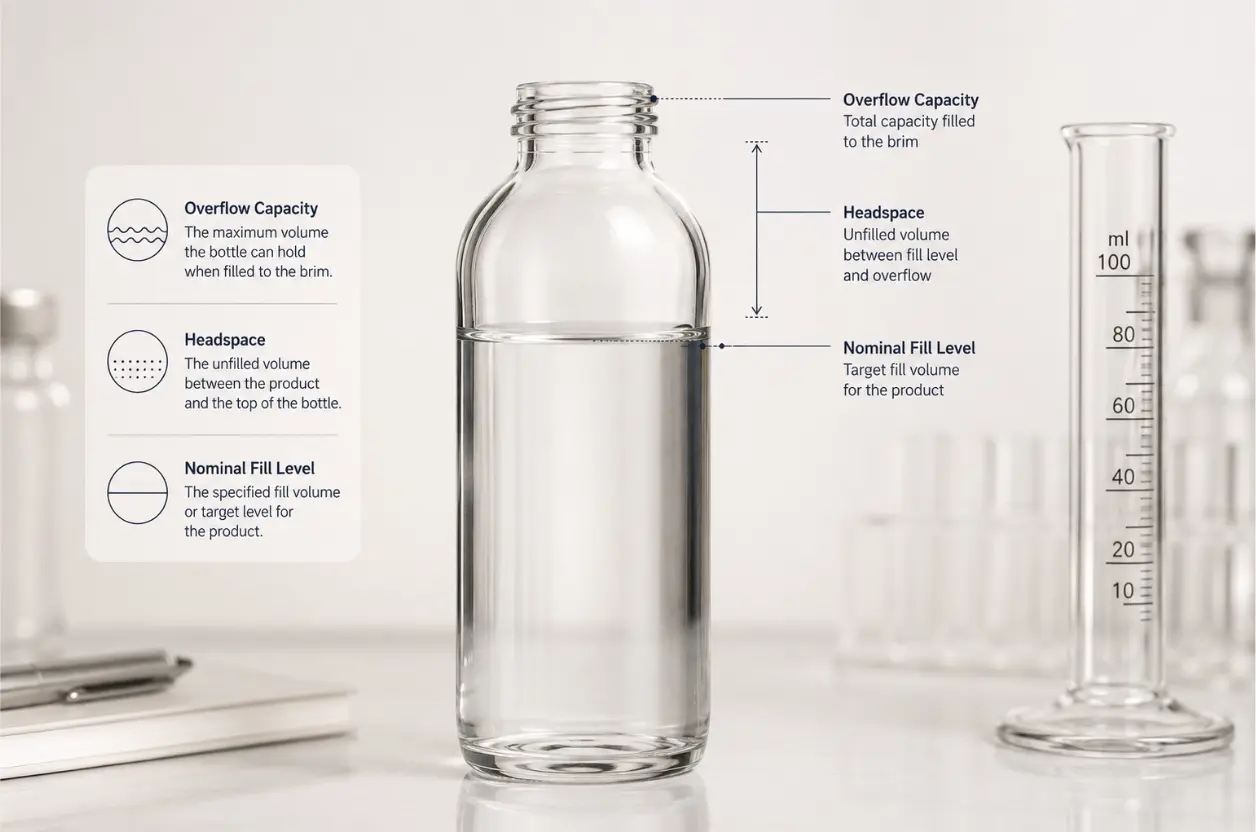
Headspace is the empty space between the product surface and the top of the bottle.
This space is not wasted. It is part of the package design.
A bottle needs headspace for several reasons.
Liquid may expand when temperature changes. Some products may foam during filling. Some closures need space to seal correctly. Some brands also want a certain visual fill level for shelf appearance.
Headspace should be planned together with the bottleneck, shoulder, closure, and filling process. It should not be decided after the bottle mold is finished.
Why Is Overflow Capacity Important for Glass Bottle Buyers?
Overflow capacity helps buyers avoid several practical problems.
A bottle may look suitable in a photo, but the internal volume may not match the product requirement. The outer shape may be attractive, but the shoulder may be too high or the neck may be too narrow.
The bottle may hold the product, but the fill level may look wrong on the shelf.
The buyer needs to know the real usable space before confirming the mold, label, closure, and carton. Overflow capacity also affects cost and shipping.
A bottle with more internal volume may need a larger body. A larger body may change glass weight, carton size, and pallet loading.
For this reason, capacity should be reviewed together with peso da garrafa de vidro before final approval.
Capacity can also affect the total packaging cost. More glass, larger cartons, lower loading efficiency, or a special mold can all change the final price.
For a complete cost view, read our guide on custo da garrafa de vidro.
How Bottle Shape Affects Overflow Capacity
Two bottles can have the same nominal capacity but different overflow capacity.
The outer shape can change the internal space.
A tall narrow bottle may hold the same product volume as a short wide bottle. But the fill height and headspace may look different. A bottle with broad shoulders may need a different fill level from a bottle with straight walls. A square bottle may have a different internal volume from a round bottle with similar height and width. The base also matters.
A thick base or deep concave bottom can reduce the available internal volume if the outer dimensions stay the same. This is common in premium spirits bottles, where the heavy base improves appearance and hand feel but uses more glass at the bottom.
For more detail on how base shape affects volume and design, read our article on por que é que as garrafas têm o fundo côncavo.
Example: 500 ml Bottle With 530 ml Overflow Capacity
A simple example makes the difference clear. Suppose a glass bottle has these values:
| Artigo | Value |
|---|---|
| Capacidade nominal | 500 ml |
| Capacidade de excedente | 530 ml |
| Headspace at nominal fill | About 30 ml |
| Intended product | Still beverage, sauce, or spirits |
In this example, the buyer fills 500 ml of product. The bottle can physically hold 530 ml when filled to the top. The extra 30 ml provides space above the liquid. This does not mean the buyer should fill 530 ml. It means the bottle has enough internal space to support a normal 500 ml fill. The exact required headspace depends on the product, filling method, closure, and market requirement. A carbonated product, hot-filled product, perfume, oil, syrup, and liquor may not use the same headspace rule.
How to Measure Overflow Capacity
The usual measurement method is simple in principle.
The empty bottle is placed on a level surface. It is filled with water until the liquid reaches the top edge. The water volume is then measured.
In practice, the method must be controlled. The bottle should be clean. The bottle should stand upright. The water should be filled carefully to avoid bubbles. The measurement tool should be accurate enough for the required tolerance. For technical projects, the measurement should be done by the supplier or an approved testing team. The result should be recorded on the drawing or product specification.
A buyer should not use one informal sample test as the only basis for a large order. Glass production has normal manufacturing variation.
The supplier should confirm the expected overflow capacity range and tolerance.
How Much Difference Should There Be Between Nominal Capacity and Overflow Capacity?
There is no single fixed difference for every bottle. The gap depends on the product and package design.
A still product may need less headspace than a foaming product. A hot-fill product may need more room for process behavior. A luxury bottle may use a fill level that supports its appearance. A bottle with a long narrow neck may show small level changes more clearly than a wide bottle.
The best question is not:
“What is the standard gap?”
The better question is:
“What headspace does this product and filling process need?”
The buyer should confirm this with the filling plant, closure supplier, and bottle manufacturer. A supplier can recommend a bottle. But the final fill requirement must match the product formula, filling equipment, legal market, and closure system.
Capacity Tolerance Also Matters
A bottle drawing may show a target overflow capacity, but actual production may have a tolerance.
Glass bottles are formed through heat, molds, air pressure, timing, and cooling. Small variations can happen during production. This is why buyers should confirm the capacity tolerance, not only the target number.
For example, a drawing may state:
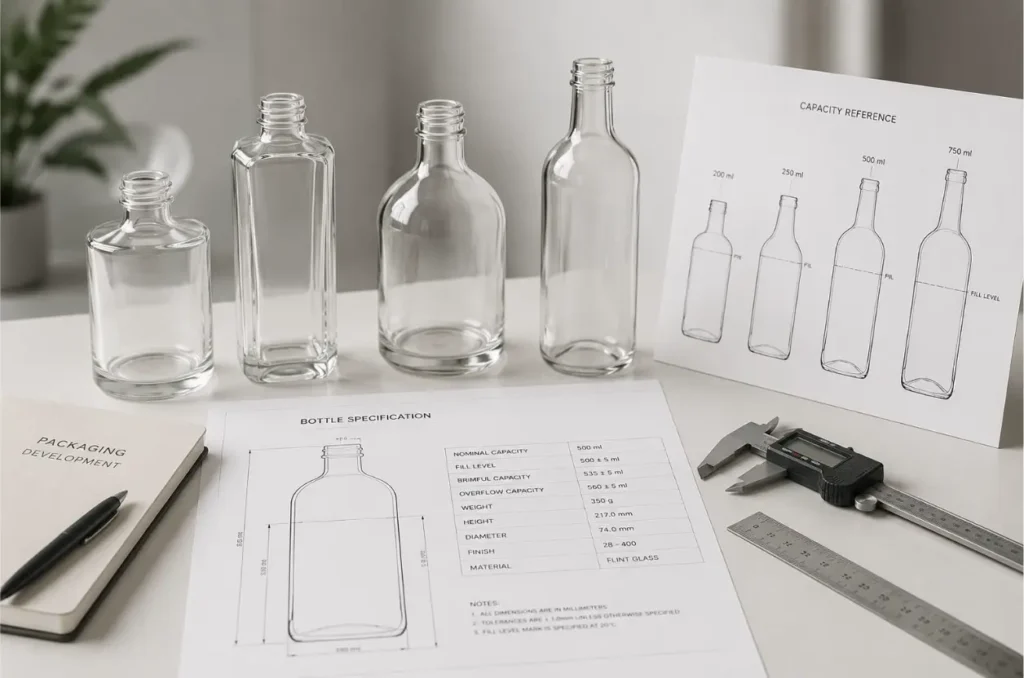
| Capacity Item | Example Specification |
|---|---|
| Capacidade nominal | 500 ml |
| Capacidade de excedente | 530 ml |
| Overflow capacity tolerance | ±5 ml |
| Nível de enchimento | Confirmed by buyer |
| Acabamento do pescoço | Confirmed by closure |
| Amostra aprovada | Required before mass production |
The exact tolerance should be confirmed by the supplier. It can depend on bottle size, shape, production process, and quality standard.
For products sold in regulated markets, brands should also check local net content rules. In the United States, NIST Handbook 133 provides procedures for checking the net contents of packaged goods.
This resource is not a bottle design manual. It is useful because it shows why declared quantity and actual filled quantity must be treated carefully.
Common Buyer Mistakes
Many bottle capacity problems happen before production starts.
The first mistake is comparing bottles only by nominal capacity.
Two 500 ml bottles may not have the same overflow capacity, headspace, fill height, or appearance.
The second mistake is assuming overflow capacity is the filling capacity.
If a buyer fills to the top, the package may spill, leak, foam, or fail during closure.
The third mistake is ignoring bottle shape.
A thick base, deep punt, high shoulder, or narrow neck can change usable internal space.
The fourth mistake is approving a custom mold before confirming fill level.
Once the mold is made, changing capacity may require mold adjustment or a new mold.
The fifth mistake is not checking the filled product with the real closure.
A bottle may hold the liquid, but the closure may need extra space, a different finish, or a different sealing condition.
These mistakes are avoidable when the buyer confirms the complete packaging system.
What Should Buyers Confirm Before Ordering?
Before placing a glass bottle order, the buyer should request a clear specification.
| Item a confirmar | Por que é importante |
|---|---|
| Capacidade nominal | Confirms normal filling volume |
| Capacidade de excedente | Confirms maximum internal volume |
| Nível de enchimento | Controls product appearance and headspace |
| Capacity tolerance | Shows expected production variation |
| Peso da garrafa | Affects cost and freight |
| Dimensões da garrafa | Affect filling line and carton design |
| Conceção da base | Affects volume, weight, and stability |
| Acabamento do pescoço | Affects closure and sealing |
| Closure type | Affects headspace and sealing performance |
| Amostra aprovada | Confirms real appearance and handling |
This table should be used before confirming a new mold or bulk order.
For stock mold bottles, these values may already exist. For custom bottles, they need to be confirmed during drawing and sample review.
How Overflow Capacity Affects Custom Glass Bottle Design
In custom bottle projects, overflow capacity should be confirmed early.
A buyer may want a thick base, special shoulder, deep embossing, or unique shape. These design features can change the internal volume.
If the bottle must hold exactly 750 ml at a certain fill height, the designer needs to plan the body volume, base thickness, shoulder curve, and neck height together.
The bottle cannot be designed only from the outside. A beautiful outer shape may not leave enough internal space. It may also create a fill level that looks too high or too low. This is why a custom glass bottle drawing should include both outside dimensions and capacity details.
Jingbo Glass supports buyers as a fabricante de garrafas de vidro personalizadas by reviewing bottle shape, capacity, weight, neck finish, closure match, decoration, packing, and export needs together.
Overflow Capacity and Different Product Categories
Different product categories use capacity in different ways.
Spirits bottle usually needs a clean and stable fill level. Premium spirits bottles may also use a thick base, which can reduce internal volume if the outer size is not adjusted.
Perfume bottle may need more attention to shoulder shape, spray pump compatibility, and visual fill height.
Food jar may need enough opening space, sealing area, and headspace for the product type.
Beverage bottle may need careful review of filling speed, foam, closure type, and transport conditions.
Pharmaceutical or cosmetic bottle may have stricter tolerance and dosing needs.
This is why one general rule cannot cover every bottle. The bottle should be designed around the product, not only around the number printed on the label.
FAQ About Overflow Capacity and Brimful Capacity
What is overflow capacity?
Overflow capacity is the maximum internal volume a bottle can hold when it is filled to the very top. It is not the normal filling volume. It is mainly used for design, measurement, and capacity control.
Is brimful capacity the same as overflow capacity?
In most bottle packaging projects, yes.
Both terms usually mean the maximum internal volume when the bottle is filled to the top. The buyer should still ask the supplier to confirm the measurement method.
Is overflow capacity the same as nominal capacity?
N.º.
Overflow capacity is the maximum volume the bottle can hold. Nominal capacity is the normal declared filling volume. A 500 ml bottle may have 500 ml nominal capacity and 530 ml overflow capacity.
Why is overflow capacity higher than nominal capacity?
The extra space provides headspace. Headspace helps with filling, closure, temperature change, product movement, foam, and appearance.
Can I fill a bottle to its overflow capacity?
Usually, no.
Overflow capacity is a maximum measurement, not a normal filling target. Most products need space above the liquid.
Does a deeper punt reduce overflow capacity?
It can.
A deeper concave bottom uses internal space if the outer dimensions stay the same. The final effect depends on the complete bottle geometry.
Should overflow capacity appear on the technical drawing?
Sim.
For serious purchasing and custom bottle projects, the drawing should show nominal capacity, overflow capacity, dimensions, weight, neck finish, and tolerance.
Conclusão
Capacidade de excedente and brimful capacity usually mean the same thing in glass bottle packaging. Both refer to the maximum amount of liquid a bottle can hold when filled to the top.
The more important distinction is between overflow capacity and nominal capacity.
Nominal capacity is the normal declared fill volume. Overflow capacity is the total internal volume. The space between them helps create the right headspace for filling, sealing, storage, transport, and product appearance.
For buyers, capacity should never be checked alone. It should be reviewed together with bottle weight, base design, neck finish, closure, fill level, carton packing, and legal market needs.
A correct bottle is not only a bottle that can hold the liquid.