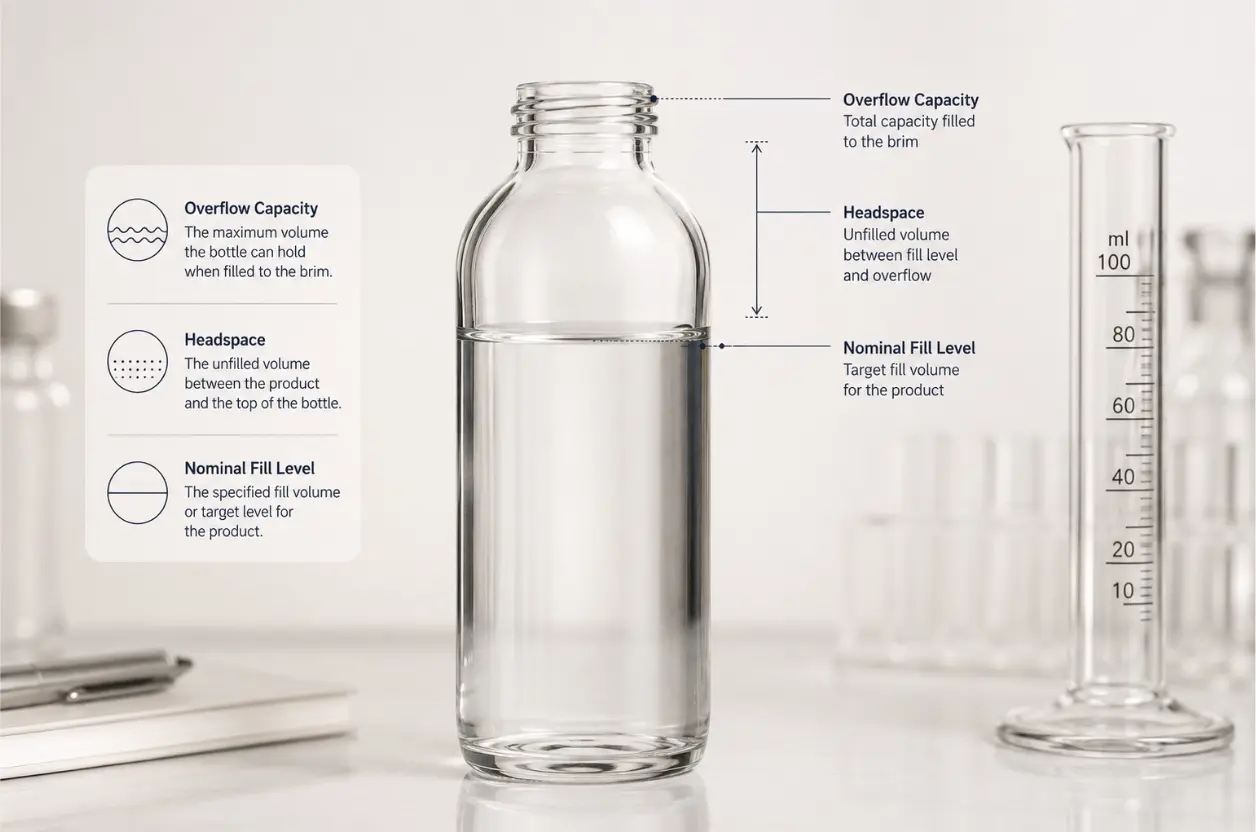
Overflow capacity is the maximum volume a bottle can hold when it is filled to the very top. In most glass bottle projects, it means the same thing as brimful capacity. Both terms are different from nominal capacity, which refers to the normal declared filling volume.
Bottle capacity sounds simple, but it often confuses real packaging projects. A buyer may ask for a 500 ml glass bottle. A supplier may mention 530 ml overflow capacity. A drawing may show nominal capacity, fill level, headspace, brimful capacity, and total capacity. These terms are close, but they should not be mixed.
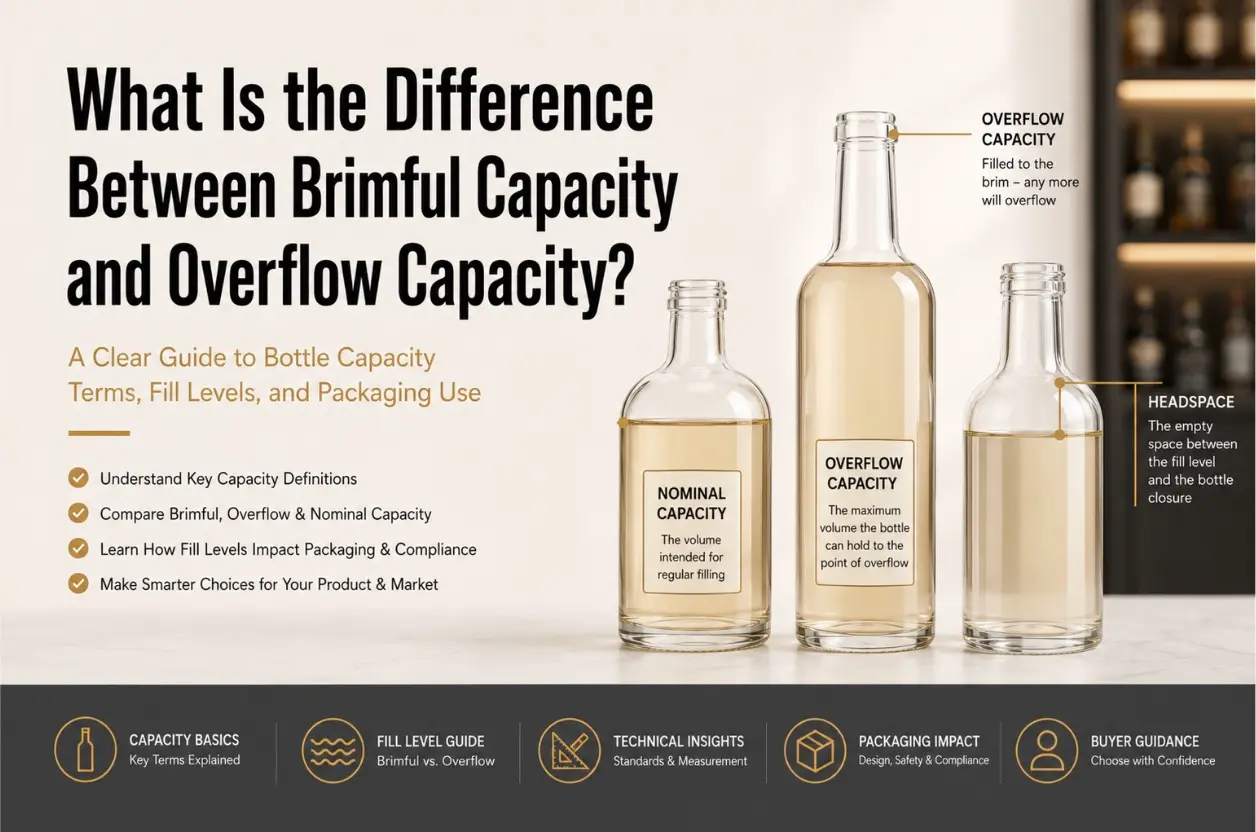
In most bottle packaging quotations, brimful capacity and overflow capacity mean the same thing. They both describe the maximum internal volume of a bottle when it is filled to the top. The more important difference is between overflow capacity and nominal capacity. Nominal capacity is the normal declared filling volume, while overflow capacity is the maximum space inside the bottle.
This difference matters for glass bottle buyers. It affects filling accuracy, label claims, headspace, closure fit, product expansion, shelf appearance, and the final technical drawing. For B2B buyers, overflow capacity should not be guessed from a bottle photo. It should be confirmed by the supplier’s drawing, sample measurement, or approved specification.
What Is Overflow Capacity?
Overflow capacity is the total internal volume of a bottle when it is filled to the top. In simple terms, it is the maximum amount of liquid the bottle can physically hold before it overflows through the opening.
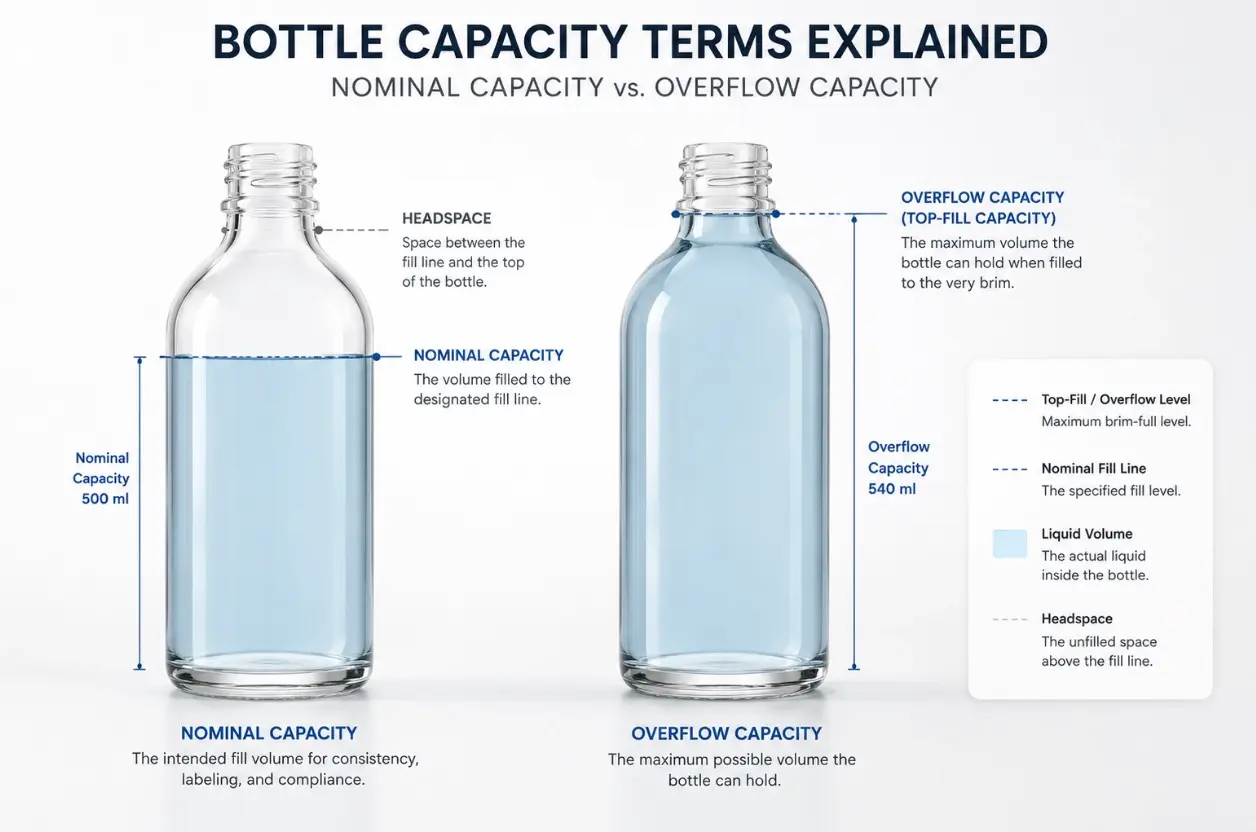
For example, a bottle may be designed for a 500 ml normal fill. But when it is filled to the very top, it may hold 530 ml. In that case, the overflow capacity is 530 ml. This does not mean the bottle should be filled with 530 ml of product during normal production. It means the bottle has 530 ml of total internal space.
Overflow capacity is mainly used for bottle design, technical drawings, capacity checking, and production control. It helps the buyer and supplier confirm whether the bottle can hold the intended product volume with enough room above the liquid. That empty room is called headspace, 或 ullage in many liquid packaging and wine-related discussions. A correct bottle design needs both the right product fill and the right headspace.
What Is Brimful Capacity?
Brimful capacity means the volume a bottle can hold when it is filled to the brim. This is why brimful capacity is usually the same as overflow capacity in bottle packaging. The two terms describe the same physical condition from slightly different angles.
“Brimful capacity” describes the bottle being full to the brim. “Overflow capacity” describes the bottle being full to the point where liquid would overflow.
In many supplier quotations, drawings, and product discussions, both terms are used for the maximum internal volume. The wording may change by supplier, country, or product category. The buyer should still ask how the supplier measures it.
The safest question is simple:
Does this number mean the maximum volume when the bottle is filled to the very top?
If the answer is yes, the supplier is usually talking about brimful capacity or overflow capacity.
Are Brimful Capacity and Overflow Capacity the Same?
For most glass bottle projects, yes.
Brimful capacity and overflow capacity usually refer to the same maximum internal bottle volume.
The difference is mostly wording.
| Term | Common Meaning in Bottle Packaging |
|---|---|
| Overflow capacity | Maximum volume when filled to the top |
| 满溢的容量 | Maximum volume when filled to the brim |
| Full capacity | Often used for the same idea, but should be confirmed |
| Total capacity | Often used for the same idea, but should be confirmed |
| Maximum capacity | Usually means the same idea, but should be confirmed |
The more important point is this:
Overflow capacity is not the same as nominal capacity.
A bottle’s nominal capacity may be 500 ml, while its overflow capacity may be 530 ml. The extra space allows the bottle to be filled, sealed, stored, transported, and used without being filled to the absolute top.
This space is important because the product inside the bottle is not static in every condition. Liquid level can change with temperature, filling speed, foam, viscosity, carbonation, and handling.
The bottle needs enough room for real use.
What Is Nominal Capacity?
Nominal capacity is the normal declared filling volume.
If a bottle is sold as a 500 ml bottle, 500 ml is usually the nominal capacity. If a spirits bottle is sold as a 750 ml bottle, 750 ml is usually the nominal capacity. Nominal capacity is the amount of product the brand expects to fill and declare on the label. This is the number that matters for product packaging, retail labeling, and quantity control.
International legal metrology guidance uses the term “nominal quantity” for the quantity of product declared on the label. OIML R 87 also explains that some national regulations may call this net quantity, net contents, net mass, or net volume. (For reference, see OIML R 87 Quantity of Product in Prepackages.)
This is why buyers should not confuse nominal capacity with overflow capacity. Nominal capacity is the normal product volume. Overflow capacity is the total internal bottle volume.
Overflow Capacity vs Nominal Capacity
This is the key comparison buyers need to understand.
| Item | Overflow / Brimful Capacity | Nominal Capacity |
|---|---|---|
| Basic meaning | Maximum internal volume | Normal declared fill volume |
| Fill position | Filled to the top | Filled to the designed fill level |
| Used for | Bottle design and capacity check | Label claim and product filling |
| Usually higher? | Yes | No |
| Practical headspace left? | No | Yes |
| 示例 | 530 ml total capacity | 500 ml fill volume |
A 500 ml bottle should not normally have only 500 ml of total internal capacity. There would be no headspace. The product may expand, foam, spill, or create closure problems. The package may also look overfilled. This is why overflow capacity is usually higher than nominal capacity.
Why Does Headspace Matter?
Headspace is the empty space between the product surface and the top of the bottle.
This space is not wasted. It is part of the package design.
A bottle needs headspace for several reasons.
Liquid may expand when temperature changes. Some products may foam during filling. Some closures need space to seal correctly. Some brands also want a certain visual fill level for shelf appearance.
Headspace should be planned together with the bottleneck, shoulder, closure, and filling process. It should not be decided after the bottle mold is finished.

Why Is Overflow Capacity Important for Glass Bottle Buyers?
Overflow capacity helps buyers avoid several practical problems.
A bottle may look suitable in a photo, but the internal volume may not match the product requirement. The outer shape may be attractive, but the shoulder may be too high or the neck may be too narrow.
The bottle may hold the product, but the fill level may look wrong on the shelf.
The buyer needs to know the real usable space before confirming the mold, label, closure, and carton. Overflow capacity also affects cost and shipping.
A bottle with more internal volume may need a larger body. A larger body may change glass weight, carton size, and pallet loading.
For this reason, capacity should be reviewed together with glass bottle weight before final approval.
Capacity can also affect the total packaging cost. More glass, larger cartons, lower loading efficiency, or a special mold can all change the final price.
For a complete cost view, read our guide on glass bottle cost.
How Bottle Shape Affects Overflow Capacity
Two bottles can have the same nominal capacity but different overflow capacity.
The outer shape can change the internal space.
A tall narrow bottle may hold the same product volume as a short wide bottle. But the fill height and headspace may look different. A bottle with broad shoulders may need a different fill level from a bottle with straight walls. A square bottle may have a different internal volume from a round bottle with similar height and width. The base also matters.
A thick base or deep concave bottom can reduce the available internal volume if the outer dimensions stay the same. This is common in premium spirits bottles, where the heavy base improves appearance and hand feel but uses more glass at the bottom.
For more detail on how base shape affects volume and design, read our article on why bottles have concave bottoms.
Example: 500 ml Bottle With 530 ml Overflow Capacity
A simple example makes the difference clear. Suppose a glass bottle has these values:
| Item | Value |
|---|---|
| 额定容量 | 500 毫升 |
| Overflow capacity | 530 ml |
| Headspace at nominal fill | About 30 ml |
| Intended product | Still beverage, sauce, or spirits |
In this example, the buyer fills 500 ml of product. The bottle can physically hold 530 ml when filled to the top. The extra 30 ml provides space above the liquid. This does not mean the buyer should fill 530 ml. It means the bottle has enough internal space to support a normal 500 ml fill. The exact required headspace depends on the product, filling method, closure, and market requirement. A carbonated product, hot-filled product, perfume, oil, syrup, and liquor may not use the same headspace rule.
How to Measure Overflow Capacity
The usual measurement method is simple in principle.
The empty bottle is placed on a level surface. It is filled with water until the liquid reaches the top edge. The water volume is then measured.
In practice, the method must be controlled. The bottle should be clean. The bottle should stand upright. The water should be filled carefully to avoid bubbles. The measurement tool should be accurate enough for the required tolerance. For technical projects, the measurement should be done by the supplier or an approved testing team. The result should be recorded on the drawing or product specification.
A buyer should not use one informal sample test as the only basis for a large order. Glass production has normal manufacturing variation.
The supplier should confirm the expected overflow capacity range and tolerance.

How Much Difference Should There Be Between Nominal Capacity and Overflow Capacity?
There is no single fixed difference for every bottle. The gap depends on the product and package design.
A still product may need less headspace than a foaming product. A hot-fill product may need more room for process behavior. A luxury bottle may use a fill level that supports its appearance. A bottle with a long narrow neck may show small level changes more clearly than a wide bottle.
The best question is not:
“What is the standard gap?”
The better question is:
“What headspace does this product and filling process need?”
The buyer should confirm this with the filling plant, closure supplier, and bottle manufacturer. A supplier can recommend a bottle. But the final fill requirement must match the product formula, filling equipment, legal market, and closure system.
Capacity Tolerance Also Matters
A bottle drawing may show a target overflow capacity, but actual production may have a tolerance.
Glass bottles are formed through heat, molds, air pressure, timing, and cooling. Small variations can happen during production. This is why buyers should confirm the capacity tolerance, not only the target number.
For example, a drawing may state:
| Capacity Item | Example Specification |
|---|---|
| 额定容量 | 500 毫升 |
| Overflow capacity | 530 ml |
| Overflow capacity tolerance | ±5 ml |
| Fill level | Confirmed by buyer |
| 颈部收尾 | Confirmed by closure |
| Approved sample | Required before mass production |
The exact tolerance should be confirmed by the supplier. It can depend on bottle size, shape, production process, and quality standard.
For products sold in regulated markets, brands should also check local net content rules. In the United States, NIST Handbook 133 provides procedures for checking the net contents of packaged goods.
This resource is not a bottle design manual. It is useful because it shows why declared quantity and actual filled quantity must be treated carefully.
Common Buyer Mistakes
Many bottle capacity problems happen before production starts.
The first mistake is comparing bottles only by nominal capacity.
Two 500 ml bottles may not have the same overflow capacity, headspace, fill height, or appearance.
The second mistake is assuming overflow capacity is the filling capacity.
If a buyer fills to the top, the package may spill, leak, foam, or fail during closure.
The third mistake is ignoring bottle shape.
A thick base, deep punt, high shoulder, or narrow neck can change usable internal space.
The fourth mistake is approving a custom mold before confirming fill level.
Once the mold is made, changing capacity may require mold adjustment or a new mold.
The fifth mistake is not checking the filled product with the real closure.
A bottle may hold the liquid, but the closure may need extra space, a different finish, or a different sealing condition.
These mistakes are avoidable when the buyer confirms the complete packaging system.
What Should Buyers Confirm Before Ordering?
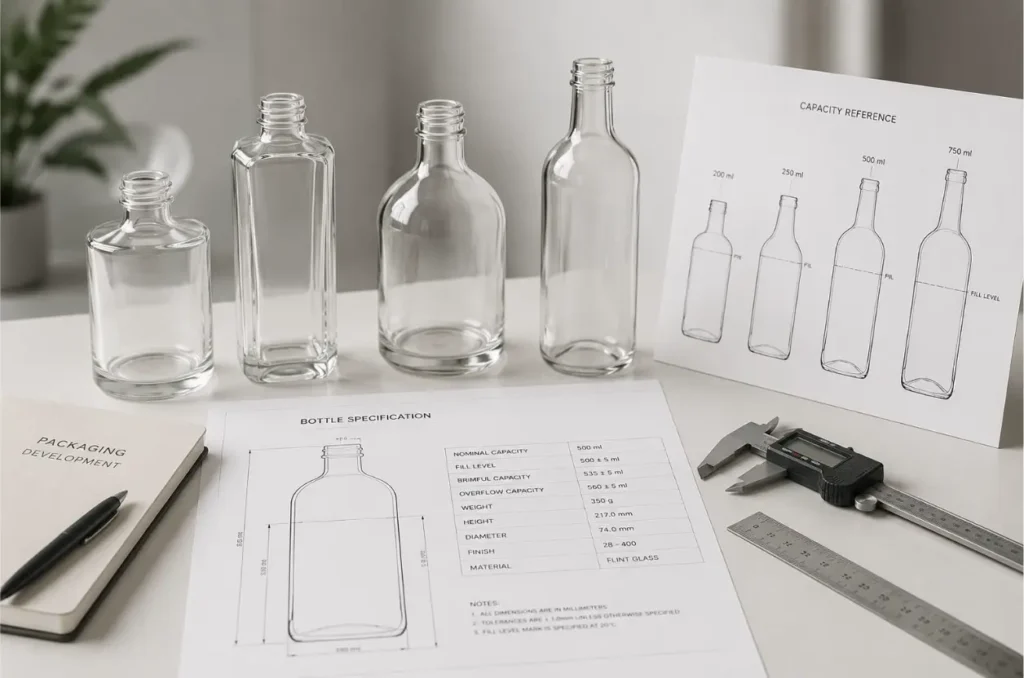
Before placing a glass bottle order, the buyer should request a clear specification.
| Item to Confirm | 为何这很重要 |
|---|---|
| 额定容量 | Confirms normal filling volume |
| Overflow capacity | Confirms maximum internal volume |
| Fill level | Controls product appearance and headspace |
| Capacity tolerance | Shows expected production variation |
| Bottle weight | Affects cost and freight |
| Bottle dimensions | Affect filling line and carton design |
| Base design | Affects volume, weight, and stability |
| 颈部收尾 | Affects closure and sealing |
| Closure type | Affects headspace and sealing performance |
| Approved sample | Confirms real appearance and handling |
This table should be used before confirming a new mold or bulk order.
For stock mold bottles, these values may already exist. For custom bottles, they need to be confirmed during drawing and sample review.

How Overflow Capacity Affects Custom Glass Bottle Design
In custom bottle projects, overflow capacity should be confirmed early.
A buyer may want a thick base, special shoulder, deep embossing, or unique shape. These design features can change the internal volume.
If the bottle must hold exactly 750 ml at a certain fill height, the designer needs to plan the body volume, base thickness, shoulder curve, and neck height together.
The bottle cannot be designed only from the outside. A beautiful outer shape may not leave enough internal space. It may also create a fill level that looks too high or too low. This is why a custom glass bottle drawing should include both outside dimensions and capacity details.
Jingbo Glass supports buyers as a 定制玻璃瓶制造商 by reviewing bottle shape, capacity, weight, neck finish, closure match, decoration, packing, and export needs together.
Overflow Capacity and Different Product Categories
Different product categories use capacity in different ways.
Spirits bottle usually needs a clean and stable fill level. Premium spirits bottles may also use a thick base, which can reduce internal volume if the outer size is not adjusted.
Perfume bottle may need more attention to shoulder shape, spray pump compatibility, and visual fill height.
Food jar may need enough opening space, sealing area, and headspace for the product type.
Beverage bottle may need careful review of filling speed, foam, closure type, and transport conditions.
Pharmaceutical or cosmetic bottle may have stricter tolerance and dosing needs.
This is why one general rule cannot cover every bottle. The bottle should be designed around the product, not only around the number printed on the label.
FAQ About Overflow Capacity and Brimful Capacity
What is overflow capacity?
Overflow capacity is the maximum internal volume a bottle can hold when it is filled to the very top. It is not the normal filling volume. It is mainly used for design, measurement, and capacity control.
Is brimful capacity the same as overflow capacity?
In most bottle packaging projects, yes.
Both terms usually mean the maximum internal volume when the bottle is filled to the top. The buyer should still ask the supplier to confirm the measurement method.
Is overflow capacity the same as nominal capacity?
No.
Overflow capacity is the maximum volume the bottle can hold. Nominal capacity is the normal declared filling volume. A 500 ml bottle may have 500 ml nominal capacity and 530 ml overflow capacity.
Why is overflow capacity higher than nominal capacity?
The extra space provides headspace. Headspace helps with filling, closure, temperature change, product movement, foam, and appearance.
Can I fill a bottle to its overflow capacity?
Usually, no.
Overflow capacity is a maximum measurement, not a normal filling target. Most products need space above the liquid.
Does a deeper punt reduce overflow capacity?
It can.
A deeper concave bottom uses internal space if the outer dimensions stay the same. The final effect depends on the complete bottle geometry.
Should overflow capacity appear on the technical drawing?
Yes.
For serious purchasing and custom bottle projects, the drawing should show nominal capacity, overflow capacity, dimensions, weight, neck finish, and tolerance.
结论
Overflow capacity and brimful capacity usually mean the same thing in glass bottle packaging. Both refer to the maximum amount of liquid a bottle can hold when filled to the top.
The more important distinction is between overflow capacity and nominal capacity.
Nominal capacity is the normal declared fill volume. Overflow capacity is the total internal volume. The space between them helps create the right headspace for filling, sealing, storage, transport, and product appearance.
For buyers, capacity should never be checked alone. It should be reviewed together with bottle weight, base design, neck finish, closure, fill level, carton packing, and legal market needs.
A correct bottle is not only a bottle that can hold the liquid.