Glass bottle weight can range from less than 200 g for small bottles to more than 1,000 g for premium heavy-base bottles. The final weight depends on capacity, shape, base thickness, neck design, glass distribution, and the product’s use.
This is why buyers should not compare glass bottles by capacity alone.
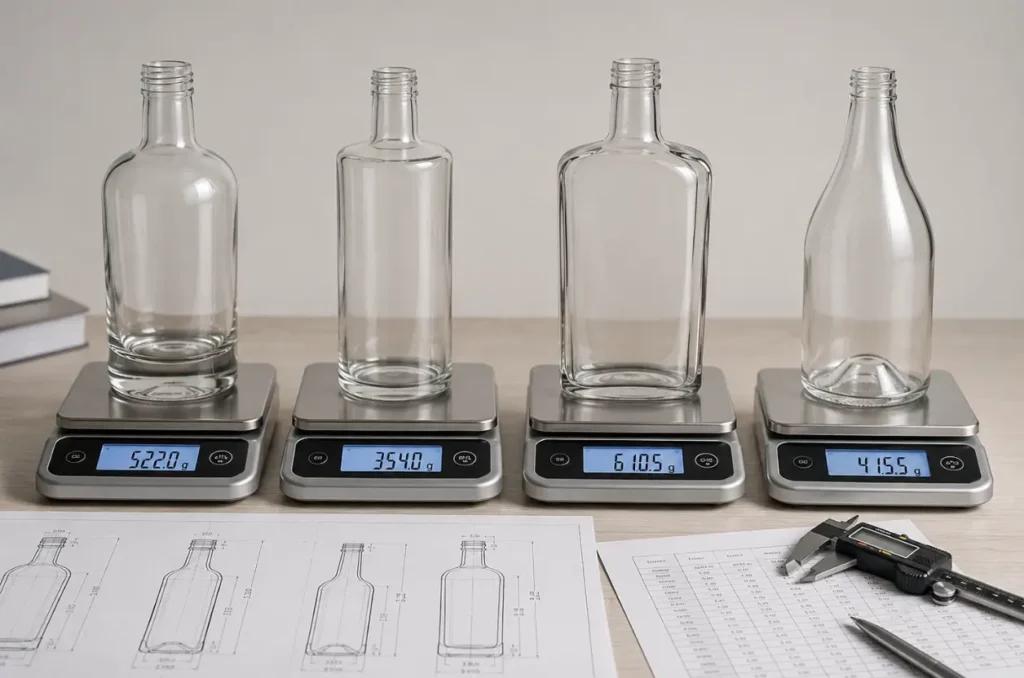
Two bottles can both hold 750 ml. One may be light and practical for high-volume filling. Another may use a thick base, broad shoulders, and heavy glass to create a premium feel. Both bottles can be correct. They serve different business goals.
For B2B buyers, glass bottle weight is one of the first details to confirm before comparing quotations. It affects cost, carton weight, pallet loading, shipping weight, warehouse handling, and shelf impression.
How Much Does an Empty Glass Bottle Weigh?
There is no universal weight for every bottle size.
A 100 ml sample bottle can be around 180 g when it uses a premium heavy feel. Jingbo’s 100ml Long Neck Glass Spirit Bottle is listed with a 180 g weight on its product page.
A 750 ml liquor bottle can be much heavier. Jingbo’s 750ml Slim Cylindrical Glass Bottle is listed with a 680 g glass weight and an extra-thick bottom.
These examples show an important point. Bottle weight does not rise only because capacity rises. It also changes because of design purpose.
A small bottle may feel heavy because the brand wants a premium sample package. A larger bottle may be lighter than expected if it is designed for efficient filling and transport.
The exact glass bottle weight should come from the supplier’s confirmed product drawing or specification sheet. The weight should not be guessed from product photos.
The table below shows practical weight categories. These are not fixed standards. They are useful planning ranges.
| Bottle Type | Common Capacity Range | Typical Weight Direction | Main Reason |
|---|---|---|---|
| Mini sample bottle | 30 ml–100 ml | Light to medium | Small volume, but sometimes thick base for premium feel |
| Perfume bottle | 30 ml–100 ml | Medium to heavy | Thick walls and decorative shape are common |
| Beverage bottle | 250 ml–500 ml | Light to medium | High-volume filling and shipping efficiency matter |
| Sauce or food bottle | 100 ml–1,000 ml | Medium | Needs filling stability and safe handling |
| Standard liquor bottle | 500 ml–750 ml | Medium to heavy | Shelf presence and hand feel matter |
| Premium spirits bottle | 700 ml–1,000 ml | Heavy | Thick base and luxury appearance are often required |
| Large-format bottle | 1.5 L and above | Heavy | Larger capacity and structural support increase weight |
A buyer should ask for the confirmed empty bottle weight before approving a quote. The weight should also appear on the technical drawing or product specification sheet.
Why Can Bottles With the Same Capacity Have Different Weights?
Capacity means internal volume. Weight means the amount of glass used.
Those two values are related, but they are not the same.
A bottle can hold the same liquid volume while using a different outer shape, base thickness, shoulder design, neck finish, or glass distribution. This is why glass bottle weight can change even when capacity does not change.
Base Design
The base often creates the biggest weight difference.
A thin flat base can reduce glass use. A thick solid base can make the bottle feel more stable and premium. A concave bottom, also called a punt, can change the way glass is distributed in the base.
For pressure bottles, the base is part of the strength design. For spirits bottles, the base often supports appearance, balance, and shelf feel.
A deeper or thicker base may add weight. It may also reduce internal volume when the outside dimensions stay the same.
This does not mean every bottle should use a lighter base. It means the base should match the bottle’s real use.
For a deeper explanation of base shape, read our guide on why bottles have concave bottoms.
Body Shape
Round bottles often use glass efficiently because the shape distributes stress well.
Square bottles, flat bottles, pear-shaped bottles, and special geometric bottles may need different wall support. Sharp corners, wide panels, deep ribs, and embossed areas can also affect glass distribution.
A tall narrow bottle may have the same capacity as a short wide bottle. The weight may still be different because the surface area and structural needs are different.
The buyer should not approve a bottle only from a front-view image. Side view, base view, neck drawing, and full dimensions all matter.
Neck and Finish
The neck may look like a small part of the bottle, but it affects weight and function.
A long neck uses more glass than a short neck when the body stays similar. A bar-top finish, screw finish, crown finish, or special closure finish may need different material thickness around the mouth.
The neck also needs dimensional stability. It must fit the closure, filling line, sealing process, and transport conditions.
Reducing neck weight without checking the closure system can create sealing problems.
Glass Distribution
Total weight does not show where the glass is placed.
Two bottles may both weigh 680 g. One may have balanced walls and a stable base. The other may have too much glass in the bottom and thinner areas in the shoulder.
The second bottle may look heavy, but it may not be better.
Good bottle design is not only about adding more glass. It is about placing enough glass in the right areas.

Does a Heavier Glass Bottle Mean Better Quality?
No
A heavy bottle can feel more valuable in the hand. This is why premium spirits, perfume, and gift packaging often use thick glass or a heavy base.
The customer notices the weight before using the product. That first impression can support a premium brand position.
But weight alone does not prove quality.
A heavy bottle can still have poor wall balance, visible defects, unstable dimensions, or bad surface finish. A lighter bottle can perform well when its geometry, glass distribution, and production control are correct.
The better question is not “Is this bottle heavy?”
The better question is “Does this weight create useful value?”
| Added Weight Helps When It… | Added Weight Becomes a Problem When It… |
|---|---|
| Improves shelf presence | Only increases freight cost |
| Creates a premium hand feel | Makes cartons too heavy |
| Supports base stability | Reduces container loading efficiency |
| Strengthens a critical area | Does not improve real performance |
| Matches the product price level | Makes the package harder to handle |
A luxury whiskey bottle may need a heavy base. A high-volume juice bottle may not.
A perfume bottle may need a thick and elegant shape. A food jar may need more practical weight control.
Each product category has its own packaging logic.
How Does Glass Bottle Weight Affect Cost?
Glass bottle weight affects cost in several ways.
A heavier bottle usually uses more glass. It may also need more energy during production, depending on the design and manufacturing process. It can affect production speed, mold wear, inspection needs, and packing requirements.
But bottle price does not rise by weight alone.
The final price also depends on mold type, glass color, order quantity, decoration, packing, tolerance, and quality standard.
This is why two 750 ml bottles with similar weights can still have different prices.
A useful cost view should include the complete packaging system:
Bottle cost + closure + decoration + carton + pallet + freight + breakage risk
Bottle weight affects several of these items at the same time.
A heavier bottle can increase empty-bottle price. It can also increase carton gross weight and shipment weight. This can raise the landed cost per usable bottle.
For a full cost breakdown, read our guide on glass bottle cost.
Empty Bottle Weight Is Not the Same as Filled Package Weight
Buyers sometimes calculate shipping weight too simply.
The empty bottle is only one part of the finished package.
A filled bottle includes the bottle, product, closure, label, decoration, and sometimes a sleeve or outer box.
The basic calculation is:
Filled unit weight = empty bottle weight + product weight + closure and decoration weight
The product weight depends on density. A 750 ml bottle filled with water, oil, syrup, perfume, or liquor will not always have the same filled weight.
Cartons and dividers also need to be added.
Gross carton weight = filled unit weight × bottles per carton + carton and divider weight
This matters for manual handling, pallet planning, inland transport, and ocean freight.
A quote that only gives the empty bottle weight is not enough for final logistics planning.
How Does Bottle Weight Affect Packing and Shipping?
Bottle weight changes every shipping calculation.
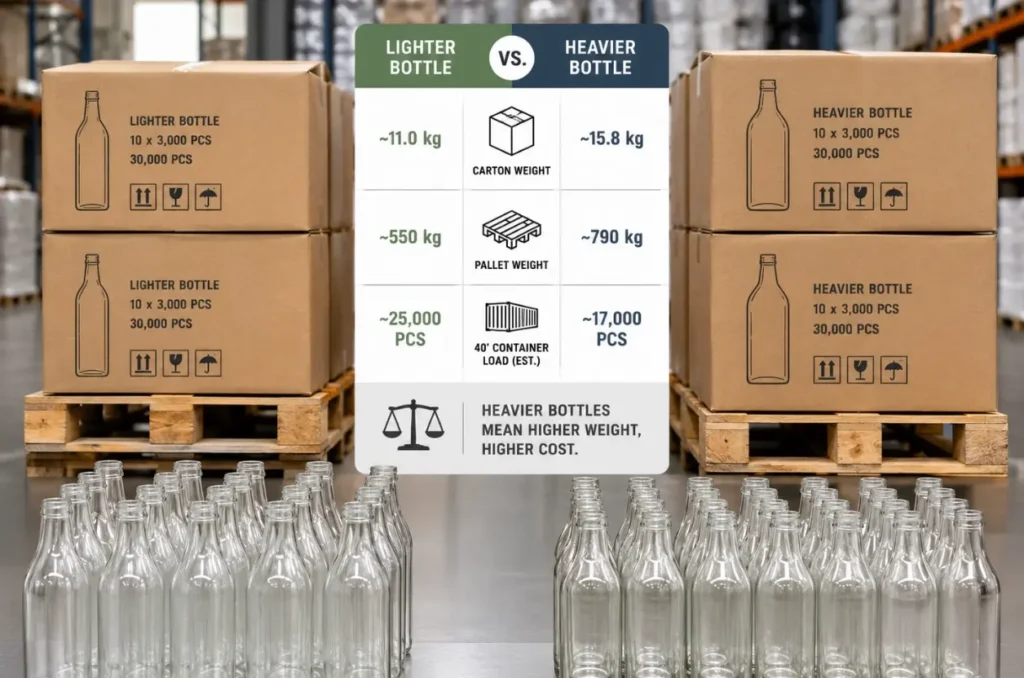
A heavier bottle creates a heavier carton. A heavier carton creates a heavier pallet. A heavier pallet can affect container loading and warehouse handling.
In export projects, glass bottle weight can decide whether a shipment is limited by space or by total payload.
A container may reach its weight limit before it reaches its space limit. This is common when the bottle is heavy and the order quantity is large.
A lighter bottle may allow more units per shipment, but only when bottle dimensions, carton size, and pallet plan also support better loading.
Consider two empty 750 ml bottle designs.
| Design | Empty Bottle Weight | Order Quantity | Total Empty Glass Weight |
|---|---|---|---|
| Bottle A | 500 g | 30,000 pcs | 15,000 kg |
| Bottle B | 800 g | 30,000 pcs | 24,000 kg |
Bottle B adds 9,000 kg of empty glass before filling, closures, cartons, pallets, and other packing materials.
That difference can affect freight cost, container planning, warehouse loading, and manual handling.
This is why buyers should request packing data together with bottle weight.
| Information to Confirm | 为何这很重要 |
|---|---|
| Empty bottle weight | Shows unit-level glass use |
| Bottles per carton | Helps calculate carton weight |
| Gross carton weight | Helps assess handling and transport |
| Cartons per pallet | Shows warehouse and loading efficiency |
| Pallet gross weight | Helps avoid overload problems |
| Bottles per container | Helps calculate freight cost per bottle |
A clear supplier quote should make these figures easy to compare.

How Does Bottle Weight Affect Filling and Handling?
Filling lines need bottles that are stable and consistent.
A very light bottle may move poorly on a conveyor if the base is narrow or the center of gravity is high. A very heavy bottle may create more impact during handling and may slow manual work.
Weight is only one part of filling performance.
Bottle height, body diameter, base contact ring, shoulder shape, neck finish, and dimensional tolerance also matter.
A short wide bottle may stand better than a tall narrow bottle with the same weight. A thick base may improve balance, but it may also add cost and reduce internal volume.
The filling plant should review the bottle before mass production when possible.
For a custom project, the buyer should confirm the bottle height, base diameter, contact ring, neck finish, empty weight, filled weight, and label area. These checks reduce the risk of approving a beautiful bottle that creates problems on the filling line.
When Should a Brand Choose a Heavy Bottle?
A heavy bottle can be the right choice when packaging is part of the product value.
This is common in premium spirits. Whiskey, vodka, gin, brandy, cognac, and tequila brands often use thick glass or heavy bases to create a strong shelf presence.
Heavy-base designs are especially common in premium 玻璃酒瓶.
Perfume brands also use heavy glass for a similar reason. The bottle is part of the product experience. Customers hold it, display it, and connect it with the brand.
Gift products, limited editions, and collector packaging may also justify extra glass weight.
In these cases, the bottle is not only a container. It is a brand asset.
But the extra weight still needs control.
The package should not become so heavy that it creates high freight cost, difficult carton handling, or filling-line problems.
A premium bottle should feel intentional. It should not feel heavy only because the design was not optimized.
When Is a Lightweight Bottle Better?
Lightweight glass is often better for high-volume products, long-distance shipping, and practical retail packaging.
Beverage bottles, sauce bottles, food jars, and some personal-care bottles often need efficient packing and transport. In these categories, buyers may care more about unit cost, shipping weight, and handling than heavy luxury feel.
A lighter bottle can reduce material use and freight pressure. It can also make cartons easier to handle.
But lightweighting should not mean making every wall thin.
A safe lightweight bottle still needs proper base support, wall balance, neck strength, and packing protection.
Official Champagne information shows this point clearly. The Champagne sector reduced its standard bottle from 900 g to 835 g while maintaining the bottle’s role for pressurized Champagne packaging. Comité Champagne also states that this weight change reduced carbon impact from glass manufacturing and transportation.
This example is useful because it shows the right principle.
A bottle can become lighter when the design is properly engineered and tested. Lightweighting should not mean removing glass at random.
How Can a Bottle Be Made Lighter Without Becoming Weak?
The safest method is to redesign the complete bottle, not simply reduce glass thickness everywhere.
The manufacturer can review the base, heel, sidewall, shoulder, neck, and contact ring. Some areas may have more glass than needed. Other areas may need protection because they carry more stress.
A good lightweight design removes unnecessary glass while keeping enough material in critical areas.
The product type matters.
A still water bottle does not face the same pressure as a sparkling beverage bottle. A perfume bottle does not pass through the same handling system as a beer bottle. A sauce bottle may need heat-fill or pasteurization review, depending on the product.
The full package should be tested under real conditions.
That means checking the bottle with its closure, carton, pallet, filling process, and transport route.
A weak lightweight bottle can create more cost through breakage, rejects, and product loss. A well-designed lightweight bottle can reduce waste without reducing performance.
What Weight Information Should Buyers Request?
A buyer should never rely only on product photos.
Photos can show shape and style. They cannot show exact weight, wall balance, capacity tolerance, or packing efficiency.
Before placing an order, buyers should request a clear technical specification.
| 规格 | 为何这很重要 |
|---|---|
| 额定容量 | Confirms the intended fill volume |
| Overflow capacity | Shows the total internal volume |
| Empty bottle weight | Supports cost and freight planning |
| Weight tolerance | Shows expected production variation |
| Overall height | Affects filling and packing |
| Body diameter or width | Affects cartons and conveyors |
| 颈部收尾 | Affects closure compatibility |
| Base design | Affects stability and glass use |
| Bottles per carton | Helps calculate carton gross weight |
| Bottles per pallet | Helps calculate warehouse efficiency |
| Approved sample | Defines the expected final feel |
For custom bottles, the target weight should appear on the confirmed drawing.
For repeat orders, the supplier and buyer should use the same approved specification. This avoids changes in feel, packing, and shipping weight.
How Jingbo Glass Helps Buyers Select Bottle Weight
Jingbo Glass reviews bottle weight as part of the full packaging project.
The team does not treat heavier glass as automatically better. The right bottle weight depends on the product category, brand position, closure, filling method, packing plan, and shipping route.
Jingbo Glass supports buyers as a 定制玻璃瓶制造商 for stock molds, custom molds, decoration, packing, and export projects.
For a premium spirits project, a heavier base may support the brand image. For a high-volume food or beverage project, controlled weight may help reduce packing and transport pressure.
Jingbo’s own product pages show how bottle weight can vary by design. A 100 ml long-neck sample bottle is listed at 180 g, while a 750 ml slim cylindrical spirits bottle is listed at 680 g.
This difference is not only about capacity. It is also about use, feel, base design, and market position.
When buyers compare options, Jingbo can help review the drawing, sample weight, packing method, and shipping plan together.
The goal is not to make the bottle as heavy as possible.
The goal is to choose enough weight for strength, filling performance, shelf presence, and safe transport without creating unnecessary cost.
Frequently Asked Questions About Glass Bottle Weight
Why is glass bottle weight important for buyers?
Glass bottle weight helps buyers estimate cost, carton weight, pallet weight, freight pressure, and the final handling load after filling.
It also helps the buyer compare different bottle designs more accurately.
A low unit price may not be the best choice if the finished shipment becomes too heavy or the bottle does not match the filling line.
How much does a 750 ml glass bottle weigh?
A 750 ml glass bottle does not have one fixed weight.
A lightweight 750 ml bottle may be much lighter than a premium heavy-base spirits bottle. Jingbo’s 750 ml slim cylindrical spirits bottle is listed with a 680 g glass weight.
Does a heavier bottle mean stronger glass?
Not always.
Strength depends on shape, glass distribution, wall balance, base design, annealing, and surface quality. A heavy bottle can still fail if the glass is not placed well.
Does a thick base increase bottle weight?
Yes, in most cases.
A thick base adds more glass to the bottom of the bottle. It can improve shelf feel and stability, but it can also increase cost and shipping weight.
Can a lighter bottle still be safe?
Yes.
A lighter bottle can be safe when the design is properly engineered, produced, packed, and tested. The key is not thin glass everywhere. The key is correct glass distribution.
Why do perfume bottles often feel heavy?
Perfume bottles often use thick glass because the package is part of the luxury experience. The customer holds the bottle closely, so weight, clarity, and shape have a strong effect on perceived value.
Should bottle weight be included in a quotation?
Yes.
A useful quotation should include empty bottle weight, capacity, size, neck finish, packing method, bottles per carton, gross carton weight, and expected container loading.
结论
Glass bottle weight depends on more than capacity.
A bottle’s weight is shaped by its base, walls, shoulders, neck finish, glass distribution, product use, and brand position.
A heavier bottle can improve premium feel, shelf presence, and stability. It can also increase cost, carton weight, pallet load, and freight pressure.
A lighter bottle can improve efficiency, but it still needs proper strength and safe packing.
The best bottle is not always the heaviest bottle. It is also not always the lightest bottle.
The best choice is the bottle weight that gives the right balance of strength, appearance, filling performance, packing efficiency, and total landed cost.