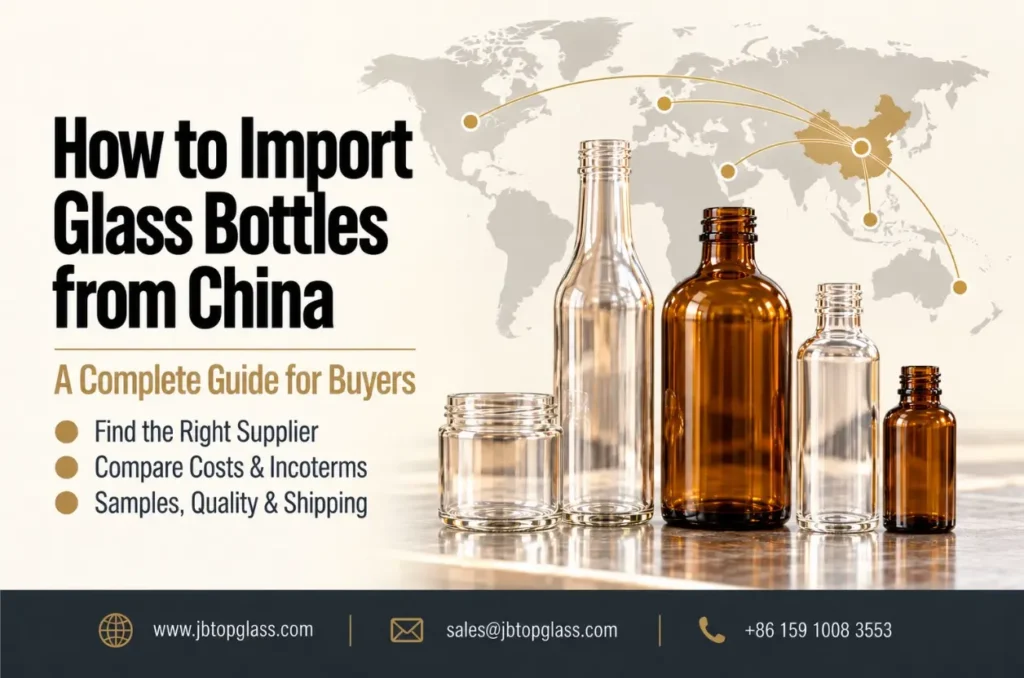
The best way to import glass bottles from China is to complete the project in a clear order. First, define the bottle and closure. Then compare suitable suppliers, request detailed quotations, approve samples, confirm quality standards and arrange shipping.
This process sounds simple, but small misunderstandings can become expensive after production starts. A buyer might approve a 500 ml bottle without checking its brimful capacity. Another buyer might choose a cap that does not match the bottle neck. A low quotation might also exclude decoration, closures, pallets or local freight charges.
For this reason, the cheapest factory price does not always produce the lowest final cost. Buyers need to compare the complete package and calculate the landed cost per usable bottle.
This guide explains each stage without turning the process into a long import checklist.
Decide What Type of Glass Bottle You Need
You do not need a finished technical drawing before contacting a supplier. However, you should know what the bottle will contain and how it will be used.
A juice bottle, spirits bottle, perfume bottle and food jar do not follow the same requirements. The product affects the bottle shape, glass color, closure, filling method and testing plan.
Start with the intended product and fill volume. Tell the supplier whether the bottle will be cold filled, hot filled, pasteurized or used for a carbonated product. You should also explain how the finished product will be stored and transported.
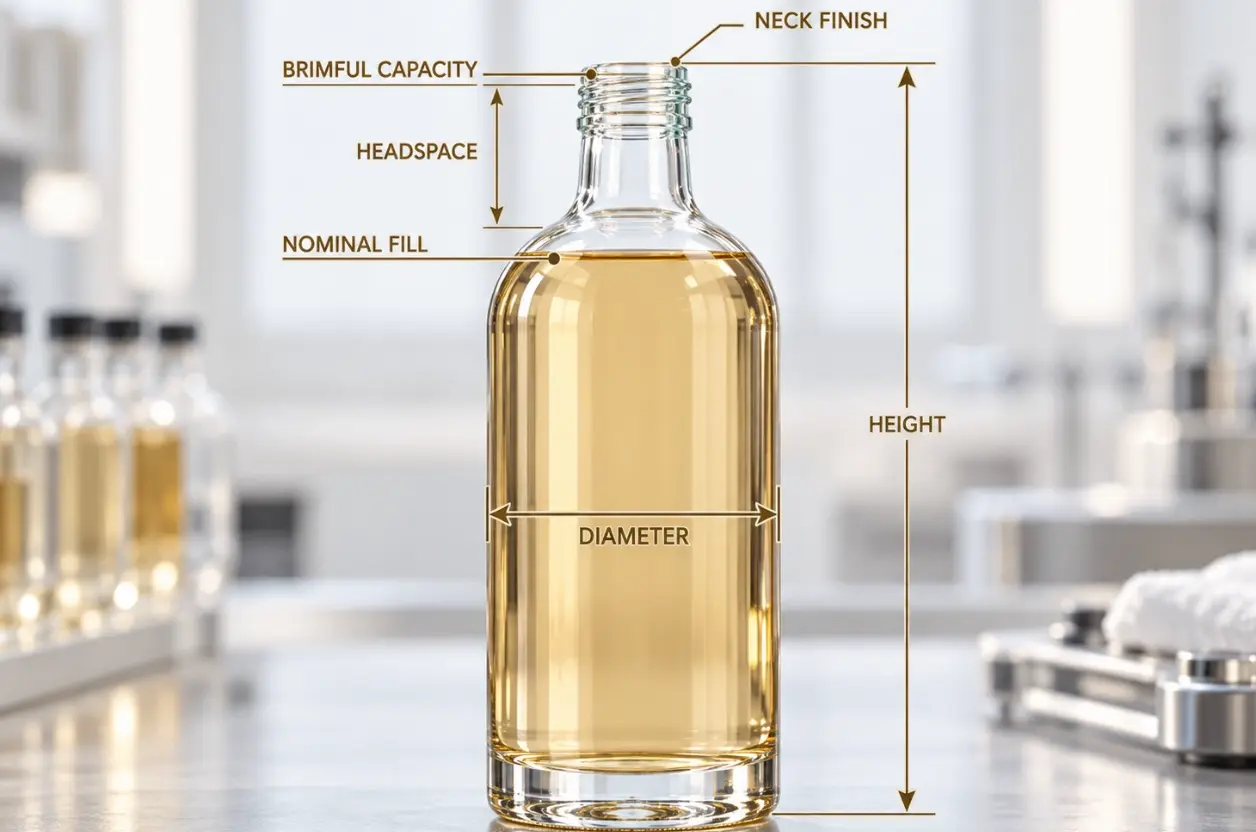
Capacity needs more attention than many first-time buyers expect. The stated bottle size normally refers to the intended fill volume. The brimful capacity is the total amount the bottle holds when filled to the top. The difference provides headspace for filling and sealing.
The closure is another early decision. A bottle neck described only as “28 mm” or “38 mm” may not be specific enough. Closures with a similar diameter can use different thread profiles, heights and liners. The bottle neck, closure and sealing equipment must work together.
Stock Bottle, Existing Mold or New Mold?
Chinese glass bottle suppliers generally offer three sourcing routes.
| Sourcing route | Best for | What to consider |
|---|---|---|
| Finished stock bottle | Trials, urgent orders and smaller quantities | Stock quantity, glass color and closures may be limited |
| Existing mold, made to order | Standard bottles with custom branding | Production MOQ and factory scheduling still apply |
| New custom mold | Exclusive shapes, dimensions, necks or embossed details | Tooling, sample approval and extra development time are required |
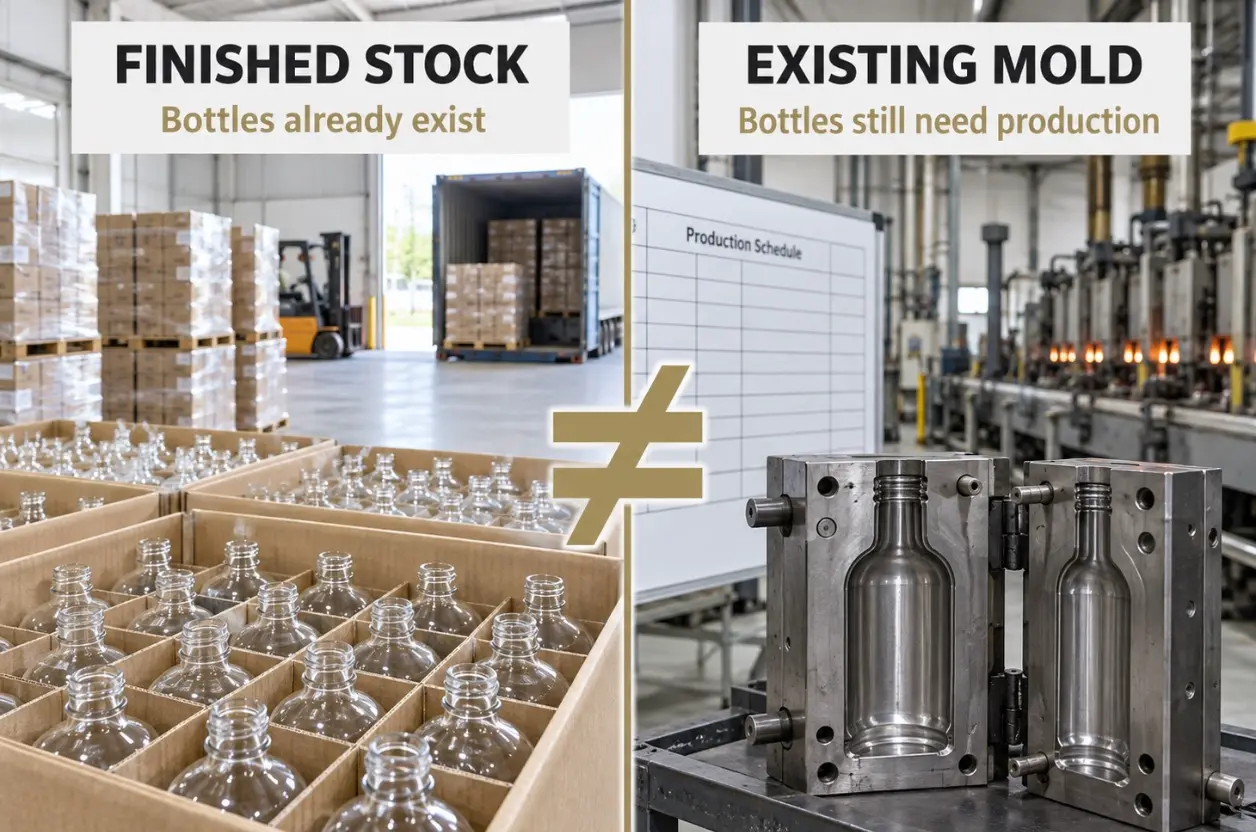
A stock bottle should already exist in the supplier’s warehouse. An existing mold only means the factory can produce that design. It does not mean finished bottles are ready to ship.
Many brands do not need a new bottle mold. An existing shape can look very different after changing the glass color, closure, coating, printing or label. Jingbo Group’s design personalizado de garrafas de vidro page shows how an existing bottle can be adapted for a new brand.
A new mold makes sense when the bottle structure itself must change. This includes the shape, capacity, dimensions, neck finish or embossed details. The glass bottle mold development process should include a drawing and trial bottle before mass production begins.
Find a Supplier That Fits Your Project
Buyers can find Chinese glass bottle suppliers through Google, B2B marketplaces, packaging exhibitions, referrals and sourcing agents. The channel matters less than the supplier’s ability to produce the bottle you need.
Look at the company’s main product range first. A supplier that mainly produces food jars may not be the right choice for a detailed perfume bottle. A decorative spirits bottle factory may not have experience with pressure-rated beverage bottles.
You should also understand whether you are speaking with a manufacturer or a trading company. A manufacturer gives you more direct access to production. A trading company may offer more products, lower quantities or easier purchasing from several factories.
A trading company is not automatically a poor choice. The real question is who controls the bottle specification, production quality and corrective action when something goes wrong.
Ask the supplier to show recent projects in the same product category. A live factory video, production photos or an independent audit can provide more useful information than a polished company introduction. You should also confirm which processes are completed by the supplier and which are outsourced.
Decoration deserves particular attention. A factory may produce the glass bottle but send coating, printing or hot stamping to another company. Outsourcing is common, but the bottle supplier should still control the result and accept responsibility for the complete order.
The registered company name should match the quotation and sales documents. If the bank beneficiary or export company has a different name, ask for a written explanation before making payment. Some factories use a separate export company, but the relationship should be clear.
Request a Quotation You Can Compare
A message that says “Please quote 500 ml bottles” will rarely produce an accurate price. The supplier still does not know which bottle, glass weight, neck, closure, decoration or packing method you require.
Your enquiry should explain the product application, target capacity, preferred shape, glass color, closure, decoration, quantity and destination. Include a reference image or drawing if you have one. You should also mention the filling temperature or pressure requirements when they affect the bottle.
The supplier can then recommend an existing model or explain whether a new mold is necessary.
A useful quotation should identify the exact bottle, including its capacity, weight, dimensions, glass color and neck finish. It should explain whether the closure, decoration and export packing are included.
The quotation should also show the quantity, unit price, tooling or setup fees, sample costs, production time and payment terms. It must state the Incoterm and named port or place. Any important exclusion should be easy to see.
This detail matters because two similar prices may cover different products. One supplier might quote the plain bottle only. Another might include the cap, printed logo, divided carton and pallet. The second unit price may look higher but produce a lower total cost.
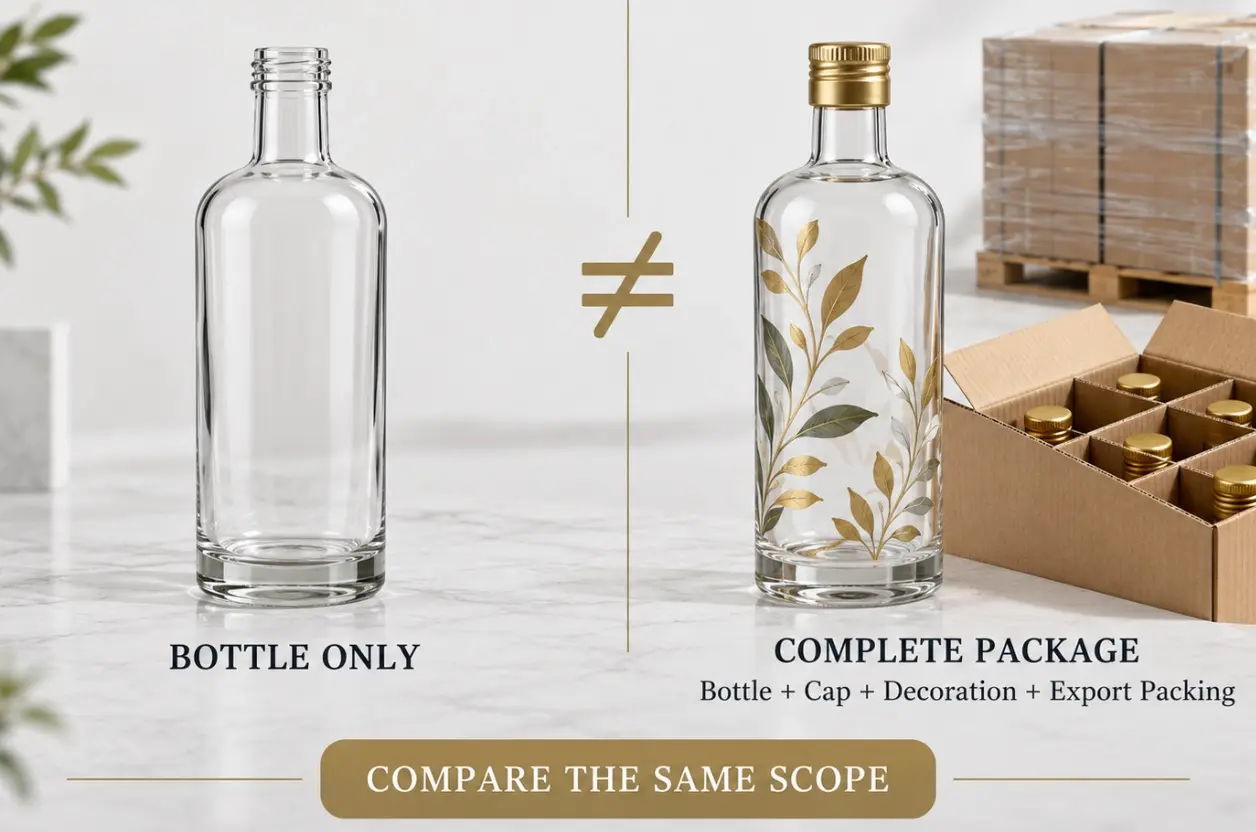
Ask for prices at realistic order quantities. Do not request a 100,000-piece price if you expect to order 10,000 bottles. The supplier may use a different production plan, packing method or unit price for each quantity.
You should also confirm whether the quote is based on existing inventory or a new production run. Stock can sell out while you are testing samples or arranging payment.
Approve the Bottle Before Mass Production
Samples are important, but buyers need to understand what each sample proves.
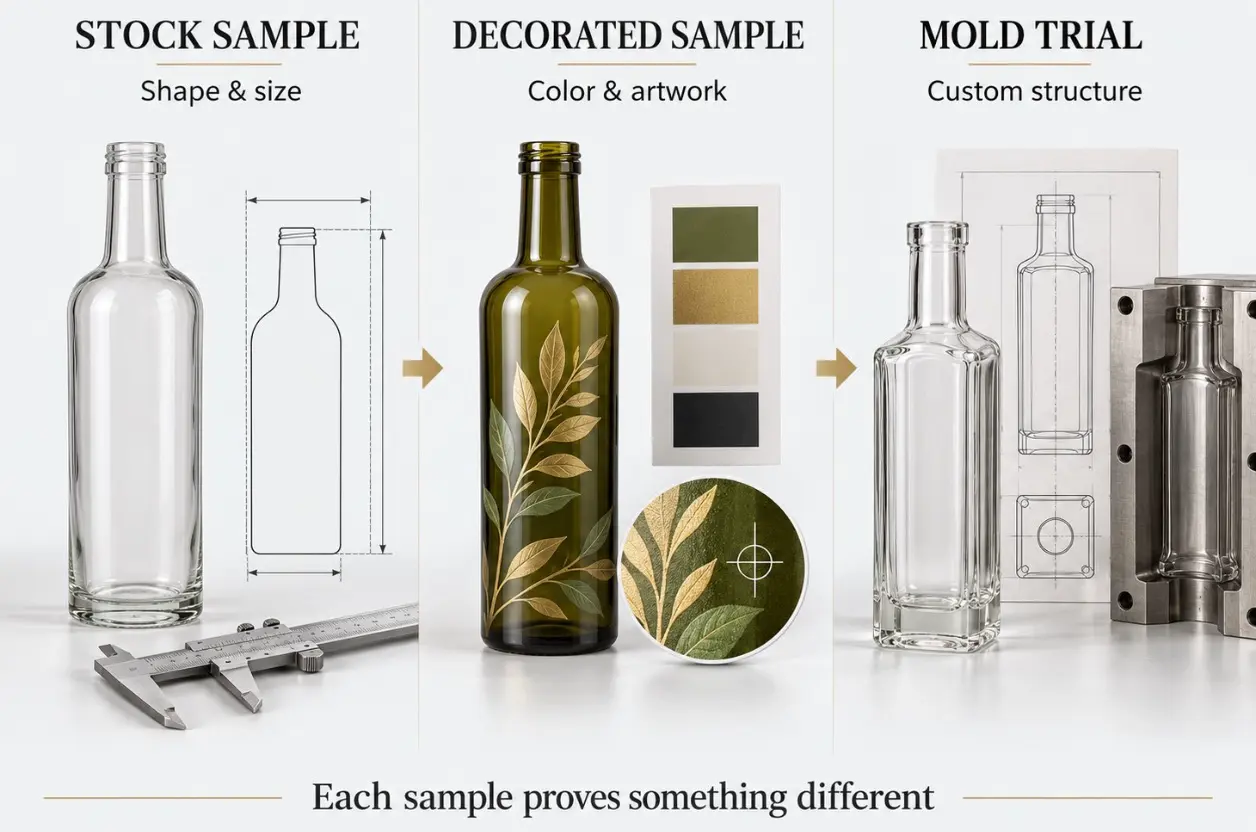
A stock sample shows the bottle shape, size and general glass quality. It may come from an earlier batch and may not include your final color, decoration or closure.
A decorated sample shows the appearance of the finished design. A trial bottle from a new mold confirms whether the bottle structure matches the approved drawing. Neither sample should be treated as approval for everything unless it represents the complete package.
Check the capacity, dimensions, bottle weight and neck finish first. Place the bottle on a flat surface and check whether it stands steadily. Apply the real closure and look at how the cap, stopper, pump or sprayer sits on the neck.
The bottle should then be tested under the intended filling conditions. A hot-filled sauce bottle needs a different test from a cold-filled juice bottle. A carbonated drink needs pressure-related testing. A perfume bottle needs to work with its pump or crimping system.
Food and beverage buyers should review the glass, closure and decoration as one package. The guide to food-safe glass bottles explains why a general statement such as “food-grade glass” does not answer every application question.
When you approve the sample, keep one physical bottle as the reference sample. The supplier should keep another one. The final drawing, artwork and closure specification should support that sample.
A physical sample is especially useful for color. A coating or print viewed on a computer screen will change with the display and lighting. The approved bottle gives both sides a more reliable reference during production.
Confirm the Order and Quality Standard
The purchase order or sales contract should match the approved bottle. Do not rely on a catalog image or old message history as the final specification.
The documents should identify the bottle model, drawing, closure, decoration, packing, order quantity and price. They should also state when the production period begins. “Thirty days” is unclear unless both sides know whether the count starts after payment, artwork approval or sample approval.
Custom mold projects need additional terms. The buyer should know who owns the mold, where it will be stored and whether the supplier can use it for another customer. An NDA can protect exclusive bottle designs and development information.
Quality control should not begin after production is finished. The supplier should check the approved drawing and decoration before the main run starts. A check during production is useful for a new bottle or a large order because it gives the factory time to correct a problem.
The final inspection should review the bottle dimensions, visible defects, decoration, closure fit, quantity and packing. If the buyer uses a sampling standard such as AQL, the inspection level and defect limits should be agreed in advance.
We will cover glass bottle inspection in another article, including how to identify critical, major and minor defects before shipment. For now, the most important point is to agree on the quality standard before production begins, not after the bottles arrive.
Choose the Right Incoterm and Understand Who Pays
An Incoterm shows where the seller’s responsibility ends and where the buyer’s responsibility begins. It also explains which side arranges and pays for each stage of transportation.
O International Chamber of Commerce publishes the official Incoterms rules. Every quotation and contract should include the selected term, the named port or place and the version used, such as “FOB Qingdao, Incoterms 2020.”
| Incoterm | What the seller handles and pays | What the buyer handles and pays |
|---|---|---|
| EXW | The seller packs the bottles and makes them available at the agreed factory or warehouse. The seller is not required to load the goods onto the collection vehicle. | The buyer pays for loading, collection in China, export clearance, China-side charges, international freight, insurance, import clearance, duty, tax and delivery to the final address. |
| FOB | The seller pays for transport to the named Chinese port, export clearance, origin port charges and loading the goods onto the buyer’s nominated vessel. | The buyer pays for ocean freight, cargo insurance, destination handling charges, import clearance, customs duty, tax and delivery from the destination port to the warehouse. |
| CIF | The seller handles export clearance and pays the origin charges, ocean freight and the minimum cargo insurance required under CIF to the named destination port. | The buyer pays destination handling and unloading charges unless they are clearly included, as well as customs clearance, duty, tax and delivery from the port to the final address. The buyer also pays for additional insurance if the minimum cover is not sufficient. |
| DAP | The seller pays for transportation to the named destination and handles export and transit formalities. The goods are delivered ready for unloading. | The buyer unloads the goods, completes import clearance and pays the customs broker, import duty, tax and any required import permits. |
| DDP | The seller arranges transportation to the named destination, completes export and import clearance and pays the applicable duty and tax. The goods are delivered ready for unloading. | The buyer normally only receives and unloads the goods. Freight, customs clearance, duty and tax should already be included in a genuine DDP price. The buyer should still confirm who will act as the importer of record. |
Cost and risk do not always transfer at the same point. Under FOB and CIF, the risk normally passes to the buyer when the goods are loaded on board the vessel at the Chinese port. Under CIF, the seller continues paying the freight to the destination port even though the transport risk has already passed to the buyer.
Under DAP and DDP, the risk transfers when the goods reach the named destination and are ready for unloading. Under EXW, the risk transfers when the goods are made available at the supplier’s premises, before they are loaded.
EXW may look like the lowest quotation, but it places almost the entire shipping process on the buyer. A foreign buyer may also need a local forwarder or export agent to complete Chinese export procedures.
FOB is more practical for buyers who already work with a freight forwarder. It gives the buyer control over the international freight and destination arrangements.
CIF is convenient when the supplier arranges sea freight, but it is not a complete landed price. The buyer still needs to ask the destination agent about terminal handling, customs clearance, duty, tax and inland delivery.
DDP appears to be the simplest option because the seller includes most transport and import costs. However, buyers should verify the importer-of-record arrangement. Some countries require a locally registered company to complete import clearance or handle import tax. These details should be confirmed before accepting a DDP quotation.
Check Customs Documents and Market Requirements
The supplier normally provides a commercial invoice and packing list. The shipping company issues the bill of lading or sea waybill. Some shipments also need a certificate of origin, insurance document, test report or wood-packing document.
The exact requirements depend on the destination, bottle use and importer. A buyer importing food jars into the EU may need different supporting information from a buyer importing perfume bottles into the United States.
Many empty glass bottles and jars used for packaging fall under HS heading 7010. However, the complete customs code depends on details such as capacity, color, use and the national tariff system.
O World Customs Organization provides the international HS framework, but each country can add more digits to the code. Ask a customs broker to confirm the final classification instead of copying a code from another importer.
Product compliance also depends on the final use. There is no single certificate that makes every glass bottle acceptable in every country.
For example, food-contact materials sold in the EU fall under the general framework of Regulation (EC) No 1935/2004. The European Commission provides the official legislation, but additional national or product-specific requirements may apply.
Ask your importer, laboratory or compliance adviser for the correct document list before production. The supplier can then provide existing reports or arrange testing for the actual bottle and decoration.
Calculate the Real Cost of Importing Glass Bottles
The bottle price is only one part of the final cost.
Your landed cost may include the bottles, mold, decoration, closures, export packing, inspection, China-side transport, international freight, insurance, duty, customs fees, destination charges and delivery to your warehouse.
O cálculo básico é o seguinte:
Landed cost per usable bottle = Total import cost ÷ Number of accepted bottles received
The word “usable” is important. If you order 10,000 bottles but only 9,850 meet the agreed standard, your cost should be divided by 9,850.
This calculation also helps you compare different offers. A lightweight bottle may reduce freight but may not suit the desired brand position. A cheaper packing method may save money at the factory but increase breakage. The best quotation is the one that produces an acceptable bottle at a predictable total cost.
Import VAT or GST may be recoverable in some markets. Your accountant or customs adviser can tell you whether it should be treated as a permanent cost.
How Long Does the Import Process Take?
The total schedule includes bottle selection, quotation, sampling, production, inspection, shipping and customs clearance.
A finished-stock order is the fastest option when enough bottles are physically available. A bottle made from an existing mold still needs a production slot. Decoration and custom closures add more time.
At Jingbo Group, regular made-to-order production generally takes about 30–45 days after the required approvals and payment arrangements are complete. A new bottle mold and the first undecorated trial sample normally take about 15–20 business days after drawing approval and tooling payment.
These periods do not include international shipping or destination customs clearance.
Plan backward from the date when the bottles must reach your filling plant. Leave time for sample changes, inspection and possible shipping delays. A rushed order gives both sides less time to solve problems before production.
Common Mistakes When Importing Glass Bottles
The first mistake is choosing a bottle from a photograph. A photo does not show the exact capacity, glass weight, neck finish or closure fit.
The second mistake is comparing prices before comparing what the prices include. A low unit price loses its advantage when the buyer later adds caps, decoration, pallets and unexpected destination charges.
Another common problem is treating the closure as a separate decision. A cap or stopper must match the neck finish, liner, product and sealing equipment. It should be tested with the bottle before the order is approved.
Buyers also rely too heavily on generic certificates. A report for one undecorated bottle does not automatically cover another bottle, a coating, an ink or a cap liner.
Finally, some importers treat CIF as the final landed price. CIF only covers specific costs to the named port. The buyer still needs to understand customs clearance and local charges.
Most of these mistakes begin before production. A clear specification, complete quotation and approved sample prevent more problems than a complaint after delivery.
Perguntas frequentes
Quanto custa importar garrafas de vidro da China?
The cost depends on the bottle size, weight, glass color, quantity, decoration, closure and packing. Tooling, freight, import duty and destination charges also affect the final price.
Buyers should compare the landed cost per usable bottle rather than only the factory unit price.
What Is the MOQ for Chinese Glass Bottles?
MOQ depends on the bottle category and production method.
At Jingbo Group, regular glass bottle orders generally start at around 10,000 pieces. Food jar orders may start at around 20,000 pieces. Small perfume and aromatherapy bottles often require higher quantities.
Some finished stock models may be available from around 3,000 pieces, but the exact quantity must be confirmed. Custom larger bottle projects may start at approximately 6,000–12,000 pieces, while small bottles may require more.
Can a Small Business Import Glass Bottles from China?
Yes, but the buyer should choose a project that matches the expected sales volume.
An existing bottle with a standard closure and simple decoration reduces the initial cost. A finished-stock bottle may also lower the order quantity when enough stock is available.
Small orders do not always have the lowest cost per bottle because freight and import fees are divided across fewer units.
Should I Choose FOB, CIF or DDP?
FOB works well when the buyer has a freight forwarder and wants more control over shipping. CIF is useful when the supplier arranges ocean freight, but the buyer must check destination charges.
DDP offers a delivered price, but the importer-of-record and tax arrangements need to be clear. The best option depends on your experience, destination and ability to manage customs clearance.
Which Documents Are Needed to Import Glass Bottles?
Most shipments need a commercial invoice, packing list and transport document. Other documents depend on the destination and product use.
Your customs broker should confirm the HS code, certificate of origin requirements, food-contact documents and any rules for wood packaging.
Do I Need a Customs Broker?
A customs broker is strongly recommended for a first shipment. The broker can confirm classification, duty, tax and document requirements before the bottles leave China.
Contact the broker before placing the order. It is much easier to prepare the correct document than to solve a clearance problem after the container arrives.
How Can I Reduce Breakage During Shipping?
Use packing designed for the actual bottle. The bottles should not strike each other, and the cartons or pallets should remain stable during handling.
Decorated bottles also need protection from rubbing and scratches. Ask the supplier for final packing photos and inspect the packing before shipment when the project is new.
Conclusão
Importing glass bottles from China becomes much easier when each decision is made in the right order. Define the bottle, compare complete quotations, test the sample, agree on quality, understand the shipping terms and confirm customs requirements before production begins.
If you are planning a standard or custom glass bottle order, contact Jingbo Group. Tell us the product, capacity, preferred bottle style, closure, decoration, quantity and destination. Our team can help you review the project and prepare a suitable production plan.