
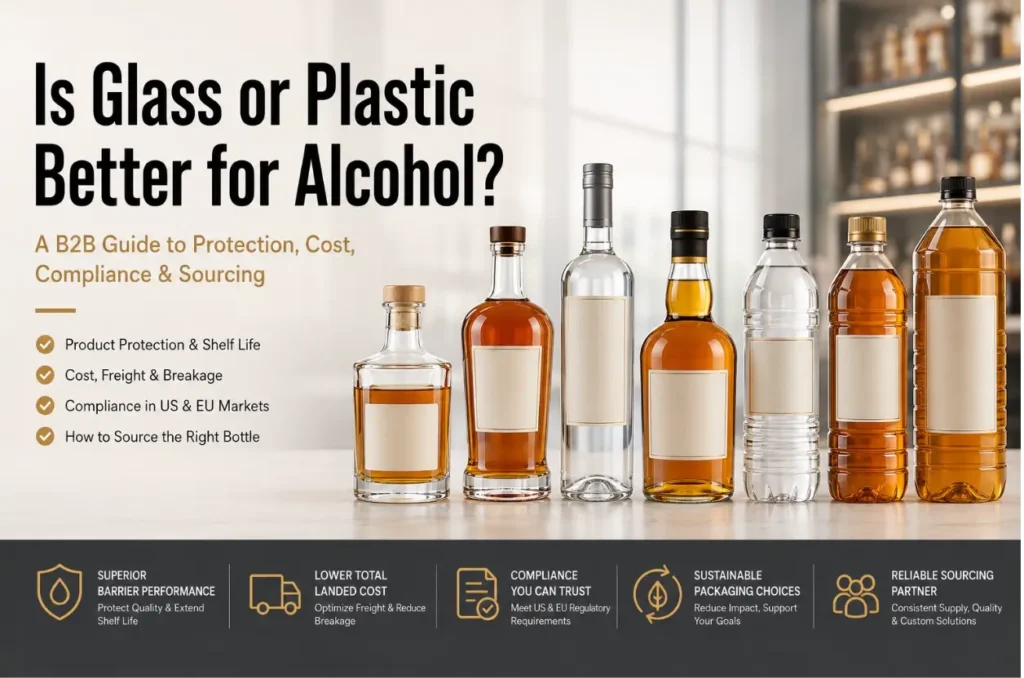
Escolher a garrafa errada pode aumentar os custos de transporte, diminuir o apelo visual nas prateleiras e criar problemas de compatibilidade. Então, o que é melhor para bebidas alcoólicas: vidro ou plástico?
O vidro é normalmente a melhor opção para bebidas espirituosas de gama alta e para o armazenamento a longo prazo. Oferece um excelente desempenho como barreira e um aspeto apelativo nas prateleiras. O plástico é mais leve e mais resistente a quebras, mas as marcas devem verificar a compatibilidade da resina, o teor alcoólico, o desempenho da tampa, o prazo de validade e a regulamentação local.
A decisão vai muito além do preço de uma garrafa vazia. A embalagem tem de se adequar à bebida, à linha de enchimento, ao fecho, ao rótulo, à rota de transporte, ao canal de vendas e ao mercado de destino.
O vidro continua a ser a escolha padrão para o uísque, a vodka, o gin, o rum, a tequila, o brandy e muitos licores. Confere ao produto peso, transparência e um aspeto sofisticado e familiar.
O plástico oferece um conjunto diferente de vantagens. É mais leve, menos propenso a partir-se e, muitas vezes, mais barato de transportar. Estas vantagens podem ser importantes para companhias aéreas, hotéis, eventos ao ar livre, festivais e produtos em embalagens de viagem.
A resposta varia consoante o produto e o canal de vendas. Um uísque em caixa de presente tem necessidades de embalagem diferentes das de uma garrafa miniatura de bebida espirituosa utilizada por uma companhia aérea ou por um hotel.
Por que razão a escolha do material é importante nas embalagens de bebidas alcoólicas?
A escolha do material tem impacto para além da aparência. Pode alterar o desempenho da garrafa durante o enchimento, o armazenamento, o transporte e a utilização pelo consumidor.
O material da garrafa influencia a compatibilidade com o álcool, a proteção de barreira, a fiabilidade da tampa, o peso, o risco de quebra, a decoração e a conformidade. O sistema de embalagem completo é mais importante do que o preço da garrafa vazia.
As embalagens de bebidas alcoólicas devem proteger mais do que apenas o líquido
A garrafa deve conter a bebida em segurança durante todo o processo de enchimento, armazenamento, transporte, exposição no ponto de venda e utilização pelo consumidor.
O teor alcoólico é importante. Uma embalagem adequada para uma bebida pronta a consumir com baixo teor alcoólico pode não ser adequada para uma bebida espirituosa de alta graduação alcoólica. A garrafa, a tampa, o revestimento interior, o revestimento exterior e a decoração têm de ser todos compatíveis com o produto a que se destinam.
Neste contexto, o desempenho da barreira refere-se à capacidade da embalagem para limitar a penetração de oxigénio e humidade, bem como a perda de produto, durante o armazenamento.
O prazo de validade também influencia a decisão. Uma bebida vendida no prazo de alguns meses pode exigir menos da embalagem do que uma bebida espirituosa de gama alta armazenada durante vários anos.
A embalagem também influencia a forma como os clientes veem a marca. Uma garrafa de vidro pesada pode reforçar uma imagem de gama alta. Uma garrafa de plástico leve pode transmitir conveniência, portabilidade ou boa relação qualidade-preço.
O canal de vendas impõe um outro conjunto de requisitos. As prateleiras dos retalhistas, as lojas duty-free, os hotéis, as companhias aéreas, os festivais, o comércio eletrónico e os espaços ao ar livre têm expectativas diferentes no que diz respeito ao peso, à resistência à quebra e à apresentação.
| Área de Decisão | Por que é importante |
|---|---|
| Teor alcoólico | Afeta a compatibilidade entre materiais e fechos |
| Prazo de validade | Determina durante quanto tempo a embalagem deve proteger a bebida |
| Posição da marca | As influências determinam a forma, a cor, o peso e a decoração |
| Linha de enchimento | Estabelece limites para as dimensões das garrafas e para o seu manuseamento |
| Distribuição | Afeta a embalagem, o frete e o risco de danos |
| Canal de vendas | Altera as necessidades em termos de conveniência e apresentação |
| Mercado de destino | Determina as regras relativas ao volume, à rotulagem e à conformidade |
Uma equipa de compras deve definir as necessidades relativas à bebida, ao mercado e à produção antes de selecionar o material. Isto reduz o risco de escolher uma garrafa baseando-se apenas na aparência ou no preço unitário.
Em uma comparação direta, o que é melhor para o álcool: o vidro ou o plástico?
O preço não diz tudo. O vidro e o plástico apresentam resistências diferentes e cada um é mais adequado para um tipo específico de projeto relacionado com bebidas alcoólicas.
As garrafas de álcool em vidro são adequadas para uma imagem de marca de luxo e para o armazenamento a longo prazo. As garrafas de álcool em plástico reduzem o peso e o risco de quebra. A melhor escolha depende do tipo de resina, do teor alcoólico, do tipo de fecho, do prazo de validade e das condições de distribuição.
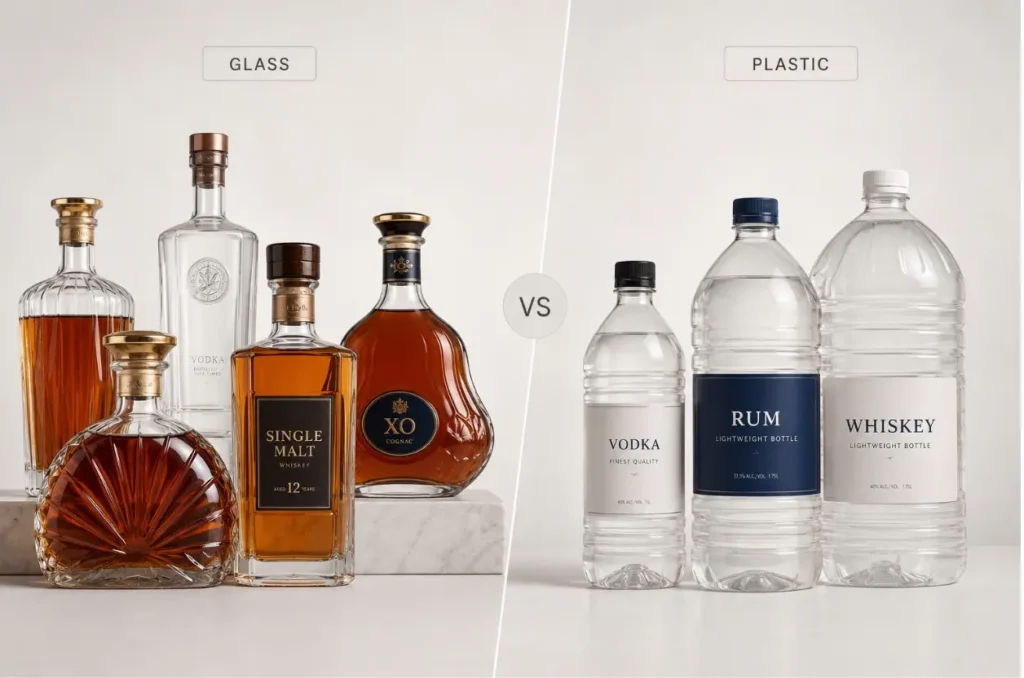
| Fator | Garrafas de vidro para bebidas alcoólicas | Garrafas de plástico para álcool |
| Aspecto na prateleira | Nítido, robusto e de alta qualidade | Leve e prático |
| Desempenho da barreira | Resistente para embalagens de bebidas espirituosas normais | Depende da resina e da estrutura |
| Peso da garrafa | Mais alto | Mais baixo |
| Risco de quebra | Requer embalagem de proteção | Mais resistente ao impacto |
| Formas personalizadas | Vasta gama de designs moldados | Vasta gama de designs moldados |
| Decoração | Revestimento, impressão, acabamento fosco, gravação em relevo e etiquetas | Impressão, etiquetas, capas e detalhes moldados |
| Custo do frete | Normalmente mais elevado | Normalmente mais baixo |
| Posicionamento premium | Forte | Mais restrito no caso das bebidas espirituosas tradicionais |
| Tratamento do consumidor | Sólido e familiar | Leve e fácil de transportar |
Em que as garrafas de álcool de vidro têm um melhor desempenho
O vidro é amplamente utilizado para o uísque, a vodka, o gin, o rum, a tequila, o brandy e os licores de alta qualidade.
Oferece uma embalagem estável e é compatível com uma vasta gama de processos de decoração. Uma garrafa de vidro bem concebida pode tornar-se parte integrante da identidade da marca, em vez de servir apenas como um recipiente básico.
O vidro também proporciona às marcas uma ampla liberdade de design. Uma garrafa pode apresentar um formato personalizado, uma base mais espessa, logótipo em relevo, acabamento fosco, revestimento por pulverização, serigrafia, estampagem a quente ou rótulos decorativos. As rolhas de cortiça e os fechos premium em metal ou sintéticos podem reforçar ainda mais a apresentação final.
Estes detalhes contribuem para que a garrafa pareça ter sido concebida de forma deliberada, em vez de ser genérica. Além disso, proporcionam às marcas mais formas de se destacarem nas prateleiras, sem dependerem apenas do rótulo.
O vidro também proporciona às marcas maior liberdade para criar destaque nas prateleiras. A forma da garrafa, o peso da base, a cor do vidro e a decoração da superfície podem, todos, ajudar uma bebida espirituosa a destacar-se numa categoria concorrida.
Este valor acrescentado em termos de apresentação pode justificar preços mais elevados. Pode também ajudar um novo produto a parecer mais consolidado e credível.
As marcas que desenvolvem embalagens de gama alta podem explorar a gama da Jingbo Glass de garrafas de vidro para bebidas alcoólicas e opções personalizadas disponíveis.
Onde as garrafas de plástico para bebidas alcoólicas podem funcionar melhor
O plástico pode ser prático quando o peso reduzido e a resistência à quebra são mais importantes do que a apresentação tradicional de alta qualidade.
As garrafas de plástico para bebidas alcoólicas são mais úteis nos casos em que o peso reduzido, a facilidade de manuseamento e a resistência à quebra são mais importantes do que a apresentação tradicional de alta qualidade. As aplicações típicas incluem produtos em formato de viagem, serviço a bordo de aviões, minibares de hotéis, eventos ao ar livre, festivais, bebidas espirituosas em miniatura, ciclos de distribuição curtos e locais que restringem a utilização de recipientes de vidro.
Estes formatos são normalmente escolhidos por razões de conveniência ou logística, e não por se tratarem de um produto de luxo. A garrafa tem, ainda assim, de ser adequada ao teor alcoólico, aos ingredientes, à temperatura de enchimento, ao prazo de validade e às condições de armazenamento.
O plástico não é um material único com um único nível de desempenho. As diferentes resinas e estruturas das garrafas proporcionam diferentes níveis de resistência ao álcool, proteção contra o oxigénio e proteção contra a humidade.
Antes de recomendar uma garrafa de plástico, o fornecedor precisa de saber a percentagem de álcool, os ingredientes, a temperatura de enchimento, o prazo de validade e as condições de armazenamento.
O plástico também pode necessitar de testes de compatibilidade com o produto ou de migração. Uma garrafa que tenha um bom desempenho com uma bebida alcoólica pode não ser adequada para outra fórmula ou outro teor alcoólico.
No caso de bebidas espirituosas de alta qualidade e de armazenamento a longo prazo, o vidro é normalmente a opção comercial mais segura. O plástico deve ser escolhido para uma utilização específica e testado com o produto final.
Como se comparam os custos, a logística e o custo total de propriedade?
O preço da garrafa representa apenas uma rubrica no custo final. O frete, a embalagem, as quebras, as alterações na linha de enchimento e o stock rejeitado podem alterar o resultado.
O plástico costuma reduzir os custos de envio, uma vez que é mais leve e menos propenso a partir-se. O vidro costuma conferir mais valor de retalho graças à sua aparência e decoração de alta qualidade. Os compradores devem comparar o custo total de propriedade, em vez do preço da garrafa vazia.
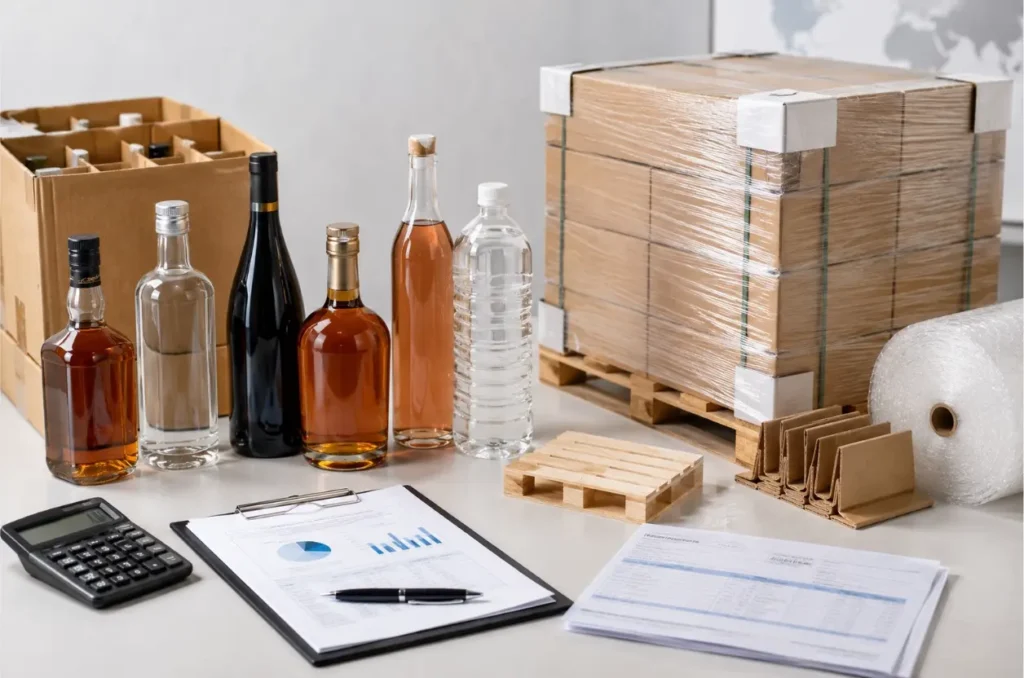
O preço unitário é apenas uma parte do custo
Uma garrafa de plástico pode ter um preço de compra mais baixo. No entanto, o comprador deve analisar a sua tampa, o rótulo, os requisitos de barreira, o desempenho no enchimento e a posição na prateleira.
Uma garrafa de vidro pode ter um custo mais elevado de aquisição e envio. Pode também ajudar uma marca a entrar em canais de gama alta ou a justificar um preço de retalho mais elevado.
Uma comparação realista de custos deve incluir a garrafa, o fecho, o molde, a decoração, os rótulos, as caixas de cartão, o transporte terrestre, o frete, o espaço de armazenamento e quaisquer ajustes na linha de enchimento. Os compradores devem também ter em conta a quebra, o stock rejeitado, a perda de produto e a capacidade do fornecedor de garantir a consistência nas encomendas repetidas.
Esta perspetiva mais ampla é mais útil do que comparar apenas o preço da garrafa vazia. Uma cotação mais baixa pode acabar por se tornar mais cara quando se somam os custos de embalagem, frete, perdas de produção ou qualidade inconsistente.
| Área de custos | Vidro | Plástico |
| Custo da garrafa vazia | Frequentemente mais elevado | Frequentemente mais baixo |
| Peso da carga | Mais alto | Mais baixo |
| Embalagem de proteção | Mais importante | Normalmente, mais simples |
| Quebra durante o transporte | Risco mais elevado | Menor risco |
| Decoração de luxo | Ampla gama | Disponível através de diferentes métodos |
| Valor de prateleira | Frequentemente mais elevado | Frequentemente centrados na conveniência ou na relação qualidade-preço |
| Investimento em moldes | Depende do design da garrafa | Depende do projeto e do processo |
| Gestão do comércio eletrónico | É necessária uma proteção mais forte | Normalmente, é mais fácil de lidar |
Uma destilaria que encomende 100 000 garrafas não deve comparar os preços unitários sem analisar as condições de embalagem e de transporte.
Uma pequena diferença de preço pode deixar de ser significativa quando se têm em conta o carregamento de contentores, a quantidade de paletes, o rendimento da decoração e as taxas de danos. Uma garrafa mais barata também pode acarretar custos mais elevados se causar problemas na linha de enchimento ou uma decoração irregular.
O peso da garrafa influencia a capacidade de envio. Uma embalagem mais leve pode reduzir os custos de transporte. Uma garrafa de vidro de alta qualidade pode oferecer maior valor no retalho. A decisão final deve ter em conta o canal de vendas da marca, o preço-alvo e as expectativas dos clientes.
Que regras regulamentares se aplicam às garrafas de álcool?
Uma garrafa pode parecer pronta para ser comercializada e, mesmo assim, não passar numa avaliação de conformidade. O seu volume, rótulo, fecho e componentes em contacto com os alimentos têm de cumprir as normas do mercado de destino.
As garrafas de bebidas alcoólicas devem cumprir os requisitos relativos ao contacto com alimentos, ao volume dos recipientes, à rotulagem e aos requisitos locais em matéria de embalagem. As marcas norte-americanas devem consultar os requisitos da TTB e da FDA. Os compradores da UE devem verificar as regras gerais relativas ao contacto com alimentos, os requisitos específicos para o plástico e a legislação nacional aplicável em matéria de bebidas alcoólicas.
O mercado de destino deve ser confirmado primeiro
No que diz respeito aos produtos vendidos nos Estados Unidos, os compradores devem consultar o site oficial Requisitos de rotulagem de bebidas espirituosas destiladas da TTB.
As indicações relativas ao volume da garrafa e ao conteúdo líquido devem também ser verificadas em relação à legislação aplicável Conteúdo líquido TTB e normas de enchimento.
Nos Estados Unidos, as normas de enchimento referem-se aos volumes permitidos dos recipientes utilizados para bebidas espirituosas destiladas.
Os requisitos relativos ao contacto com alimentos não se limitam ao corpo da garrafa. A tampa, o revestimento interior, o revestimento exterior, a impressão, o adesivo e outros componentes também podem ter de ser analisados.
Os compradores dos EUA podem consultar as informações oficiais da FDA sobre embalagens e substâncias em contacto com os alimentos.
Na União Europeia, tanto as embalagens de vidro como as de plástico têm de cumprir o quadro geral aplicável aos materiais que entram em contacto com alimentos e bebidas. As embalagens de plástico estão também sujeitas a regras mais específicas.
Os compradores da UE devem consultar o documento oficial Regulamentação da UE relativa aos materiais em contacto com os alimentos antes de aprovar o sistema de embalagem definitivo.
Antes de aprovar a embalagem, os compradores devem confirmar o volume permitido do recipiente, a indicação do conteúdo líquido, a declaração relativa ao teor alcoólico, a descrição do produto, o texto de aviso e a localização do rótulo para o mercado de destino. Devem também verificar o fecho, o revestimento interior, o revestimento exterior, a decoração, os documentos de rastreabilidade e quaisquer obrigações relativas aos resíduos de embalagem.
Estas verificações devem ser realizadas antes da aprovação do desenho técnico e do molde. Alterações de última hora no volume, nos rótulos ou nos fechos podem atrasar a produção e gerar custos adicionais com ferramentas ou decoração.
As regras variam consoante o mercado e podem sofrer alterações. Uma garrafa concebida para os Estados Unidos pode necessitar de um volume ou de um layout de rótulo diferentes para o mercado da UE.
A abordagem mais segura consiste em confirmar o destino antes de aprovar o desenho técnico e o molde. Isto pode evitar alterações dispendiosas após o início da produção de amostras ou da produção em série.
Um fornecedor de garrafas pode disponibilizar dimensões, desenhos e documentação relativa aos componentes. O produtor ou importador de bebidas alcoólicas continua a ser responsável por confirmar a embalagem final junto do seu consultor regulamentar e das autoridades locais.
O que é mais sustentável para o álcool: o vidro ou o plástico?
A sustentabilidade não depende apenas do material. O peso da garrafa, a distância de transporte, o teor de material reciclado, a reutilização e os sistemas locais de recolha são fatores que influenciam o resultado.
O vidro é altamente reciclável e adapta-se bem aos sistemas de recarga, mas o seu peso aumenta a procura de transporte. O plástico é mais leve, mas o seu desempenho depende da resina, do teor de material reciclado, da taxa de recolha e do sistema de reciclagem disponível. Nenhum dos dois materiais é, por si só, sempre mais sustentável.
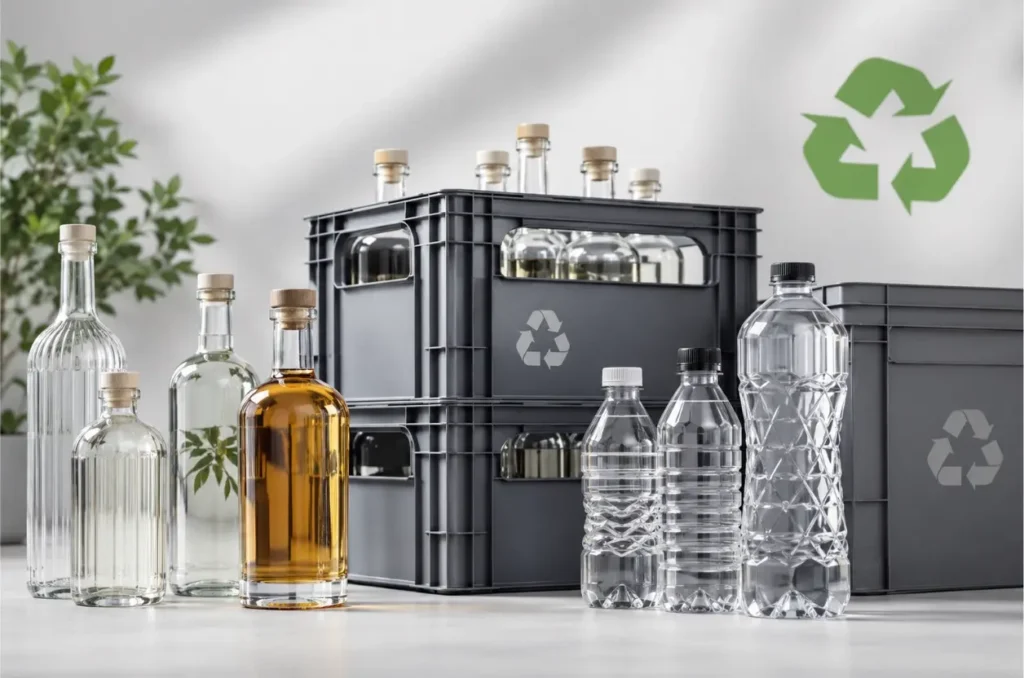
A cadeia de abastecimento completa altera a resposta
O vidro pode ser reciclado repetidamente nos locais onde existem sistemas de recolha e tratamento. Também se adapta bem a programas de recarga e devolução.
A reutilização pode melhorar o resultado quando as garrafas completam ciclos de devolução suficientes e o sistema de lavagem e transporte é eficiente.
O vidro também tem desvantagens. É mais pesado do que o plástico. Uma garrafa de luxo muito pesada aumenta o consumo de matéria-prima e o peso do transporte.
O plástico reduz o peso da carga e, normalmente, diminui as quebras durante o transporte. Além disso, permite utilizar menos material de embalagem para o mesmo volume de produto.
No entanto, o desempenho da reciclagem do plástico varia consoante a resina, a cor, o sistema de recolha local e o mercado. Uma embalagem reciclável não proporcionará o benefício esperado quando o mercado local não dispõe de capacidade de recolha e tratamento.
| Fator de sustentabilidade | Vidro | Plástico |
| Peso da embalagem | Mais alto | Mais baixo |
| Eficiência nos transportes | Mais baixo para garrafas pesadas | Normalmente mais elevado |
| Reciclagem | Válido quando existe uma coleção | Depende da resina e do sistema utilizado |
| Sistemas de recarga | Muito adequado | É possível com projetos adequados |
| Quebras e perdas de produto | Risco mais elevado | Menor risco |
| Teor de material reciclado | Disponível em vários mercados | Disponível para resinas selecionadas |
| Design leve | É possível graças à engenharia | Uma vantagem comum |
As marcas devem evitar afirmações como “o vidro é sempre mais ecológico” ou “o plástico tem sempre uma pegada ecológica menor”.”
Uma análise realista tem em conta o peso da garrafa, o local de fabrico, a distância de transporte, o teor de material reciclado, as taxas de recolha, a perda de produto e o potencial de reutilização.
Uma garrafa de vidro leve pode proporcionar um equilíbrio útil. Mantém o aspeto sofisticado do vidro, ao mesmo tempo que reduz o consumo de material e a procura de transporte.
Como devem as marcas adquirir garrafas de vidro para bebidas alcoólicas?
As fotografias ajudam os compradores a comparar estilos, mas não garantem o ajuste na linha de enchimento, a compatibilidade dos fechos nem o desempenho no transporte. São necessários detalhes técnicos antes de se poder elaborar um orçamento definitivo.
As marcas que adquirem garrafas de vidro para bebidas alcoólicas devem confirmar a capacidade, o tipo de gargalo, o peso da garrafa, o tipo de fecho, a decoração, a quantidade encomendada, os limites da linha de enchimento, o destino e a data de entrega. Um fornecedor fiável deve disponibilizar desenhos, amostras, orçamentos claros, controlo de qualidade e embalagem pronta para exportação.
O que deve constar num pedido de cotação?
Um pedido de orçamento claro ajuda o fornecedor a identificar um molde já existente adequado ou a explicar o processo de desenvolvimento personalizado.
| Informações necessárias | Exemplo |
| Produto alcoólico | Uísque |
| Capacidade da garrafa | 750 ml |
| Quantidade encomendada | 30 000 peças |
| Cor do vidro | Vidro de flint |
| Encerramento | Rolha de cortiça |
| Decoração | Serigrafia e revestimento |
| Referência | Imagem da garrafa ou desenho técnico |
| Destino | Espanha |
| Entrega obrigatória | Setembro |
Os moldes já existentes são adequados para projetos que exigem um desenvolvimento mais rápido e um investimento inicial mais baixo.
Uma garrafa normal não tem de ter um aspeto genérico. Uma marca pode criar uma embalagem mais distinta através da cor do vidro, dos fechos, dos rótulos, do revestimento, da impressão, do relevo ou da caixa exterior.
Um molde personalizado revela-se mais útil quando a marca necessita de uma silhueta única, de uma base especial ou pesada, de um acabamento personalizado no gargalo, de um logótipo em relevo ou de um painel de etiqueta específico. Também pode ser necessário quando a garrafa tem de ser compatível com o equipamento de enchimento existente ou quando a marca pretende um design que os concorrentes não consigam copiar facilmente.
Um molde padrão é, normalmente, mais rápido e mais económico. Um molde personalizado oferece maior controlo sobre a identidade, as proporções, a facilidade de manuseamento e o reconhecimento da marca a longo prazo.
Uma cotação útil deve indicar o preço da garrafa, o custo do fecho, o custo da decoração, o custo do molde (quando necessário), o método de embalagem, o prazo de entrega, as condições comerciais e a validade da cotação.
O comprador deve também perguntar se as encomendas subsequentes seguirão o mesmo desenho aprovado e o mesmo padrão de qualidade. Este aspeto é importante para produtos que necessitam de um abastecimento estável ao longo do ano.
Por que razão escolher a Jingbo Glass como fornecedor?
A Jingbo Glass apoia projetos de garrafas de álcool tanto com moldes já existentes como personalizados. Os compradores podem escolher entre designs de garrafas já estabelecidos ou colaborar com a nossa equipa no desenvolvimento de modelos OEM e ODM, na modelação 3D, nos desenhos técnicos e na produção de moldes personalizados.
Também podemos coordenar a escolha de tampas adequadas, a decoração da superfície, a produção em grande escala e a embalagem pronta para exportação. Isto permite que a garrafa, a tampa, o acabamento, o plano de produção e o método de envio sejam tratados como um único projeto de embalagem integrado.
Perguntas frequentes sobre garrafas de álcool em vidro e plástico
Os compradores costumam fazer as mesmas perguntas práticas sobre a segurança do produto, o prazo de validade, a personalização e as quantidades mínimas de encomenda.
É possível guardar bebidas alcoólicas de alta graduação em garrafas de plástico?
Alguns materiais plásticos podem conter determinados produtos alcoólicos, mas nem todas as garrafas de plástico são adequadas.
É necessário analisar a resina, a percentagem de álcool, os ingredientes, a temperatura de enchimento, as condições de armazenamento e o prazo de validade. Poderão também ser necessários ensaios de compatibilidade e de migração.
Por que razão a maioria das bebidas espirituosas de gama alta é vendida em garrafas de vidro?
O vidro proporciona um aspeto de alta qualidade, uma visibilidade nítida do produto, amplas opções de decoração e um desempenho estável da embalagem a longo prazo.
A sua clareza e corpo correspondem também às expectativas dos consumidores em relação ao uísque, à vodka, ao gin, ao rum, à tequila e ao brandy.
Será que o plástico é mais barato do que o vidro para as embalagens de bebidas alcoólicas?
O transporte do plástico costuma ser mais barato, porque é mais leve e menos propenso a partir-se.
O custo final depende ainda do frasco, do fecho, dos requisitos de barreira, dos rótulos, do desempenho no enchimento, da quantidade encomendada e do posicionamento da marca.
O vidro altera o sabor do álcool?
O vidro constitui um recipiente estável para bebidas alcoólicas em condições normais de embalagem e armazenamento.
O fecho, o revestimento, a exposição à luz, a temperatura de armazenamento e a composição do produto também podem afetar a qualidade do produto.
É possível personalizar garrafas de álcool de vidro?
Sim. As marcas podem personalizar a forma, a cor do vidro, a base, o acabamento do gargalo, a gravação em relevo, o revestimento, o efeito fosco, a impressão, o rótulo e o fecho.
Pode ser necessário um novo molde quando os modelos existentes não conseguem satisfazer os requisitos do projeto.
Que informações deve um comprador enviar para obter um orçamento?
O comprador deve indicar o tipo de produto, a capacidade, a quantidade encomendada, o tipo de fecho, a decoração, uma imagem de referência ou um desenho, o destino e a data de entrega pretendida.
Estes dados ajudam o fornecedor a verificar a disponibilidade dos moldes, a viabilidade da produção, a embalagem e o prazo de entrega.
Conclusão
No caso das bebidas espirituosas de gama alta e de longa duração, o vidro é normalmente mais resistente. O plástico é mais adequado para aplicações que exigem pouco peso. A Jingbo Glass oferece garrafas personalizadas, tampas, decoração e embalagens para exportação.
Está a planear um novo projeto de embalagem de bebidas espirituosas?
Envie à Jingbo Glass a capacidade pretendida, a quantidade, o tipo de tampa, a decoração, a imagem de referência, o destino e a data de entrega. A nossa equipa irá verificar os moldes existentes ou discutir uma solução personalizada para garrafas de vidro.