
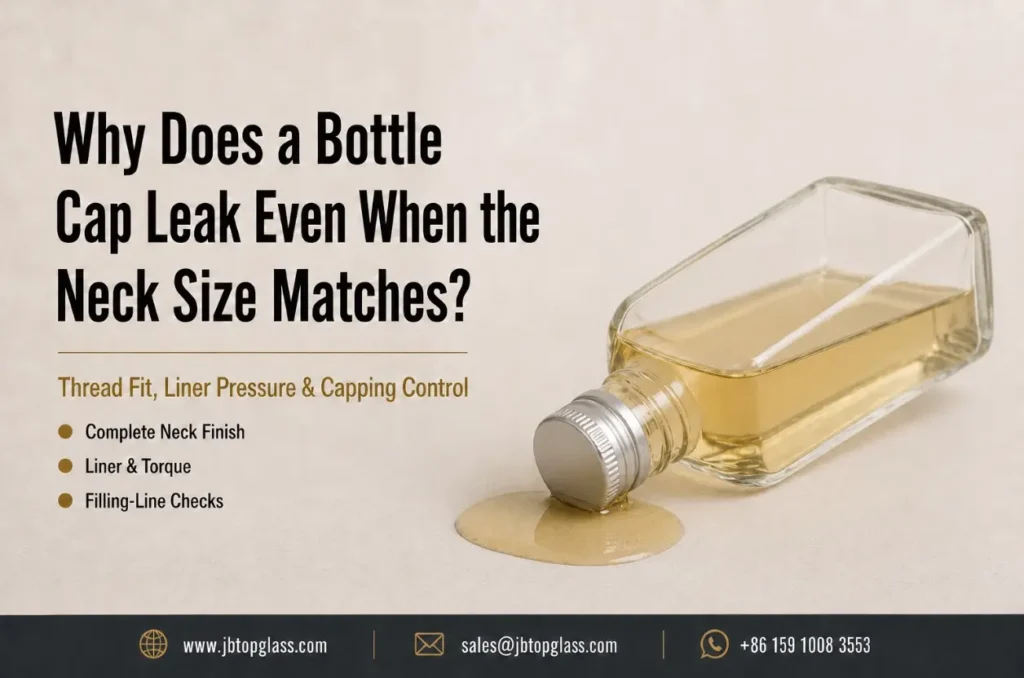
A bottle cap can leak even when its stated neck size matches the bottle. The neck diameter is only one part of the closure system. The thread design, bottle lip, cap liner, application torque and filling conditions must also match.
A cap that screws onto a bottle is not always the correct cap. The threads may connect, but the liner may not press evenly against the bottle. The package may look secure when it is empty. It may start leaking after filling, storage or transportation.
This article explains how to find the cause of a bottle cap leak. Our separate guide to 瓶颈尺寸 explains the basic neck measurements and finish codes.
Why Does Matching the Neck Size Not Guarantee a Seal?
A size such as 24 mm or 28 mm often describes the diameter of a threaded bottle finish. The number does not describe the complete neck structure.
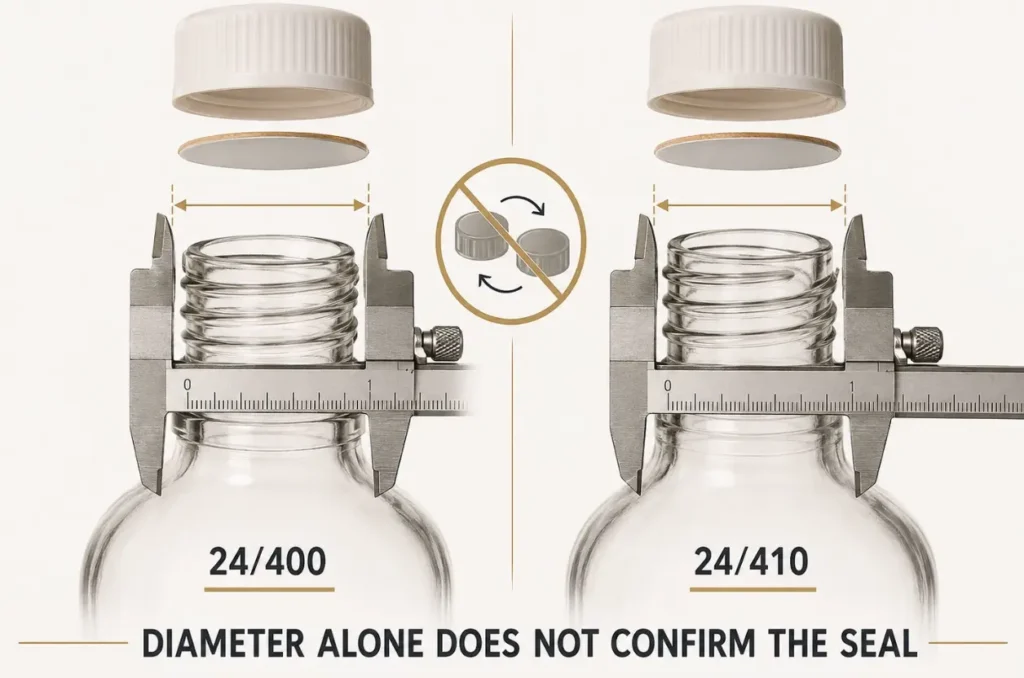
For example, 24/400 and 24/410 finishes share the same first number. However, they have different finish heights and thread structures. A cap made for one finish may begin to screw onto the other. However, the cap may not reach the correct sealing position.
The bottle opening is not always the only sealing area. Some closures seal against the top of the bottle finish. Other closures seal inside the opening or around another contact point.
Buyers should therefore confirm the complete bottle-and-cap combination. One matching diameter is not enough.
Six Reasons a Matching Bottle Cap Still Leaks
1. The Complete Neck Finish Does Not Match
The first number in a neck finish code is not enough. The buyer must also confirm the finish series, thread shape, finish height and sealing method.
Two caps can have the same stated diameter but different internal threads. They can also have different heights. One cap may stop before its liner reaches the bottle lip. Another cap may sit too low, rotate without tightening or connect with only part of the thread.
This problem is more likely when the bottles and caps come from different suppliers. Each product may match its own drawing, but the two products may not work together.
Buyers should request the complete bottle neck specification and closure specification. An approved drawing and a physical sample are important when the supplier cannot provide a standard finish code.
2. The Bottle Sealing Surface Is Uneven or Damaged
The cap may be correct, but the glass finish may have a problem.
A chip, crack, rough edge or uneven surface can leave a small path for liquid. An oval or tilted finish can also stop the cap from pressing evenly around the bottle opening.
These defects can be difficult to see after the cap has been applied. The quality team should remove the cap and inspect the top of the bottle under good lighting. The team may also need suitable gauges to check the finish dimensions.
Damage near the sealing surface is more serious than a small mark on the bottle body. Our guide to 常见的玻璃瓶缺陷 explains which defects can affect filling and sealing.
3. The Liner Does Not Seal Correctly
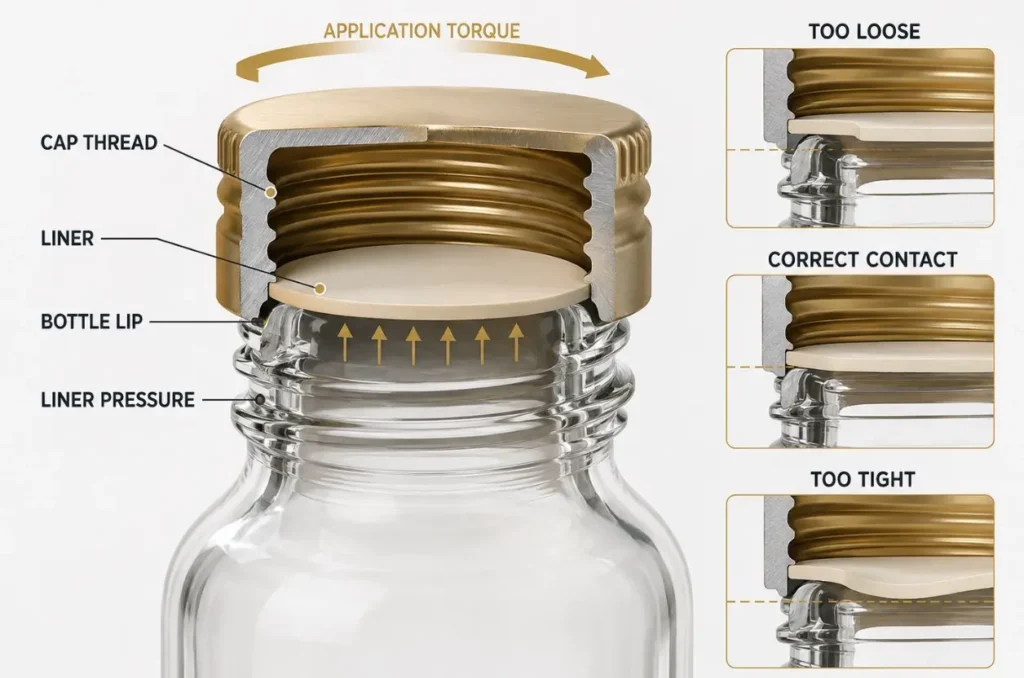
Many screw caps contain a liner. The liner presses against the bottle finish when the cap is tightened. This contact closes the space where liquid could escape.
The liner needs the correct diameter, thickness and material. A small liner may not cover the full sealing surface. A hard liner may not follow small changes in the glass. A soft liner may change shape or lose pressure during storage.
The liner material must also suit the product. Water, alcohol, oil, acid and flavor ingredients can affect liner materials in different ways. A liner that works with water may not work with another liquid.
Some caps use a molded sealing part instead of a separate liner. The cap and bottle opening still need to meet at the correct position.
4. The Application Torque Is Too Low or Too High
Application torque describes how tightly the cap is applied.
Low torque may not press the liner firmly enough against the bottle. A loose cap can also move during handling and transportation.
High torque does not always prevent leakage. Too much torque can damage the liner, deform the cap or damage the closure thread. It can also make the cap difficult for the customer to open.
No single torque value works for every bottle. The correct range depends on the cap diameter, cap material, liner, bottle finish, product and capping equipment.
The filling team should measure torque instead of checking it by hand. ASTM D2063/D2063M-24 describes torque-retention testing for packages with continuous-thread closures. The packaging team can use a suitable test method and supplier specification to set the correct range for its package.
5. The Capping Equipment Applies the Cap Incorrectly
A bottle and cap may seal during a hand test but leak on the filling line.
The cap may enter the capping head at an angle. The chuck or spindle may not line up with the bottle. High line speed, uneven pressure or poor cap feeding can also cause loose or tilted caps.
The bottle height and neck position also affect cap application. The closure may not sit evenly when the bottle is not centered under the capping head.
The production team should check whether the leaks come from one capping head, one time period or one part of the line. A clear pattern often points to an equipment problem rather than a wrong neck size.
Capping equipment can also place extra force on the bottle finish. Our article about glass bottle breakage on filling lines explains how capper alignment and bottle handling can affect the glass.
6. Filling, Storage or Transportation Conditions Change the Seal
Some bottle cap leaks only appear after the bottle leaves the filling line.
A hot-filled product exposes the bottle, cap and liner to temperature changes. A carbonated product creates pressure inside the bottle. Long storage can reduce the pressure that the liner places on the bottle lip. Vibration and impact during shipping can also loosen a weak closure.
The product may affect the liner or cap material. Some liquids can soften, swell or harden an unsuitable liner. The liner may then lose its ability to seal.
An empty bottle test cannot copy these conditions. The packaging team should test the final bottle with the intended product, fill level, filling temperature and storage conditions.
How Can You Diagnose a Bottle Cap Leak?
The position and timing of the leak can help the team find the cause.
| What You Observe | Likely Areas to Check First |
|---|---|
| The cap rotates but never becomes secure | Full neck finish, cap thread and cap height |
| Liquid escapes from one side of the cap | Uneven bottle lip, damaged finish or tilted cap |
| The cap leaks immediately after inversion | Liner coverage, liner pressure and application torque |
| Only some bottles in the production run leak | Capping-head alignment, cap feeding and bottle position |
| Leakage develops after several days | Torque retention, liner change or product compatibility |
| Leakage appears after shipping | Cap movement, vibration, pressure or temperature change |
The team should change one factor at a time. The team can first compare a good bottle-and-cap combination with a leaking one. The team should then inspect the glass finish, cap, liner and cap position. The team can review the torque records and line settings after the physical check.
This method helps the team find the actual problem. Extra torque cannot correct the wrong thread, damaged glass or unsuitable liner.
How Should Buyers Confirm Bottle and Cap Compatibility?
Buyers should approve the bottle and closure as one package. Jingbo Group’s 玻璃瓶封口件和瓶盖 page shows the main closure types and the bottle details required for each option.
The supplier needs to know the closure type, filled product, filling method and capping equipment. The buyer should provide the complete cap specification or a physical sample when the cap has already been selected.
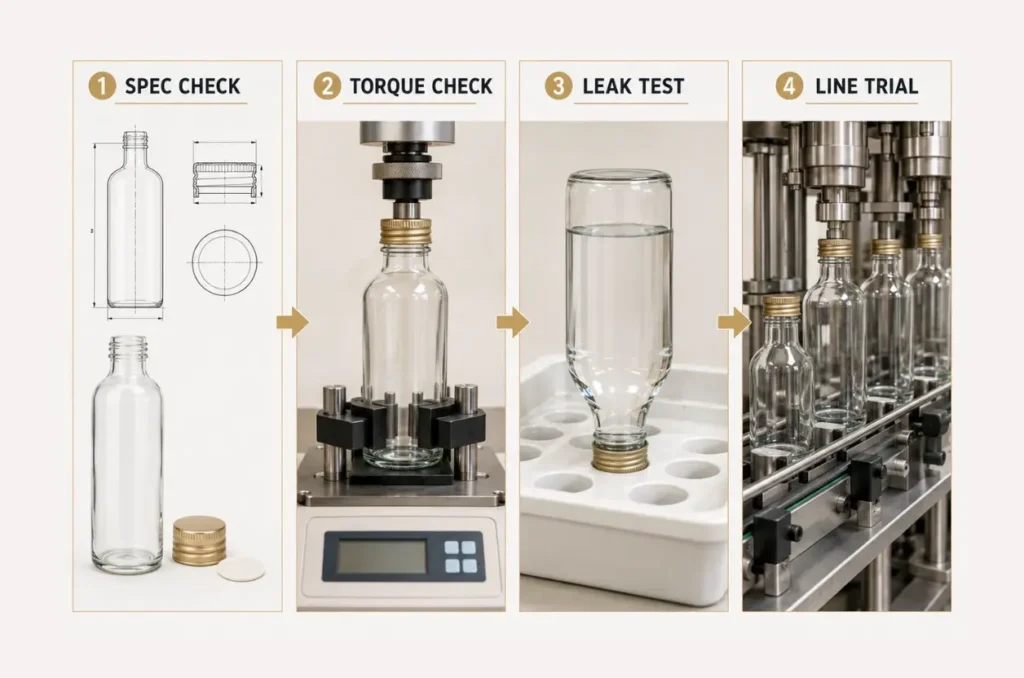
The buyer should first compare the bottle drawing, cap drawing and liner specification. The buyer should then test complete bottle-and-cap samples with the intended product.
The filled samples should face the same positions, temperatures and storage conditions expected in normal use. The filling plant should also test the final combination on the actual capping line before approving a large order.
A hand-tightened empty sample only confirms that the bottle and cap connect. The sample does not prove that the final package will remain sealed.
常见问题
Can a Cap Fit a Bottle and Still Leak?
Yes. The cap may connect with the bottle threads without pressing its liner against the correct sealing surface.
A hand-fit test only shows that the two parts can connect. The test does not confirm sealing during filling, storage and transportation.
Will Tightening the Cap More Stop the Leak?
Extra tightening does not always stop a leak. More torque may increase pressure for a short time, but it can also damage the cap or liner.
Extra torque cannot correct the wrong neck finish, an uneven bottle lip or an unsuitable liner.
Can Caps With the Same Diameter Be Interchanged?
No. Two caps may have the same diameter but use different thread styles, heights or sealing structures.
The buyer should confirm the complete neck finish and test physical samples. The buyer should not compare only the first number.
Should Bottles and Caps Be Ordered From the Same Supplier?
The bottles and caps do not have to come from the same supplier. However, the buyer must make sure that both parts work together.
The buyer should give both suppliers the approved drawings and samples when the components are purchased separately. The buyer must still test the complete package before production.
结论
A matching neck size does not guarantee a leak-free glass bottle. The complete neck finish, bottle lip, cap liner, application torque, capping equipment and filling conditions must work together.
Jingbo Group supplies glass bottles together with matching caps, stoppers and liners. Our team checks the neck finish, sealing structure and closure fit before preparing samples for your tests. You can send us your product type, required capacity, order quantity and preferred closure to receive a complete bottle-and-closure proposal.