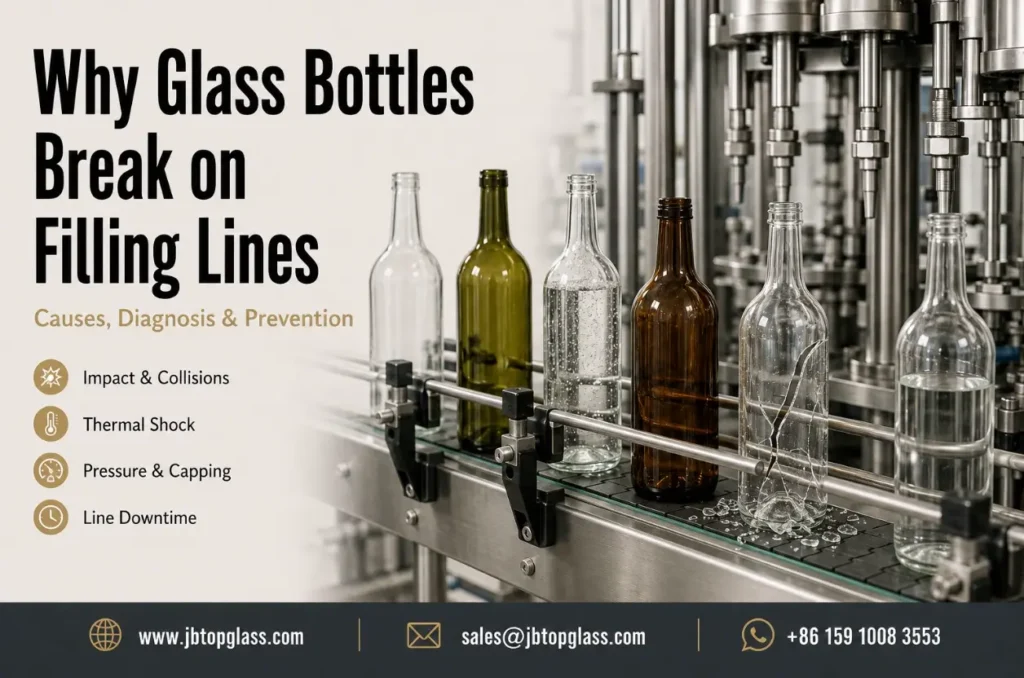
当施加在玻璃瓶上的应力超过其承受冲击、压力、温度变化或机械载荷的能力时,玻璃瓶就会在灌装线上破裂。.
问题可能发生在卸货、输送、冲洗、灌装、封盖或包装过程中。常见原因包括瓶与瓶之间的碰撞、导轨调整不当、更换部件不匹配、热冲击、灌装压力过大、瓶口损坏以及封盖操作不当。.
瓶子破裂并不一定意味着玻璃制造商生产了有缺陷的容器。该瓶子可能是运输过程中受损,或是因设备设置不当而受损,又或是未经适当的灌装线试运行就通过了验收。.
关键问题不仅仅在于“为什么这瓶子会破?”,更应该问的是:“破损是从哪里开始的?是什么应力导致了破裂?以及如何防止同样的问题再次发生?”本文重点探讨如何诊断灌装线上玻璃瓶破裂的问题。 关于气泡、裂纹、薄壁等制造相关问题的更全面解释,请参阅我们的指南: 常见的玻璃瓶缺陷.
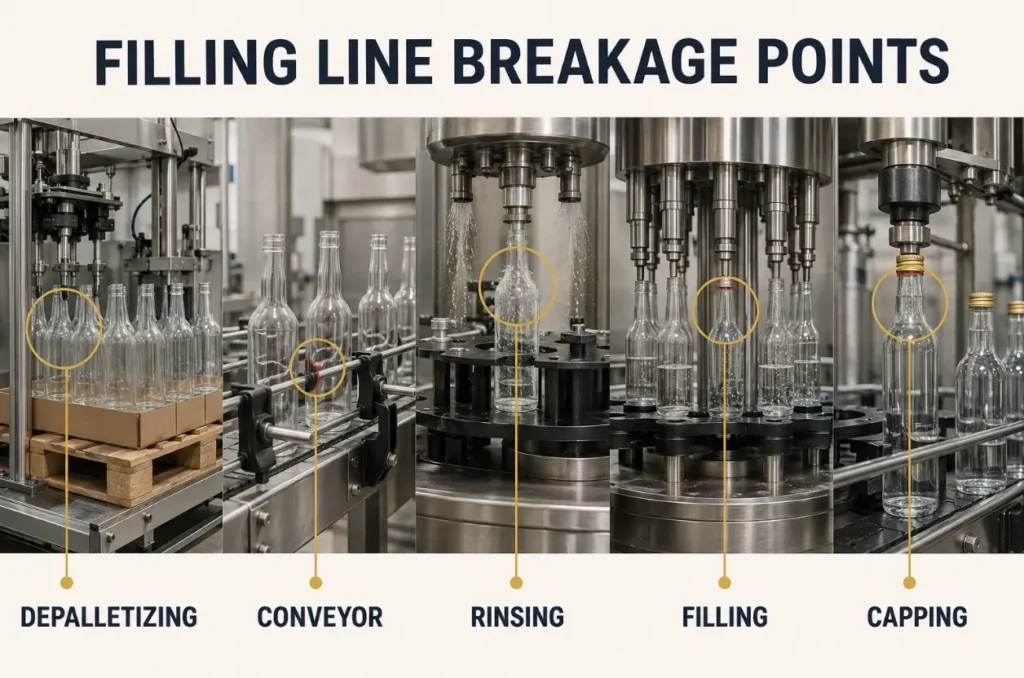
在灌装线上,玻璃瓶可能在哪些位置破裂?
灌装生产线是一个相互关联的系统。某个工位出现的故障,可能在几个工位之后才显现出来。.
例如,某瓶在卸垛过程中可能受到轻微撞击,但在灌装头施加压力之前仍保持完好;而另一瓶可能在运输过程中瓶口出现缺口,直到上盖机压在受损部位时才破裂。.
因此,瓶子破裂的位置虽然重要,但并不总能确定最初的破损发生在何处。.
卸垛和瓶子进料
在卸载托盘、移除隔层或将一组容器转移到输送带上时,瓶子可能会发生碰撞。.
如果进料间距与瓶子的形状不匹配,瓶子还可能会撞到金属导轨、搬运臂或相邻的容器。.
高身瓶、厚底瓶和窄身瓶的运行表现可能与标准圆形容器不同。一种适用于某种瓶子的输送机配置,不能自动用于另一种瓶子。.
进厂的瓶子在进入生产线前,还应检查托盘是否移位、隔板是否损坏、包装是否松动以及是否有肉眼可见的玻璃碎片。.
输送机的转移与积放
在一段传送带将瓶子转移到另一段传送带的地方,经常会出现传送带故障。.
速度的突然变化可能会导致瓶子倾倒、堆积在一起或撞击导轨。过度堆积会增加相邻容器之间的接触,特别是在瓶底和瓶肩部位。.
这些冲击可能会导致瓶子立即破裂,或造成微小的表面损伤,从而降低瓶子在后续工序中的耐受性。.
当设备根据不同的瓶径、瓶身轮廓或生产速度进行调整时,风险通常会增加。.
冲洗和清洗
瓶子冲洗机和清洗机可能会产生机械应力和温度应力。.
抓取器可能抓握瓶子过紧。喷嘴可能撞到瓶口。此外,如果瓶子在进入清洗或冲洗阶段时,所受的温差超过其经验证的容差范围,瓶子也可能开裂。.
瓶子与机器的刚性部件之间反复接触的问题值得特别关注。即使瓶子没有立即破裂,受损的瓶口或划伤的瓶壁也可能成为薄弱点。.
馅料
在灌装站,瓶子可能会与对中导环、灌装喷嘴、支撑板或升降平台发生接触。.
瓶身过高、过矮、不稳或瓶颈位置不一致时,可能无法与灌装头正确对齐。.
根据产品的不同,瓶体内部可能会受到压力、真空或温度急剧变化的影响。.
具体原因取决于产品和设备。静置酒瓶、热灌装酱料瓶和加压啤酒瓶所处的条件并不相同。.
封盖、塞瓶和封口
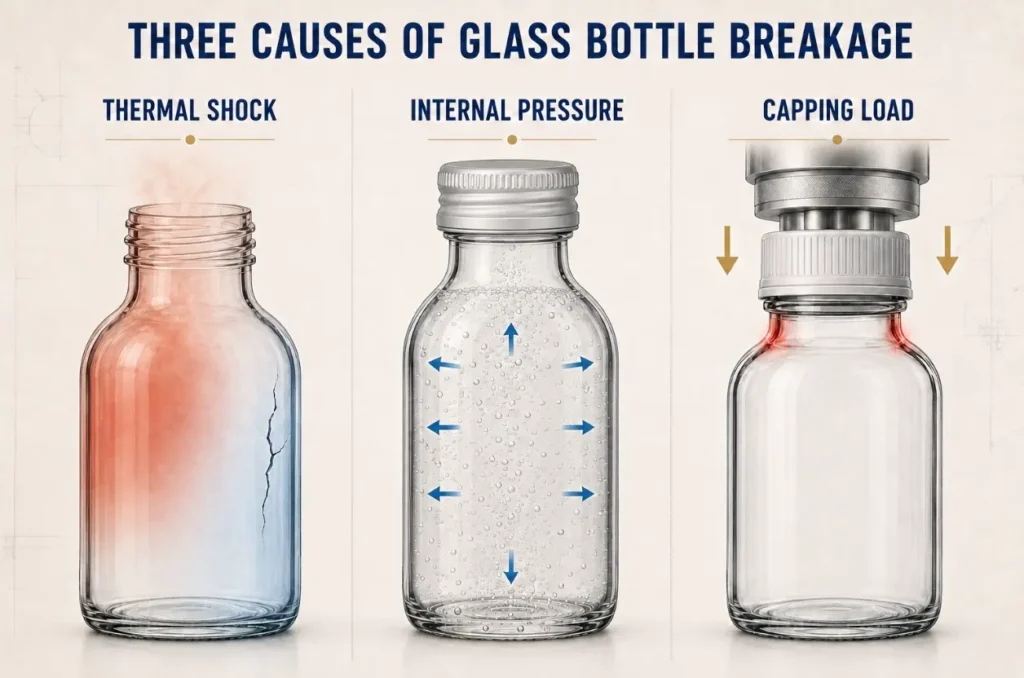
封盖机可对瓶口、瓶颈和瓶身施加压力。.
如果瓶体未居中、瓶盖与瓶口不匹配,或者施加的压力过大,瓶颈可能会出现缺口或裂纹。.
软木塞的插入可能会产生另一种形式的应力,因为塞子会进入瓶口。瓶内径、软木塞尺寸、插入参数以及瓶身支撑都需要协调配合。.
在封口前,瓶子可能看起来很正常,但当受损或匹配不佳的瓶口在受力时,瓶子可能会出现故障。.
为什么机械冲击会导致玻璃瓶破裂?
玻璃在预期使用条件下性能良好,但集中受力可能会损坏其表面。.
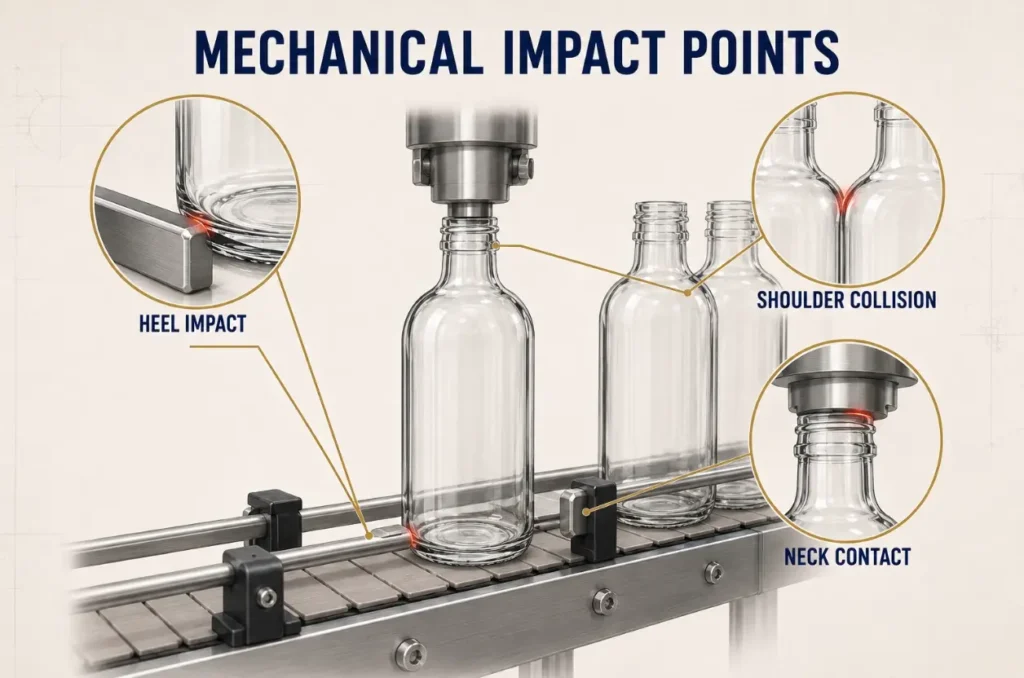
当瓶底撞击金属传送点、瓶肩与另一瓶碰撞,或瓶口撞击灌装头时,瓶子可能会破裂。.
损坏程度取决于瓶子的几何形状、接触位置、表面状况、冲击方向和工作条件。.
厚实的瓶子并不一定能抵御所有的撞击。当沉重的容器快速移动或与其他瓶子相互碰撞时,也会产生更强的冲击力。.
瓶与瓶之间的接触
当瓶子在传送带上挤在一起时,相互接触的可能性就会增加。.
圆形容器的移动方式可能与方形、锥形或带有明显浮雕的瓶子不同。突出的瓶肩、棱角和装饰性特征可能会改变相邻瓶子之间的接触点。.
如果输送带继续将瓶子推向下游堵塞的区域,即使瓶子的移动速度不快,接触力仍可能增大。.
纠正措施可能涉及调整生产线平衡、积压压力、间距或转移时机。具体设置应根据具体的机器和容器而定。.
导轨和更换部件
导轨应能支撑瓶子的移动,且不会反复撞击或挤压容器。.
当导轨设置为适应较小瓶子时、导轨高度与瓶子的接触面积不匹配时,或者磨损部位露出硬边时,可能会出现问题。.
星形轮、定时螺钉、抓爪和瓶架也必须符合批准的尺寸要求。.
例如,方形烈酒瓶与圆柱形葡萄酒瓶在处理方式上可能有所不同。如果现有的替换部件是为另一种形状设计的,并不一定意味着该瓶子有缺陷。.
现有的表面损伤
瓶子在运抵灌装厂之前,可能会出现划痕或轻微的碰撞损伤。.
损坏可能源于纸箱内的晃动、相邻瓶子之间的碰撞、不正确的托盘搬运,或是与机器部件反复摩擦。.
表面上的轻微划痕并不一定会导致破裂。然而,当瓶子随后受到压力、封盖力或温度变化的影响时,较深的损伤可能会变得更加严重。.
因此,调查应包括进货批次的状况,而不仅仅是最终发生瓶子破裂的那台机器。.
热冲击会在灌装过程中导致玻璃瓶破裂吗?
是的。当玻璃瓶的不同部位温度变化过快或不均匀时,就会发生热冲击。.
风险并非仅由产品温度决定。起始瓶温、冲洗温度、灌装温度、保温条件和冷却方式都至关重要。.
从冷库中取出的瓶子,其反应可能与在热灌装前经过逐步适应处理的瓶子不同。.
如果热水袋突然接触到冷水或受到剧烈冷却,也可能出现故障。.
这并不意味着每只热灌装瓶都会破裂。这意味着整个温度序列必须与该瓶经过验证的性能相符。.
ISO 7459:2004 描述了用于评估玻璃容器耐热冲击性和热冲击耐久性的试验方法。.
该标准并未为每种瓶子规定一个通用的安全温差值。合适的测试条件取决于容器的设计及其预期用途。.
购买者在选择瓶子之前,应提供实际灌装温度、起始瓶温、冲洗条件及冷却工艺。.
我们对……的比较 热灌装和冷灌装玻璃瓶 解释了为什么外观相似的容器在不同的装填条件下性能可能有所不同。.
灌装压力或垂直载荷会导致瓶子破裂吗?
有些灌装系统会在容器内部施加压力,而另一些则通过支撑板、升降平台、灌装头或封口设备施加外部力。.
相关风险取决于产品。.
碳酸啤酒或起泡饮料的瓶体必须能够承受与其经验证的灌装和处理条件相关的内压。静止葡萄酒或烈酒的瓶体虽然面临的内压较小,但在灌装口处仍会受到机械载荷的作用。.
ISO 7458:2004 描述了测试玻璃容器内部耐压性能的方法。.
压力测试应反映实际瓶体和产品的使用情况。不应仅仅因为瓶子看起来厚实或沉重,就认为它适合用于碳酸饮料。.
垂直载荷则不同。它指的是沿瓶身垂直轴方向施加的力。.
当设备压在瓶口上,或者在灌装和封盖过程中瓶子支撑不当,就可能产生此类应力。.
ISO 8113:2004 描述了一种测定玻璃容器抗垂直载荷能力的方法。.
即使瓶子通过了常规目视检查,但如果设备施加的力不均匀或接触面未对准,该瓶子仍可能被判定为不合格。.
为什么瓶子在封盖工位会破裂?
封盖过程中瓶子破裂通常与瓶口、瓶盖、机器设置以及玻璃本身的状况之间存在关联。.
仅凭盖子的近似直径还不足以确认是否兼容。.
此外,还必须考虑螺纹形状、端面高度、密封面、衬套、封口材料以及安装方法。.
在人工检查时看似安装不紧的封口件,当由自动化设备以生产速度进行封装时,其表现可能会有所不同。.
领型与闭合方式不匹配
瓶盖必须完全符合瓶口的规格要求。.
两只瓶子的瓶口可能相似,但螺纹设计、瓶口高度或密封面可能不同。.
如果盖子未能正确扣合,机器可能会导致封口螺纹错位、施加不均匀的力,或者压在成品的错误部位上。.
我们的指南: 瓶颈尺寸和瓶颈口型 解释了为什么公称直径并不能保证完全兼容。.
施力过大或不均匀
拧得更紧的盖子并不一定密封性更好。.
过大的拧紧力可能会损坏瓶盖、导致内衬变形、使表面出现缺口,或给瓶颈施加过大的应力。.
施力不足会引发另一个问题,因为闭合件可能无法正确密封。.
应根据具体的玻璃瓶、瓶盖、内衬、产品和设备,确定正确的施力范围。并不存在一个适用于所有玻璃瓶的统一扭矩值。.
现有饰面损坏
瓶口周围的小缺口或裂纹,在拧上瓶盖或塞入软木塞后可能会变得更加严重。.
该问题可能源于运输、拆垛、冲洗或更早阶段与机器的接触。.
如果有多瓶在封盖机处破裂,请检查进料端的瓶口状况,以及封盖头、对准和施加设置。.
京博集团 玻璃瓶封口件和瓶盖 该页面说明了为何应将瓶体和瓶盖作为一个完整的包装系统进行审查。.
灌装线故障总是由瓶子缺陷引起的吗?
不。瓶子有缺陷是一种可能的原因,但并非唯一的原因。.
薄弱部位、薄点、现有裂纹、表面损伤或玻璃分布不均,都会降低容器在正常生产条件下承受压力的能力。.
然而,如果生产线使用了不正确的更换部件、接触压力过大或采用了未经批准的温度循环,即使是合适的瓶子也可能出现故障。.
相反的情况也是可能的。即使设备调整正确,受损的瓶子仍可能在设备上破裂。.
因此,要确定责任归属,需要同时从瓶子和生产线两方面获取证据。.
调查应考虑破损是否与某一个托盘、某一个生产批次、某一个模具、某一种瓶型、某一个机位或最近的一次设备调整有关。.
如果提高速度后,来自不同供应商的瓶子在同一位置发生破损,则应立即检查机器的设置。.
如果故障集中出现在某一批次中,而同一条生产线生产的其他批次却运行正常,那么就应该对这些进厂的容器进行更仔细的检查。.
仅凭其中任何一种情况都无法单独证明原因。瓶子供应商、灌装公司和质量团队需要共同审查现有证据。.
如何诊断灌装线上玻璃瓶破裂的问题?
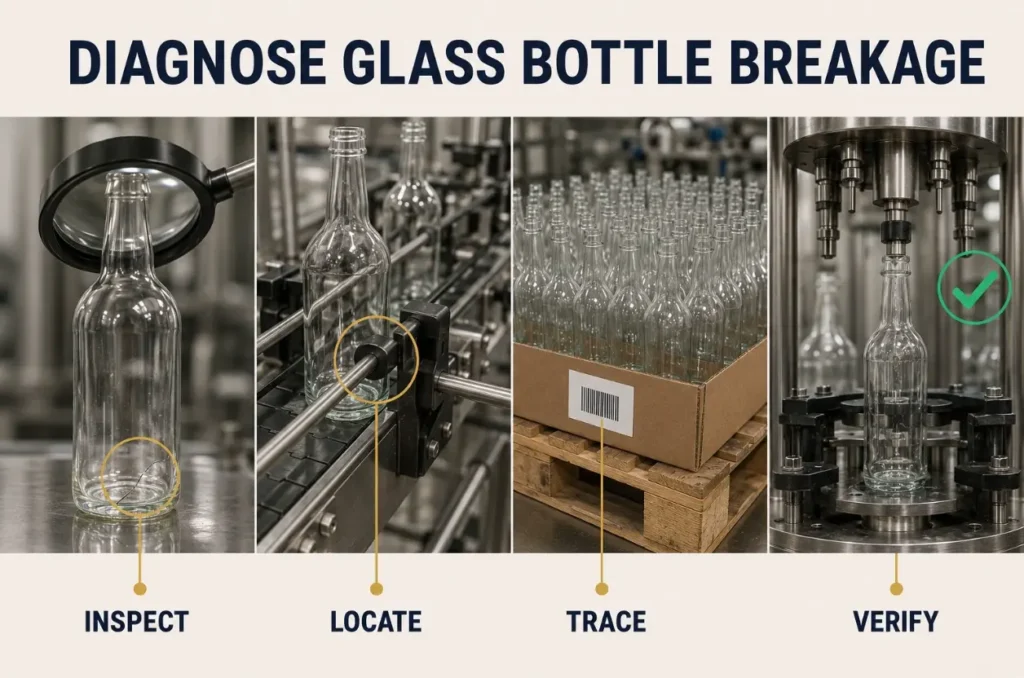
一项有用的调查应从故障位置、发生时间以及重复模式入手。.
与其询问瓶子是否只是“太脆弱了”,不如查明容器的哪个部位出现了故障,以及当时的具体情况。.
| 破损模式 | 可能的原因 | 需要检查的内容 |
|---|---|---|
| 输送机进料口附近的鞋跟或底板损伤 | 瓶子碰撞、转移点卡滞或导轨损坏 | 输送带间距、转运时机、接触面及进料托盘的状态 |
| 星轮或灌装头附近的肩部损坏 | 更换部件不正确、对中不良或瓶与瓶之间发生接触 | 瓶体尺寸、星形轮配合、导向对准及设备间隙 |
| 在冲洗或热灌装过程中出现的裂纹 | 温度变化、受热不均或表面已有的损伤 | 瓶体温度、冲洗温度、灌装条件及热测试数据 |
| 在加压灌装过程中发生瓶体破裂 | 不适当的压力条件或容器强度不足 | 产品压力、灌装参数、瓶体规格及压力测试结果 |
| 封盖过程中瓶口或瓶颈受损 | 闭合不匹配、超载、对中不良或现有表面损伤 | 瓶颈处理、衬垫、瓶盖贴合度、封盖头及应用设置 |
| 故障集中于一个托盘或一个生产批次 | 运输损坏、搬运问题或特定批次的问题 | 托盘状况、发货记录、霉菌鉴定及进货检验 |
| 提高生产线速度后的断线现象 | 冲击力过大、积压或瓶体移动不稳 | 输送机平衡、设备同步、间距及换线记录 |
该表列出了需要调查的领域。它不能替代现场检查,也不能确认具体故障的原因。.
记录确切的故障位置
请记录瓶子破裂的工位以及瓶子的哪个部位出现故障。.
后跟骨折、表面受损和肩部开裂,这些情况分别指向不同的调查方向。.
在调整受影响的设备或丢弃破损的容器之前拍摄的照片会很有用。.
记录中还应注明瓶子是空的、正在灌装、已经装满还是正在封盖。.
将进料瓶与生产线上的瓶子进行比较
检查同一批货中未开封的包装。.
然后将这些瓶子与在疑似机器工作站前立即收集到的容器进行比较。.
如果进来的瓶子没有损坏,但在经过某个特定的转运点后出现了相同的痕迹,那么问题可能是设备造成的。.
如果未开封的纸箱内部已出现类似损坏,应调查运输或进货包装情况。.
查看最近的更改
瓶身形状、供应商、封口方式、灌装温度、设备速度或生产设置发生变更后,往往会出现破损。.
新款瓶子的容量可能与旧款设计相同,但高度、肩宽、底径或瓶口位置可能有所不同。.
A new closure may require different application settings.
A recent maintenance adjustment may also change the timing between conveyors, star wheels or filling heads.
The investigation should identify what changed before the problem began.
Preserve Batch and Mold Traceability
Record the production lot, pallet number and any relevant mold identification.
If breakage appears repeatedly in one production group, the supplier may need to review manufacturing records, glass distribution, inspection results or shipment handling.
If the failures occur across several unrelated batches, the line conditions may be more relevant.
Traceability does not establish responsibility by itself. It allows the investigation to move beyond assumptions.
What Should a Filling Plant Do When a Bottle Breaks?
A broken glass bottle creates more than a packaging loss.
Fragments may reach neighboring bottles, machine surfaces, conveyors or nearby product. The appropriate response depends on the product, process and facility’s approved glass-breakage procedure.
The first step is to stop the affected operation and prevent additional containers from entering the risk area.
The surrounding product should then be isolated according to the facility’s established procedure. Trained personnel should inspect the equipment and remove glass fragments using the approved cleaning and verification process.
The line should not restart until the responsible quality or production team confirms that the affected area has been cleared.
该 FDA’s Juice HACCP Hazards and Controls Guidance identifies transportation damage, mechanical handling, filling, capping and thermal shock as potential causes of glass contamination.
The guidance also discusses stopping the line, removing broken glass and holding potentially affected product when broken glass is found at a relevant control point.
These recommendations are presented within the context of juice processing. Other products and facilities should follow the requirements and risk controls applicable to their own operations.
A quick cleanup without documented inspection may allow the same problem to happen again.
The incident should be recorded, the likely cause investigated and the corrective action verified before normal production resumes.
How Can Buyers Prevent Glass Bottle Breakage Before Production?
The best prevention begins before a bulk order enters the filling facility.
A bottle should be approved for the actual product, closure, equipment and handling conditions rather than selected only from a product photograph.
Confirm the Complete Bottle Specification
The approved drawing should identify the bottle height, body dimensions, base contact area, neck finish and relevant tolerances.
A bottle with unusual shoulders, a narrow base or a non-round body may require additional review.
The filling company should confirm whether the design works with its existing conveyor guides, star wheels, grippers, support plates and capping equipment.
When a new bottle shape requires a dedicated mold, 定制玻璃瓶模具开发 should include a discussion of filling-line restrictions before the design is finalized.
Run a Representative Line Trial
A successful hand-filled sample does not guarantee successful automated filling.
The most useful trial uses the actual bottle, intended closure, planned product conditions and relevant machine setup.
The test should include normal bottle movement through rinsing, filling, closing and any downstream handling stage that may affect the container.
If the bottle is hot-filled or used for a carbonated product, the trial conditions should represent the intended process.
A short visual inspection alone cannot replace a practical production review.
Check Packaging and Incoming Handling
The bottle must reach the filler in suitable condition.
Dividers, cartons, pallets and wrapping should limit movement during transportation and unloading.
The appropriate method depends on the bottle shape, surface finish, order quantity and handling equipment at the destination.
京博集团 玻璃瓶包装解决方案 explain the practical differences between divider cartons, pallet packing and cartons secured on pallets.
Incoming inspection should focus on damage patterns, pallet condition and visible glass fragments rather than only counting the delivered quantity.
Match the Closure Before Bulk Production
The bottle and closure should be approved together.
Confirm the finish design, closure dimensions, liner, sealing surface and planned application method before placing a large order.
A closure that performs well during manual sampling may still need adjustment on an automated capper.
Any change to the cap supplier, liner material or application equipment should trigger another compatibility review when the change could affect performance.
Define Relevant Performance Tests
The required tests depend on the product and filling process.
A hot-filled bottle may require thermal shock evaluation. A carbonated bottle may require internal pressure testing. A bottle exposed to significant machine loading may need an appropriate vertical-load assessment.
Not every bottle needs the same testing program.
The manufacturer, buyer, filler and any relevant laboratory should agree on the performance requirements before production begins.
Maintain Change Control
A repeat order should match the previously approved specification.
Changes to bottle weight, wall distribution, neck finish, closure, carton design or filling-line setup can alter performance even when the bottle looks similar.
If a supplier introduces a design adjustment, the filling company should understand the change before the new bottles enter production.
The same principle applies to machine changes. New guide rails, higher line speeds or different capping heads may require another trial.
常见问题
Does Filling-Line Breakage Always Mean the Bottles Are Defective?
No. Breakage can result from bottle defects, transportation damage, incorrect equipment settings, unsuitable temperature changes or closure problems.
The cause should be investigated using the fracture location, production conditions, incoming bottle condition and batch information.
Can a Bottle Break Later After a Small Earlier Impact?
Yes. A bottle may receive surface damage at one stage and fail later when it experiences filling pressure, temperature change or capping load.
The station where the bottle breaks is not always the location where the original damage occurred.
Can Lightweight Glass Bottles Run on Automated Filling Lines?
Yes, if the bottle has been properly designed, produced, handled and validated for the intended equipment.
Low weight alone does not determine whether a bottle is suitable. Glass distribution, bottle shape, surface condition, line settings and product requirements also matter.
Does Higher Capping Torque Prevent Leaks?
Not necessarily. Excessive application force can damage the closure, distort the liner or place unwanted stress on the bottle finish.
The correct setting depends on the specific bottle, closure, liner and machine.
任何玻璃瓶都能用于热灌装吗?
No. The bottle must be suitable for the actual temperature conditions, including its starting temperature, product temperature and cooling method.
The closure and liner must also be appropriate for the intended process.
What Information Should Buyers Provide Before Ordering Bottles?
Buyers should identify the product, bottle capacity, filling method, closure type, expected temperature conditions and any relevant pressure requirements.
They should also provide the bottle dimensions, equipment restrictions and order quantity when these details are available.
What Is the First Step After a Bottle Breaks on the Line?
Stop the affected operation and follow the facility’s approved glass-breakage procedure.
Potentially affected products should be isolated, the equipment should be inspected and the line should restart only after the responsible team confirms that it is safe to do so.
结论
Glass bottle breakage on filling lines can result from mechanical impact, unsuitable handling, thermal shock, internal pressure, closure problems or existing container damage.
The most effective investigation identifies where the bottle failed, what changed and whether the problem originated in the bottle, packaging, transportation or production equipment.
京博集团 can help review bottle dimensions, neck finishes, compatible closures, custom designs and export packaging before bulk production. Share your bottle requirements and filling conditions so the complete packaging system can be evaluated together.