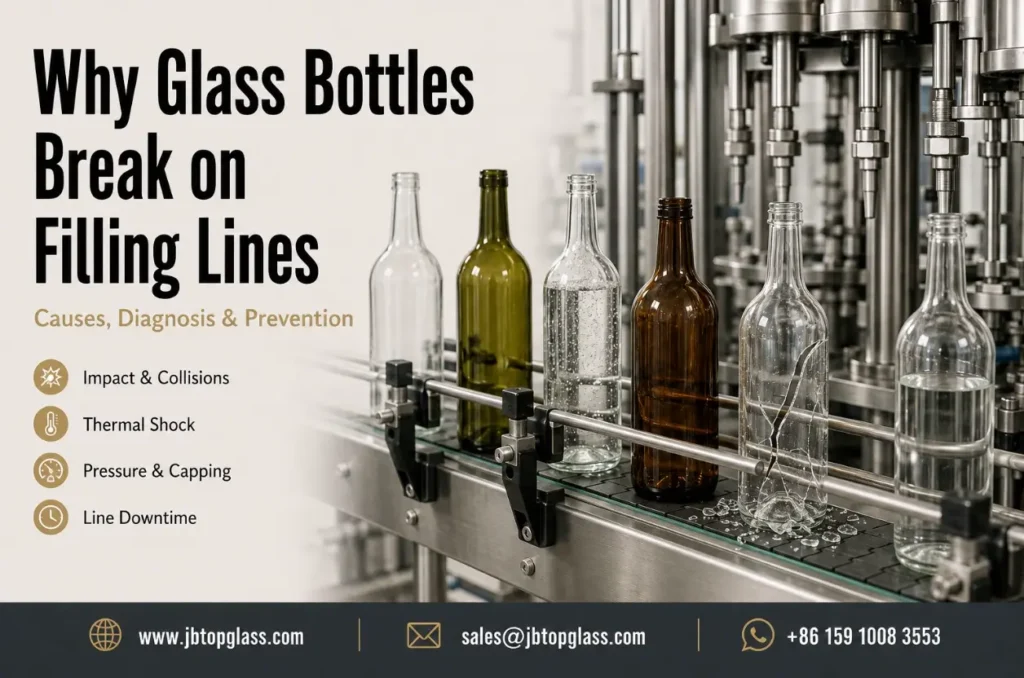
Glass bottles break on filling lines when the stress placed on the container exceeds its ability to withstand impact, pressure, temperature change or mechanical loading.
The problem can begin during unloading, conveying, rinsing, filling, capping or packing. Common causes include bottle-to-bottle collisions, poorly adjusted guide rails, incompatible change parts, thermal shock, excessive filling pressure, damaged bottle finishes and incorrect closure application.
A broken bottle does not automatically mean the glass manufacturer produced a defective container. The bottle may have been damaged during transportation, exposed to unsuitable equipment settings or approved without a proper filling-line trial.
The important question is not simply, “Why did this bottle break?” The better question is, “Where did the damage begin, what stress caused the failure and how can the same problem be prevented?” This article focuses on diagnosing glass bottle breakage on filling lines. For a broader explanation of bubbles, cracks, thin spots and other manufacturing-related issues, see our guide to common glass bottle defects.
Where Can Glass Bottles Break on a Filling Line?
A filling line is a connected system. Damage can occur at one station and become visible several stations later.
For example, a bottle may receive a small impact during depalletizing but remain intact until pressure is applied at the filling head. Another bottle may develop a finish chip during transportation and break only when the capper presses against the damaged area.
The location where the bottle breaks is therefore important, but it does not always identify where the original damage occurred.
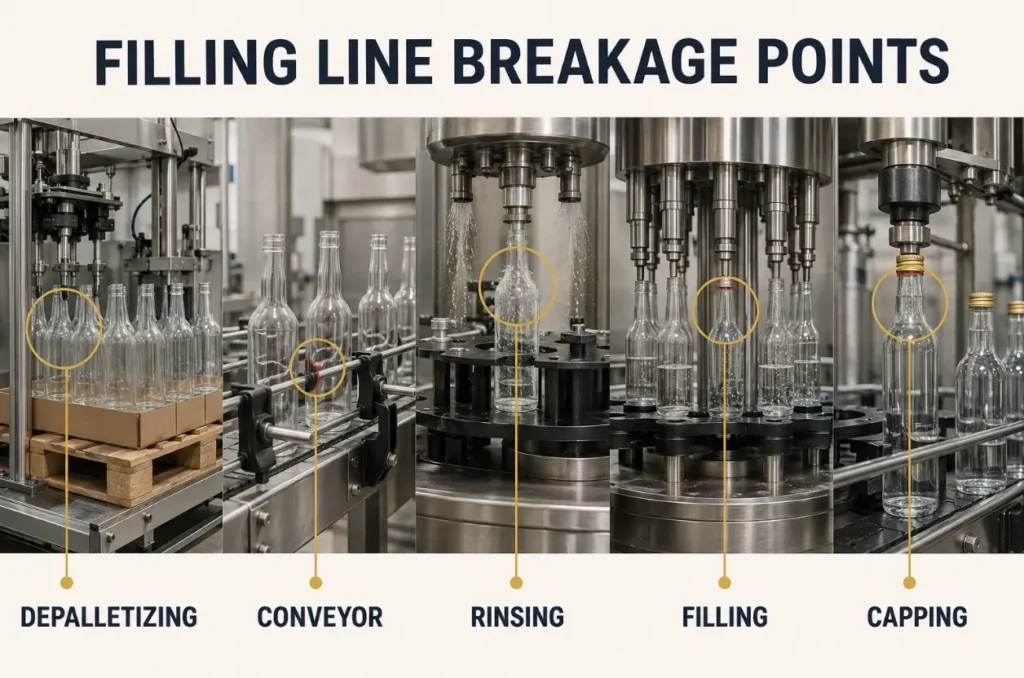
Depalletizing and Bottle Infeed
Bottles can collide when pallets are unloaded, divider layers are removed or groups of containers are transferred onto a conveyor.
A bottle may also strike a metal guide, handling arm or neighboring container if the infeed spacing does not match its shape.
Tall bottles, heavy-base bottles and narrow-body designs may behave differently from standard round containers. A conveyor setup that works well for one bottle cannot automatically be used for another.
Incoming bottles should also be checked for pallet movement, damaged dividers, loose wrapping and visible glass fragments before they enter the line.
Conveyor Transfers and Accumulation
Conveyor problems often appear where one section transfers bottles to another.
A sudden speed change can cause bottles to tip, bunch together or strike a guide rail. Excessive accumulation can increase contact between adjacent containers, especially around the heel and shoulder.
These impacts may produce immediate breakage or create small surface damage that reduces the bottle’s resistance later in the process.
The risk usually increases when equipment is adjusted for a different bottle diameter, body profile or production speed.
Rinsing and Washing
Bottle rinsers and washers can create both mechanical and temperature-related stress.
A gripper may hold the bottle too tightly. A nozzle may strike the finish. A bottle may also crack if it enters a wash or rinse stage with a temperature difference that exceeds its validated tolerance.
Repeated contact between the bottle and rigid machine parts deserves particular attention. Even when the bottle does not break immediately, a damaged finish or scratched sidewall can become a weak point.
Filling
At the filling station, the bottle may experience contact with a centering bell, filling nozzle, support plate or lifting platform.
A bottle that is too tall, too short, unstable or inconsistent in neck position may not align correctly with the filling head.
Depending on the product, the bottle may also experience internal pressure, vacuum or a rapid temperature change.
The actual cause depends on the product and equipment. A still spirit bottle, hot-filled sauce bottle and pressurized beer bottle do not face the same conditions.
Capping, Corking and Closing
A capper can place force on the bottle finish, neck and body.
If the bottle is not centered, the closure does not match the finish or the application load is excessive, the neck may chip or crack.
Cork insertion can create a different form of stress because the closure enters the bottle opening. The bottle bore, stopper dimensions, insertion settings and bottle support all need to work together.
A bottle may appear normal before closure application but fail when a damaged or poorly matched finish is placed under load.
Why Does Mechanical Impact Cause Glass Bottle Breakage?
Glass can perform well under its intended conditions, but concentrated contact can damage the surface.
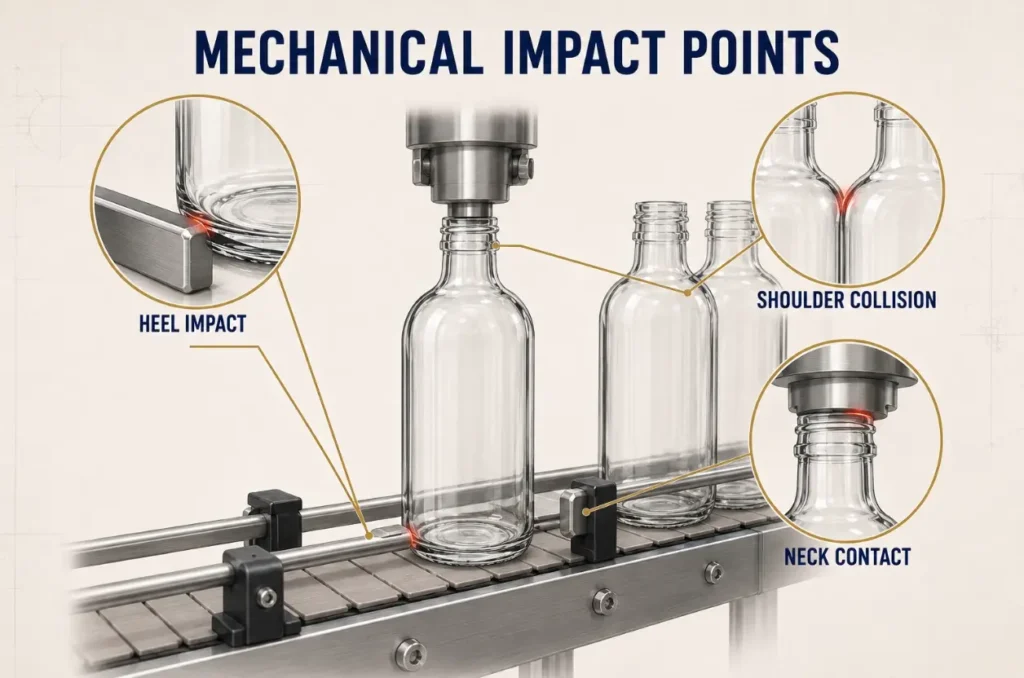
A bottle may break when its heel strikes a metal transfer point, its shoulder collides with another bottle or its finish hits a filling head.
The amount of damage depends on the bottle geometry, contact location, surface condition, impact direction and operating conditions.
A thick bottle is not automatically protected from every impact. A heavy container can also generate a stronger collision when it moves quickly or accumulates against other bottles.
Bottle-to-Bottle Contact
Repeated contact becomes more likely when bottles are crowded together on the conveyor.
Round containers may move differently from square, tapered or heavily embossed bottles. Projecting shoulders, corners and decorative features can change where adjacent bottles touch.
If the conveyor continues pushing bottles against a blocked downstream section, the contact force can increase even though the bottles are not moving quickly.
The corrective action may involve adjusting line balance, accumulation pressure, spacing or transfer timing. The appropriate settings depend on the specific machine and container.
Guide Rails and Change Parts
Guide rails should support bottle movement without repeatedly striking or squeezing the container.
Problems can occur when the rails are set for a smaller bottle, when the rail height does not match the bottle’s contact area or when a worn section exposes a hard edge.
Star wheels, timing screws, grippers and bottle supports must also match the approved dimensions.
A square spirit bottle, for example, may require different handling from a cylindrical wine bottle. The bottle is not necessarily defective if the existing change parts were designed for another shape.
Existing Surface Damage
A bottle can receive scratches or minor impact damage before it reaches the filling station.
The damage may come from movement inside a carton, contact between neighboring bottles, incorrect pallet handling or repeated rubbing against machine parts.
A small surface mark does not always cause failure. However, deeper damage can become more serious when the bottle later experiences pressure, capping force or temperature change.
The investigation should therefore include the condition of the incoming shipment, not only the machine where the bottle finally broke.
Can Thermal Shock Break Glass Bottles During Filling?
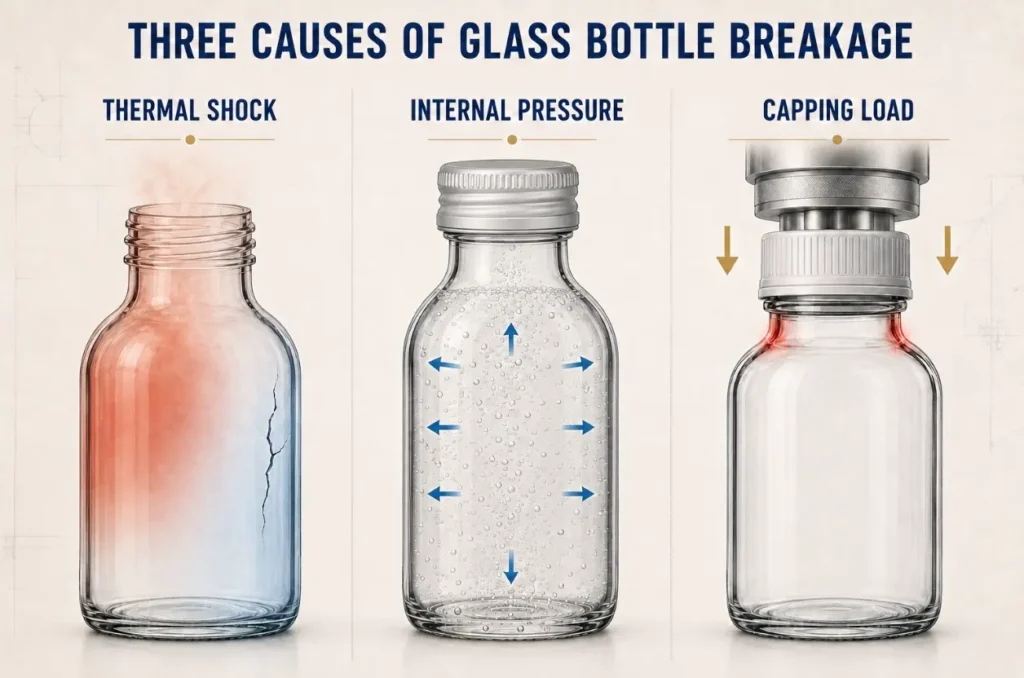
Yes. Thermal shock can occur when different parts of a glass bottle change temperature too quickly or unevenly.
The risk is not determined by the product temperature alone. The starting bottle temperature, rinse temperature, filling temperature, holding conditions and cooling method all matter.
A bottle taken from a cold warehouse may respond differently from a bottle that has been gradually conditioned before hot filling.
A hot bottle may also fail if it is suddenly exposed to cold rinse water or aggressive cooling.
This does not mean every hot-filled bottle will break. It means the complete temperature sequence must match the bottle’s validated performance.
ISO 7459:2004 describes test methods for evaluating the thermal shock resistance and thermal shock endurance of glass containers.
The standard does not establish one universal safe temperature difference for every bottle. The suitable test conditions depend on the container design and intended application.
Buyers should provide the actual filling temperature, starting bottle temperature, rinse conditions and cooling process before selecting a bottle.
Our comparison of hot-fill and cold-fill glass bottles explains why containers that look similar may perform differently under different filling conditions.
Can Filling Pressure or Vertical Load Break a Bottle?
Some filling systems place pressure inside the container. Others apply external force through support plates, lifting platforms, filling heads or closure equipment.
The relevant risk depends on the product.
A carbonated beer or sparkling beverage bottle must tolerate the internal pressure associated with its validated filling and handling conditions. A still wine or spirits bottle may face less internal pressure but still experience mechanical loading at the filling head.
ISO 7458:2004 describes methods for testing the internal pressure resistance of glass containers.
A pressure test should reflect the actual bottle and product application. A bottle should not be treated as suitable for carbonation simply because it looks thick or heavy.
Vertical loading is different. It refers to force applied along the bottle’s vertical axis.
This type of stress can arise when equipment presses down on the finish or when the bottle is supported incorrectly during filling and capping.
ISO 8113:2004 describes a method for determining the resistance of glass containers to vertical load.
A bottle may pass a general visual inspection and still fail if the equipment applies force unevenly or the contact surface is misaligned.
Why Do Bottles Break at the Capping Station?
Bottle breakage during capping often involves the relationship between the bottle finish, closure, machine settings and existing glass condition.
The approximate cap diameter alone is not enough to confirm compatibility.
The thread profile, finish height, sealing surface, liner, closure material and application method must also be considered.
A closure that appears to fit loosely during a manual check may behave differently when an automated machine applies it at production speed.
Incorrect Neck and Closure Matching
A cap must match the bottle’s complete finish specification.
Two bottles may have similar openings but different thread designs, finish heights or sealing surfaces.
If the cap does not engage correctly, the machine may cross-thread the closure, apply uneven force or press against the wrong part of the finish.
Our guide to bottle neck size and neck finish explains why a nominal diameter does not confirm complete compatibility.
Excessive or Uneven Application Force
A tighter cap is not always a better seal.
Excessive application force can damage the closure, distort the liner, chip the finish or place too much stress on the bottle neck.
Insufficient force creates a different problem because the closure may not seal correctly.
The correct application range should be established for the actual bottle, closure, liner, product and machine. There is no single torque value that applies to every glass bottle.
Existing Finish Damage
A small chip or crack around the bottle opening can become more serious when a cap or cork is applied.
The problem may have originated during transportation, depalletizing, rinsing or earlier machine contact.
If multiple bottles break at the capper, inspect the incoming finishes as well as the closure head, alignment and application settings.
مجموعة جينغبو أغطية وأغطية الزجاجات الزجاجية page shows why the bottle and closure should be reviewed as one complete packaging system.
Are Bottle Defects Always Responsible for Filling-Line Breakage?
No. Bottle defects are one possible cause, but they are not the only explanation.
A weak area, thin spot, existing crack, damaged finish or unsuitable glass distribution can reduce the container’s ability to withstand normal production conditions.
However, a suitable bottle can also fail when the line uses incorrect change parts, excessive contact pressure or an unapproved temperature cycle.
The opposite situation is also possible. A damaged bottle may break on equipment that is otherwise correctly adjusted.
Assigning responsibility therefore requires evidence from both the bottle and the line.
The investigation should consider whether breakage is connected to one pallet, one production lot, one mold, one bottle shape, one machine station or one recent equipment adjustment.
If bottles from different suppliers break at the same location after a speed increase, the machine setup deserves immediate attention.
If failures are concentrated in one batch while the same line runs other batches successfully, the incoming containers deserve closer examination.
Neither pattern proves the cause by itself. The bottle supplier, filling company and quality team need to review the available evidence together.
How Do You Diagnose Glass Bottle Breakage on Filling Lines?
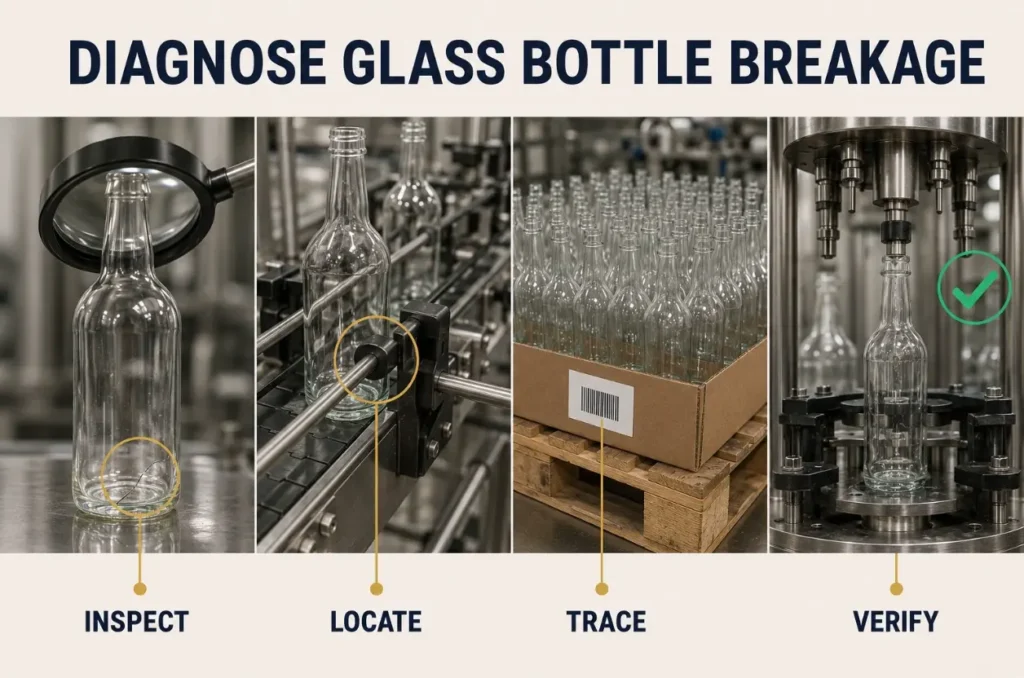
A useful investigation begins with the failure location, timing and repeat pattern.
Instead of asking whether the bottle is simply “too weak,” identify the part of the container that failed and the conditions present at that moment.
| Breakage Pattern | Possible Cause | What to Check |
|---|---|---|
| Heel or base damage near the conveyor infeed | Bottle collisions, hard transfer points or damaged guide rails | Conveyor spacing, transfer timing, contact surfaces and incoming pallet condition |
| Shoulder damage near a star wheel or filling head | Incorrect change parts, poor centering or bottle-to-bottle contact | Bottle dimensions, star-wheel fit, guide alignment and equipment clearance |
| Cracks appearing during rinsing or hot filling | Temperature change, uneven heating or existing surface damage | Bottle temperature, rinse temperature, filling conditions and thermal test data |
| Bottle bursting during a pressurized filling process | Unsuitable pressure conditions or insufficient container resistance | Product pressure, filling settings, bottle specification and pressure-test results |
| Finish or neck damage during capping | Mismatched closure, excessive load, poor alignment or existing finish damage | Neck finish, liner, cap fit, capping head and application settings |
| Failures concentrated in one pallet or production lot | Transport damage, handling problems or a batch-specific issue | Pallet condition, shipment records, mold identification and incoming inspection |
| Breakage after a line-speed increase | Higher impact, accumulation pressure or unstable bottle movement | Conveyor balance, machine synchronization, spacing and changeover records |
The table identifies areas to investigate. It does not replace a physical inspection or confirm the cause of an individual failure.
Record the Exact Failure Position
Document the station where the bottle broke and the part of the bottle that failed.
A heel fracture, damaged finish and cracked shoulder point to different investigation paths.
Photographs are useful when taken before the affected equipment is adjusted or the broken container is discarded.
The record should also identify whether the bottle was empty, being filled, already filled or being capped.
Compare Incoming Bottles With Bottles From the Line
Inspect unopened packaging from the same shipment.
Then compare those bottles with containers collected immediately before the suspected machine station.
If the incoming bottles are undamaged but the same marks appear after a specific transfer point, the equipment may be creating the problem.
If similar damage is already visible inside unopened cartons, transportation or incoming packaging should be investigated.
Review Recent Changes
Breakage often follows a change in bottle shape, supplier, closure, filling temperature, machine speed or production setup.
A new bottle may have the same capacity as the previous design but different height, shoulder width, base diameter or finish position.
A new closure may require different application settings.
A recent maintenance adjustment may also change the timing between conveyors, star wheels or filling heads.
The investigation should identify what changed before the problem began.
Preserve Batch and Mold Traceability
Record the production lot, pallet number and any relevant mold identification.
If breakage appears repeatedly in one production group, the supplier may need to review manufacturing records, glass distribution, inspection results or shipment handling.
If the failures occur across several unrelated batches, the line conditions may be more relevant.
Traceability does not establish responsibility by itself. It allows the investigation to move beyond assumptions.
What Should a Filling Plant Do When a Bottle Breaks?
A broken glass bottle creates more than a packaging loss.
Fragments may reach neighboring bottles, machine surfaces, conveyors or nearby product. The appropriate response depends on the product, process and facility’s approved glass-breakage procedure.
The first step is to stop the affected operation and prevent additional containers from entering the risk area.
The surrounding product should then be isolated according to the facility’s established procedure. Trained personnel should inspect the equipment and remove glass fragments using the approved cleaning and verification process.
The line should not restart until the responsible quality or production team confirms that the affected area has been cleared.
الـ FDA’s Juice HACCP Hazards and Controls Guidance identifies transportation damage, mechanical handling, filling, capping and thermal shock as potential causes of glass contamination.
The guidance also discusses stopping the line, removing broken glass and holding potentially affected product when broken glass is found at a relevant control point.
These recommendations are presented within the context of juice processing. Other products and facilities should follow the requirements and risk controls applicable to their own operations.
A quick cleanup without documented inspection may allow the same problem to happen again.
The incident should be recorded, the likely cause investigated and the corrective action verified before normal production resumes.
How Can Buyers Prevent Glass Bottle Breakage Before Production?
The best prevention begins before a bulk order enters the filling facility.
A bottle should be approved for the actual product, closure, equipment and handling conditions rather than selected only from a product photograph.
Confirm the Complete Bottle Specification
The approved drawing should identify the bottle height, body dimensions, base contact area, neck finish and relevant tolerances.
A bottle with unusual shoulders, a narrow base or a non-round body may require additional review.
The filling company should confirm whether the design works with its existing conveyor guides, star wheels, grippers, support plates and capping equipment.
When a new bottle shape requires a dedicated mold, تطوير قوالب زجاجية مخصصة للزجاجات should include a discussion of filling-line restrictions before the design is finalized.
Run a Representative Line Trial
A successful hand-filled sample does not guarantee successful automated filling.
The most useful trial uses the actual bottle, intended closure, planned product conditions and relevant machine setup.
The test should include normal bottle movement through rinsing, filling, closing and any downstream handling stage that may affect the container.
If the bottle is hot-filled or used for a carbonated product, the trial conditions should represent the intended process.
A short visual inspection alone cannot replace a practical production review.
Check Packaging and Incoming Handling
The bottle must reach the filler in suitable condition.
Dividers, cartons, pallets and wrapping should limit movement during transportation and unloading.
The appropriate method depends on the bottle shape, surface finish, order quantity and handling equipment at the destination.
مجموعة جينغبو glass bottle packaging solutions explain the practical differences between divider cartons, pallet packing and cartons secured on pallets.
Incoming inspection should focus on damage patterns, pallet condition and visible glass fragments rather than only counting the delivered quantity.
Match the Closure Before Bulk Production
The bottle and closure should be approved together.
Confirm the finish design, closure dimensions, liner, sealing surface and planned application method before placing a large order.
A closure that performs well during manual sampling may still need adjustment on an automated capper.
Any change to the cap supplier, liner material or application equipment should trigger another compatibility review when the change could affect performance.
Define Relevant Performance Tests
The required tests depend on the product and filling process.
A hot-filled bottle may require thermal shock evaluation. A carbonated bottle may require internal pressure testing. A bottle exposed to significant machine loading may need an appropriate vertical-load assessment.
Not every bottle needs the same testing program.
The manufacturer, buyer, filler and any relevant laboratory should agree on the performance requirements before production begins.
Maintain Change Control
A repeat order should match the previously approved specification.
Changes to bottle weight, wall distribution, neck finish, closure, carton design or filling-line setup can alter performance even when the bottle looks similar.
If a supplier introduces a design adjustment, the filling company should understand the change before the new bottles enter production.
The same principle applies to machine changes. New guide rails, higher line speeds or different capping heads may require another trial.
الأسئلة الشائعة
Does Filling-Line Breakage Always Mean the Bottles Are Defective?
No. Breakage can result from bottle defects, transportation damage, incorrect equipment settings, unsuitable temperature changes or closure problems.
The cause should be investigated using the fracture location, production conditions, incoming bottle condition and batch information.
Can a Bottle Break Later After a Small Earlier Impact?
Yes. A bottle may receive surface damage at one stage and fail later when it experiences filling pressure, temperature change or capping load.
The station where the bottle breaks is not always the location where the original damage occurred.
Can Lightweight Glass Bottles Run on Automated Filling Lines?
Yes, if the bottle has been properly designed, produced, handled and validated for the intended equipment.
Low weight alone does not determine whether a bottle is suitable. Glass distribution, bottle shape, surface condition, line settings and product requirements also matter.
Does Higher Capping Torque Prevent Leaks?
Not necessarily. Excessive application force can damage the closure, distort the liner or place unwanted stress on the bottle finish.
The correct setting depends on the specific bottle, closure, liner and machine.
Can Any Glass Bottle Be Used for Hot Filling?
No. The bottle must be suitable for the actual temperature conditions, including its starting temperature, product temperature and cooling method.
The closure and liner must also be appropriate for the intended process.
What Information Should Buyers Provide Before Ordering Bottles?
Buyers should identify the product, bottle capacity, filling method, closure type, expected temperature conditions and any relevant pressure requirements.
They should also provide the bottle dimensions, equipment restrictions and order quantity when these details are available.
What Is the First Step After a Bottle Breaks on the Line?
Stop the affected operation and follow the facility’s approved glass-breakage procedure.
Potentially affected products should be isolated, the equipment should be inspected and the line should restart only after the responsible team confirms that it is safe to do so.
الخاتمة
Glass bottle breakage on filling lines can result from mechanical impact, unsuitable handling, thermal shock, internal pressure, closure problems or existing container damage.
The most effective investigation identifies where the bottle failed, what changed and whether the problem originated in the bottle, packaging, transportation or production equipment.
Jingbo Group can help review bottle dimensions, neck finishes, compatible closures, custom designs and export packaging before bulk production. Share your bottle requirements and filling conditions so the complete packaging system can be evaluated together.