
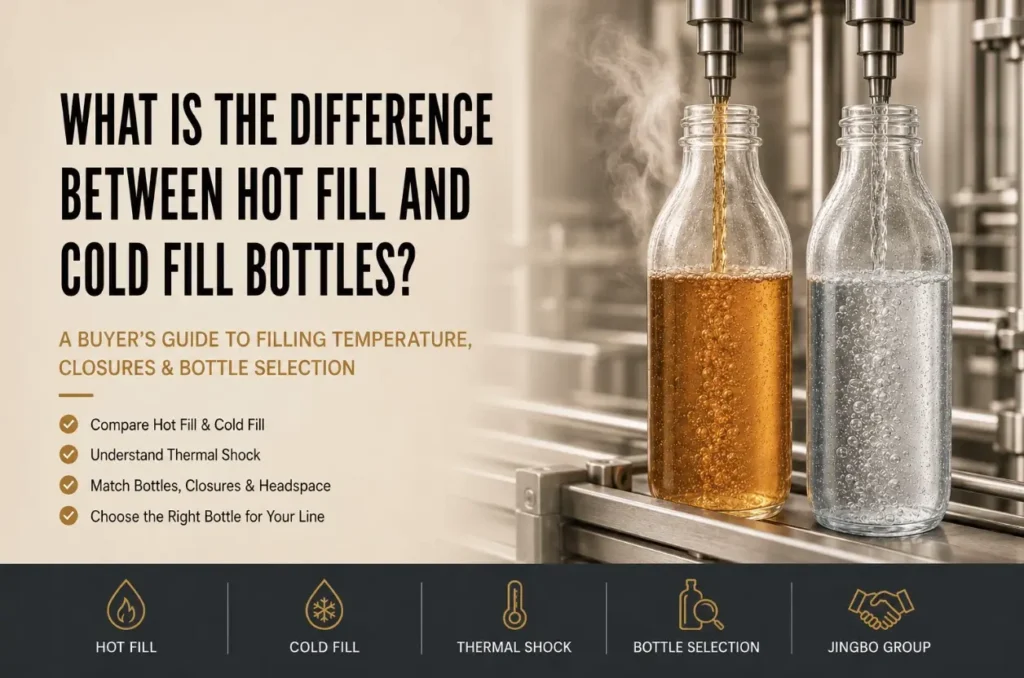
Hot fill and cold fill bottles are selected for different filling conditions. A hot-fill glass bottle must withstand hot product entering the container and the temperature changes that follow. A cold-fill bottle faces less immediate thermal stress, but it must still match the product, closure, filling line, storage conditions, and any later pressure or heat treatment.
For a bottle buyer, the important question is not simply whether a catalog calls a bottle “hot fill” or “cold fill.” The real question is whether the bottle and closure can work with the actual production process. Two empty bottles may look almost identical while performing differently on the filling line.
What Is the Main Difference Between Hot Fill and Cold Fill Bottles?
In hot filling, the product is heated before it enters the bottle. The bottle is filled, closed, held as required by the process, and then cooled. The complete package must tolerate this temperature cycle without cracking, leaking, or losing its seal.
In cold filling, the product enters the bottle at a lower temperature. The fill itself does not provide the same heat treatment to the inside of the package. Product safety and shelf life must therefore depend on other validated controls, such as refrigeration, formulation, a cold-fill-and-hold process, or aseptic processing.
| What the Buyer Must Compare | Hot-Fill Bottle | Cold-Fill Bottle |
|---|---|---|
| Product at filling | Heated | Ambient or chilled |
| Main package concern | Thermal shock during filling and cooling | Product compatibility, hygiene, pressure, and any separate treatment |
| الختام | Must tolerate heat and maintain the seal during cooling | Must match the product, line, pressure, storage, and sanitation method |
| Headspace | Allows for hot-product expansion and cooling contraction | Depends on fill accuracy, foaming, gas, pressure, and storage |
| Information needed | Fill temperature, bottle temperature, hold, cooling, and closure | Fill conditions, sanitation, pressure, storage, and closure |
The food producer and its process authority establish the required safety process. The bottle supplier then evaluates the package against those known conditions.
What Must a Hot-Fill Glass Bottle Handle?
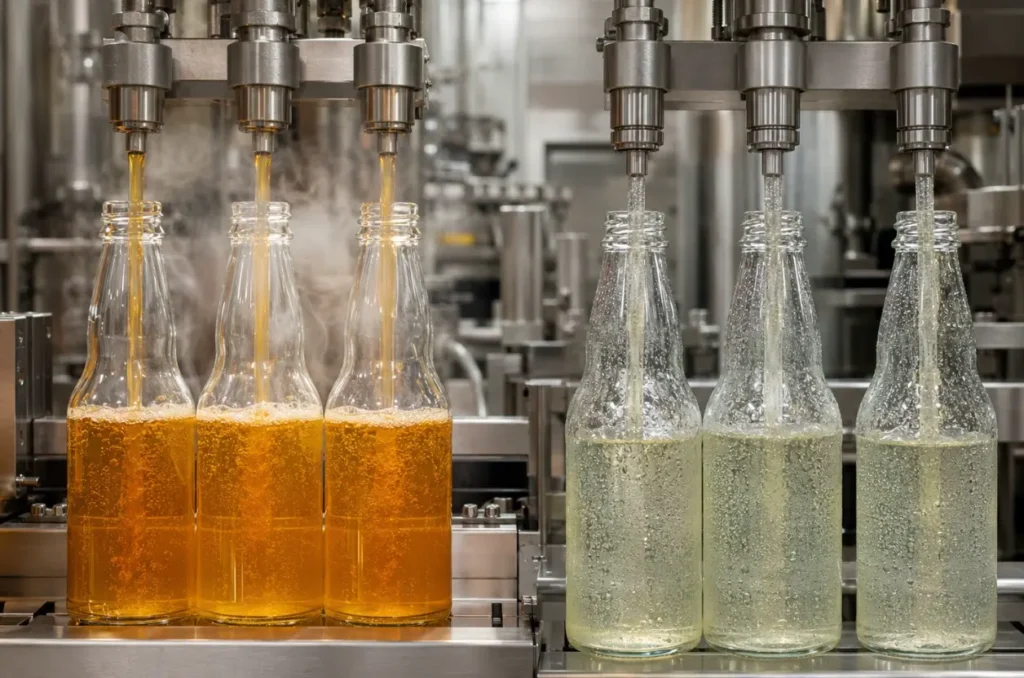
A hot-fill bottle must perform through filling, closing, holding, and cooling. Each stage can affect the glass, closure, and seal.
The Temperature Difference
Glass can handle heat when the temperature change is controlled. The greater risk is a rapid difference between the hot product and a cooler bottle.
When hot liquid enters cold glass, the inner surface heats and expands first. Rapid cooling can reverse the stress. Cracking may occur at the base, body, shoulder, or neck. Buyers should therefore provide both the fill temperature and the lowest expected bottle temperature before filling. The fill temperature alone does not describe the thermal shock.
Bottle shape, glass distribution, annealing, scratches, and handling damage also affect performance. A heavier bottle is not automatically safer. ASTM C149 covers thermal shock testing for commercial glass containers used in processes such as hot packing and pasteurization, but it does not give one universal hot-fill temperature for every bottle.
The Closure and Cooling Vacuum
The bottle finish, cap, and liner must work together at the actual application temperature. As the product cools, its volume decreases and may create a vacuum. The closure must maintain the seal through that change.
A suitable glass body with the wrong neck finish, cap, liner, or application setting can still leak. The bottle and closure should therefore be evaluated as one package.
The Headspace and Fill Level
Hot liquid expands and then contracts as it cools. The bottle needs enough headspace for this change while meeting the target fill volume and fill height.
Nominal capacity and maximum internal volume are not the same. Buyers should compare the required fill with the bottle’s overflow capacity, closure position, and target headspace. External dimensions alone cannot answer this question.
The University of Minnesota Extension also states that containers used for hot-fill hold must be designed for the process. Its hot-fill-hold guidance shows why the container and lid must be considered together.
What Must a Cold-Fill Bottle Handle?
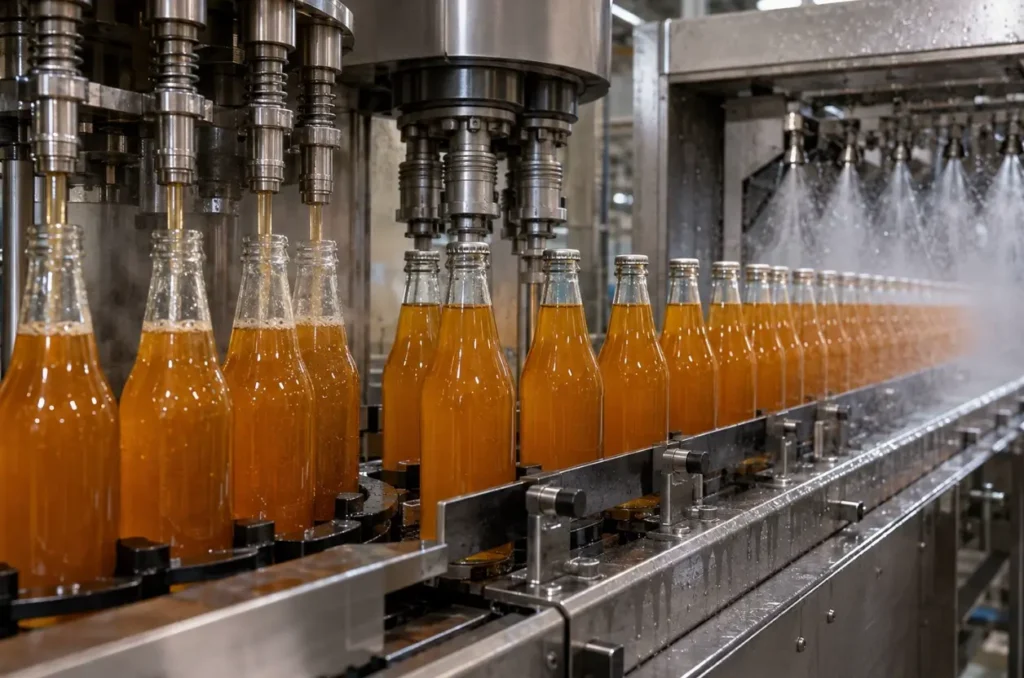
Cold filling creates less immediate thermal shock, but the bottle still has to match the product and the full production line.
A still product filled at ambient temperature may mainly require product compatibility, accurate filling, and reliable sealing. A carbonated drink also needs pressure resistance. A package that is tunnel-pasteurized after closing must withstand heat even if it was initially cold-filled.
Cold filling is not one preservation method. “Cold Fill and Hold” has a narrower meaning for certain validated acidified-food processes. Aseptic cold filling is different again: the product and package receive their required treatments separately before filling and sealing under controlled conditions. The FDA’s guide to aseptic processing and packaging explains why package sterilization is a critical part of an aseptic system.
Can the Same Glass Bottle Be Used for Hot Fill and Cold Fill?
A glass bottle designed and tested for hot filling can often also be used for a still product filled at a lower temperature. However, the bottle capacity, neck finish, closure, and dimensions must still match the cold-filling line.
A bottle used only for cold filling should not automatically be used for hot filling. It may not be able to withstand the sudden temperature change when hot product enters the bottle or the cooling process that follows. Bottle shape, wall thickness, or appearance alone cannot confirm hot-fill suitability.
Carbonated products and in-package pasteurization also require separate evaluation because they expose the bottle to internal pressure or additional temperature changes. Jingbo Group can review the intended filling process, recommend a suitable existing bottle, and provide bottle and closure samples for line testing. The complete package should be confirmed under actual production conditions before mass production.
What Should You Tell Your Bottle Supplier?
You do not need to prepare a detailed technical report. Simply tell the supplier what product you will fill, whether it is still or carbonated, the required volume, the approximate filling temperature, and the closure you plan to use. You should also mention whether the filled bottle will be inverted, cooled in water, pasteurized, refrigerated, or exposed to another special process.
If you already have a filling line, you can provide the permitted bottle height and diameter. A photo, drawing, or sample of your current bottle and closure can also help.
Based on this information, Jingbo Group can evaluate the required capacity, bottle dimensions, neck finish, closure, and filling conditions. We first check whether an existing bottle can meet the project requirements. If no suitable design is available, we can develop a custom bottle and mold. Final bottle and closure samples can then be tested on the customer’s filling line before mass production.ter that its capacity, neck finish, closure, or thermal performance does not fit production.
How Does Jingbo Group Match Bottles to the Filling Process?
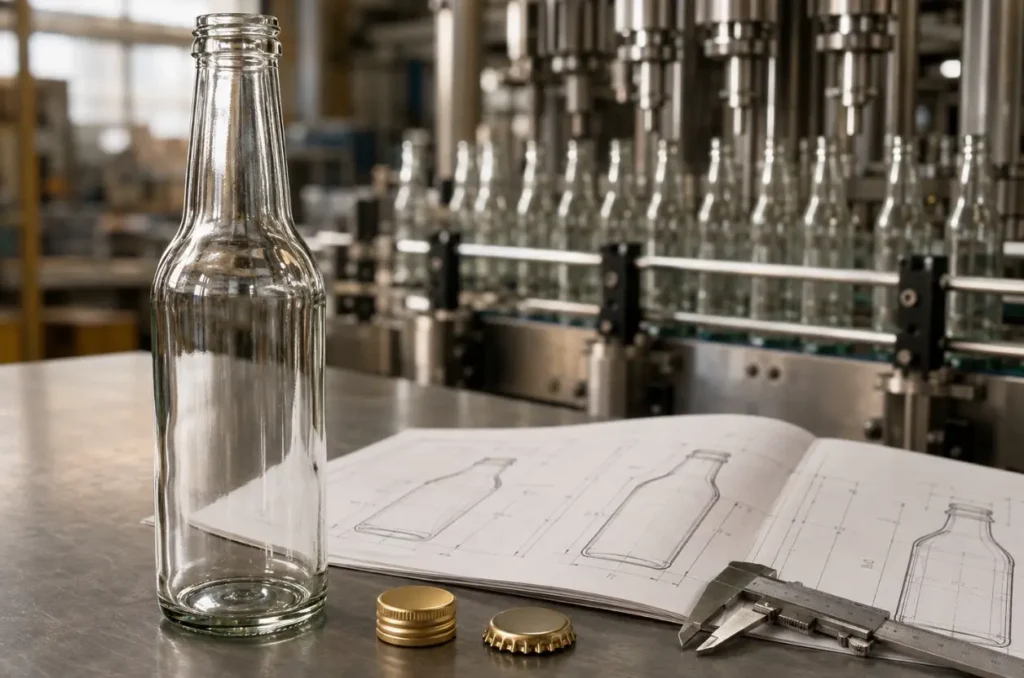
Jingbo Group uses two sourcing routes: selecting an existing bottle or developing a custom bottle. Instead of asking the buyer to source the bottle, closure, and export packing as separate purchases, we review them as one packaging project. We do not treat a catalog label such as “hot-fill bottle” as enough information for approval.
Start With an Existing Bottle When It Fits
For a faster launch, a market test, or a project that needs to control development cost, Jingbo Group can first compare the required capacity, overflow capacity, dimensions, neck finish, closure, and filling conditions with existing bottle and jar designs.
If an existing option fits, the buyer can avoid unnecessary mold development. Stock availability and the final order requirement still need to be confirmed for the selected model.
Develop a Custom Bottle When Existing Options Do Not Fit
Custom bottle becomes useful when the project needs a different shape, capacity relationship, fill height, neck finish, labeling area, or brand appearance.
Jingbo Group can support 3D bottle design, engineering review, mold development, and sample confirmation. The sample can then be checked with the intended closure and tested by the customer on the actual filling line before mass production.
Match the Bottle, Closure, and Export Packing
Jingbo Group can coordinate the glass bottle with a compatible closure and prepare the empty containers for export delivery. This reduces the risk of treating the bottle, cap, and packing as unrelated purchases.
The functional package should be confirmed before decoration is finalized. Buyers can review our glass bottle customization services to see how design, mold, closures, decoration, and packing connect within one project.
Jingbo Group evaluates the packaging conditions provided by the buyer. The producer, filling plant, and qualified process authority remain responsible for validating the food-safety process. This keeps the packaging decision and the product-safety decision clear.
الأسئلة الشائعة
Can Any Glass Bottle Be Used for Hot Filling?
No. The bottle must match the fill temperature, starting bottle temperature, hold, cooling, closure, and line conditions. A general temperature claim cannot approve every bottle shape.
Does Cold Filling Always Mean Refrigerated Storage?
No. Some products require refrigeration, while others use a validated formulation, cold-fill-and-hold method, or aseptic process. Cold filling alone does not determine shelf life.
Is Hot Filling the Same as Pasteurizing a Sealed Bottle?
No. Hot filling places heated product into the container. In-package pasteurization heats the filled and closed package. A cold-filled bottle may therefore still need thermal-shock performance if it is pasteurized later.
Are Thicker Glass Bottles Better for Hot Fill?
Not automatically. Glass distribution, shape, annealing, surface condition, and controlled temperature changes matter more than weight alone.
الخاتمة
Hot fill and cold fill bottles differ because they face different production conditions, not because they always have different shapes. The right choice depends on the actual temperature cycle, product, closure, headspace, pressure, equipment, and later treatment.
Jingbo Group can first compare these requirements with existing bottles and jars. If no existing option fits, we can move the project into custom design, mold development, closure matching, and sample confirmation. Send the product, fill volume, fill temperature, bottle temperature, closure, line limits, and any cooling or pasteurization details so our team can recommend the right starting route.