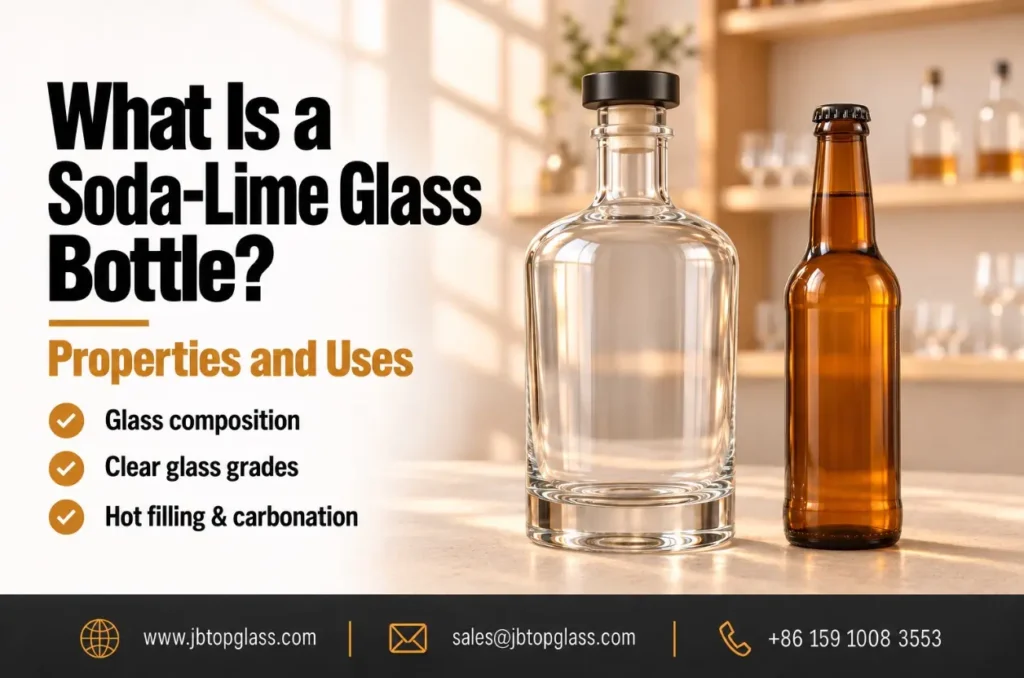
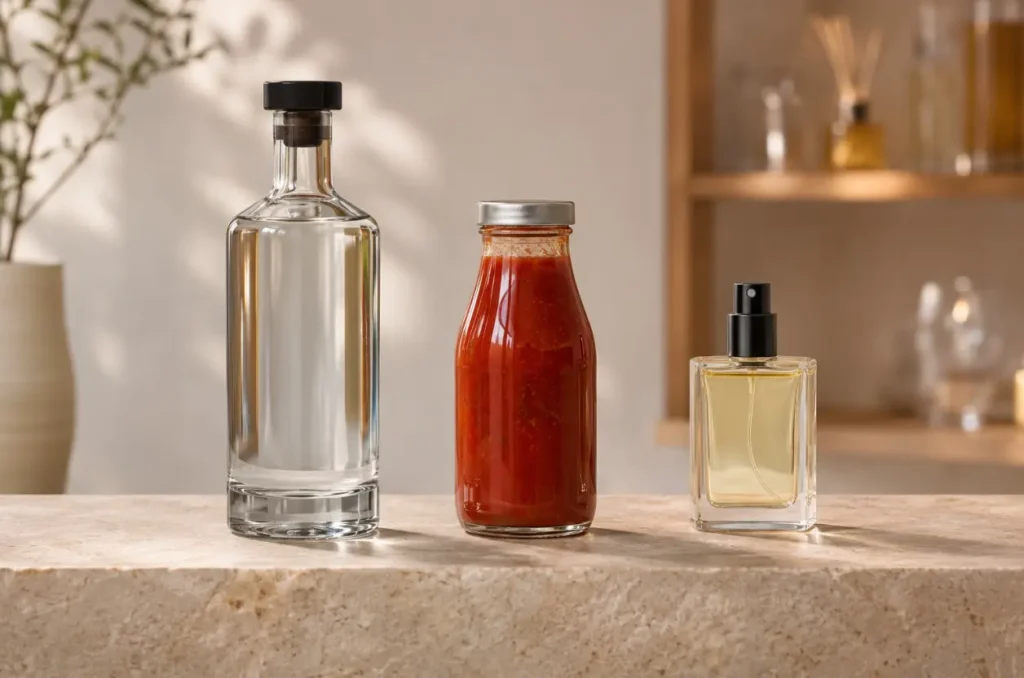
Soda-lime glass is widely used for spirits, sauces, and perfume bottles. When you choose a bottle, the glass grade affects how clear it looks, and the bottle design needs to suit your product and filling process. This guide explains what soda-lime glass is made of, how Crystal White, High White, and Ordinary White differ, and what to check when choosing a bottle for your product.
What Is a Soda-Lime Glass Bottle?
A soda-lime glass bottle is a container made from glass whose main components are silica, sodium oxide, and calcium oxide. You may also see it called soda-lime-silica glass on a bottle specification.
The glass can be clear or colored, and the mold gives the bottle its shape. A square spirits bottle with a heavy base and a slim beverage bottle with rounded shoulders can therefore be made from the same type of glass. If you like the look of a bottle but need a different capacity or shape, you can develop a new design using the same glass material.
Two bottles made from soda-lime glass can also differ in how much internal pressure they withstand. That depends in part on the shape and how the glass is distributed through the walls and base.
What Are Soda-Lime Glass Bottles Made Of?
Silica sand, soda ash, and limestone supply the main components. Sand provides the silica that forms the glass structure. Soda ash helps the batch melt at a lower temperature than silica would on its own. Limestone adds calcium oxide, which helps the finished glass hold up during contact with liquids.
| Raw material | What it contributes | Why it’s used |
|---|---|---|
| Sable siliceux | Silica | Forms the main structure of the glass |
| Carbonate de sodium | Sodium oxide | Permet au mélange de fondre à une température plus basse |
| Calcaire | Calcium oxide | Improves the chemical durability of the glass |
| Débris de verre | Crushed glass ready to be remelted | Replaces part of the fresh raw material batch |
| Colorants and other additives | Components used to adjust the formulation | Help control color and other characteristics of the glass |
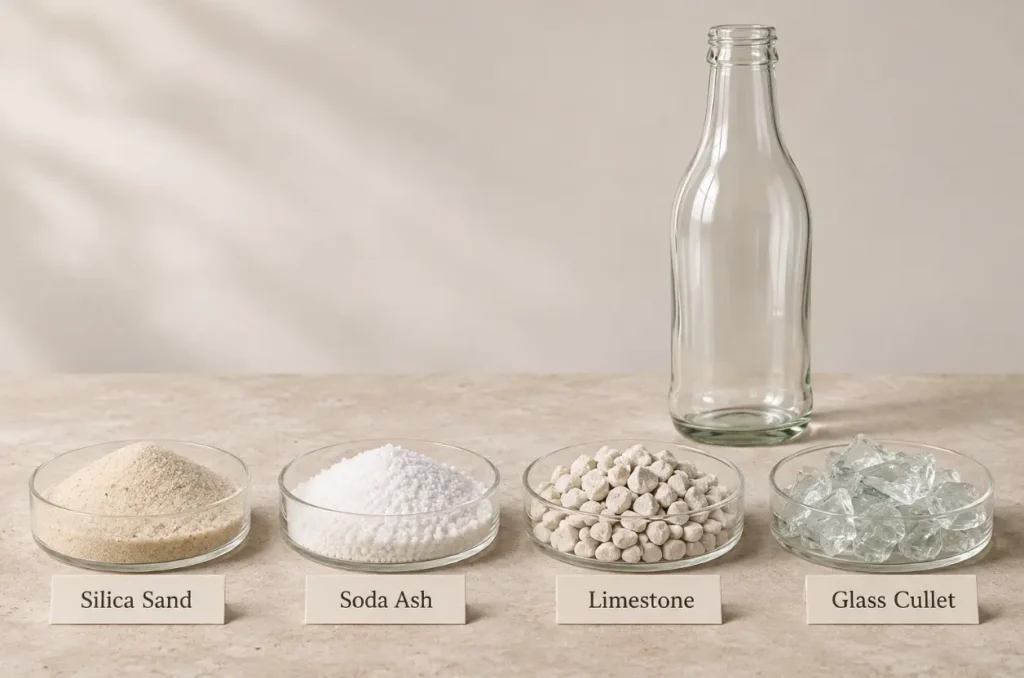
The raw materials react during melting and become part of a single glass structure. Cullet already contains glass-forming components, so manufacturers can melt it with the fresh ingredients.
Small amounts of iron in the raw materials can give clear bottle glass a green or blue-green tint. You might barely see it through a thin sidewall but notice it straight away in a thick base. That’s where the grade of clear glass starts to matter.
What Are the Grades of Clear Soda-Lime Glass?
Jingbo Group’s three grades of clear bottle glass are Crystal White, High White, and Ordinary White. You may also see the corresponding trade terms super flint, high flint, and standard flint. All three grades are transparent soda-lime glass. In these names, white describes how close the glass looks to colorless.
| Clear glass grade | Typical iron content in our material reference | How it looks in a bottle | Common uses |
|---|---|---|---|
| Crystal White (super flint) | Below 0.02% | Nearly colorless, with very little visible green tint | Premium perfume, cosmetics, spirits, and food bottles |
| High White (high flint) | About 0.03%–0.08% | Bright and clear, with a slight cool tint that may show in thicker areas | Spirits, premium beverages, and condiment bottles |
| Ordinary White (standard flint) | About 0.1%–0.3% | Transparent, with a more visible green or blue-green tint | Everyday beverage bottles, food jars, and bottles where a slight tint is acceptable |
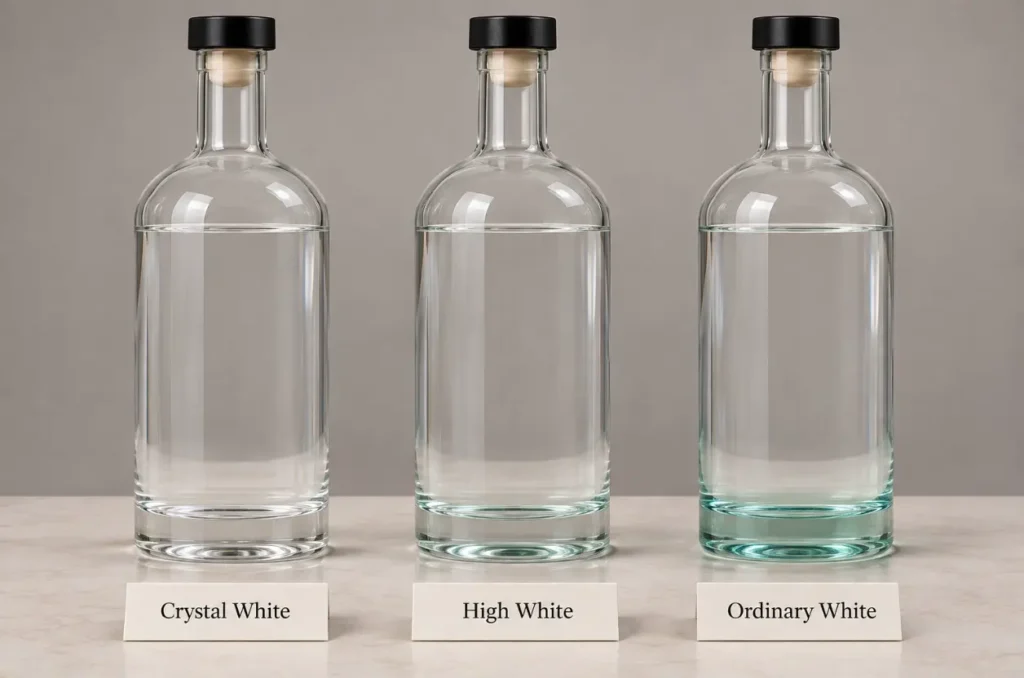
The iron content ranges are reference values. If you need to specify a maximum iron content, check how it is reported on the material specification. If you’re choosing a grade for its appearance, compare finished bottles of the same shape and glass thickness under the same light. A slight tint can be easy to miss through the sidewall and more visible through a thick base.
Say you’re developing a 750 mL vodka bottle with a thick base. Fill a High White sample and a Crystal White sample with the same spirit. Look at them under the lighting where the bottle will be displayed, paying particular attention to the exposed glass below the label. If the High White base looks clear enough for your design, you can approve that sample as the reference for production. If you want the base to look closer to colorless, the Crystal White sample lets you see how much difference the change makes. For more on how glass thickness affects what you see, see our guide to flint glass grades.
Why Are Soda-Lime Glass Bottles Widely Used for Packaging?
The Glass Wall Keeps Oxygen Out
An intact glass wall provides a barrier to oxygen and water vapor under normal storage conditions. If you bottle juice, for example, oxygen can already be present inside the bottle at filling or enter through a poor seal. The wall itself keeps oxygen in the surrounding air from passing through the glass. The Food Packaging Forum’s glass packaging factsheet explains how the wall and closure contribute to the finished package.
The Glass Holds Up in Contact With Many Products
Chemical durability describes how well the glass surface holds up when it stays in contact with a liquid. Soda-lime glass has the durability needed for many products, including spirits, juices, and edible oils. Prolonged contact with strongly alkaline liquids or repeated exposure to high temperatures can be more demanding. In those cases, check how the glass holds up under the actual contact conditions.
You Can Build the Design Into the Bottle
Soda-lime glass can be shaped while hot. You can build features such as flat panels, rounded shoulders, and raised lettering into the bottle. If you want a logo you can feel, it can be formed in the mold. If you want it in a particular ink color, it can be printed afterward. With embossing, you approve the artwork as part of the mold design. With printing, you can review the artwork on a formed bottle.
It Works Well for Repeated Production Runs
Soda-lime glass uses widely available raw materials and flows well at the temperatures used to form bottles. That makes it practical to produce the same bottle design in repeated runs. The design affects how much work goes into each bottle. A heavy-base spirits bottle can use more glass than a lighter bottle of the same capacity. Frosting and printing add finishing steps after forming. The glass grade is one part of the cost, alongside the bottle weight and the decoration you choose.
What Are Soda-Lime Glass Bottles Used For?
Spirits and Wine
If your product is gin or vodka, a clear soda-lime glass bottle lets the liquid and the molded details show through. You can keep the front flat for a label and put the raised details on the sides. The 500 mL embossed glass liquor bottle shows this layout. You can use the same approach when developing a bottle in a different shape or capacity.
For wine, start with what the bottle needs to do. If light exposure is a concern for a still wine, consider a tinted bottle. For sparkling wine, choose a bottle designed for the pressure it will hold after filling. Both bottles can be made from soda-lime glass.
Food and Beverages
Soda-lime glass bottles are used for juice, vinegar, edible oil, and sauces. If shoppers need to see the color or texture of the product, clear glass gives them that view. The way the product pours can then guide the bottle shape. A narrow neck can work for a thin dressing, while a thicker sauce may need a wider opening to fill and pour easily.
Perfume, Cosmetics, and Home Fragrance
Perfume, cosmetic oils, and reed diffusers can all use clear soda-lime glass. The round-shoulder glass bottle range shows one shape used across cosmetic and home fragrance packaging. If you want the liquid color to show, leave the glass clear. If you plan to frost the bottle, review a filled sample so you can see how much of the liquid and its fill level will still be visible.
Once you’ve chosen the appearance, check what the finished bottle will face during filling and storage. For sparkling wine, that means checking internal pressure. For a hot-filled sauce, it means checking what happens when hot liquid enters a cooler bottle and when the bottle cools afterward. The clear glass grade describes the bottle’s appearance. To understand its response to heating and cooling, start with how the glass expands as its temperature changes.
Soda-Lime Glass Bottle vs. Borosilicate Glass Bottle
The difference you’re most likely to notice in use is how the two glasses respond to temperature changes. Common low-expansion borosilicate glass expands less as it heats up. If one part of the bottle heats faster than another, the difference in expansion is smaller, which generally means less stress in the glass.
| What to compare | Soda-lime glass bottle | Borosilicate glass bottle |
|---|---|---|
| Main components | Silica, sodium oxide, and calcium oxide | Silica with boron oxide as a main component |
| Thermal expansion | Generally expands more for the same temperature change | Common low-expansion grades expand less |
| Thermal shock resistance | More sensitive to sudden heating or cooling | Generally better under comparable conditions |
| Chemical durability | Suitable for many food, drink, and fragrance applications | Grades are available for more demanding chemical exposure |
| Common bottle applications | Food, beverages, spirits, cosmetics, and fragrances | Laboratory and other specialized applications |
A laboratory bottle may go through repeated heating and cooling. A sauce bottle may go through one hot-fill and cooling cycle and spend the rest of its time at room temperature. For that sauce bottle, check whether the specific soda-lime glass bottle can handle the cycle it will go through on your line.
Can Soda-Lime Glass Bottles Be Used for Hot Filling?
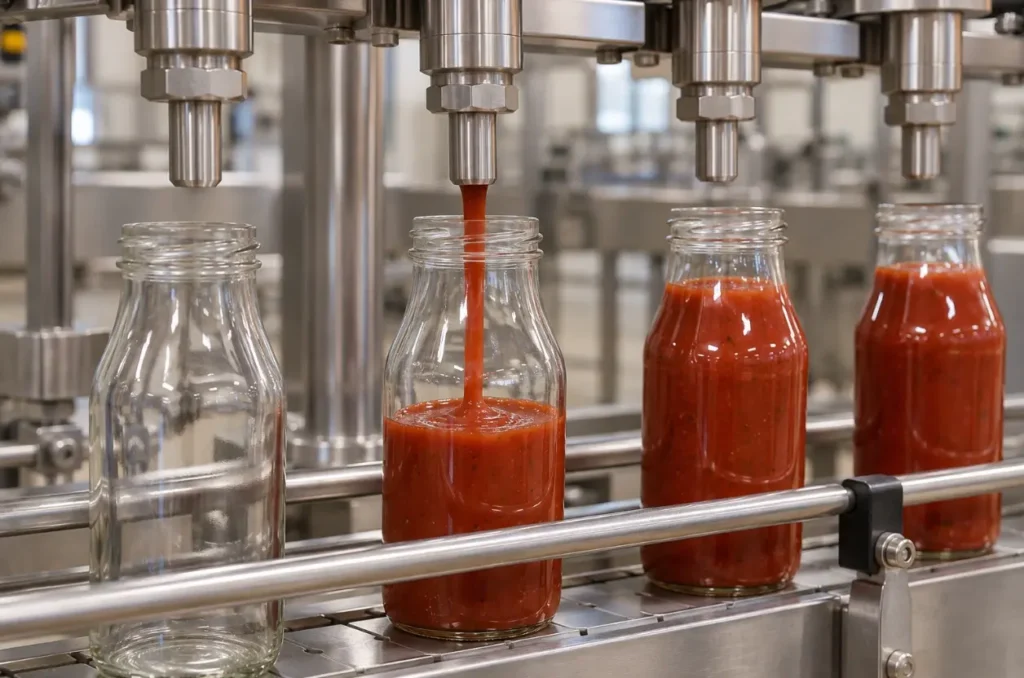
Yes. A soda-lime glass bottle can be used for hot filling if it has been tested for the temperatures and timing on your line. Start by measuring the temperature of the empty bottle and the temperature of the product just before it goes in.
When hot sauce enters a cool bottle, the inside of the glass warms and expands before the outside does. That uneven expansion puts the wall under stress. During rapid cooling, the outside can cool and contract while the inside is still warm. A sudden temperature change that creates this kind of stress is called thermal shock.
The same sauce at the same filling temperature can put more stress on a cold bottle than on one that has been warmed before filling. Cooling matters too. A bottle left to cool gradually and one moved straight into a cold water spray go through different temperature changes, even if both came off the same filler.
Foire aux questions
Are Soda-Lime Glass Bottles Safe for Food and Drinks?
Yes, when the finished bottle is suitable for the food or drink and meets the requirements where you sell it. Check that the documentation covers the bottle as supplied, including any decoration that could come into contact with the product. If you’re moving from an uncoated bottle to a decorated one, check whether your existing documentation covers the new version. For products sold in the EU, see the European Commission’s guidance on food-contact materials.
Can You Change From High White to Crystal White Without Changing the Bottle Shape?
Yes, provided the mold can run on a production line that makes Crystal White glass. The bottle can keep the same shape, capacity, and molded details when the glass grade changes. Check the mold and line combination before production. Then review a finished sample of the actual bottle, particularly if the design has a heavy base or raised details that make the glass color more visible.
Can You Use a Soda-Lime Glass Bottle for a Carbonated Drink?
Yes, if the bottle was designed and tested for the pressure your drink creates. Ask for pressure test results for the exact bottle you plan to use, especially if you’re switching from a still drink to a carbonated version. The ASTM C147 internal pressure test measures the strength of the glass container under pressure. You also need to check how the bottle and closure perform together under your filling and storage conditions.
What’s the Difference Between Annealed and Tempered Glass Bottles?
Most packaging bottles are annealed. After forming, the bottles pass through a controlled cooling stage that reduces stress in the glass. Thermal tempering uses a different cooling process to put the glass surface under compression. If your application calls for a tempered bottle, confirm the treatment for that particular model. You can see where annealing fits into glass bottle production in the manufacturing guide.
Does Amber Soda-Lime Glass Protect the Contents From Light?
Yes. Amber glass reduces the amount of light that reaches the contents. In one study of clear, green, and amber wine bottles, the amber sample offered the most shielding across the light ranges measured. The result depends on the glass shade and the wavelengths your product is sensitive to. If you’re comparing two amber bottles for the same drink, ask for light transmission data for the actual bottles.
Do Soda-Lime Glass Bottles Contain Recycled Glass?
They can. Manufacturers can remelt clean crushed glass, called cullet, with fresh raw materials to make new bottles. Cullet can come from scrap generated during production or from bottles collected after use. If you plan to state a percentage of post-consumer recycled glass on your label, ask for data that shows how much of the glass came from packaging collected after consumer use.
Conclusion
When you choose a soda-lime glass bottle, look at the glass grade in a finished sample, especially around the base. If your product is hot filled or carbonated, check how the bottle performs under the conditions it will face. For a custom glass bottle, share your reference, target capacity, preferred clarity, and estimated quantity with Groupe Jingbo. Once you approve the drawing, we can make glass samples for you to review before bulk production.