
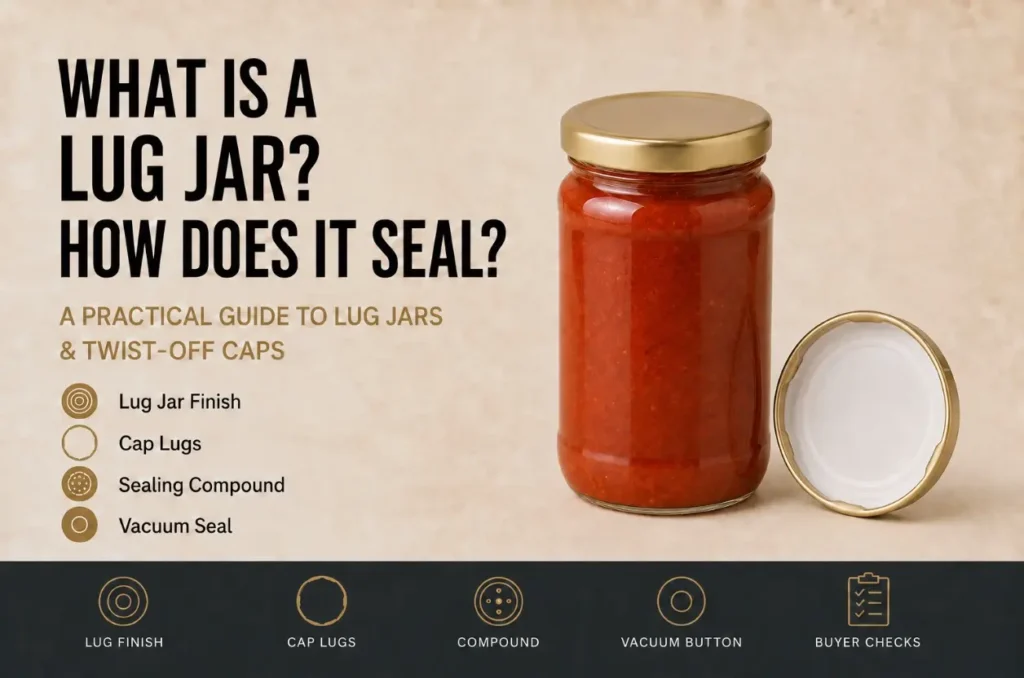
lug jar is a glass jar with several short, separated thread sections around its finish. These raised glass sections work with a matching metal twist-off closure. Because the threads are interrupted rather than continuous, the cap reaches its applied position after a relatively short turn. The exact turning angle depends on the closure and finish design.
Lugs are not separate pieces of metal and they do not project from the cap like external ears. They are shallow inward-formed areas along the curled lower edge of the metal skirt. When the cap is applied, these areas seat beneath the glass thread sections and hold the cap in position.
But the lugs are not the part that seals the product. The actual seal is formed where the gasket on the underside of the cap makes continuous contact with the glass sealing surface. In a vacuum-packed food product, the pressure difference inside the closed jar also helps keep the closure seated.
What Is a Lug Jar?
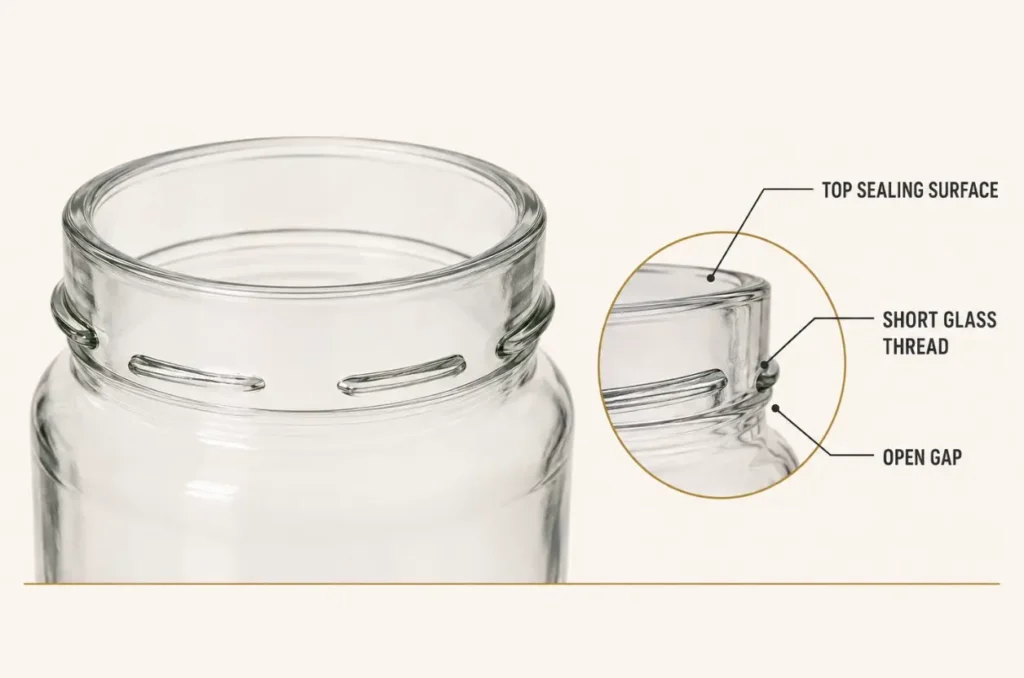
“Lug jar” describes the finish at the top of the jar, not the shape of its body. A round pasta sauce jar, a low jam jar and a tall pickle jar can all use a lug finish.
The finish has several short raised thread sections with open gaps between them. Their number, height, position and profile depend on the finish specification. A cap made for that finish is placed over the opening and turned until its lugs engage below the glass threads.
This is different from a continuous-thread finish, which has a helical thread that continues farther around the neck.
What Is a Lug Cap?
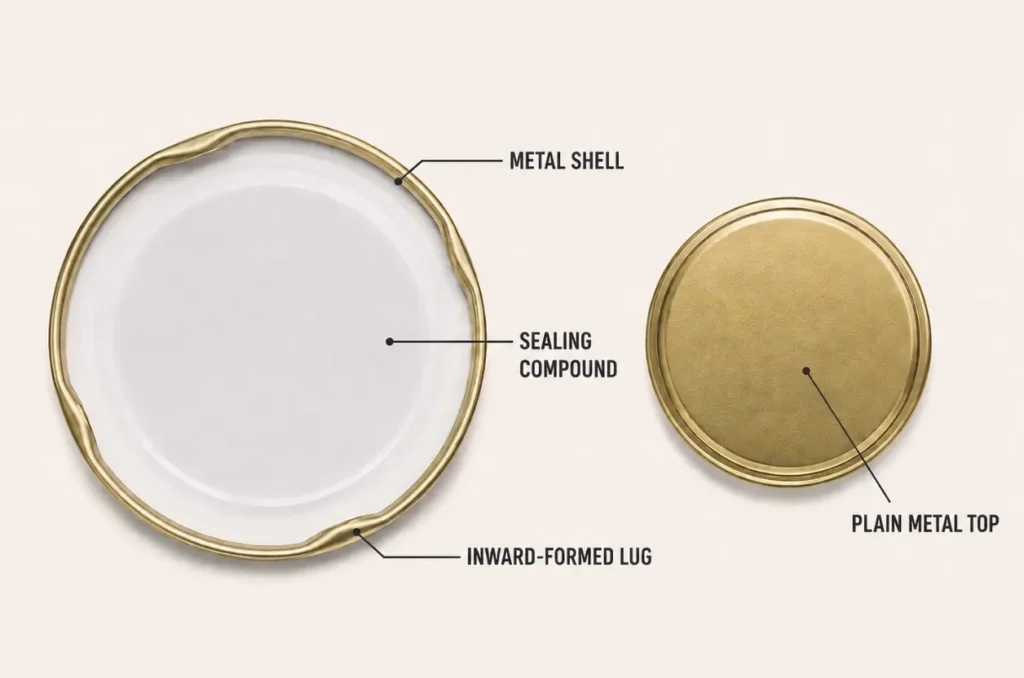
A lug cap is a twist-off metal closure designed for a compatible lug finish. It is typically made from a coated steel shell. The outside may be plain, printed or colored, but its appearance does not confirm its compatibility with a jar.
The cap shell has a top panel, a rounded shoulder, a vertical skirt and a curled lower edge. At several points around that curl, the metal is formed slightly inward. These shallow engagement points are the cap lugs. The FDA defines a lug as an inward protrusion from the curl that seats under the thread or lug on the glass finish and holds the cap in position in its guide to glass-container closures.
From the underside, the lugs may look like small changes in the shape of the curled edge. They are often much less noticeable than the gasket.
How Does a Lug Cap Seal a Glass Jar?
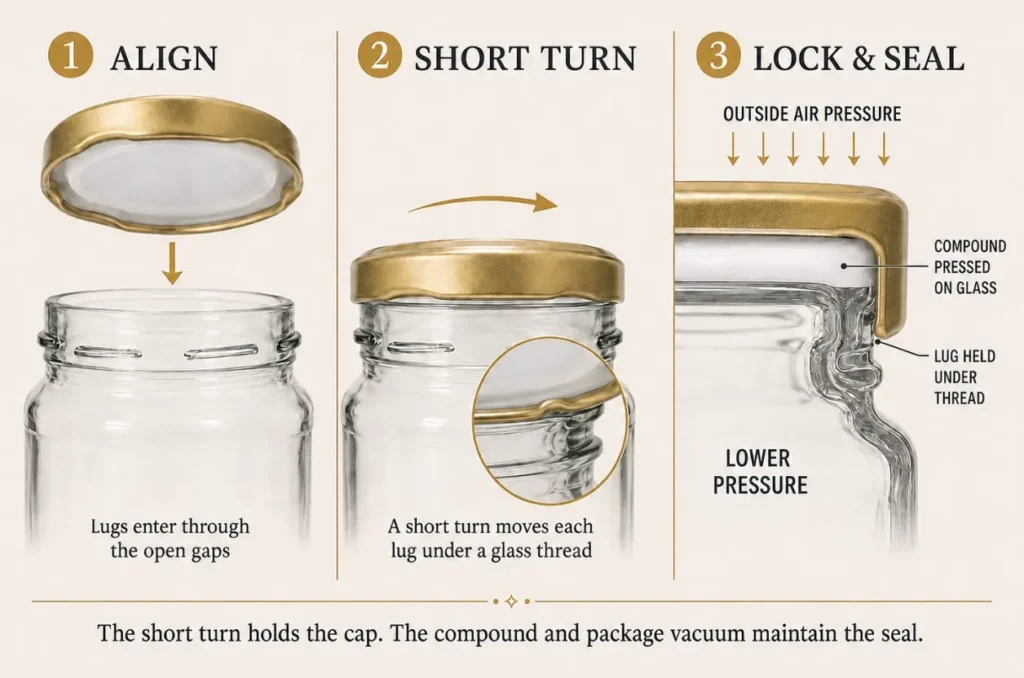
The closure works through mechanical engagement, gasket contact and, when the package is designed for it, vacuum.
First, the cap must sit level over the correct jar finish. As the cap turns, its shallow lugs travel beneath the matching glass thread sections. The geometry of the finish and the cap application move the closure into its specified seated position.
This engagement holds the cap on the jar and maintains its position. It does not seal the opening by itself. The seal is made by the gasket pressing continuously against the glass sealing surface at the top of the finish. A clean, undamaged surface and an even gasket impression are therefore essential.
In many commercial vacuum-packed foods, steam is used at the capper to displace part of the headspace air. When the trapped steam condenses and the product cools, pressure inside the package falls below outside atmospheric pressure. Some packages create vacuum by another controlled method. The resulting pressure difference helps hold the cap toward the jar.
FDA guidance for low-acid foods states that both the lugs and vacuum hold a lug closure in place, with vacuum playing the larger role in that type of vacuum package. This statement applies to a designed and controlled vacuum-packing process. A lug finish alone does not prove that a jar is vacuum sealed.
| Part of the Package | Main Function |
|---|---|
| Glass lug finish | Provides the sealing surface and the short thread sections used for engagement |
| Cap lugs | Seat below the glass threads and keep the closure in its applied position |
| Gasket | Makes continuous sealing contact with the glass finish |
| Package vacuum | Helps hold the closure toward the jar in a vacuum-designed package |
| Internal coating | Protects the metal and must be compatible with the product and process |
The seal is only reliable when all these elements are compatible and the cap is applied within the closure supplier’s specifications.
What Does the Button on a Lug Cap Mean?
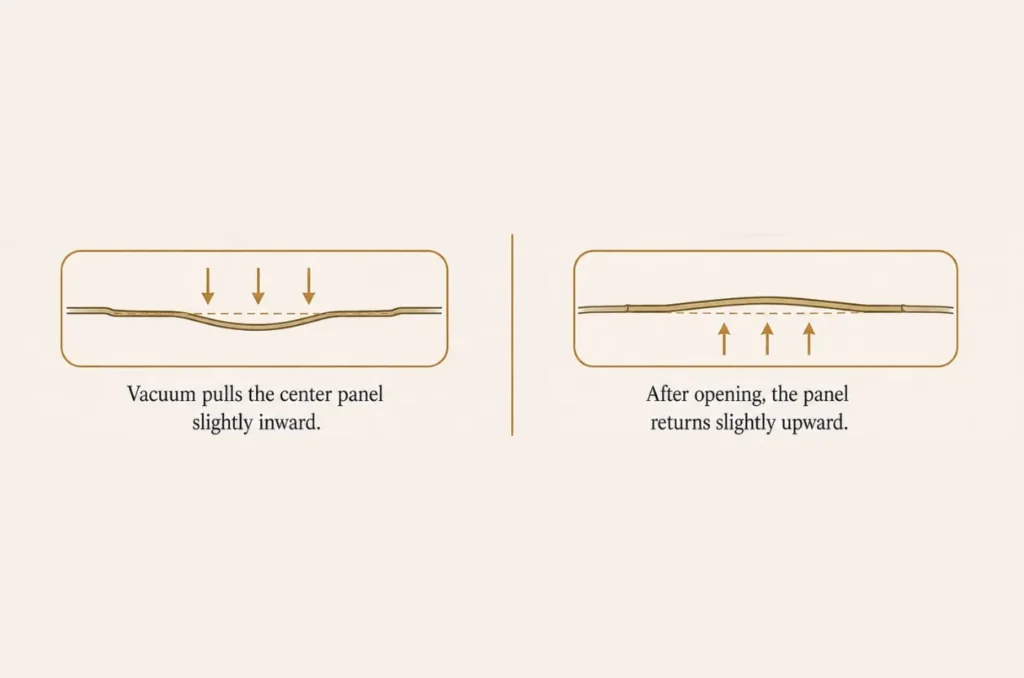
Some metal vacuum closures are manufactured with a vacuum safety button, also called a flip panel. It is a designed circular area in the center of the cap panel. When the package reaches the vacuum level specified for that closure, the button pulls down. If the original vacuum seal is broken or the vacuum falls below the closure’s release level, it returns upward and may make an audible click.
Not every lug cap has this feature. Many lug closures have a plain top panel. A buyer should therefore order a button version only when it is part of the package specification.
A safety button also should not be confused with the general shape of the whole cap panel. FDA guidance notes that the panel of a vacuum closure may be concave under vacuum. A dedicated button is a manufactured feature within that panel; ordinary panel deflection does not turn a buttonless cap into a button cap.
The button indicates the vacuum condition for its particular design. It does not create the seal, measure food safety or replace production tests. Silgan’s steel closure button guidance also explains that button response depends on the specified vacuum range and can be affected by package temperature and elevation.
Is a Lug Jar the Same as a Screw-Top Jar?
No. Both closures are opened by turning, but their engagement systems are different.
| Fonctionnalité | Lug Jar | Continuous-Thread Jar |
| Glass finish | Several short, separated thread sections | One or more continuous helical threads |
| Cap engagement | Discrete shallow lugs formed at the curled edge | A continuous thread formed in or molded into the cap skirt |
| Application movement | A relatively short, specification-dependent turn | The cap follows a longer thread path |
| Common closure | Metal twist-off lug cap | Metal or plastic continuous-thread cap |
| Seal | Gasket against the matching glass sealing surface | Liner or sealing feature specified for that closure system |
A press-on twist-off closure is another system that can be confused with a lug cap. The FDA describes a PT closure as a steel shell with no metal lugs. It is pressed onto a compatible glass finish, and the glass threads form impressions in the gasket material along the inside wall. It is removed by twisting, but that does not make it a lug closure.
For this reason, the words “twist-off” on a listing are not enough to identify the finish. Buyers should confirm whether the package uses a lug, PT or continuous-thread system.
Where Are Lug Jars Commonly Used?
Lug jars are widely used for pasta sauce, salsa, jam, chutney, pickles, olives, preserved vegetables and other foods. They provide a wide opening and convenient consumer removal and reclosing.
The same closure specification is not suitable for every food. Acidity, oil, salt, filling temperature, later heat treatment and storage conditions can affect the required coating and gasket. Product or food particles on the glass sealing surface can also interrupt gasket contact.
Jar body shape is a separate decision. Buyers can review Jingbo Group’s glass food jars for different capacities and shapes, but the exact finish and cap must still be confirmed for the selected model.
Are All Lug Jars Suitable for Hot Filling?
No. A lug finish only identifies how the jar and closure engage. It does not confirm that the complete package is suitable for hot filling, pasteurization or retort processing.
The glass jar must be suitable for the actual temperature change. The cap coating and gasket must be selected for the product and process. Headspace, sealing temperature, cap application, cooling and any later thermal treatment also affect final vacuum and seal performance.
Hot fill, pasteurization and retort are different processes. A closure designed for one should not be assumed suitable for another. Silgan’s steel closure operating guidelines state that closure compounds are designed with a specific thermal process in mind and that each product and packaging process requires its own review.
The food producer and its process authority must establish and validate the preservation process. The packaging suppliers then confirm whether the proposed jar and closure are made for those declared conditions. For a broader explanation, read Hot-Fill vs Cold-Fill Glass Bottles.
Why Do Lug Jar Seals Fail?
A cap can appear closed and still be incorrectly applied. A cocked cap sits at an angle because one or more lugs have not seated under the glass threads. A crushed lug can result when a lug is forced down over a glass thread. A stripped cap has been turned past its intended position, damaging the lug engagement instead of improving it.
The sealing area can also fail. A chip, an uneven top surface, product on the rim or an incomplete gasket impression can create a leak path. Excessive compression may cause the glass finish to cut through the gasket material.
Vacuum-related problems can come from fill temperature, headspace, residual air, steam flow, capper performance, cooling or later storage conditions. More application force is not a universal solution. The cause should be identified before the capper is adjusted.
The FDA’s inspection guide treats cocked caps, crushed lugs, stripped caps, low vacuum and gasket condition as separate checks because they have different causes and corrective actions.
What Should Buyers Confirm Before Ordering Lug Jars?
Start with the product and process. State what will be filled, the target capacity, filling and sealing temperature, expected headspace, cooling method and any pasteurization or retort step. Also identify whether the package is intended to hold a commercial vacuum and whether a vacuum safety button is required.
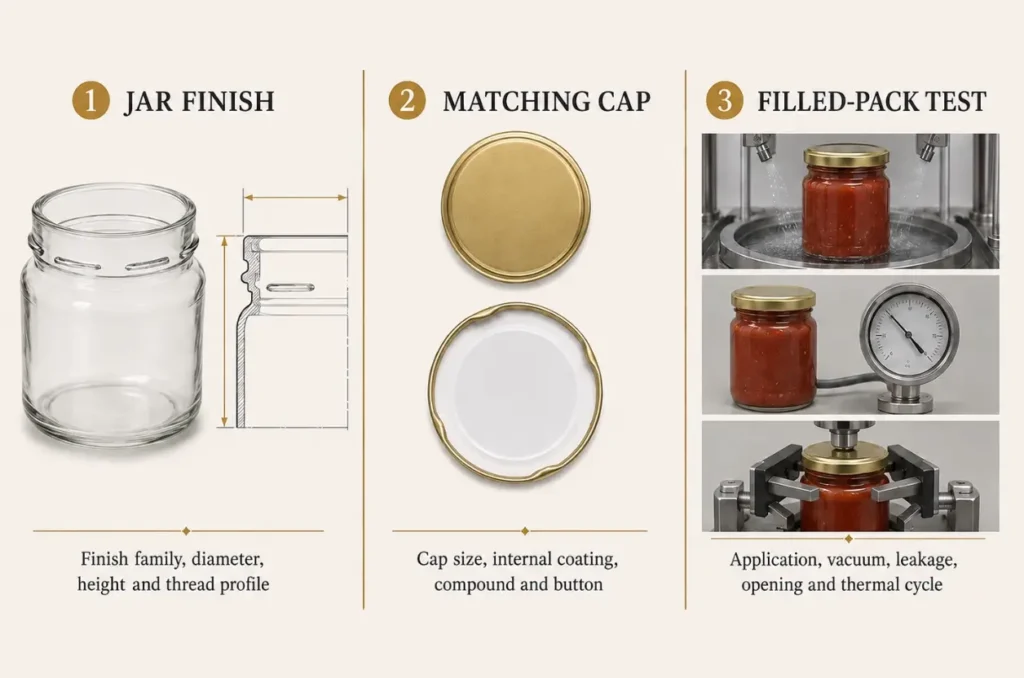
Then confirm the complete closure system. The jar drawing and closure technical data should agree on the finish type, nominal size, finish height, glass thread profile, cap height, lug geometry, gasket and internal coating. A cap diameter, photograph or color is not enough. If an existing filling line or cap is involved, provide the cap drawing and physical samples for matching.
Finally, test production-representative jars and caps on the intended equipment and with the intended process. Checks may include cap level, closure security or pull-up, gasket impression, vacuum, leakage, opening performance and behavior after the planned thermal cycle. The acceptable limits must come from the closure, jar and validated process specifications rather than a generic online value.
Jingbo Group treats the closure as part of the complete jar project. Our bouchons et capsules pour bouteilles en verre page explains what information is needed to match a closure to a bottle finish.
Foire aux questions
How Many Lugs Does a Lug Cap Have?
The number varies with cap diameter and closure design. Four, six and eight-lug versions are common in commercial food packaging, but the count alone does not confirm fit. Match the complete cap and finish specifications.
Can a Lug Cap Be Used Again After Opening?
Consumers can usually turn the cap back onto the jar for short-term storage after opening. This does not restore the original commercial vacuum or any first-opening indication. A used cap should not be treated as a new closure for another commercial filling run.
Is a Lug Cap Airtight?
A correctly matched and applied cap can form an effective seal as part of a validated package. “Airtight” should not be assumed from hand tightness or cap diameter. Seal performance depends on the finish, gasket, application, product and processing conditions.
Can a Lug Jar Be Cold Filled?
Some lug jar systems are used for cold-filled products, but the preservation method and closure must be designed for that process. Cold filling does not automatically create a vacuum, and a hot-fill closure specification should not be transferred to a cold-fill project without review.
Is a Lug Jar the Same as a Mason Jar?
No. “Lug jar” identifies an interrupted-thread finish. “Mason jar” usually describes a familiar jar style and often uses a two-piece home-canning closure. A Mason-style body can also be made with another finish, so the body shape does not identify the closure system.
Why Does a Jar Lid Pop When It Opens?
The sound usually comes from pressure equalizing as the seal is broken. If the closure has a vacuum safety button, that feature may also return to its raised position with a click. A pop is a useful opening cue, but it is not a substitute for a validated process and package inspection.
Conclusion
Lug jar is identified by short, separated thread sections around its finish. Its matching metal cap uses shallow lugs formed into the curled lower edge to hold the closure in position. The gasket, not the lugs, forms the seal against the glass. In a vacuum-designed food package, lower internal pressure also helps keep the cap seated.
Jingbo Group manufactures glass food jars for bulk packaging projects and can help compare existing jar models, matching closures and custom jar requirements. Contactez notre équipe with your target capacity, food product, filling process and required closure so the complete package can be reviewed before ordering.