
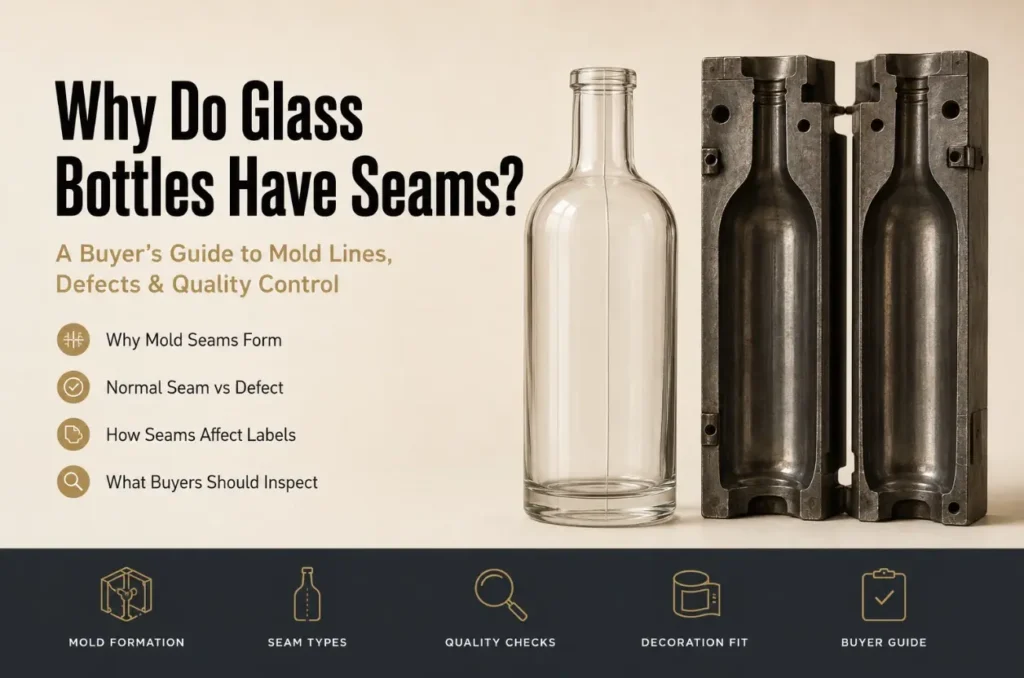
Glass bottles have seams because most commercial bottles are formed inside metal molds made from two or more sections. Where those mold sections meet, they can leave a thin raised line on the glass. This line is called a mold seam or parting line, and a smooth, controlled seam is normally part of the manufacturing process rather than a defect.
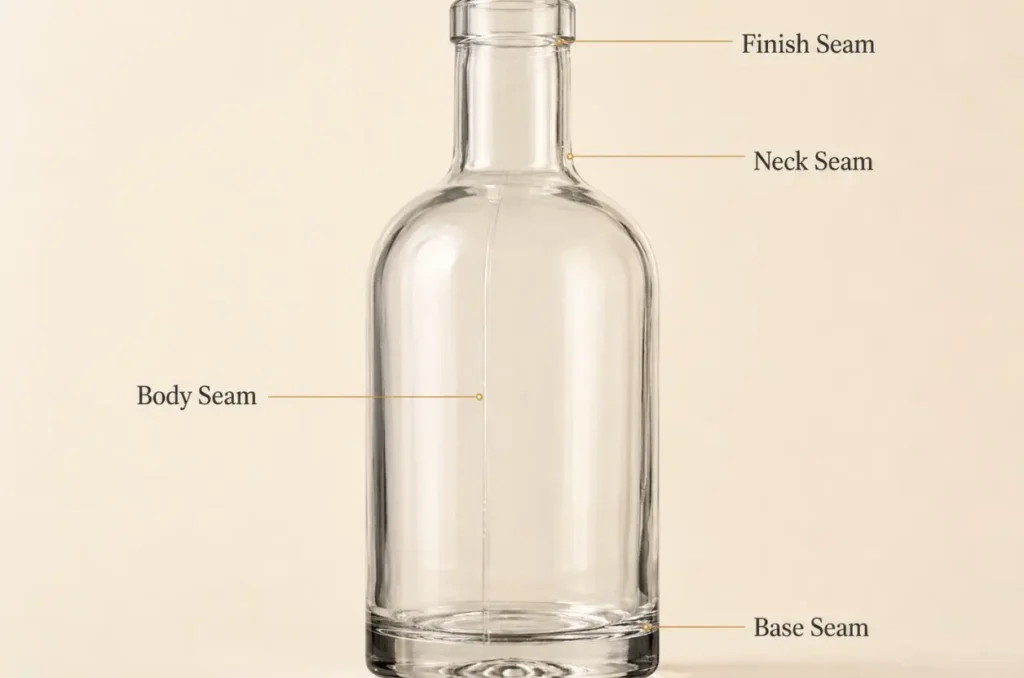
A seam may run vertically along the bottle body, continue across the shoulder, appear around the neck, or form a circular line near the base. Its position depends on the mold structure and the way the bottle is formed.
Some seams are easy to see, especially on clear bottles with flat sides. Others are placed along corners, curves, or less visible areas so they blend into the shape.
The important question is not whether a bottle has a seam. Most machine-made bottles do. The real question is whether the seam is smooth, properly aligned, and within the approved appearance standard.
What Is a Glass Bottle Seam?
A glass bottle seam is a line left at the meeting point between two mold components.
The technical term “parting line” describes the location where the mold opens after the bottle has been formed. The hot glass presses against both sides of this joint and may reproduce a faint line on its surface.
A seam can feel slightly raised when you run a finger across it. On a well-made bottle, it should be narrow, smooth, and consistent.
Glass bottle seams are not the same as cracks. A crack is a break in the glass structure and may affect safety or performance. A normal mold seam is a surface feature created by the forming equipment.
Seams are also different from flow lines or cords. Flow lines may appear as wavy or streak-like patterns inside the glass, while mold seams follow the defined joints of the mold.
How Are Glass Bottle Seams Formed?
Modern glass containers begin as measured pieces of molten glass called gobs. Each gob enters a blank mold and is shaped into an initial hollow form called a parison.
The machine then transfers the parison to a final blow mold. Compressed air expands the hot glass until it reaches the inner surface of the mold and takes on the bottle’s final shape.
The blow mold must open so the finished bottle can be removed. It is therefore divided into separate sections. The joints between those sections create the main body seams.
The Glass Packaging Institute explains that modern container glass is melted and shaped through processes such as pressing and blowing. Jingbo Group’s guide to the glass bottle manufacturing process shows how the gob, parison, and final mold work together during commercial bottle production.
Body Seams
Body seams usually run vertically along opposite sides of a round bottle.
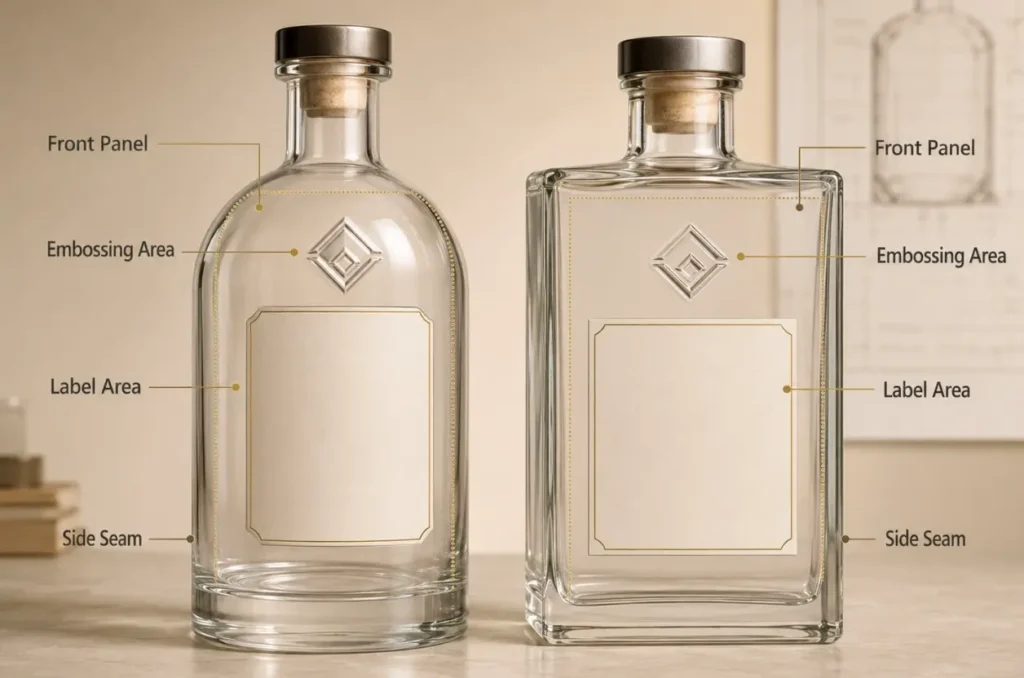
On square or rectangular bottles, the mold designer may place them along narrow side panels, edges, or rounded corners. This helps keep the main front and back display areas visually cleaner.
The line often begins near the heel and continues across the body and shoulder. Its exact path depends on the bottle shape and mold construction.
A bottle formed in a two-part body mold normally has two opposing vertical seams. More complex molds may create additional parting lines around specific structural or decorative areas.
Base Seams
A circular or curved line may appear around the bottom of the bottle.
This line can form where the body mold meets the bottom plate or base component. It may follow the outside edge of the heel or appear within the recessed area underneath the bottle.
Base seams are often less noticeable because they are outside the main display area. They should still be smooth and free from sharp glass.
A line on the base should not be confused with a crack, impact mark, or unstable bottom. Those conditions require separate inspection.
Neck and Finish Seams
The neck and finish may be formed by separate mold parts. This can create fine lines around the neck ring, bead, lip, or closure finish.
On many machine-made bottles, a vertical side seam continues from the body toward the top. Historical bottle specialists also use the way a seam ends or continues through the lip as one clue when studying how and when a bottle was made.
The U.S. National Park Service notes that an applied finish on an older bottle may interrupt the side seam, while a thin seam continuing through the lip is characteristic of later machine-made production. This method is useful for historical identification, although a seam alone cannot provide an exact manufacturing date.
Why Are Some Bottle Seams More Visible Than Others?
Not every mold seam has the same appearance.
Its visibility depends on the mold, bottle design, glass temperature, forming pressure, machine setup, and condition of the mold joint. Bottle color and surface treatment also change how easily the line can be seen.
Bottle Shape
A seam is easier to notice on a wide, flat panel than on a curved surface.
Square bottles may show seams clearly if the lines cross the middle of the side panels. A well-planned mold usually places them along corners, edges, or less important surfaces.
Round bottles often hide the line more effectively because reflections move across the curved body.
Glass Color and Clarity
Clear glass can make both the seam and its shadow easier to see.
Amber, dark green, and coated bottles may visually reduce a fine seam. However, color does not remove the line. It only changes how strongly it appears under normal lighting.
Highly transparent premium glass can also reveal very small surface details. This is why a seam that looks minor on an amber bottle may appear more noticeable on a clear spirits or perfume bottle.
Mold Alignment
The two mold halves must meet correctly.
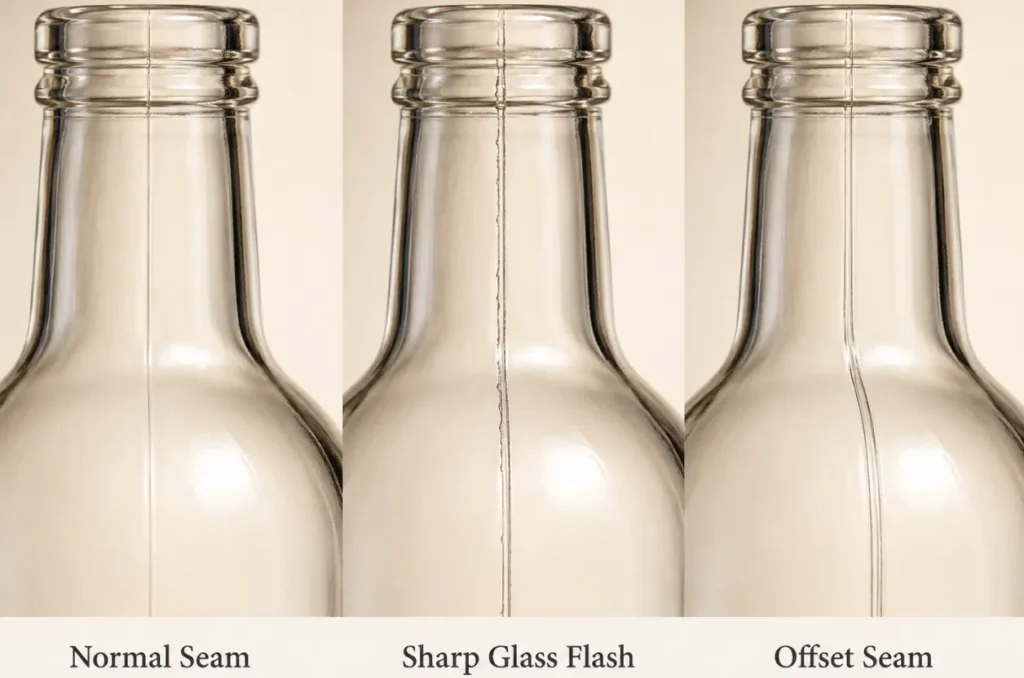
If they are properly aligned, the seam should remain fine and even. If one side sits slightly higher than the other, the bottle may show an offset line or a small step across the surface.
A significant mismatch is not the same as a normal seam. It may indicate that the mold alignment or machine setup needs adjustment.
Mold Condition
Molds experience repeated cycles of heat, cooling, opening, and closing.
Wear, residue, or damage near the parting surface can make the line more visible. Regular mold cleaning and maintenance help keep the joint controlled.
A custom bottle also needs accurately manufactured mold components. Even a good design can produce an unattractive seam if the mold surfaces do not meet correctly.
Glass Temperature and Forming Conditions
Molten glass needs the right temperature and viscosity when it enters the mold.
Glass that is too fluid may push farther into small gaps at the mold joint. Glass that is too cool may not reproduce the bottle shape evenly.
Stable forming conditions help the seam remain consistent across a production run.
Are Glass Bottle Seams a Defect?
A thin, smooth seam is normally not a defect.
It is a predictable result of forming glass inside a mold that must open. Commercial bottle standards usually focus on whether the seam affects appearance, handling, closure fit, decoration, or bottle performance.
A seam becomes a concern when it is unusually sharp, heavy, misaligned, cracked, chipped, or inconsistent with the approved sample.
| Seam Condition | Usually Normal or a Concern? | What It Looks Like |
|---|---|---|
| Thin and smooth line | Normally acceptable | Fine, even line along the mold joint |
| Slightly visible seam | Normally acceptable | Visible under light but smooth to the touch |
| Sharp raised edge | Quality concern | Edge can be felt clearly or may scratch |
| Heavy glass flash | Quality concern | Excess glass projects from the joint |
| Offset seam | Quality concern | Two sides of the bottle do not align |
| Cracked seam area | Defect | Fracture extends into the glass |
| Seam through key decoration | Design concern | Line interferes with a logo or label panel |
| Irregular base seam | Requires inspection | May affect appearance or base stability |
The approved quality level depends partly on the product. A standard beverage bottle and a premium perfume or liquor bottle may have different cosmetic expectations.
However, sharp edges, cracks, and severe misalignment should not be accepted simply because mold seams are normal.
What Is Glass Flash?
Glass flash is excess material that forms along the mold joint.
It may appear as a thin fin, sharp ridge, or small projection extending from the normal seam. Flash can occur when hot glass pushes into a gap between mold components.
A very small raised line may still fall within the approved standard. Pronounced or sharp flash is a quality problem because it can affect handling and appearance.
Flash around the bottle finish requires particular attention. It may interfere with a stopper, cap, liner, or tamper-evident component.
The body seam should also be checked before decoration. A heavy ridge may remain visible beneath coating or make a label sit unevenly.
What Is an Offset Mold Seam?
An offset seam appears when the two sides of the bottle do not line up correctly at the mold joint.
Instead of one smooth line, the surface may have a noticeable step. Embossed patterns, shoulders, or base details may also fail to meet at the same level.
Minor visual differences can occur during glass production, but a clear offset may indicate poor mold alignment or unstable forming conditions.
On a square bottle, an offset can make a corner look twisted. On a round bottle, it may create an uneven profile when the container is viewed from the side.
A badly offset finish is more serious because it may affect how the closure sits on the bottle.
Do Handmade Glass Bottles Have Seams?
Not every handmade glass bottle has a mold seam.
A completely free-blown bottle is shaped without a full body mold, so it may not have the straight vertical seams found on machine-made containers. It may instead show hand-tooling marks, uneven glass distribution, or a pontil scar on the base.
A mouth-blown bottle made inside a multipart mold can still have mold seams. The key factor is whether the body touched mold sections, not whether a person or a machine supplied the air.
This is why “handmade” does not always mean “seamless.”
Modern decorative bottles may also combine hand-finishing with molded components. Their visible marks depend on the exact production method.
Can Mold Seams Help Identify an Old Bottle?
Yes, but they should be used together with other clues.
Historical researchers examine the location and height of a seam, the bottle finish, base marks, pontil scars, embossing, glass color, and production irregularities.
For example, a seam that stops below an applied lip can suggest a different manufacturing method from a seam that runs through the complete finish.
Machine-made bottles became common during the late nineteenth and early twentieth centuries. The Society for Historical Archaeology maintains a detailed historic bottle identification resource for examining manufacturing marks and construction methods.
A seam should not be used by itself to claim an exact year. Bottle manufacturers used different machines, molds, and finishing methods during overlapping periods.
Can Glass Bottles Be Made Without Visible Seams?
A mold-made bottle normally needs parting lines because the mold must open.
The lines can be minimized, repositioned, or made less noticeable, but completely removing every trace is difficult in high-volume commercial production.
Premium mold engineering can place the seams away from the main display panel. Rounded corners, textured surfaces, embossing, and selected decoration can also reduce their visual impact.
Some decorative glass products are ground, polished, flame-finished, or made through specialized processes. These options are not standard for ordinary packaging bottles and may add cost or create other surface differences.
For most brands, the better goal is not a completely invisible seam. It is a fine, consistent seam located where it does not interfere with the design.
Do Seams Make a Glass Bottle Weaker?
A normal, well-formed seam does not automatically mean the bottle is weak.
Bottle strength depends on the glass composition, distribution, surface condition, annealing, shape, base, and handling history. A smooth parting line is simply a record of the mold joint.
A sharp ridge, crack, chip, or serious mismatch is different. Those conditions may create stress concentrations or show that the bottle was not formed correctly.
The seam should therefore be evaluated by condition rather than by visibility alone.
A visible but smooth seam may be acceptable. A less visible seam with a fine crack is not.
How Do Mold Seams Affect Labels and Decoration?
The seam position should be considered before the artwork is finalized.
A paper label can bridge a fine seam, but a raised or poorly positioned line may remain visible underneath it. Small labels placed entirely on one panel usually avoid this issue.
Direct printing requires similar planning. Fine text, metallic details, or a logo should not be centered over a parting line when another placement is available.
Embossing needs even more attention because the design is built into the mold. A logo split between two mold halves can show minor alignment differences.
For square and rectangular bottles, the front panel is usually kept as clean as possible. The seams may be placed along the side edges or corners instead.
Brands considering screen printing, coating, frosting, hot stamping, labels, or embossing can review Jingbo Group’s guide to glass bottle decoration.
Where Should Seams Be Placed on a Custom Bottle?
Seam placement is part of mold development, not a decision that should be left until decoration begins.
The mold engineer considers the bottle shape, release direction, corners, handles, embossing, label panels, and finish structure.
For a round bottle, the seam usually follows two opposite sides. The label artwork can then be positioned between those lines.
For a square bottle, placement along the corner or narrow side panel often protects the main front view. A sculpted bottle may require parting lines that follow its curves or recessed areas.
A custom bottle with a large embossed logo needs additional planning. The main lettering should remain away from the mold joint when possible.
How Jingbo Group Controls Glass Bottle Seams
Jingbo Group considers seam position during bottle design and mold development. For custom projects, the mold structure can be planned around the main label panel, embossed logo, bottle corners, and other visible details.
During production, mold condition, alignment, forming temperature, and bottle appearance all influence the final seam. Inspection helps identify sharp flash, severe offsets, cracks, and other conditions that go beyond a normal parting line.
Buyers can use an existing bottle sample to approve the acceptable seam appearance before bulk production. For a custom mold, the sampling stage also provides an opportunity to review seam placement before labels or decoration are finalized.
Frequently Asked Questions About Glass Bottle Seams
ガラス瓶にはなぜ継ぎ目があるのでしょうか?
Glass bottles have seams because commercial bottle molds are made from separate metal sections. The line appears where those sections meet during forming.
Are Seams on Glass Bottles Normal?
Yes. Thin, smooth mold seams are normal on most machine-made glass bottles.
Does a Seam Mean a Glass Bottle Is Cheap?
No. Both standard and premium mold-made bottles can have seams. Quality depends on how fine, smooth, aligned, and well-positioned the seam is.
Is a Glass Bottle Seam a Crack?
No. A normal seam is a surface line created by the mold. A crack is a break in the glass and requires separate inspection.
Why Do Some Bottles Have Two Vertical Lines?
A two-part body mold usually leaves one seam on each side of the bottle. The two lines mark where the opposing mold sections met.
Why Is the Seam Sharp?
A sharp seam may be caused by excess glass entering a gap at the mold joint. Pronounced sharp flash should be treated as a quality concern.
Why Does the Seam Run Across the Bottle Neck?
Different mold parts form the body, neck, and finish. Their joints can leave vertical or circular lines around these areas.
Can Mold Seams Be Removed?
They can sometimes be reduced through better mold precision, maintenance, forming control, or specialized finishing. Completely removing every parting line is not standard for most commercial bottles.
Do Handmade Bottles Have Mold Seams?
Free-blown bottles may not have body mold seams. Handmade bottles formed inside multipart molds can still show them.
Can a Mold Seam Affect a Bottle Label?
A fine seam may be covered by a label, but a raised seam can remain visible or affect adhesion. Label and printing areas should be planned around the seam position.
Can Seams Be Used to Date Antique Bottles?
They can provide clues about the production method and approximate period. However, an exact date requires other evidence such as the finish, base marks, embossing, and glass characteristics.
結論
Glass bottle seams form where separate parts of a bottle mold meet. A thin, smooth line is a normal feature of most machine-made bottles and does not automatically indicate poor quality.
A seam becomes a concern when it is sharp, heavily raised, cracked, badly offset, or placed where it interferes with decoration. Its condition and location matter more than whether it is visible.
ジンボーグループ uses mold planning, sampling, and production inspection to help keep seams controlled.