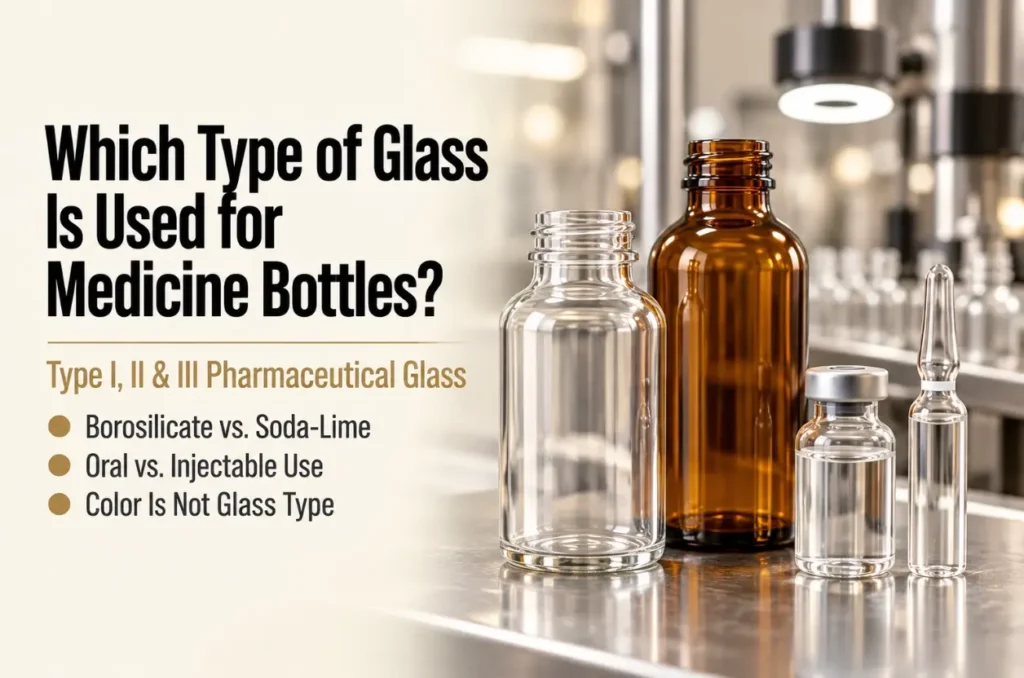
Glass medicine bottles are generally classified as Type I, Type II or Type III pharmaceutical glass.
The correct choice depends on the medicine, its route of administration and the level of chemical resistance required. Type I has the highest inherent hydrolytic resistance, but that does not mean every medicine bottle needs Type I glass.
Oral tablets, capsules and many non-parenteral products can use Type III glass. Some aqueous medicines use Type II glass. Injectable and sensitive pharmaceutical products are more commonly packaged in Type I or suitable Type II containers.
The glass type must therefore match the actual product rather than a general description such as “pharmaceutical-grade glass.”
What Are the Main Types of Pharmaceutical Glass?
Pharmaceutical glass is classified mainly by its hydrolytic resistance. This describes how well the glass resists releasing alkali into water or an aqueous product.
O United States Pharmacopeia General Chapter 〈660〉 identifies three main performance types.
| Glass type | Basic material | Hydrolytic resistance | Common packaging applications |
|---|---|---|---|
| Type I | Borosilicate glass | High throughout the glass | Many injectable, sensitive and non-parenteral products |
| Type II | Surface-treated soda-lime-silica glass | High on the treated inner surface | Certain acidic or neutral aqueous medicines |
| Type III | Soda-lime-silica glass | Moderate | Many oral and other non-parenteral medicines |
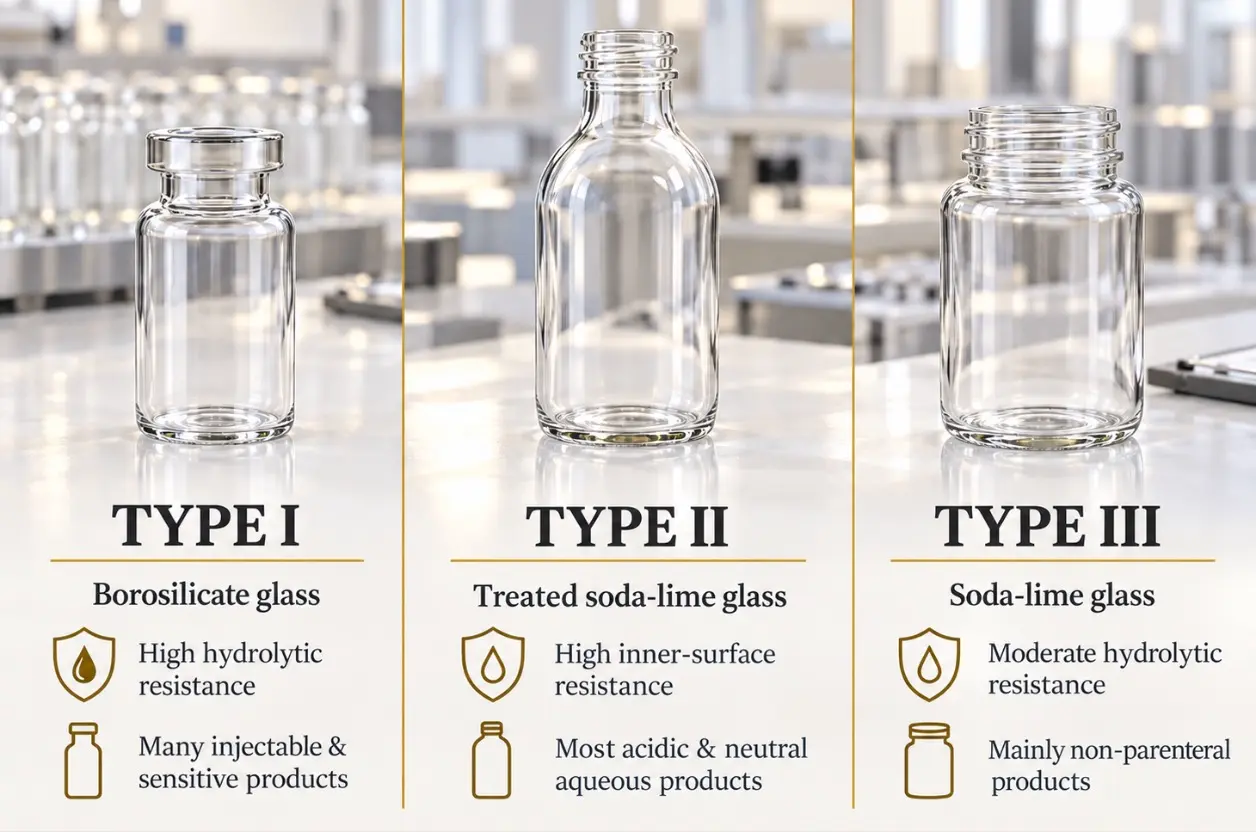
These classifications describe chemical performance. They do not describe the bottle’s color, shape, wall thickness or manufacturing method.
Type I Borosilicate Glass
Type I glass contains boric oxide and other components that give the glass high hydrolytic resistance. Its resistance comes from the composition of the glass itself rather than a surface treatment.
Borosilicate glass also handles temperature changes better than ordinary soda-lime glass. This property can be important when the container goes through washing, hot filling, sterilization or other temperature-sensitive processes.
Type I glass is widely used for injection vials, ampoules and other pharmaceutical products that need strong chemical resistance. However, the drug manufacturer must still confirm compatibility with the formulation and production process.
Type II Treated Soda-Lime-Silica Glass
Type II containers begin as soda-lime-silica glass. The manufacturer treats the inner surface to improve its hydrolytic resistance.
This treatment creates a surface with higher resistance than untreated Type III glass. USP states that containers meeting Type II performance are suitable for most acidic and neutral aqueous products for parenteral and non-parenteral use.
The important distinction is that Type II performance depends on the treated inner surface. Buyers should not assume that every soda-lime medicine bottle meets Type II requirements.
Type III Soda-Lime-Silica Glass
Type III glass is conventional soda-lime-silica glass with moderate hydrolytic resistance. It is often considered for tablets, capsules and other medicines that do not need the higher resistance of Type I or Type II containers.
Type III glass is usually not selected for injectable products. USP allows exceptions when suitable stability data demonstrate that the container works with the specific formulation.
This makes Type III a practical option for many oral medicine bottles, but not a universal choice for every pharmaceutical application.
Which Glass Has the Highest Pharmaceutical Grade?
Type I borosilicate glass has the highest inherent hydrolytic resistance among Type I, Type II and Type III pharmaceutical glass.
Calling it the “highest pharmaceutical grade,” however, can be misleading. Pharmaceutical packaging is not selected through a simple good-better-best ranking.
A Type III bottle may be entirely appropriate for dry tablets. Choosing Type I for the same product would not automatically improve its safety or shelf life. It could simply increase packaging cost without solving a real problem.
Type I becomes valuable when the formulation, sterilization process or route of administration requires its chemical and thermal performance. The best glass is the type that meets the relevant pharmacopoeial requirements and passes compatibility and stability testing with the finished medicine.
Which Glass Is Used for Oral Medicines and Injectable Products?
Oral medicine bottles and injectable containers do not have the same requirements.
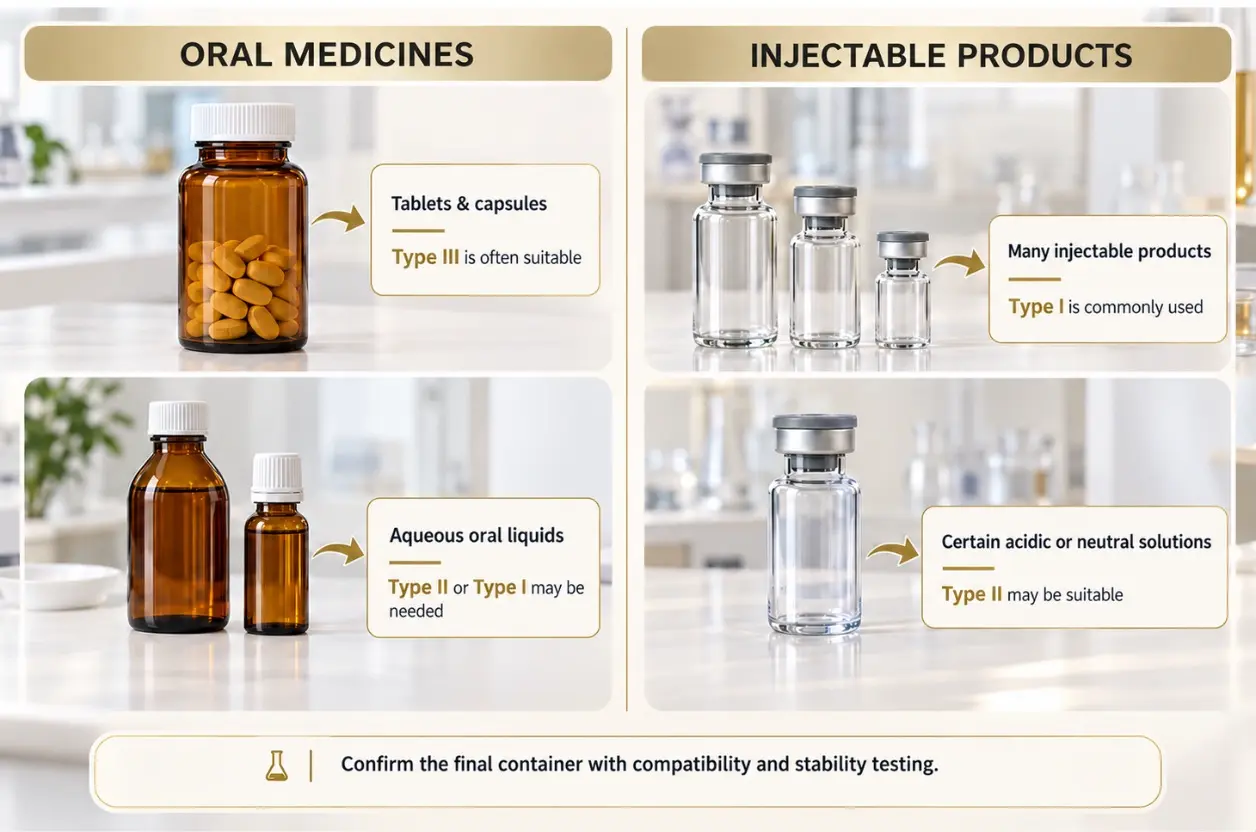
Tablets and capsules have limited direct interaction with the glass surface. Type III glass may therefore be suitable when the complete package also provides the required protection from moisture, contamination and light.
Liquid oral medicines require closer evaluation because the product remains in contact with the inner surface. The formulation’s pH, water content and storage period can influence whether Type III, Type II or Type I glass is appropriate.
Injectable medicines face stricter requirements because the product enters the body without passing through the digestive system. Type I borosilicate glass is commonly used for injectable vials and ampoules. Type II containers may be suitable for certain acidic or neutral aqueous injections.
Buyers should also use the correct container name. Liquid oral medicines usually come in medicine bottles, syrup bottles or dropper bottles. Injectable products are more commonly packaged in vials, ampoules, cartridges or prefilled syringes. An ordinary medicine bottle should never be treated as an injection vial simply because both containers are made of glass.
Does Amber Glass Mean Type I Glass?
Amber describes the color and light-protection function of the container. Type I, Type II and Type III describe its hydrolytic performance.
These are separate properties.
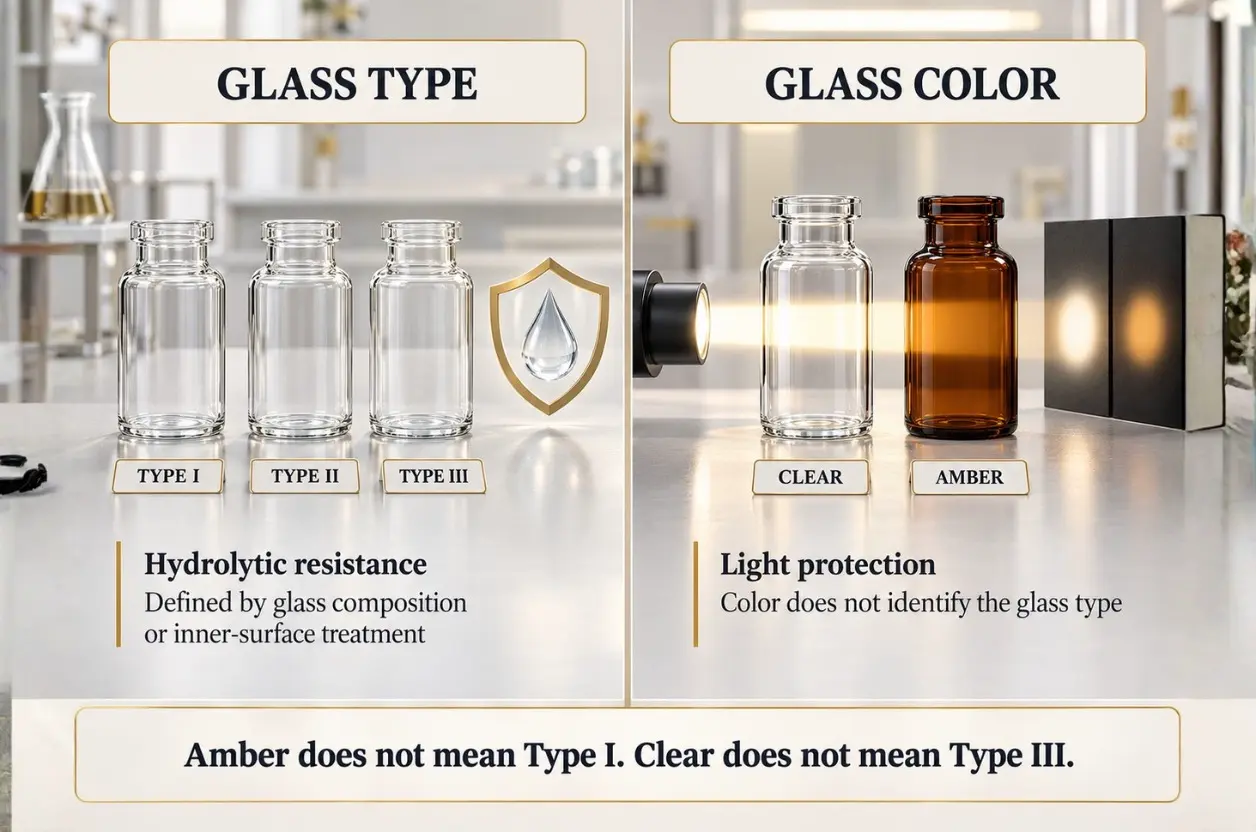
An amber bottle is not automatically Type I glass. A clear bottle is not automatically Type III glass. Buyers need to confirm the glass type and color independently.
Amber glass can help protect light-sensitive medicines by reducing the transmission of ultraviolet and visible light. Clear glass gives users better visibility of the contents but may require secondary packaging when the medicine is sensitive to light.
O nosso guia sobre why medicines are kept in coloured bottles explains the light-protection function in more detail.
What Should Buyers Confirm Before Ordering Medicine Bottles?
Buyers should first identify whether the container is intended for tablets, capsules, syrup, oral drops or an injectable product. This single detail affects the appropriate glass type and the level of documentation required.
The supplier should also know whether the formulation is aqueous, oily or dry. The product’s pH, filling temperature, sterilization method and expected shelf life may affect material selection.
Buyers should request a clear statement of the proposed glass type. A description such as “high-quality glass” does not confirm Type I, Type II or Type III performance.
The required standard must also be agreed upon before production. The United States Pharmacopeia, European Pharmacopoeia and other national standards may use different testing or documentation requirements. WHO packaging guidance recommends choosing the glass according to the medicine’s characteristics and intended use.
Finally, the bottle should be evaluated as part of a complete packaging system. Glass type alone does not confirm that the bottle, closure, liner and filling process are suitable for the medicine.
Conclusão
Medicine bottles can use Type I, Type II or Type III glass. Type I borosilicate glass provides the highest inherent hydrolytic resistance. Type II offers improved inner-surface resistance, while Type III is suitable for many non-parenteral products.
The right choice depends on the medicine rather than the bottle’s appearance. Buyers should consider the dosage form, route of administration, formulation, processing method and target-market requirements before placing an order.
If you are sourcing glass medicine bottles, contact Jingbo Group to discuss the required bottle format, capacity, glass color, closure and intended application.