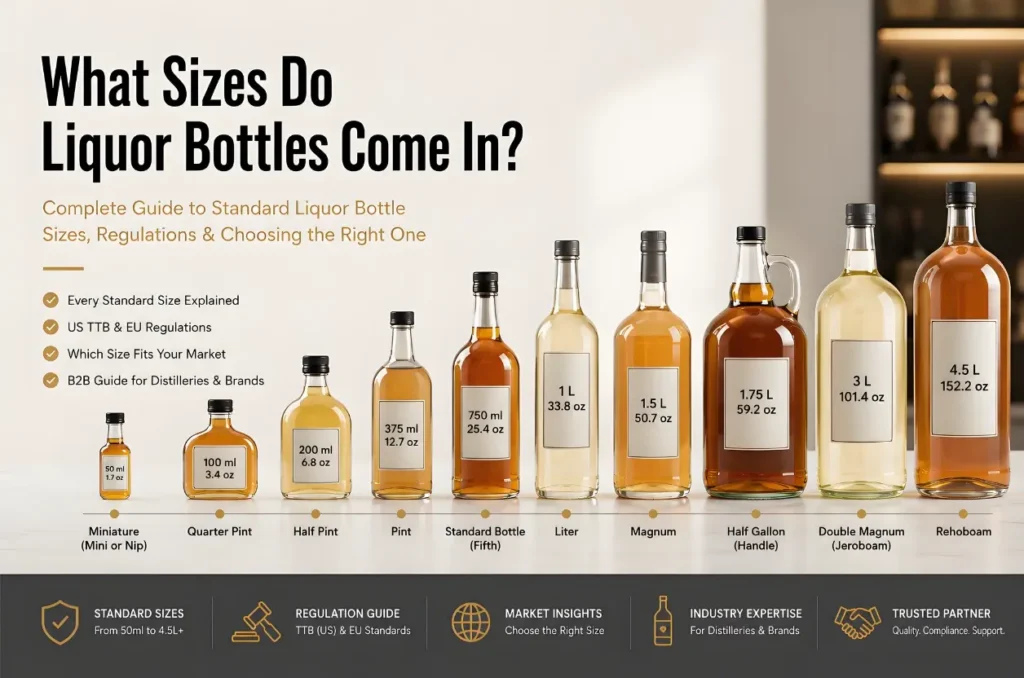
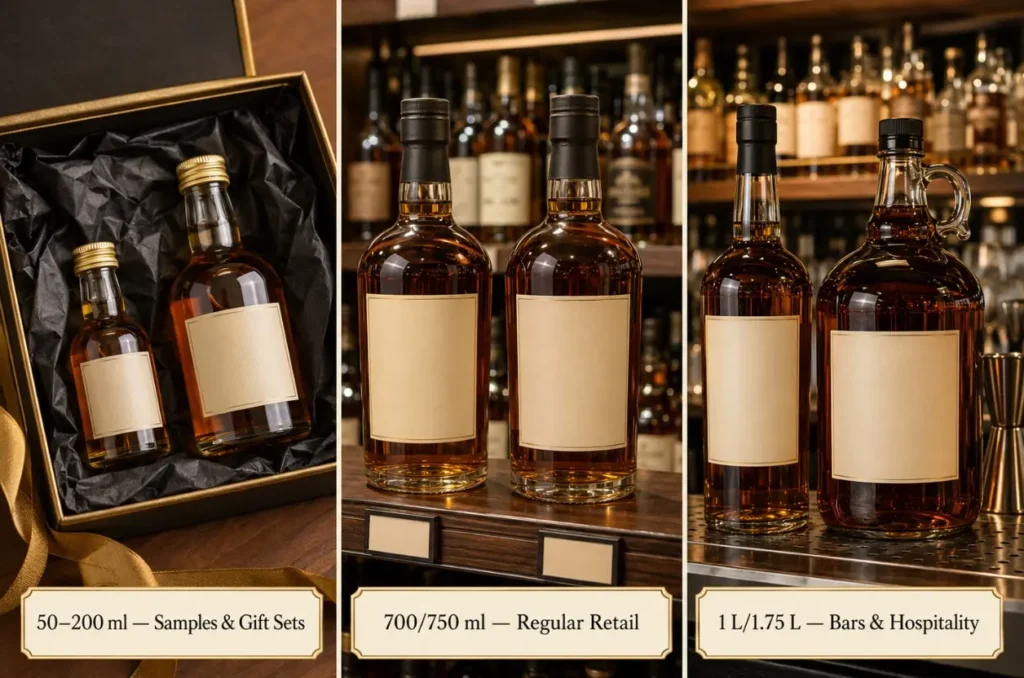
Liquor bottles commonly range from 50 ml miniatures to 1.75 L handles. The most widely used retail sizes are 700 ml and 750 ml, while smaller and larger formats are used for samples, gifts, travel retail, bars and value packs. The right size depends on the destination market, product plan and filling requirements.
Liquor Bottle Size Chart
The chart below compares common liquor bottle sizes, their approximate volume in US fluid ounces and their typical commercial uses.
| 容量 | Approx. US fl oz | Common name | Typical use |
| 50 毫升 | 1.7 fl oz | Miniature or nip | Samples, travel packs and promotions |
| 100 毫升 | 3.4 液盎司 | Small format | Gift sets, tastings and trial products |
| 200 毫升 | 6.8 fl oz | Small format | Limited editions and single-serve products |
| 350 ml | 11.8 fl oz | Regional small format | Market-specific retail products |
| 375 毫升 | 12.7 fl oz | Half bottle | Premium spirits, gifts and trial purchases |
| 500 毫升 | 16.9 fl oz | Half liter | Specialty spirits and regional retail |
| 700 毫升 | 23.7 fl oz | Common European format | Regular retail in Europe and other markets |
| 750 毫升 | 25.4 fl oz | Standard bottle or fifth | Regular retail in the US and many other markets |
| 1 L | 33.8 fl oz | Liter bottle | Travel retail, bars and hospitality |
| 1.5 L | 50.7 fl oz | 大幅面 | Gifting, display and large-format products |
| 1.75 升 | 59.2 fl oz | Handle or large format | Value packs, bars and hospitality |
These are common trade names rather than universal legal names. The fluid-ounce values are approximate US fluid ounces. Available and permitted capacities can also vary by product category and destination market.
What Are the Most Common Liquor Bottle Sizes?
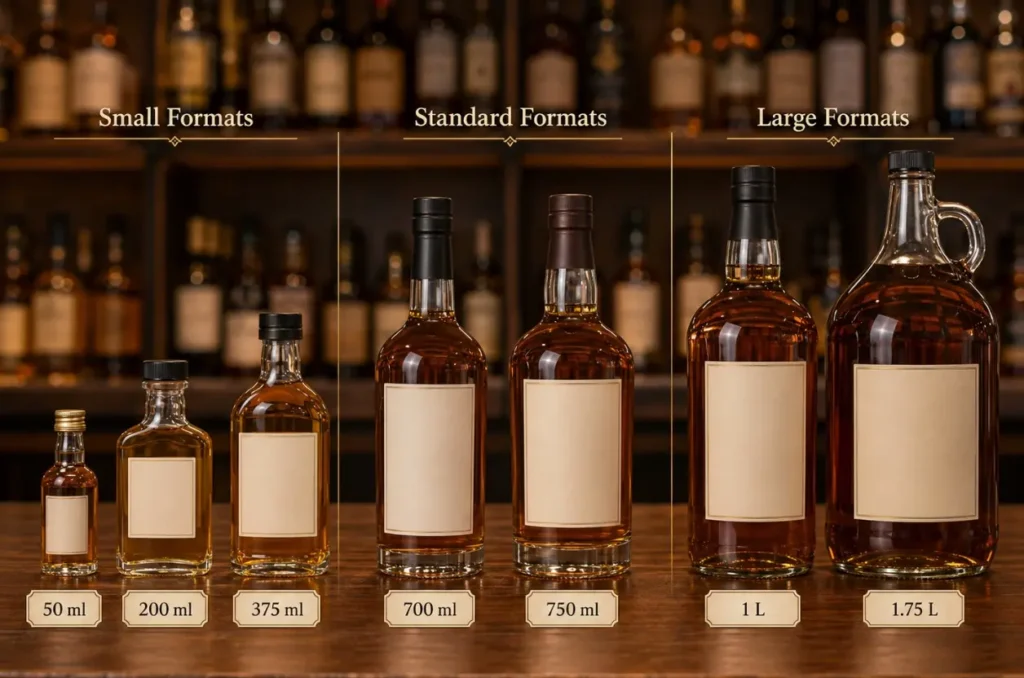
50 ml, 100 ml and 200 ml bottles
Small liquor bottles are often used for sampling, gift sets, hotel minibars, airline service and promotional packs. They allow customers to try a product at a lower price, but they also leave less space for labels and decoration.
Small bottles are not simply reduced versions of a larger bottle. The neck finish, closure, label area and filling-line handling still need to be checked for the selected capacity.
350 ml, 375 ml and 500 ml bottles
These middle-sized formats work well for premium spirits, seasonal releases and smaller retail packs. A 375 ml bottle is often described as a half bottle in markets where 750 ml is the main format. The 350 ml and 500 ml sizes are more dependent on regional retail habits and local regulations.
For a brand, these formats can provide a lower entry price without moving all the way down to a miniature bottle. They are also useful when a product is sold in a gift box with glasses or other accessories.
700 ml and 750 ml bottles
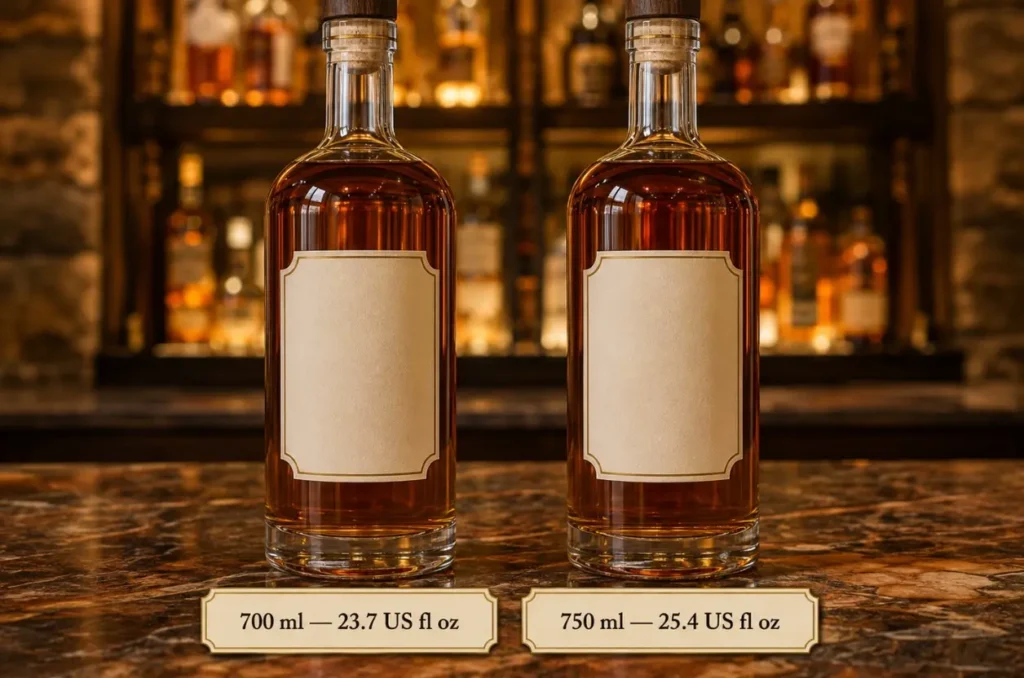
The 700 ml and 750 ml formats are the two capacities most international spirits buyers compare. A 700 ml bottle is widely used in European markets, while 750 ml remains common in the United States and many other countries.
The 50 ml difference is small, but the bottles are not automatically interchangeable. Changing capacity can affect the bottle height, diameter, fill level, label position, carton layout and total packed weight. Buyers should confirm the actual drawing and samples rather than judging capacity from a product photo.
Brands comparing these two formats can review existing 700 ml and 750 ml glass liquor bottles before deciding whether a new bottle mold is necessary.
1 L, 1.5 L and 1.75 L bottles
Larger bottles are common in travel retail, bars, restaurants and value-oriented product lines. They offer more volume per unit, but they also require more attention to handling and packaging.
The bottle body must be comfortable to hold and pour. The filled-bottle weight, carton strength, pallet pattern and filling-line limits should all be reviewed before the size is approved. A handle may improve control on some 1.75 L designs, but it is not used on every large-format bottle.
Why Are 700 ml and 750 ml Both Common?
There is no single liquor bottle size used in every country. The two formats developed around different market practices and packaging rules.
United States
In the United States, the current standards of fill for distilled spirits authorize both 700 ml and 750 ml containers, along with several other metric capacities. The US Alcohol and Tobacco Tax and Trade Bureau added 700 ml as an authorized size effective December 29, 2020. Buyers can check the current list in 《联邦法规汇编》第27编第5.203条 and the TTB’s 2020 standards-of-fill announcement.
This means a 700 ml distilled spirits bottle can be sold in the US when the product and packaging meet the other applicable requirements. However, 750 ml remains familiar to US distributors, retailers and consumers, so legal availability alone does not determine the best commercial choice.
European Union
For prepacked spirit drinks in the 100 ml to 2 L range, Directive 2007/45/EC lists 100, 200, 350, 500, 700, 1,000, 1,500, 1,750 and 2,000 ml as nominal quantities. The general list includes 700 ml but not 750 ml.
Exceptions and product-specific requirements can apply. A supplier can help confirm the bottle specification, but the brand owner or importer should verify the final legal and labeling requirements for each destination market.
Practical choice for an international brand
A company selling in both the US and Europe may use separate 700 ml and 750 ml bottles with a related design language. Another option is to use 700 ml in markets where it is legally permitted and commercially accepted, reducing the number of packaging formats.
The decision should be made with the importer, distributor and filling partner. It should also account for label files, closures, cartons and pallet plans, not capacity alone.
Does Bottle Capacity Determine Bottle Weight?
No. Capacity and bottle weight are related, but they are not the same specification. Two 750 ml glass bottles can have very different weights because of their height, diameter, glass distribution, base thickness, shoulder shape and decoration requirements.
A heavier bottle may create a more substantial appearance, but it also increases shipping weight and material use. A lighter bottle can reduce logistics costs, provided that the design still performs correctly during filling, packing and transport.
For a closer comparison, see our guide to 玻璃瓶的重量. Always ask for the technical drawing and unit-weight tolerance for the exact bottle model you intend to purchase.
How Should Brands Choose a Liquor Bottle Size?
1. Start with the destination market
First confirm where the finished spirit will be sold. Check the permitted nominal quantities and any product-specific requirements before approving the bottle. If several countries are involved, list the requirements for every target market rather than assuming that one format will work everywhere.
2. Match the size to the product plan
The package should support the intended price, sales channel and drinking occasion. A 50 ml bottle may suit samples, while 375 ml can work for a premium trial size. The 700 ml and 750 ml formats are suited to regular retail, and 1 L or 1.75 L may be better for travel retail, hospitality or value ranges.
3. Confirm nominal and overflow capacity
The capacity printed on the label is the nominal fill quantity. It is not necessarily the maximum amount the bottle can physically hold. The bottle also has an overflow capacity, measured when it is filled to the top.
The difference affects the visible fill level and the headspace available after filling. Review the technical drawing and understand nominal and overflow capacity before running a filling test.
4. Check the complete packaging system
A bottle cannot be approved in isolation. Confirm the neck finish, closure, tamper-evident component, label area, decoration method and secondary packaging. The filled bottle should also be tested on the intended filling and capping equipment.
For export projects, compare the number of bottles per carton, cartons per pallet and total packed weight. A visually attractive bottle may still create unnecessary logistics costs if its dimensions use pallet space poorly.
5. Compare an existing bottle with a custom design
An existing bottle can reduce development work and may be suitable when the project schedule is tight. Before choosing it, confirm current availability, minimum order quantity, decoration options and whether the neck finish matches the selected closure.
A custom bottle may be appropriate when the brand needs a distinctive silhouette, embossed details or a specific capacity-to-dimension relationship. In that case, 定制玻璃瓶设计 should begin with the target market, nominal capacity, closure system, filling method and packaging limits—not appearance alone.
常见问题
What is the standard size of a liquor bottle?
There is no single worldwide standard. A 750 ml bottle is common in the United States, while 700 ml is widely used in Europe. The correct choice depends on the destination market, spirit category and sales channel.
Is a fifth of liquor 750 ml?
Yes. In modern US retail, “a fifth” commonly refers to a 750 ml liquor bottle. The name comes from the older one-fifth US gallon format, which was close to the current metric size.
How many ounces are in 700 ml and 750 ml liquor bottles?
A 700 ml bottle holds approximately 23.7 US fluid ounces. A 750 ml bottle holds approximately 25.4 US fluid ounces.
Is a 700 ml liquor bottle legal in the United States?
Yes. The US standards of fill for distilled spirits authorize 700 ml containers. The size was added to the authorized list effective December 29, 2020.
Is overflow capacity the same as the capacity on the label?
No. The label normally states the nominal amount of product. Overflow capacity is the total internal volume when the bottle is filled to the top. The difference provides space for the intended fill level and headspace.
Can the same bottle design be made in both 700 ml and 750 ml sizes?
Often, yes. A manufacturer can develop related bottles with similar proportions and branding features. However, each size needs its own engineering review, drawing and capacity verification. The two bottles may also require different molds, cartons and filling-line settings.
结论
Liquor bottle sizes range from small 50 ml miniatures to large 1.75 L formats, but 700 ml and 750 ml are the main sizes for many retail spirits. The best option is the one that meets the destination market’s rules, supports the product plan and works with the complete filling and packaging system.
Jingbo Group manufactures glass liquor bottles for commercial packaging projects. We can help you compare existing 700 ml and 750 ml bottle models or review a custom design when available shapes do not fit your project. Contact our team to discuss your target market, capacity and preferred bottle style.